
原油供应过剩

Search documents
宝城期货原油早报-20250826
Bao Cheng Qi Huo· 2025-08-26 03:13
Report Summary 1. Report Industry Investment Rating - Not provided in the given content 2. Core View - The domestic crude oil futures contract 2510 is expected to run strongly, with a short - term and medium - term outlook of oscillation and an intraday view of oscillation with a stronger bias [1][5] 3. Summary by Related Content 3.1 Time Cycle and View - For the crude oil 2510 contract, the short - term (within one week) and medium - term (two weeks to one month) views are both oscillation, and the intraday view is oscillation with a stronger bias, with a general reference view of strong operation [1] 3.2 Core Logic - The International Energy Agency (IEA) predicts a record supply surplus in the global crude oil market next year due to slow demand growth and a surge in supply, even with an upward adjustment of the global crude oil demand for this year and next year, but the demand growth rate has declined. Crude oil inventories will accumulate at a rate of 2.96 million barrels per day, exceeding the average accumulation rate during the 2020 pandemic. With the increasing expectation of the Fed's interest rate cut, the domestic crude oil futures 2510 contract maintained an oscillation - with - stronger - bias trend in the overnight session on Monday, rising 1.16% to 499.2 yuan/barrel. It is expected to maintain this trend on Tuesday [5] 3.3 Price Calculation and Fluctuation Definition - For varieties with night trading, calculate the price change from the night - trading closing price to the day - trading closing price; for varieties without night trading, calculate from the previous day's closing price to the day - trading closing price [2] - A decline of more than 1% is considered a fall, 0 - 1% a weak oscillation, a rise of 0 - 1% a strong oscillation, and a rise of more than 1% an increase. The concept of strong/weak oscillation only applies to the intraday view, not the short - term and medium - term views [3][4]
大越期货原油早报-20250826
Da Yue Qi Huo· 2025-08-26 02:56
Report Summary 1. Report Industry Investment Rating No information provided. 2. Core View of the Report - The short - term geopolitical risk of oil prices has increased, and crude oil is currently running strongly and is expected to continue. Short - term operation is in the range of 495 - 505, and long - term long positions should be held [3]. 3. Summary According to the Table of Contents 3.1 Daily Prompt - Fundamental factors are neutral; the basis is positive; inventory factors are positive; the disk is negative; the main position is neutral. The short - term geopolitical situation increases the risk of oil prices, and the current strong operation of crude oil is expected to continue [3]. 3.2 Recent News - Trump believes Putin's dislike of Zelensky is hindering the meeting between the two leaders. Putin's foreign minister said an agenda was needed before the meeting. Trump also said the decision on the meeting should be made by Ukraine and Russia [5]. - Nigeria's state - owned oil company NNPC said that almost all pipeline thefts have been eliminated [5]. - The futures price of Brent crude was 3 cents/barrel lower than Dubai crude, the first negative spread since April. Traders expect future supply to be excessive, while the demand for Middle - East crude has been boosted by geopolitics as Trump pressures India on Russian oil procurement [5]. 3.3 Long - Short Focus - **Likely Positive Factors**: US secondary sanctions on Russian energy exports; extension of the Sino - US tariff exemption period [6]. - **Likely Negative Factors**: Possible cease - fire between Russia and Ukraine; continued tension in US trade relations with other economies [6]. - **Market Drivers**: Short - term geopolitical conflicts decrease, and trade tariff risks increase. In the medium - to - long - term, supply will increase after the peak season [6]. 3.4 Fundamental Data - **Inventory Data**: US API crude inventory decreased by 2.417 million barrels in the week ending August 15, more than expected; EIA inventory decreased by 6.014 million barrels, more than expected; Cushing area inventory increased by 0.419 million barrels. As of August 25, the Shanghai crude oil futures inventory was 4.767 million barrels, unchanged [3]. - **Price Data**: In the futures market, Brent crude decreased by 0.45 to 67.22, a decrease of 0.66%; WTI crude increased by 0.14 to 63.66, an increase of 0.22%; SC crude increased by 4.30 to 491.0, an increase of 0.88%; Oman crude increased by 0.26 to 69.98, an increase of 0.37%. In the spot market, prices of various types of crude oil also showed different degrees of change [7][9]. 3.5 Position Data - As of August 19, WTI crude oil's main position was long, with an increase in long positions; Brent crude oil's main position was long, with a decrease in long positions [3].
供应过剩与制裁夹击,布伦特对中东原油价差罕见转负
Hua Er Jie Jian Wen· 2025-08-25 06:23
Core Insights - The international crude oil market is experiencing a rare reversal in its pricing structure due to expectations of oversupply and geopolitical factors [1] - Brent crude futures prices fell below Dubai crude by 3 cents per barrel, marking the first negative spread since April of this year [1] - This price inversion indicates significant changes in the supply-demand fundamentals in the key European and Asian markets [1] Supply and Demand Dynamics - The primary factor leading to the weakening of Brent prices is the market's pessimistic outlook on future supply [1] - Traders expect that both OPEC+ and non-OPEC oil-producing countries will increase production, resulting in an oversupply situation in the coming months [1] - This expectation has not only depressed the forward prices of Brent futures but also weakened the inter-month price spread, which typically signals ample short-term supply and a bearish market sentiment [1] Geopolitical Influences - Demand for Middle Eastern crude has been unexpectedly boosted by geopolitical factors [1] - Reports indicate that U.S. President Trump is pressuring India regarding the procurement of Russian oil, leading Indian refiners to seek alternative supplies from the Middle East [1] - As most crude oil exported from the Persian Gulf is priced based on Dubai crude, this additional demand has provided stronger support for Dubai prices compared to Brent, ultimately driving the reversal in their price spread [1]
全球供应过剩预期升温 布油期货价格罕见低于迪拜原油
智通财经网· 2025-08-25 06:13
Group 1 - The core viewpoint is that due to U.S. President Trump's actions against Russian oil supplies and expectations of an oil surplus later this year, the global benchmark Brent crude oil price is unusually lower than Middle Eastern oil prices [1][4] - Brent crude futures are trading at a discount of 3 cents per barrel compared to Dubai crude for the first time since April [1] - Traders anticipate a significant influx of oil in the coming months as both OPEC+ and non-OPEC countries are increasing oil production, which is putting pressure on Brent futures [4] Group 2 - The increase in oil production is weakening the time spread, an indicator of market health [4] - Demand for Middle Eastern crude has seen a temporary boost due to a buying spree from Indian refiners, influenced by pressure from Trump regarding India's purchases of Russian oil [4]

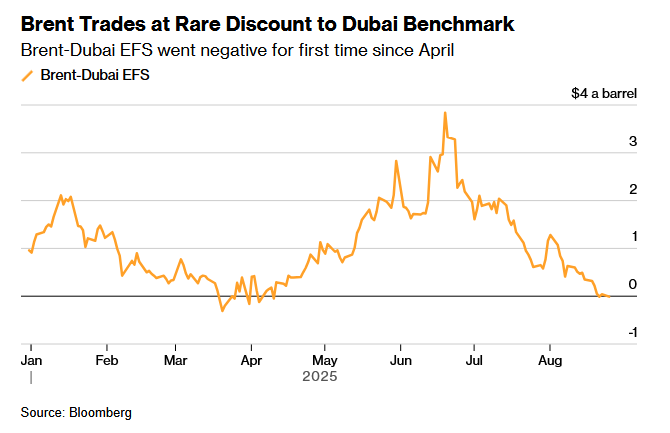
因特朗普打击俄油及供应过剩,布伦特原油价格罕见低于迪拜原油
Sou Hu Cai Jing· 2025-08-25 05:52
Group 1 - The core viewpoint of the article highlights the unusual situation where Brent crude oil prices have fallen below Middle Eastern oil prices due to Trump's actions against Russian oil supply and an anticipated oversupply later this year [1] - Brent crude futures are trading at a discount of 3 cents per barrel relative to Dubai crude, marking the first time since April that this price differential has turned negative [1] - The increase in production by OPEC+ and non-member countries is expected to lead to an oversupply in the oil market in the coming months, putting pressure on Brent crude futures and weakening the time spread, which is an indicator of market health [1] Group 2 - The demand for Middle Eastern crude has been boosted by a brief surge in purchases from Indian refiners, prompted by Trump's threats regarding India's purchase of Russian oil [1]
原油市场:即将进入“预期最为充分”的“供远大于求”时期
Hua Er Jie Jian Wen· 2025-08-22 04:34
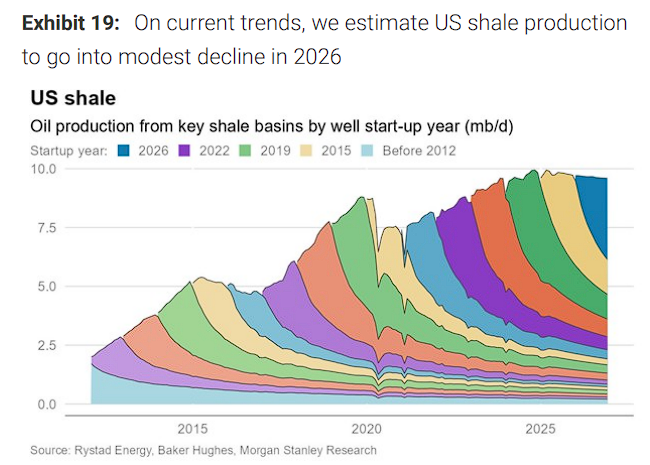
原油市场正在迈向一个规模庞大且被市场广泛预期的供应过剩时期,但是摩根士丹利认为,油价不太可能出现无序大跌。 8月22日,据追风交易台消息,大摩在最新研报中称,原油市场即将进入一个规模庞大的供应过剩时期,预计第四季度原油供应过剩将达到1.5百 万桶/日,2026年上半年将进一步扩大至超过2百万桶/日。 在供应方面,非OPEC国家石油供应增长强劲,预计从2025年中期至年底将新增0.9百万桶/日产能。同时,OPEC"8国集团"自3月以来已增产约1百 万桶/日,但这一增长几乎完全由沙特阿拉伯和阿联酋两国贡献。 在需求方面,研报中,全球石油需求继续增长,但是增速明显低于趋势水平。虽然"供大于求"将会推动油价走低,但是大摩认为,与历史上的石 油价格暴跌不同,此次供应过剩已被市场广泛预期,这将有助于避免无序抛售的发生。 大摩分析师维持布伦特原油将在2026年第一季度跌至60美元/桶的预测不变,基于三大支撑因素:库存经济学、OPEC可能的减产行动以及市场的 广泛预期,将共同限制油价的下行空间,使其不太可能长期跌破60美元/桶。 非OPEC供应激增在即 大摩称,与2024年不同,2025年非OPEC供应正在兑现其增长预测,年 ...

亚洲炼油商寻油版图扩张难挽狂澜 资深顾问:原油正逼近供应过剩“临界点”
智通财经网· 2025-08-21 11:55
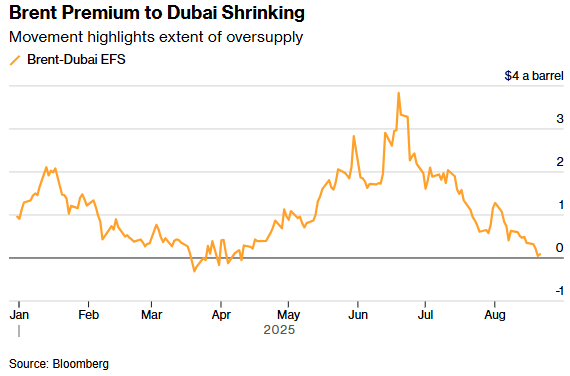
Core Viewpoint - Asian refiners are diversifying their crude oil sources beyond traditional Middle Eastern suppliers, but this strategy has not successfully boosted the market amid expectations of an oversupply in the crude oil market [1][2]. Group 1: Market Dynamics - Asia consumes about 40% of the world's oil, historically relying on the Persian Gulf for crude supply [1]. - U.S. President Donald Trump's trade and foreign policies have prompted refiners to purchase crude from the U.S., Brazil, and Nigeria [1]. - The surge in light sweet crude oil purchases was expected to support Brent crude prices, but the price premium of Brent over Dubai crude has fallen to its lowest level since April [1]. - Market expectations indicate that crude oil oversupply will begin in the next quarter due to increased production from OPEC+ and non-OPEC countries [1][2]. Group 2: Supply and Demand Outlook - Global average daily oil production has increased by 1.4 million barrels compared to the same period in 2025, exceeding the International Energy Agency's (IEA) demand growth forecast [2]. - Analysts predict a weakening of market demand in Q4 of this year and Q1 of next year [2]. - The reallocation of crude oil flows due to Trump's policies has created uncertainty and volatility in the market [2]. - The IEA forecasts that global oil demand growth will be less than half of 2023's rate in the coming years [5]. Group 3: Price Competitiveness - The narrowing price gap between Brent and Dubai crude allows U.S. and West African crude to enter the Asian market at more competitive prices [3]. - Increased demand for U.S. crude has raised prices along the U.S. Gulf Coast, but has not supported broader domestic benchmark prices [5]. - Major banks are bearish on oil prices, with Goldman Sachs predicting Brent crude will slightly decline to the mid-$60 range by year-end [5].
原油价格仍有下跌空间
Qi Huo Ri Bao· 2025-08-20 23:18
Core Insights - The oil market is experiencing a phase of rising prices due to strong downstream demand and geopolitical factors, but recent data indicates potential downward pressure on prices [1][6] Group 1: OPEC+ Production Decisions - OPEC+ has decided to increase production by 547,000 barrels per day starting in September, effectively ending the voluntary production cuts that were set to last until November 2023, one year earlier than planned [2] - The production increase follows a gradual ramp-up, with OPEC+ increasing output by 180,000 barrels per day in May, 349,000 barrels per day in June, and 335,000 barrels per day in July [2] - The new production levels are expected to be absorbed by strong market demand during the consumption peak season [2] Group 2: U.S. Oil Market Dynamics - U.S. oil rig counts have been declining since April, but have stabilized around 411 rigs, with production holding steady at approximately 13.3 million barrels per day [2] - The EIA has revised U.S. oil production forecasts upward by 40,000 barrels per day to 13.41 million barrels per day [2] - Recent data shows an increase in U.S. crude oil inventories by 3.036 million barrels, contrary to expectations of a decrease [3] Group 3: Geopolitical Factors - Recent U.S.-Russia discussions have led to a temporary suspension of further sanctions against Russia, which is expected to stabilize Russian oil exports [4] - The geopolitical landscape appears to be easing, with potential future discussions involving U.S., Russia, and Ukraine leadership [4] Group 4: Supply and Demand Outlook - EIA forecasts indicate a significant increase in global oil inventories, with projections of over 2 million barrels per day in Q4 2025 and Q1 2026 [5] - Both EIA and IEA have adjusted their global oil supply growth forecasts upward, while demand growth estimates have been revised downward [5] - The overall sentiment in the oil market is bearish, with multiple factors contributing to a potential decline in oil prices [6]
成本支撑减弱叠加供需结构不佳 燃料油维持偏弱走势
Qi Huo Ri Bao· 2025-08-18 23:25
Core Viewpoint - The International Energy Agency and the U.S. Energy Information Administration have lowered their forecasts for international oil prices for the next two years due to expectations of oversupply in the oil market, leading to a decline in both domestic and international crude oil futures prices [1][2] Group 1: Geopolitical Factors - The recent meeting between U.S. and Russian leaders in Alaska did not yield any agreements but was deemed constructive, indicating a potential de-escalation of the Russia-Ukraine conflict, which has contributed to a reduction in international crude oil price premiums [2] - Despite significant differences remaining between the U.S. and Russia regarding the Russia-Ukraine situation, there is a growing optimism that the conflict may cool down, impacting oil market dynamics [2] Group 2: Supply and Demand Dynamics - There is a notable oversupply in the Asian low-sulfur fuel oil market since late July, while high-sulfur fuel oil prices have dropped to a near three-year low due to ample supply and weak downstream demand [3] - The influx of fuel oil arbitrage cargoes into the Asian market has contributed to a stable spot price differential for fuel oil, although trading activity remains weak with significant discrepancies in pricing between buyers and sellers [3] Group 3: Downstream Market Behavior - The shipping, power generation, and refining sectors are the primary consumers of fuel oil, with shipping fuel consumption being the largest segment. Recent data shows a decrease in wholesale outflow of marine heavy oil, attributed to weak domestic market demand and cautious procurement by downstream enterprises [4] - Overall, the expectation of a cooling Russia-Ukraine conflict, combined with a shrinking premium in the international crude oil market and rising oversupply expectations, suggests that the price focus for crude oil may shift downward, further weakening the cost support for fuel oil [4]
宝城期货原油早报-20250818
Bao Cheng Qi Huo· 2025-08-18 02:41
Report Summary 1. Report Industry Investment Rating No relevant content provided. 2. Core View of the Report - The international crude oil market is expected to face a record supply surplus next year due to slow demand growth and a surge in supply, even with an upward adjustment of global crude oil demand data for this year and next by the IEA, the demand growth rate has declined [5]. - As the Russia - Ukraine conflict is expected to end, the geopolitical premium is being reversed, and domestic and international crude oil futures prices showed a weak trend on the night of last Friday. The domestic crude oil futures 2510 contract is expected to maintain a weak - oscillating trend on Monday [5]. 3. Summary by Related Catalogs 3.1 Time - Cycle Views - **Short - term**: The short - term view of crude oil 2510 is oscillating [1]. - **Medium - term**: The medium - term view of crude oil 2510 is oscillating, and the medium - term view of domestic crude oil (SC) is also oscillating [1][5]. - **Intraday**: The intraday view of crude oil 2510 is weakly oscillating, and the intraday view of domestic crude oil (SC) is also weakly oscillating [1][5]. 3.2 Core Logic - The IEA's energy outlook report indicates that due to slow demand growth and a surge in supply, and OPEC+ increasing production, the global crude oil market will face a record supply surplus next year. The demand growth rate has declined, and crude oil inventories will accumulate at a rate of 2.96 million barrels per day, exceeding the average accumulation rate during the 2020 pandemic [5]. - With the expected end of the Russia - Ukraine conflict, the geopolitical premium is being reversed, leading to a weak trend in crude oil futures prices [1][5]. 3.3 Price Performance - The domestic crude oil futures 2510 contract slightly rose 0.98% to 484.1 yuan per barrel [5].