自动驾驶

Search documents
鸿腾精密再涨超10% 公司受益于全球光模块市场高增长 毛利率有望持续改善
Zhi Tong Cai Jing· 2026-02-26 02:17
Core Viewpoint - Hongteng Precision (06088) has seen a significant stock price increase, reflecting positive market sentiment regarding its transition from "precision parts" to "system-level interconnection solutions" [1] Group 1: Company Developments - The company has benefited from the high growth of the global optical module market, with product offerings in 224G high-speed interconnection, 800G/1.6T optical modules, and CPO solutions already integrated with core customers in North America [1] - In the electric vehicle (EV) sector, the value of connectors per vehicle has increased due to the widespread adoption of the 800V platform and advancements in autonomous driving levels [1] - Through the acquisition and integration of Voltaira and Auto-Kabel, the company has established a vertically integrated layout encompassing "sensing-connection-power management-high voltage" and successfully expanded into emerging markets such as Saudi Arabia [1] Group 2: Market Perception and Future Outlook - CITIC Securities International previously reported that the market has traditionally viewed Hongteng Precision as a "consumer electronics assembly/cable manufacturer," but the company's substantial breakthroughs in AI server interconnection and electric vehicle businesses are transforming its revenue structure towards high-margin, high-barrier "connector and core component manufacturing" [1] - The customer certification and mass production progress of high-margin new products such as optical modules, CPO technology, and automotive high-voltage connectors will be crucial for optimizing product structure and driving continuous improvement in overall gross margin [1] - High-margin related businesses are expected to see significant performance growth by 2026 [1]
L3级自动驾驶技术市场深度分析-智能出行的未来引擎与生态重构
QYResearch· 2026-02-26 02:10
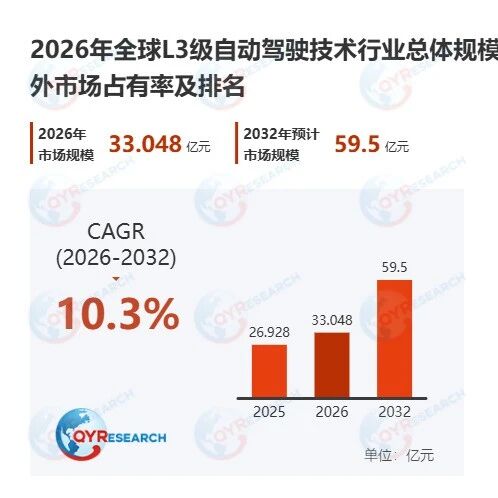
Core Viewpoint - L3 level autonomous driving represents a critical turning point in driving automation, allowing systems to perform dynamic driving tasks under specific conditions while retaining human oversight for complex scenarios [2][6]. Market Overview - The global L3 level autonomous driving technology market is projected to reach $880 million by 2032, with a compound annual growth rate (CAGR) of 10.3% over the coming years [4][14]. - The market size is expected to grow from approximately $3.3048 billion in 2026 to $8.8 billion by 2032 [14]. Industry Structure - The industry chain of L3 level autonomous driving consists of a three-dimensional structure: upstream focuses on core components like LiDAR and AI chips, midstream involves system integration by automakers and Tier 1 suppliers, and downstream is closely tied to various vehicle applications [6][9]. - Key players in the upstream include Huawei, Hesai Technology, and NVIDIA, while major automakers like Mercedes-Benz and Xpeng lead the midstream integration [6]. Policy and Standards - Policies such as China's regulations on intelligent connected vehicle testing and the EU's GDPR for data privacy are accelerating the deployment of L3 technology [7]. - Local governments are establishing autonomous driving demonstration zones and providing testing licenses and financial subsidies to promote infrastructure upgrades [7]. Opportunities and Challenges - The demand for "hands-free" driving is increasing, with highways and urban expressways being the first to implement L3 technology, potentially leading to a market size exceeding $1 trillion by 2030 [8]. - However, challenges remain, including the need for improved perception robustness in complex scenarios, regulatory frameworks for accident liability, and significant infrastructure investments [8][9]. Industry Barriers - The complexity of L3 technology involves interdisciplinary fields such as computer vision and artificial intelligence, requiring long-term accumulation of expertise [9]. - Financially, developing a single model can exceed 1 billion yuan, and scaling production necessitates specialized production lines and data systems [9]. - Establishing a collaborative ecosystem among chip manufacturers, algorithm companies, and automakers is essential, making it difficult for new entrants to build a complete value chain quickly [9].

特斯拉,不想当“车企”了
3 6 Ke· 2026-02-26 01:31
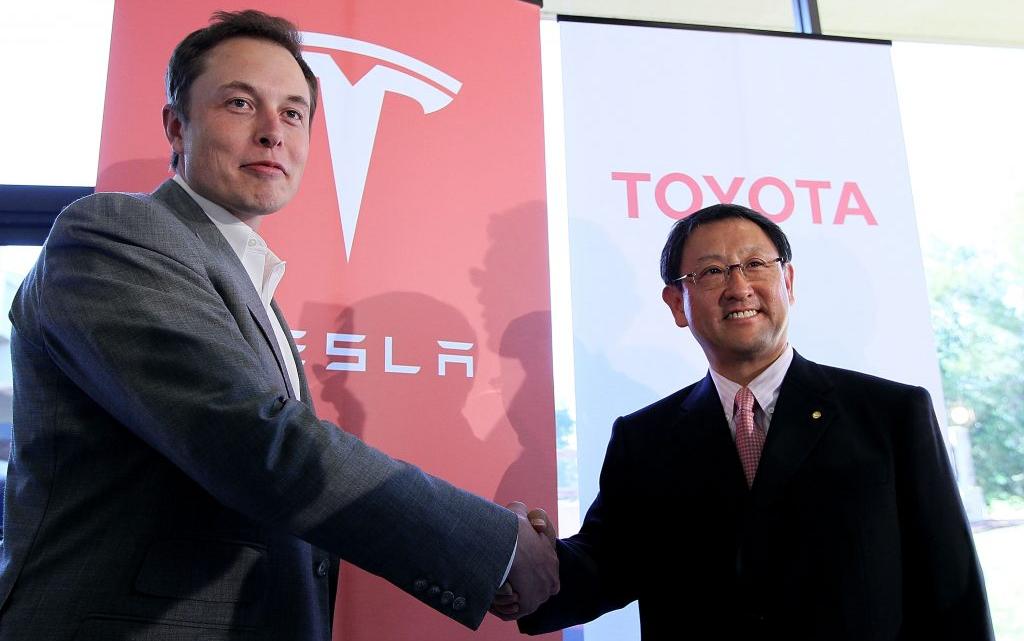
Core Insights - The article highlights the contrasting performance and market valuation of Toyota and Tesla, with Toyota selling 11.32 million vehicles and Tesla delivering 1.63 million vehicles in 2025, resulting in a sales gap of 9.69 million vehicles [1][3] - Despite Toyota's higher sales and net profit of $31.2 billion compared to Tesla's under $3.8 billion, Tesla's market capitalization reached $1.54 trillion, nearly five times that of Toyota's $311 billion, indicating a significant shift in how the capital market evaluates automotive companies [3][5] - The article emphasizes that Tesla's focus has shifted from merely selling cars to providing transportation services, with plans to develop AI and robotics technologies, which are seen as future growth drivers [5][12] Sales and Profit Comparison - In 2025, Toyota is projected to generate a net profit of $31.2 billion, while Tesla's profit is expected to be less than $3.8 billion [3] - Tesla's market capitalization is significantly higher at $1.54 trillion compared to Toyota's $311 billion, illustrating a valuation disparity [3] Business Strategy and Future Outlook - Tesla's CEO Elon Musk has indicated a strategic pivot, with plans to cease production of the Model S and Model X to focus on manufacturing robots, aiming for an annual output of 1 million units [5] - The company's mission has evolved to prioritize wealth generation through AI and robotics, positioning itself for a future of high-income opportunities [5][12] - Tesla's upcoming Cybercab, a robotaxi, is set to be mass-produced, with a projected price of $30,000, which is lower than the entry-level Model 3, indicating a competitive pricing strategy in the robotaxi market [10][12] Legal and Regulatory Challenges - Tesla has filed a lawsuit against the California DMV to overturn a ruling that found the company guilty of false advertising regarding its autonomous driving capabilities [13][15] - The lawsuit aims to protect Tesla's brand reputation and facilitate the commercialization of the Cybercab, as the company seeks to eliminate potential legal risks [15] Market Potential - The robotaxi market is projected to exceed $400 billion by 2026, highlighting the significant growth potential in this sector [12] - Tesla's Robotaxi fleet has reportedly surpassed 200 vehicles, with plans for exponential growth, indicating strong ambitions in this emerging market [15]

8点1氪丨比尔·盖茨就其与爱泼斯坦关系道歉;魅族手机或于3月正式退市;腾讯元宝回应生成拜年海报中出现骂人脏话
3 6 Ke· 2026-02-25 23:56
Group 1: Automotive Industry - Over 20 automotive brands have launched seven-year low-interest loan programs, with brands like BYD and IM Motors offering competitive financing options [6][7] - Meizu's mobile phone business has effectively ceased operations and is set to officially delist in March 2026, while its FlymeAuto business will operate independently [1] Group 2: Technology and Communication - WeChat has introduced a new feature allowing users to receive photos and files face-to-face without needing to add friends or use data [5] - Apple CEO Tim Cook's total compensation for 2025 has been set at $74.29 million, remaining stable compared to 2024 [4] Group 3: Travel and Entertainment - Domestic flight ticket prices have significantly decreased, with average prices dropping over 50% since peaking on February 23 [3] - The 2026 Spring Festival box office in China reached 5.752 billion yuan, marking an eight-year low, leading to stock declines for several film companies [4] Group 4: Financial Performance - Nvidia reported fourth-quarter revenue of $68.127 billion, a 73% year-over-year increase, with a net profit of $42.96 billion, up 94% [16] - Ctrip Group's fourth-quarter net revenue was 15.4 billion yuan, reflecting a 21% year-over-year growth [17] - HSBC Holdings reported a 4% increase in revenue for 2025, totaling $68.3 billion, driven by growth in wealth management and wholesale banking [18] - Transsion Holdings reported a 4.5% decline in total revenue for 2025, with net profit down 53.43% due to increased competition and rising costs [19]
中原证券晨会聚焦-20260226
Zhongyuan Securities· 2026-02-25 23:34
Core Insights - The report highlights the performance of various sectors in the A-share market, indicating a mixed trend with certain industries like battery and communication resources leading the gains while others like tourism and media lag behind [6][9][10] - The report emphasizes the importance of macroeconomic data and policy changes in shaping market expectations and investment strategies [8][12][20] Domestic Market Performance - The Shanghai Composite Index closed at 4,147.23 with a gain of 0.72%, while the Shenzhen Component Index closed at 14,475.87 with a gain of 1.29% [4] - The average P/E ratios for the Shanghai Composite and ChiNext are 16.93 and 53.12 respectively, indicating a favorable long-term investment environment [8][12] International Market Performance - Major international indices such as the Dow Jones and S&P 500 experienced declines of 0.67% and 0.45% respectively, reflecting a cautious global market sentiment [5] Industry Analysis - The aerospace and media sectors are noted for their strong performance, while the film industry faced a disappointing Spring Festival box office, with total revenue down 40.09% year-on-year [14][15] - The automotive industry is projected to benefit from policies promoting vehicle upgrades, with a target of replacing 500,000 vehicles by the end of 2026 [6][20] Investment Recommendations - The report suggests focusing on sectors such as electric batteries, communication devices, and aerospace for short-term investment opportunities due to their current market strength [12][20] - In the automotive sector, the report recommends monitoring companies involved in intelligent driving and robotics, as these areas are expected to see significant growth [20][28] Key Data Updates - The report notes that the automotive industry saw stable production and sales figures in January 2026, with a total of 245,000 vehicles produced and 234,700 sold [18] - The battery sector reported a 3.31% increase in the index, with a total of 94,500 electric vehicles sold in January, indicating a slight year-on-year increase [37]

递表港交所 伯镭科技的矿卡双刃剑
Bei Jing Shang Bao· 2026-02-25 16:13
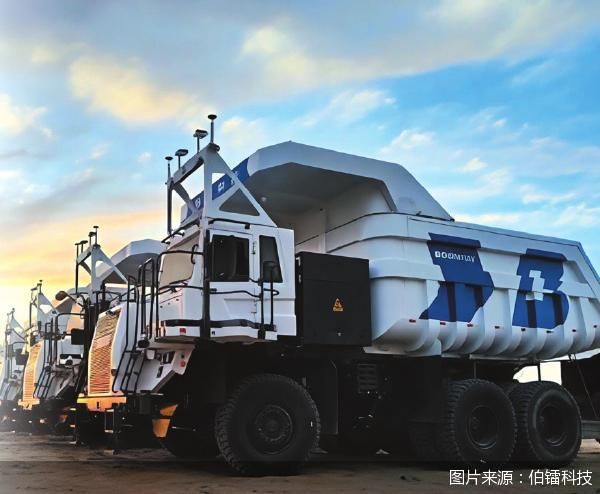
Core Viewpoint - Shanghai Berai Intelligent Technology Co., Ltd. (referred to as "Berai Technology") has officially submitted its listing application to the Hong Kong Stock Exchange, showcasing significant revenue growth and positioning itself as the world's largest pure electric autonomous mining truck provider by shipment volume and revenue in 2024 [1][3]. Group 1: Revenue Growth and Business Model - Berai Technology's revenue is projected to increase from 69.565 million yuan in 2023 to 171 million yuan in 2024, and further to 315 million yuan in the first three quarters of the previous year, reflecting a year-on-year growth of over 800% [1]. - The company's main business, "Smart Vehicle," generated revenues of 57.887 million yuan, 149 million yuan, and 291 million yuan for 2023, 2024, and the first three quarters of the previous year, respectively, accounting for 83.2%, 87.2%, and 92.4% of total revenue [3][4]. - Berai Technology's flagship brand, "Berai Electric Bull," launched a series of models in collaboration with OEMs, marking it as the first Chinese company to mass-produce autonomous mining trucks [3]. Group 2: Customer Dependency and Risks - In the first three quarters of the previous year, the largest customer contributed 65% of the revenue, while the top five customers accounted for 97.7% of total revenue [1][9]. - The company acknowledges its reliance on third-party suppliers for manufacturing and assembly, which may weaken control over product quality and quantity [4]. - The risk of over-dependence on major clients is highlighted, as it could lead to reduced bargaining power and potential revenue impacts if client orders fluctuate [9]. Group 3: Market Trends and Pricing Strategy - The average price of mining trucks is expected to decline due to technological advancements and economies of scale, with the average price projected to be around 1.5 million yuan in 2024 [6]. - Berai Technology aims to counteract this downward price trend by shifting its sales strategy towards higher-tonnage and higher-value mining truck models, such as the Berai Electric Bull 145 model, which offers enhanced specifications compared to the more common 105 model [7]. - The gross margins for the Smart Vehicle, Smart Mining, and Smart Transportation segments are reported at 16.1%, 48.9%, and 3.6% respectively for the first nine months of 2025, indicating that the Smart Vehicle segment, while generating the most revenue, is not the highest in terms of profitability [7].
Waymo扩大机器人出租车服务范围
Xin Lang Cai Jing· 2026-02-25 15:31
Core Insights - Waymo, a subsidiary of Alphabet, has expanded its autonomous driving services to include Dallas, Houston, San Antonio, and Orlando, increasing its operational coverage to 10 major metropolitan areas in the U.S. [1] Group 1 - Waymo is now providing driverless ride-hailing services to specific passengers in four new cities [1] - The expansion signifies a strategic move to enhance Waymo's presence in the autonomous vehicle market [1] - The total number of metropolitan areas served by Waymo has reached 10 [1]


提前两个月落地! Cybercab首台量产车下线
Mei Ri Jing Ji Xin Wen· 2026-02-25 11:17
Core Viewpoint - Tesla's first autonomous taxi, Cybercab, has officially entered mass production two months ahead of schedule, marking a significant step in its autonomous driving strategy [1] Group 1: Product Launch and Features - The first Cybercab model was produced at Tesla's Texas Gigafactory and is designed for fully autonomous driving, lacking a steering wheel and pedals [1] - The vehicle is priced around $25,000, and consumers will have the option to purchase it [1] - The design of Cybercab features a symmetrical body that supports bidirectional driving, eliminating traditional front and rear [5] Group 2: Technological Advancements - The mass production of Cybercab validates Tesla's transition from Level 2 (L2) driver assistance to Level 4 (L4) autonomous driving technology [2] - Tesla's Full Self-Driving (FSD) vehicles have demonstrated significantly better safety performance compared to human drivers, with major collision intervals averaging about 5.3 million miles [2] Group 3: Industry Perspectives - There are differing opinions within the industry regarding Tesla's Robotaxi development path, with some experts suggesting that existing models may only serve as L2 vehicles and that true L4 capabilities require new designs [3] - It is anticipated that Tesla's Robotaxi development may follow a gradual approach similar to other companies, potentially delaying full deployment until 2027 [3] Group 4: Regulatory Challenges - Despite the early production of Cybercab, regulatory approval for its operation remains uncertain, as current U.S. regulations require vehicles to retain manual control features [4] - Cybercab must resolve its "vehicle legality" issue and obtain commercial operation permits from regulatory bodies [4] Group 5: Financial Performance - Tesla's financial performance in 2025 showed a decline, with revenue at $94.83 billion, a decrease of approximately 3%, and net profit down by about 46% to $3.79 billion [6] - Vehicle deliveries also fell by 8.55% year-over-year, totaling 1.6361 million units [6] - The company has shifted its focus from electric vehicles to artificial intelligence and robotics, with a significant portion of its future value expected to come from its robot, Optimus [6] Group 6: Market Reactions - The market response to Tesla's transformation has been cautious, with stock prices declining by about 19.8% from their December 2025 peak [7] - Analysts from Morgan Stanley and Wells Fargo have downgraded Tesla's ratings, citing concerns over the slower-than-expected commercialization of Robotaxi and robotics [7]
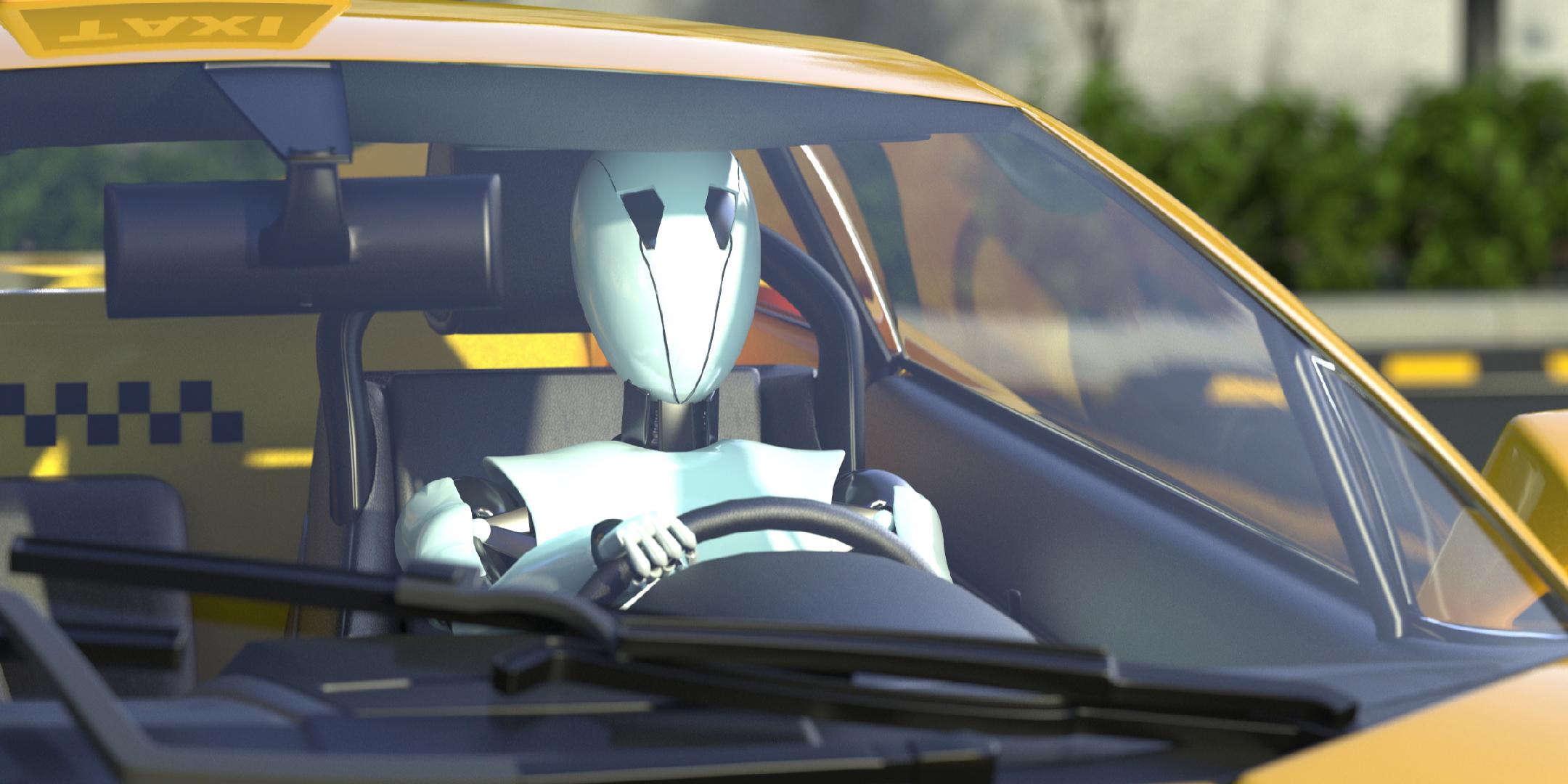
Robotaxi可以放心坐了吗
Jing Ji Guan Cha Wang· 2026-02-25 11:09
Core Insights - The Robotaxi industry is experiencing accelerated commercialization and safety controversies since 2025, with 2026 anticipated as a pivotal year for large-scale deployment [2] - Major automotive companies and tech firms are expanding their Robotaxi operations, while safety incidents raise public concerns about the reliability of these services [2][8] Industry Developments - Tesla plans to remove safety drivers in Austin by 2025 and aims for mass production of its CyberCab by Q1 2026 [3] - Xiaopeng Motors will launch three Robotaxi models in 2026 and has partnered with Gaode for a global ecosystem collaboration [3] - Baidu's Robotaxi service, "Luo Bo Kuaipao," operates in 22 cities with over 250,000 fully autonomous orders weekly, serving more than 17 million users [3] - Waymo's total order volume reached 15 million in 2025, doubling from previous figures, with plans for global expansion following a $16 billion funding round [3] Collaborations and Strategies - GAC Toyota's Robotaxi, the Platinum Smart 4X, has been launched, with plans for 1,000 units by 2026 in collaboration with Pony.ai [4] - Geely's strategy aims to expand Robotaxi services to 100 cities, with a target of 1 billion yuan in revenue by 2026 [5] - Didi and GAC Aion have launched their first Robotaxi, R2, set to operate in major cities starting Q2 2026 [5] - Pony.ai has achieved profitability for its Robotaxi in Guangzhou, indicating a shift towards sustainable operations [7] Safety and Regulatory Challenges - Safety incidents involving Robotaxis have raised significant concerns, including a fire in Beijing and accidents in Chongqing and Hunan [8][9] - The industry faces challenges in technology adaptation, regulatory frameworks, and operational practices, with calls for improved safety standards and accountability [9][10] - The lack of unified safety regulations and the rapid expansion of services without adequate safety measures have been highlighted as critical issues [9][10] Future Outlook - The Robotaxi sector is expected to reach a tipping point in 2026, driven by technological advancements, supportive policies, and increased capital investment [6][10] - The industry must balance rapid growth with safety considerations to gain public trust and ensure sustainable development [10]
马年投资锦囊|平安基金莫艽:深度研究丈量价值,以终局思维穿越周期
Sou Hu Cai Jing· 2026-02-25 10:31
Core Viewpoint - The interview with Mo Qiao, a fund manager at Ping An Fund, emphasizes the importance of deep research and a robust investment framework to navigate market noise and identify investment opportunities [3][4]. Group 1: Fund Performance - Mo Qiao's representative fund, Ping An Enjoy Flexible Allocation Mixed Fund, achieved a return of 21.18% in 2024, ranking in the top 5% among 425 funds, while the CSI 300 index rose by 14.5% and the equity mixed fund index by 3.5% during the same period [3]. - In 2025, during a challenging market for value-style products, the fund maintained a positive return of 24.57% [3]. - The maximum drawdowns for the fund were 15.8% in 2024 and 12.8% in 2025 [3]. Group 2: Investment Philosophy - Mo Qiao aims for an annualized return of 15% over the next decade, highlighting that few fund managers achieve this consistently [4]. - He identifies five core areas for investment: artificial intelligence, autonomous driving, robotics, commercial aerospace, and solid-state batteries [4]. - The investment strategy is described as "using DCF as the principle and four methods as the tools," focusing on deep research to define value ranges [4][5]. Group 3: Research Methodology - The DCF model's effectiveness relies on accurately predicting future growth variables, which necessitates extensive research to clarify a company's intrinsic value range [5]. - Mo Qiao emphasizes that intrinsic value is not a single point but a range, and deep research is essential to refine this understanding [5]. - He follows the Kelly Criterion for dynamic position adjustment based on stock prices relative to their intrinsic value range, advocating for a flexible approach to investment [5][6]. Group 4: Value Investment Strategy - Mo Qiao critiques the focus on low P/E and P/B ratios, warning that it can lead to "value traps," and asserts that price comparisons to intrinsic value are more critical [6]. - He insists on investing only in high-quality companies, as they have a higher probability of maintaining excellence compared to poor companies [6]. - The strategy includes a focus on "absolute left-side investment," prioritizing undervalued quality companies, especially in sectors with low economic sentiment [9]. Group 5: Research Impact - Mo Qiao's research approach is characterized by detailed documentation, producing extensive reports that cover all aspects of a company, from business models to competitive dynamics [7][8]. - This method allows for a deep understanding of various industries, even those previously unexamined, enabling quick adaptation to new market conditions [8]. - The investment style, combining deep research with flexible strategies, has garnered trust from both institutional and individual investors, creating a self-reinforcing cycle of research, cognition, and trust [9].