AI芯片

Search documents
今日国际国内财经新闻精华摘要|2025年12月18日
Xin Lang Cai Jing· 2025-12-18 00:57
International News - The US stock market saw a decline on Wednesday, with the Dow Jones falling by 0.47%, the Nasdaq by 1.79%, and the S&P 500 by 1.14%. Notably, Tesla and Broadcom dropped over 4%, while Oracle fell more than 5% [1][12] - In after-hours trading, Micron Technology's stock increased by 9% [2][13] - The Nasdaq Golden Dragon China Index decreased by 0.76%, with several Chinese concept stocks like Shengfeng Logistics, Furlong Group, and Huya experiencing significant declines [3][14] - The cryptocurrency market exhibited notable volatility, with Bitcoin fluctuating between $89,000 and $90,000 before dropping below $86,000, resulting in a daily decline of 2.21%. Ethereum fell below $2,800, down 5.61% for the day [3][14] - In the commodities market, energy products showed significant gains, with Brent crude oil rising by 3% to $60.69 per barrel, and US natural gas futures increasing by over 4% to $3.387 per million British thermal units [3][14] - Precious metals saw gains, with New York gold futures surpassing $4,380 per ounce, up 1.10%, and silver futures exceeding $67 per ounce, up 5.82% [4][15] - The World Bureau of Metal Statistics reported a projected shortage of 0.14 million tons of refined copper by October 2025, while a cumulative surplus of 3.61 million tons was recorded from January to October [5][16] - The US Senate passed a $900.6 billion defense authorization bill for the fiscal year 2026, which will be sent to Trump for signing [5][16] - Trump is expected to sign an executive order to redefine cannabis laws and impose sanctions on Venezuela to regain oil extraction rights [5][16] - The US plans to revoke citizenship from more individuals, and legal expert Alan Dershowitz stated that the constitutionality of Trump's third term remains uncertain [6][17] - Russian President Putin indicated that Russia would pursue its goals in Ukraine through diplomatic or military means, asserting that the West is the instigator of the conflict [6][17] - The US and Russia are scheduled to hold talks regarding the Ukraine conflict in Miami this weekend, while the US has allowed certain transactions related to Russian civilian nuclear energy [7][18] - Google is collaborating with Meta to expand AI chip software support, aiming to run TPU on the PyTorch tool as a replacement for Nvidia's solution [7][18] - Novartis and Roche are nearing an agreement with the White House regarding drug pricing discussions [7][18] - The Federal Reserve issued a regulatory notice to Citigroup, requiring improvements in risk management [7][18] - The German Bundestag approved a €50 billion defense procurement plan, and US Treasury Secretary Yellen confirmed that Bridgewater founder Dalio has joined Trump's team [7][18] Domestic News - According to the People's Daily, from January to November, China's railways transported 4.28 billion passengers, setting a historical record for the same period. During the same time, express delivery volume increased by 14.9%, with business revenue rising by 7.1% [8][19] - In regional development, Fujian is implementing a new era of mountain-sea cooperation, while Xi'an in Shaanxi is driving high-quality development through technological innovation. The Hainan Free Trade Port has made progress, with customs clearance for goods entering and exiting "first" and "second" lines starting on December 18, along with the opening of eight foreign trade ports and ten "second" line ports [8][19] - SenseTime Group announced a placement of 1.75 billion Class B shares at a price of HKD 1.80 per share [9][20] - In the domestic commodities market, silver futures rose by 4%, currently priced at CNY 15,612.00 [10][20] - The Chinese Ministry of Foreign Affairs' special envoy for Asian affairs will visit Cambodia and Thailand on December 18 to mediate the border conflict between Cambodia and Thailand, with China expressing its intention to promote a resolution [11][20]



百度昆仑芯征战IPO:营收跑赢同行,估值为何却只有零头
Xin Lang Cai Jing· 2025-12-17 13:38
Core Viewpoint - Baidu plans to spin off its AI chip company Kunlun Chip for an independent IPO, aiming to submit its application to the Hong Kong Stock Exchange in early 2026 and complete the IPO by early 2027, with projected revenue exceeding 2 billion yuan in 2025 [1][31]. Group 1: Company Overview - Kunlun Chip was established in April 2021, evolving from Baidu's internal AI chip department, and has developed a full-stack product line from chips to software platforms [5][34]. - The latest Kunlun Chip product, the P800, is designed for large-scale AI clusters and has shown significant improvements in memory specifications compared to competitors [7][36]. - Kunlun Chip has secured major contracts, including a significant order from China Mobile, capturing 70% to 100% of the procurement project for AI computing devices [8][37]. Group 2: Financial Performance - Kunlun Chip's revenue is projected to exceed 1 billion yuan in 2024 and over 2 billion yuan in 2025, positioning it among the top three in the domestic AI chip sector [15][44]. - Despite strong revenue growth, Kunlun Chip's valuation stands at approximately 21 billion yuan, significantly lower than competitors like Cambricon and Moore Threads, which have market valuations exceeding 600 billion yuan [19][48]. - The company has attracted substantial investment, with a recent funding round raising about 2.83 billion yuan, involving notable investors such as BYD and China Mobile [10][39]. Group 3: Market Position and Challenges - Kunlun Chip's market presence is limited compared to competitors, with a significant portion of its business still reliant on Baidu, raising concerns about its long-term growth potential [19][53]. - The competitive landscape in the AI chip sector is intense, with established players like Nvidia and Huawei having built strong ecosystems that Kunlun Chip is still developing [21][50]. - Analysts suggest that Kunlun Chip's lower valuation may stem from market skepticism regarding its ability to achieve independent profitability and diversify its customer base beyond Baidu [19][54].


在手订单12.41亿元 壁仞科技冲刺“港股GPU第一股”
Zheng Quan Ri Bao Wang· 2025-12-17 11:48
Group 1 - The core viewpoint of the news is that Shanghai Birun Technology Co., Ltd. has successfully passed its listing hearing and is set to become the first GPU stock on the Hong Kong Stock Exchange, highlighting its rapid growth and strong market potential [1][3]. - Birun Technology is a leading provider of general intelligent computing solutions in China, with revenue skyrocketing from 499,000 yuan in 2022 to 337 million yuan in 2024, reflecting a compound annual growth rate of 2500% [1]. - The company plans to launch its high-performance Birun™166 series products in the second half of 2025, which is expected to further enhance its competitive edge and revenue potential [1]. Group 2 - Birun Technology has attracted significant attention from top financial investment institutions and industry capital, achieving a post-financing valuation exceeding 20 billion yuan before its IPO in August 2025 [2]. - The company's strong founding team, led by CEO Zhang Wen, possesses over 10 years of experience in AI and hardware technology, which supports its promising commercialization prospects [2]. - With the upcoming mass production and commercialization of the new Birun™166 chip in 2025, the company is poised for rapid growth in sales and revenue [2]. Group 3 - Birun Technology is positioned to benefit from policy incentives as a strategic emerging industry, with AI chips showing vast growth potential and structural investment opportunities [3]. - As the first GPU stock in the Hong Kong market, Birun Technology will fill a significant gap in the GPU sector, providing investors with new opportunities to engage with the Chinese AI industry chain [3].
资本热话 | 中一签赚近30万!沐曦上市首日暴涨,预计明年盈亏平衡
Sou Hu Cai Jing· 2025-12-17 09:30
Core Viewpoint - The company Muxi is a leading developer of high-performance general-purpose GPU products in China, but it has not yet achieved profitability despite significant revenue growth and substantial investments from major private equity firms [1][2]. Financial Performance - Muxi's revenue for 2022, 2023, and the first quarter of 2024 was reported at 42.64 million, 530.21 million, and 743 million respectively, with a projected revenue of 9.15 billion for the first half of 2024, reflecting a year-on-year growth of 404.51% [1][2]. - The company incurred net losses of 7.77 billion, 8.71 billion, and 14.09 billion for the years 2022, 2023, and the first quarter of 2024, with a total cumulative loss exceeding 32 billion from 2022 to 2024 [1][2]. - Muxi expects to generate revenue between 12 billion and 12.6 billion for the first nine months of 2024, with a projected loss of 3 billion to 3.8 billion, indicating a reduction in losses compared to previous periods [2]. Market Position and Competition - Muxi's GPU products are reported to be among the top tier in China, with cumulative sales exceeding 25,000 units [1]. - The company faces challenges in achieving profitability due to the dominance of foreign giants in the domestic GPU chip market and low penetration rates of domestic products [2]. - Muxi anticipates reaching a breakeven point by 2026, while its market share in the Chinese AI chip market is estimated to be around 1% in 2024 [2].
壁仞科技获港股IPO备案,冲刺 "港股GPU第一股"
机器人圈· 2025-12-17 09:19
Core Viewpoint - The approval of Shanghai Birun Technology Co., Ltd.'s overseas listing and the full circulation of unlisted shares marks a significant milestone, positioning the company as a potential leader in the Hong Kong GPU market and providing new investment opportunities in China's AI industry [2][7]. Group 1: Company Overview - Founded in September 2019, Birun Technology focuses on the development of original general-purpose computing systems and aims to achieve breakthroughs in high-end domestic intelligent computing chips [3]. - The company has achieved several milestones, including the launch of its first general-purpose GPU in March 2022 and the release of the BR100 GPU chip in August 2022, which broke international computing power records [3]. Group 2: Financial and Investment Highlights - Birun Technology has attracted significant capital, raising nearly 20 billion yuan in total funding since its inception, with a valuation of approximately 155 billion yuan (around 21.77 billion USD) [4]. - The company has a diverse investor base, including prominent firms such as Qiming Venture Partners and IDG Capital [4]. Group 3: Technological Development and Collaborations - The company has established partnerships with leading universities and institutions to enhance its AI hardware and software ecosystem, including collaborations with Tsinghua University and Shanghai AI Laboratory [5]. - In October 2023, Birun Technology was placed on the U.S. Entity List, prompting the company to accelerate its independent innovation efforts [5]. Group 4: Leadership and Strategic Vision - The founder, Zhang Wen, has a strong background in law and investment, which has contributed to the company's rapid growth and strategic direction [6]. - Zhang emphasizes the importance of talent, management, and large-scale applications in the semiconductor industry, aiming to create versatile products that meet market demands [7].
科创板“国产GPU第二股”上市,暴涨569%
3 6 Ke· 2025-12-17 08:48
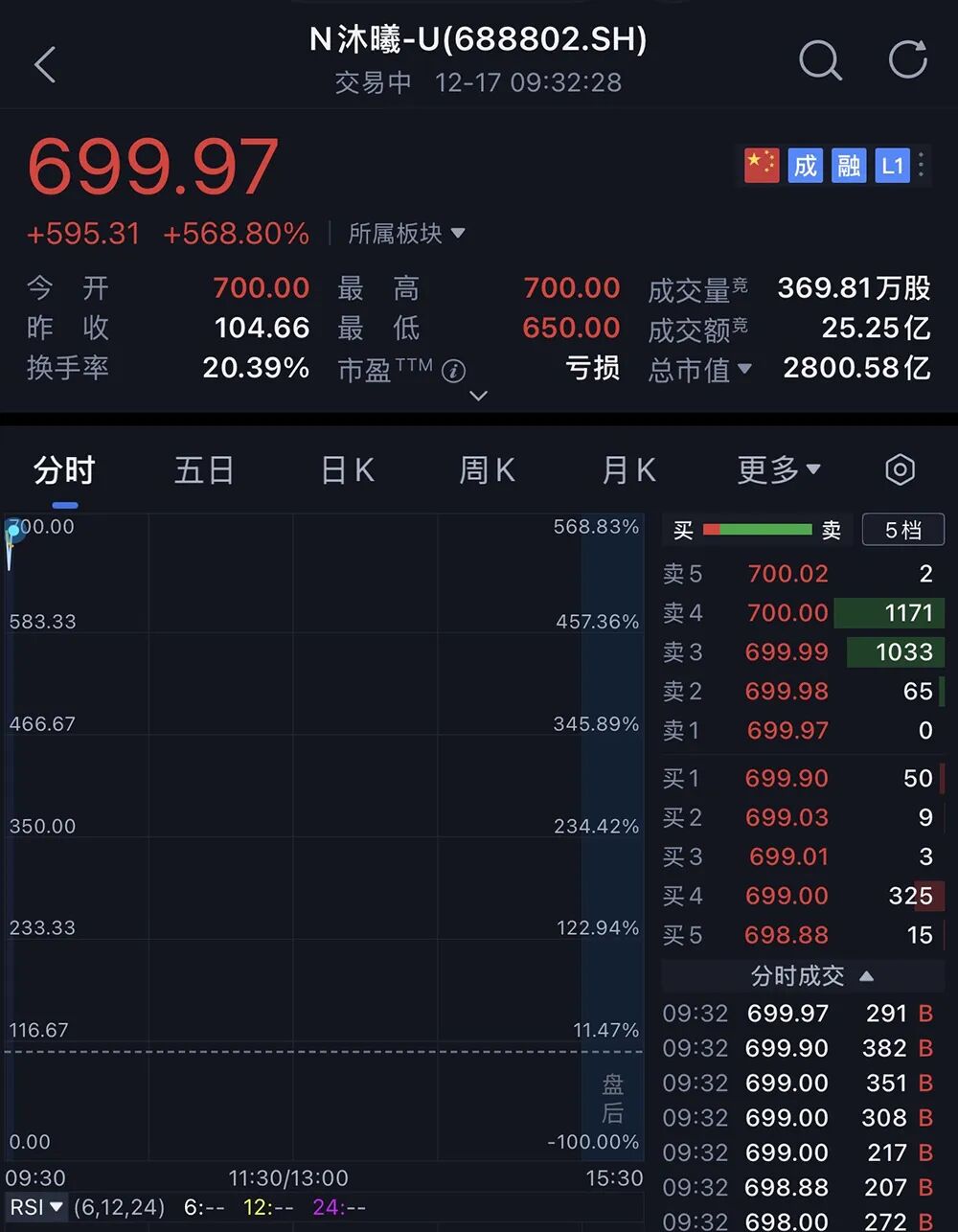
Core Viewpoint - Mu Xi Co., Ltd. has successfully listed on the Shanghai Stock Exchange's Sci-Tech Innovation Board, becoming the second domestic GPU company to do so after Moore Threads, with an initial public offering (IPO) price of 104.66 yuan per share and a market capitalization of 280.1 billion yuan at the opening [1][3]. Company Overview - Mu Xi was established in September 2020, with a registered capital of 360 million yuan before the IPO and 400 million yuan after [3]. - The company is recognized as a national-level specialized and innovative "little giant" enterprise [3]. - The IPO process took less than six months from acceptance to listing [3]. Financial Performance - The company expects to achieve revenue between 1.5 billion and 1.98 billion yuan in 2025, representing a year-on-year growth of 101.86% to 166.46% [6][8]. - The net profit attributable to the parent company is projected to be a loss of 762 million to 527 million yuan, a year-on-year decrease of 45.84% to 62.59% [6][8]. - For the first nine months of 2025, the company reported revenue of 1.236 billion yuan, with a significant reduction in losses, achieving a net profit of -346 million yuan, a year-on-year improvement of 55.79% [9][10]. Product Lines and Market Position - Mu Xi's main products cover three areas: AI computing, general computing, and graphics rendering, with cumulative GPU sales exceeding 25,000 units [20][23]. - The company has launched several GPU series, including the Xi Yun C series for training and inference, the Xi Si N series for AI applications, and the Xi Cai G series for graphics rendering [20][23]. Shareholder Structure - The company has a diverse shareholder base, including major players like China Telecom, JD.com, Meituan, and Lenovo, which participated in the strategic placement of shares [5][28]. - The largest shareholders include Shanghai Jiao Mai and the founder Chen Weiliang, who controls 22.94% of the voting rights [30][32]. Research and Development - Mu Xi employs 652 R&D personnel, accounting for 74.94% of its total workforce, and holds 255 domestic patents, including 245 invention patents [25]. - The company is focused on developing next-generation chips and has a strong team with extensive experience in high-performance GPU design [26][27].
国产GPU上市:量化狂欢,有人一签赚30万,有人早赚百亿
Sou Hu Cai Jing· 2025-12-17 07:23
量化资金再次吃到肉。110家私募总共获配3846万元,幻方、衍复、九坤三家又成大赢家,分别拿了490 万、468万、318万的配售额。按现在接近700%的涨幅算,这些量化私募浮盈超2亿,幻方单日浮盈3000 万左右,衍复也不差,九坤也赚了2000来万。 最近国产AI芯片圈可太热闹了!寒武纪作为国产AI芯片第一股,市值已经冲到5000多亿,成了资本市 场最火的AI芯片公司。 这波行情直接带火了整个国产GPU板块,一堆GPU厂商扎堆国内IPO,上演了一出财富盛宴。 先说前几天上市的摩尔线程,开盘当天直接暴涨500%+,中签的散户一签就能赚20多万,网下机构账户 更狠,合计浮盈约191亿元。 量化资金也没闲着,幻方量化获配6.13万股,衍复投资6.004万股,九坤、海南世纪前沿、明汯也分到不 少,当天这些量化机构账面浮盈好几个亿。比如幻方就赚了约2980万元,衍复也有2919万元进账。 这才刚过几天,国产GPU第二股沐曦股份又登场了。今天上午开盘直接飙涨688%,最高涨幅破700%, 又让机构们乐开了花。中签的散户运气好的话,一签能赚30来万,堪称史上最赚钱新股。线下机构配售 才是真正的大头,按上午的涨幅算,机构们 ...
芯片ETF(512760)涨超1.9%,市场关注AI芯片需求与国产化进程
Mei Ri Jing Ji Xin Wen· 2025-12-17 06:37
芯片ETF(512760)跟踪的是中华半导体芯片指数(990001),该指数聚焦于沪深市场中半导体芯片行 业的上市公司,成分股涵盖材料、设备、设计、制造、封装或测试等环节。指数选取日均成交额排名前 80%且市值较高的50只股票作为样本,行业配置以信息技术为主,以反映半导体芯片产业链相关上市公 司证券的整体表现。 东海证券指出,美方批准英伟达对华出售H200芯片并收取25%分成,此举或将加快中国AI模型训练进 程,但可能对国产AI芯片厂商短期内市场拓展和生态构建形成压力。美国芯片巨头博通2025财年第四 季度业绩全面超出市场预期,AI芯片销售额同比激增74%,成为增长核心动力,预计下一季度保持高速 增长。当前电子行业需求持续复苏,供给有效出清,存储芯片价格上涨,我国国产化力度超预期。AI 半导体业务驱动下,行业结构性机会显现,包括AI算力、AIOT、半导体设备、关键零部件和存储涨价 等领域。 (文章来源:每日经济新闻) ...
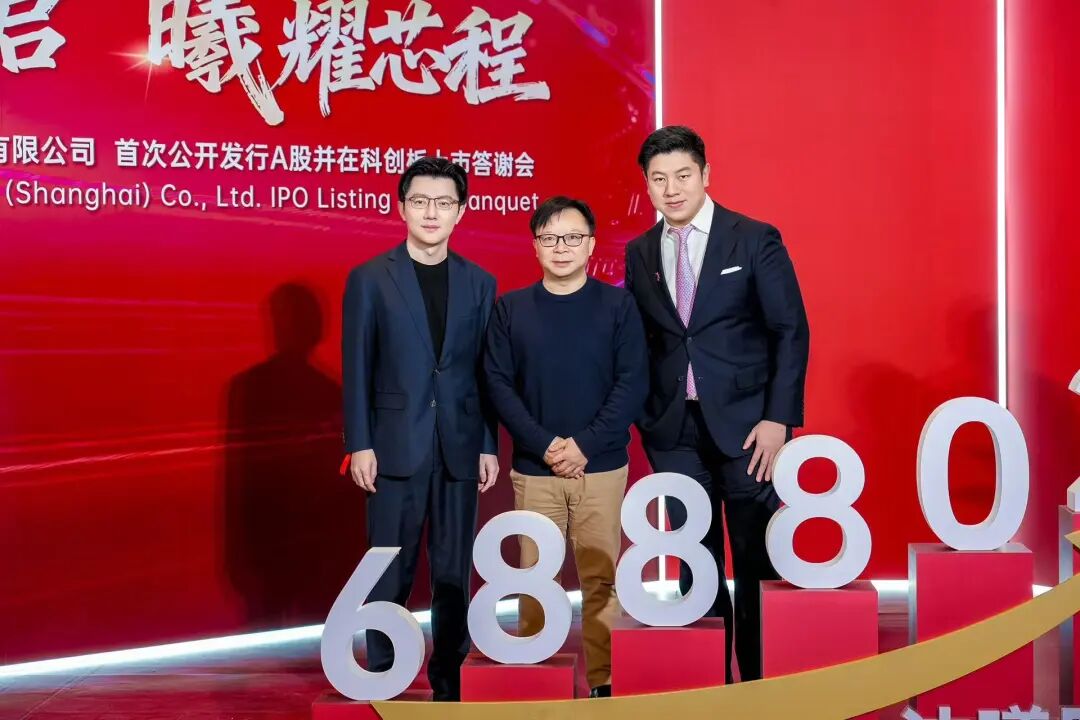
沐曦3000亿,投资人迎来超级回报
3 6 Ke· 2025-12-17 03:32
如无意外,这将是今年最后一个千亿IPO。 今日(12月17日),沐曦集成电路(上海)股份有限公司正式登陆科创板。此次IPO发行价104.66元/股,募资总额41.86亿元,今天高开568%,随后市值 突破3000亿元。 沐曦备受创投圈瞩目。掌舵者陈维良曾任职于AMD(超威半导体),在这里他结识了日后的两位创业伙伴彭莉和杨建,三人联手在2020年共同创立沐 曦。一路走来,沐曦身后集结了超100家投资方,队伍浩荡。 其中,和暄资本在2022年首次出手,连投三轮。对于这家年轻亚洲PE而言,沐曦既是和暄资本人民币基金出手的第一个项目,也是和暄资本收获的第一 个科创板IPO。 随着今日钟声敲响,属于国产GPU突围者们的高光时刻到来。不久前,摩尔线程登陆科创板,市值一路飙至超3000亿;寒武纪今年市值最高破6000亿…… 几乎所有人都在押注中国诞生自己的英伟达。 创业5年,火速敲钟,沐曦市值3000亿 沐曦的崛起,堪称国产GPU突围的一抹缩影。 这要从灵魂人物陈维良说起。他出生于1976年,先后毕业于电子科技大学和清华大学,创业前最重要的一段工作经历是在AMD(超威半导体)。招股书 显示,他在这里工作17年之久。 这样的 ...