全国统一大市场

Search documents
学习经济工作“八个坚持”的实践逻辑与价值意蕴
Sou Hu Cai Jing· 2026-01-14 07:19
Core Viewpoint - The 2026 economic work plan emphasizes "stability while seeking progress and improving quality and efficiency," with eight key principles that form a comprehensive action system covering demand, momentum, balance, livelihood, and safety [1][15]. Group 1: Economic System Optimization - The eight principles serve as a multi-dimensional optimization plan tailored for the economic system, addressing current contradictions while laying a solid foundation for long-term development [1][15]. - The principles draw parallels with human ergonomics, focusing on precise optimization and collaborative interaction among various functional modules to achieve overall stability and efficiency [3][15]. Group 2: Key Principles - **Domestic Demand as a Priority**: This principle aims to activate the "energy absorption system" of the economy, emphasizing the importance of a strong domestic market to counteract external uncertainties [4][15]. - **Innovation-Driven Growth**: This principle focuses on cultivating new productive forces, akin to the body's cellular metabolism, to transition the development model from scale-driven to quality-driven [6][15]. - **Reform and Opening Up**: This principle seeks to enhance internal circulation and external energy exchange, promoting a unified national market and reducing institutional barriers [7][15]. - **Coordinated Development**: This principle addresses the need for balanced development across urban and rural areas, ensuring resources flow effectively to enhance overall efficiency [9][15]. - **Dual Carbon Leadership**: This principle aims to establish an ecological protective barrier, promoting sustainable development through green transformation [11][15]. - **Focus on Livelihood**: This principle emphasizes the importance of safeguarding the basic livelihood of the population to maintain market vitality and social stability [12][15]. - **Risk Prevention**: This principle highlights the need for a robust risk prevention system to avoid systemic crises, focusing on real estate, local government debt, and financial risks [13][14][15]. Group 3: Implementation and Future Outlook - The implementation of the eight principles is interconnected, with each supporting the others to achieve the core goal of "stability while seeking progress and improving quality and efficiency" [15][16]. - The anticipated outcomes include improved energy absorption efficiency, accelerated functional iteration, enhanced circulation, better-balanced development, and strengthened safety measures, contributing to high-quality development during the "14th Five-Year Plan" period [16].


从价格战向质量创新的高阶形态转变
Sou Hu Cai Jing· 2026-01-14 04:49
Core Viewpoint - The article emphasizes the need to shift from "involutionary" competition, characterized by low efficiency and internal strife, to a focus on quality innovation and fair competition to promote high-quality economic development [5][6][7]. Group 1: Development Perspective - The correct development perspective significantly influences outcomes, with a focus on leveraging local advantages for differentiated development being essential for harmonious regional growth [3][8]. - The current economic environment necessitates breaking away from "involutionary" competition to facilitate the construction of a unified national market and foster technological innovation [5][6]. Group 2: Competition Policy - Establishing and implementing a foundational competition policy is crucial to overcoming local governments' reliance on selective industrial policies, with adherence to competition law serving as a regulatory anchor [4][10]. - The recent amendments to the Anti-Unfair Competition Law aim to regulate "involutionary" competition and promote a fair market environment, indicating a shift towards legal and normative governance [10][11]. Group 3: Government and Market Dynamics - The article highlights the importance of aligning government policies with national objectives to avoid detrimental "race-to-the-bottom" strategies that compromise fair competition and sustainable development [7][8]. - A systematic and differentiated evaluation framework for local governments is proposed to shift focus from GDP-centric assessments to more holistic measures that consider ecological and social factors [9][12]. Group 4: Legal Framework and Governance - The legal framework, including the Anti-Monopoly Law and fair competition review systems, is essential for preventing local government overreach and ensuring a competitive market environment [11][14]. - The establishment of a unified market foundation and cross-regional competition coordination mechanisms is necessary to correct resource allocation distortions and transition competition from price wars to quality innovation [12][13].

东吴证券首席经济学家芦哲:技术密集型、强定价权产品成为出口支柱,关税冲击耐受力增强
Sou Hu Cai Jing· 2026-01-14 04:25
2026年1月6日,复旦大学经济学院举办了"南土国际金融政策圆桌会第9期",同时也是"如何看待当前宏 观金融形势系列"的第二场活动。本次圆桌会聚焦"当前贸易顺差问题",与会学者围绕贸易结构转型、 全球价值链把控以及国内外需失衡等多重因素,系统分析了中国贸易顺差创历史新高的深层原因,并深 入探讨了中国在应对外部保护主义挑战、化解国内内卷式竞争及提升外汇与金融安全稳定性等方面面临 的现实制约及可行战略选择。 东吴证券首席经济学家芦哲指出,2025年前11个月,中国贸易顺差规模创历史新高,首次突破万亿美元 大关。虽然贸易顺差总量创历史新高,但其占GDP比重在全世界仍属中等水平。同时,顺差增长背后也 伴随着市场结构的深刻调整。芦哲认为,与2018年相比,中国贸易顺差的市场结构已发生深刻变化:美 欧市场占比明显下降,而"一带一路"沿线国家和新兴市场的重要性显著提升。这种多元化的市场布局, 为中国应对外部经贸摩擦提供了更稳健的战略回旋空间。 探究其中的原因,芦哲进一步分析认为,顺差结构的改善根植于国内产业与产品体系的深度升级。随着 加工贸易占比显著下降,技术密集型且具备较强定价权的产品已成为出口支柱。这不仅提升了中国在全 ...

破立之间 优势再造谱新篇——河南在融入和服务全国统一大市场建设中释放增长动力
Xin Hua Wang· 2026-01-14 02:18
Core Viewpoint - The strong domestic market is a strategic support for China's modernization, with a focus on building a unified national market and addressing barriers to its construction [1][3]. Group 1: Economic Development and Reforms - In 2025, Henan aims to integrate and serve the national unified market as a strategic measure for high-quality development, with key economic indicators ranking among the top in major economic provinces [1]. - Henan has launched a "clearance and barrier-breaking" campaign targeting ten key areas of concern for enterprises and the public, addressing issues like market access and high logistics costs [3][5]. - The province has implemented reforms to simplify the process for businesses relocating, consolidating multiple application steps into a single registration process [5][6]. Group 2: Logistics and Transportation - Logistics costs are a significant concern for businesses, with logistics accounting for about 20% of total costs for some companies [6]. - Henan is enhancing its transportation network by upgrading waterways and promoting multimodal transport to reduce logistics costs [6][14]. - The province's logistics costs as a percentage of GDP were 13.4% in the first three quarters of 2025, slightly below the national average [8]. Group 3: Infrastructure and Connectivity - Henan is focusing on building a "national unified market circulation hub" to leverage its geographical advantages for better connectivity [11][21]. - The province has made significant investments in inland shipping and transportation infrastructure, including the development of major ports and waterways [14][16]. - By the end of November 2025, Henan's port throughput reached 60.68 million tons, a year-on-year increase of 20.2% [16]. Group 4: Economic Performance - In the first three quarters of 2025, Henan's GDP reached 48,867.57 billion yuan, growing by 5.6%, which is 0.4 percentage points higher than the national average [22]. - The province's strategic emerging industries and high-tech manufacturing sectors saw value-added growth of 12.5% and 15.7%, respectively [24]. - Henan's total import and export value reached 840.24 billion yuan in the first eleven months of 2025, a year-on-year increase of 13.5% [21]. Group 5: Consumer Market and Investment - Henan has actively adapted to new consumption trends, implementing initiatives to boost domestic demand and enhance consumption quality [28]. - The province's fixed asset investment and retail sales of consumer goods grew by 4.3% and 5.8%, respectively, in the first eleven months of 2025 [29]. - Major projects in the province have significantly stimulated investment activity, with projects over 100 million yuan seeing an 8.6% increase in completed investment [26].
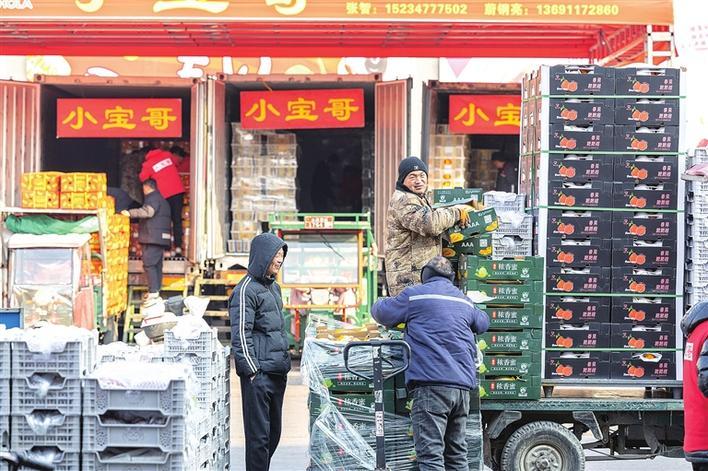
首衡:一座千亿级农产品市场的三重使命
Xin Lang Cai Jing· 2026-01-13 20:53
Core Viewpoint - The Shouheng Group has established the largest agricultural wholesale market in China, the Shouheng Gaobeidian International Agricultural Trading Center, which plays a crucial role in ensuring food supply for the Beijing-Tianjin-Hebei region and serves over 400 million people [2][3]. Group 1: Market Operations and Impact - The Shouheng Gaobeidian market operates 24/7, facilitating the rapid sorting and distribution of agricultural products, significantly reducing the congestion and pollution caused by heavy trucks entering Beijing [2][3]. - The market has successfully relocated over 7,200 businesses, alleviating pressure on Beijing's urban infrastructure and contributing to a 5.6% reduction in PM2.5 emissions [3][6]. - In 2024, the market is projected to handle a transaction volume of 19.1 million tons of fruits and vegetables, with a transaction value of 141 billion yuan, maintaining its position as the top agricultural wholesale market in China for three consecutive years [5][6]. Group 2: Emergency Supply and Logistics - The Shouheng Group has become a key player in emergency supply chains, providing 52% of the fruit and vegetable supply in the Beijing-Tianjin-Hebei region, with a 90% supply ratio for ready-to-eat vegetables in Beijing [6][7]. - The establishment of an emergency supply station has enabled the market to deliver over 700,000 tons of agricultural products since its operation, significantly reducing logistics costs by 10-20% [7][8]. - During the COVID-19 pandemic, the market ensured the stable delivery of over 20,000 tons of agricultural products daily to Beijing, controlling price increases to within 3% [6][7]. Group 3: Strategic Expansion and Integration - The Shouheng Group is expanding its operations nationwide, establishing agricultural trading centers in key cities to create a modern food supply chain ecosystem [8][9]. - The company has integrated over 600,000 acres of production bases across more than 2,000 counties into its collaborative system, promoting a new circulation model that connects production and market [8][9]. - The implementation of a "hub + digital + platform" strategy aims to break down barriers in agricultural product circulation, enhancing efficiency and resource allocation [8][9].

同题共答 为要素市场化改革提供“四川样板”
Xin Lang Cai Jing· 2026-01-13 20:53
(来源:中国改革报) 《重点任务清单》以"一个目标、两个作用、三个结合"的核心思路,明确7方面重点任务,勾勒出四川 和成都省市两级同题共答,推进要素市场化改革试点的清晰路径。这场覆盖土地、技术、人力、数据、 生态等多领域的系统性改革,正为四川、成都高质量发展注入强劲动能,也将为西部乃至全国要素市场 化改革提供可复制、可推广的实践经验。 一个目标、两个作用、三个结合 四川省发展改革委副主任梁武湖在发布会上介绍,此次成都开展要素市场化配置综合改革试点的核心目 标是:到2027年,全面完成国家部署的试点任务,传统要素配置效率显著提升,新型要素配置方式和价 值实现路径优化拓展,劳动生产率和全要素生产率持续提高,形成系列标志性改革成果,为经济高质量 发展提供坚实支撑。这一目标的提出,既呼应了国家顶层设计要求,也贴合成都作为成渝地区双城经济 圈极核城市的发展定位。 实现这一目标,离不开省、市两级的协同发力。据介绍,《重点任务清单》强化"两个作用",明确省级 层面发挥综合统筹、协调指导、评估问效作用,要素主管部门做好改革授权和业务指导,及时破解重大 问题;市级层面则聚焦组织实施、大胆创新、差异探索,结合资源禀赋谋划牵引性强 ...
新型储能纳入政府投资基金投向!国家首次作出系统规范
中关村储能产业技术联盟· 2026-01-13 12:15
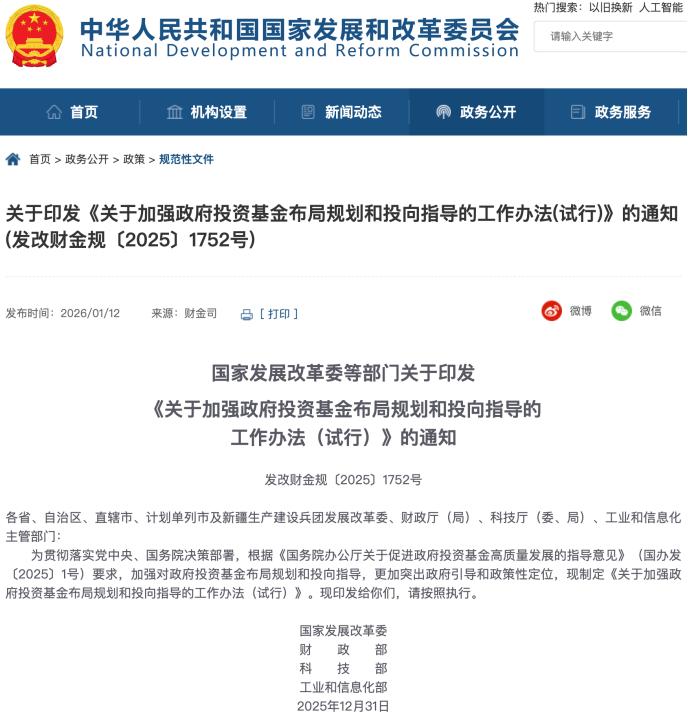
Core Viewpoint - The article discusses the implementation of a new regulatory framework for government investment funds in China, aimed at optimizing their layout and guiding investment directions to support national strategies and industrial upgrades [2][3][4]. Group 1: Government Investment Fund Overview - Government investment funds are established by various levels of government to guide social capital in supporting industry development and innovation through market-oriented methods such as equity investment [2][12]. - The new framework includes a systematic approach to fund layout and investment direction, marking the first national-level regulation of government investment funds [2][4]. Group 2: Supported Investment Areas - The framework identifies key investment areas, including: - Emerging and future industries such as information technology, new energy, advanced manufacturing, and artificial intelligence [2][3]. - Upgrading traditional industries and supporting high-quality development in manufacturing [3][4]. - Promoting the digital economy through initiatives like "AI+" and the application of 5G technology [3][4]. Group 3: Policy Measures - The framework outlines 14 policy measures focusing on three main aspects: where to invest, how to invest, and who manages the funds [3][4]. - It emphasizes early, small, long-term investments in hard technology and aims to prevent homogeneous competition and crowding out of social capital [11][12]. Group 4: Evaluation Management - An evaluation management method has been established to assess the investment direction of government funds, focusing on compliance with national planning and industry directories [4][5]. - The evaluation system includes three main indicators: policy compliance (60% weight), optimization of productivity layout (30% weight), and policy execution capability (10% weight) [6][7]. Group 5: Specific Evaluation Indicators - The evaluation indicators cover aspects such as support for new productivity, technology innovation, green development, and the promotion of private investment [29][33]. - Specific metrics include the proportion of investments in encouraged industries, the effectiveness of fund management, and the impact on social welfare [29][33][40].
万亿级“国家队”投资方向,明确了
3 6 Ke· 2026-01-13 08:27
Core Viewpoint - The article discusses the newly released "Work Method" which systematically regulates the layout and investment direction of government investment funds for the first time at the national level, aiming to guide the development of trillion-level government investment funds in China [1][7]. Group 1: Policy Measures - The "Work Method" proposes 14 policy measures focusing on three aspects: where to invest, how to invest, and who manages the funds [2][3]. - It emphasizes optimizing fund allocation to support major strategies, key areas, and weak links in resource allocation, promoting deep integration of technological and industrial innovation, and nurturing emerging pillar industries [2]. Group 2: Investment Guidance - Funds must align with national major plans and encourage industries listed in the national industrial directory, avoiding investments in restricted, eliminated, or prohibited sectors [3]. - Provincial development and reform departments are tasked with creating local priority investment lists to optimize fund allocation and direction [3]. Group 3: Evaluation Indicators - The "Management Method" establishes three primary and thirteen secondary indicators for evaluating fund performance, with a focus on policy compliance (60% weight), optimization of productivity layout (30% weight), and policy execution capability (10% weight) [4][6]. - The evaluation will consider whether fund investments support the development of new productive forces, including emerging and future industries such as AI, quantum information, and advanced manufacturing [4][5]. Group 4: Regional Strategy Alignment - The evaluation also assesses the alignment of fund investments with national regional strategies, including support for various regional development initiatives like the Western Development and Northeast Revitalization [6]. - Funds that meet these regional strategy requirements will receive higher evaluation scores [6]. Group 5: Differentiated Development - The National Development and Reform Commission highlights the need for differentiated development of government investment funds, addressing issues like mismatched local resources and homogeneous investment directions [7][8]. - National funds are to focus on supporting the construction of a modern industrial system and overcoming key technological challenges, while local funds should align with local industry foundations and development realities [8].
政府投资基金要变了
Sou Hu Cai Jing· 2026-01-13 08:10
Group 1 - The core viewpoint of the news is the introduction of new regulations by the National Development and Reform Commission, in collaboration with other ministries, to guide the planning and investment direction of government investment funds, marking a systematic approach to fund layout and investment direction at the national level [1][2][12] - The "Work Method" defines government investment funds and emphasizes their role in guiding investments towards major strategies and key areas where the market cannot fully play its role [2][12] - The "Management Method" establishes a detailed evaluation system with 13 indicators to assess the investment direction and performance of government investment funds, focusing on policy compliance and optimization of productivity layout [8][10] Group 2 - The "Work Method" includes provisions to prevent homogenization of competition and the crowding out of social capital, aiming for a high-quality development pattern of government investment funds that is appropriately scaled, reasonably laid out, and scientifically managed [3][5] - Specific prohibited investment behaviors for government investment funds are outlined, including increasing local government hidden debt and engaging in speculative trading [6][10] - The evaluation system emphasizes support for emerging industries and future industries, including areas like quantum information, generative artificial intelligence, and new energy, while also promoting the transformation of traditional industries [9][10] Group 3 - The government investment funds are encouraged to collaborate with local funds, leveraging local resources to form a financial synergy in key areas of frontier technology and supply chains [5][12] - The evaluation criteria include a focus on early-stage investments and long-term investment periods, with a preference for projects that have a high proportion of social capital contributions [10][12] - The introduction of the "negative behavior list" for investment directions aims to ensure that funds do not engage in undesirable practices, with a scoring system that influences management fees and profit distribution based on performance [10][11]
政府投资基金要变了
投资界· 2026-01-13 07:49
Core Viewpoint - The article discusses the recent release of guidelines by the National Development and Reform Commission (NDRC) and other ministries aimed at strengthening the planning and investment direction of government investment funds, marking a systematic regulation at the national level for the first time [2][3]. Group 1: Government Investment Fund Guidelines - The "Work Method" defines government investment funds and clarifies their investment directions and behaviors, emphasizing their role in supporting major strategies and addressing weak links in the market [3][4]. - The guidelines include 14 provisions that address "where to invest, how to invest, and who manages" the funds, focusing on optimizing fund layout and enhancing investment guidance [3][4]. - The guidelines aim to prevent homogenized competition and the crowding out of social capital, promoting a high-quality development pattern for government investment funds [4]. Group 2: Investment Focus and Restrictions - The guidelines specify that government investment funds must clearly outline key investment industries in their establishment plans, with a focus on emerging industries such as the metaverse, brain-computer interfaces, quantum information, humanoid robots, generative artificial intelligence, and biomanufacturing [2][4][6]. - Certain investment behaviors are prohibited, including increasing local government hidden debt through disguised debt instruments, engaging in public stock trading outside specified conditions, and providing guarantees for enterprises or projects [4][5]. Group 3: Evaluation and Assessment - The "Management Method" establishes a detailed evaluation system for government investment funds, consisting of three primary indicators and 13 secondary indicators, with a total score of 100 points [6][8]. - The evaluation emphasizes supporting the development of new and future industries, traditional industry upgrades, and the digital economy, with specific scoring criteria for compliance with investment directions [6][7]. - The evaluation includes a "negative behavior list" for investment directions and links the scores to incentives or constraints regarding national-level fund cooperation, management fees, and profit distribution [9]. Group 4: Future Implications - The article highlights the increasing importance of government funds in China's venture capital landscape, with state-owned capital expected to rise to 55% by 2025, reflecting a significant shift in the investment landscape [12]. - The introduction of these guidelines marks a new phase characterized by "standardized development and quality improvement" for government investment funds, addressing past controversies and challenges [12].