
通胀预期

Search documents
NY Fed: Inflation expectations unchanged, labor market outlook improves
Youtube· 2025-12-08 16:34
Good morning, Sarah. Yeah, some good breaking news from the New York Fed with inflation expectations unchanged and labor market indicators improving. Let's go through them.The one-year, the three-year, and the 5-year uh inflation expectations from the New York Fed survey all unchanged. 3 2 3 and three. Now, these are all a bit elevated, but it's good news that they're not going up.Inflation expectations rise for food, gas, medical care, a big increase there, and rent as well. Now, there's fodder for both ha ...


美联储:11月一年期通胀预期持稳于3.2%,3-5年期通胀预期持稳于3%
Sou Hu Cai Jing· 2025-12-08 16:24
美联储:11月一年期通胀预期持稳于3.2%,3-5年期通胀预期持稳于3%。 ...
纽约联储:11月美国家庭对个人财务状况的担忧加剧
Xin Lang Cai Jing· 2025-12-08 16:10
纽约联邦储备银行周一发布的报告显示,11 月美国家庭对自身当前及未来财务状况的悲观情绪有所加 重,不过其对未来通胀走势的预期保持稳定。 这家地区性联储银行在 11 月《消费者预期调查》中指出,受访者对当前财务状况的看法 "显著恶化", 而对一年后财务状况的展望则 "略有恶化"。 不过,11 月受访者对就业市场的看法出现好转。报告称,受访者对一年后失业率上升的预期有所回 落,对未来一年内失业的预期降至 2024 年 12 月以来的最低水平,同时家庭对主动离职概率的预期也有 所下调。 该报告发布的次日,美国央行就将召开货币政策会议,预计这场会议将颇具争议。市场普遍预测,美联 储将在周三把政策利率下调 25 个基点,至 3.50%-3.75% 的区间,以此为显现出疲软迹象的就业市场提 供支撑。 鉴于通胀压力仍远高于美联储 2% 的目标,此次降息预期可能会在政策制定者中引发大量明确反对。许 多美联储官员仍认为,当前货币政策的核心重点应是抑制物价压力。 纽约联储的报告显示,11 月通胀方面的读数大体平稳。受访者对一年后通胀的预期与上月持平,维持 在 3.2%;对三年期和五年期通胀的预期也均稳定在 3%,未发生变化。 1 ...
印度经济-印度储备银行是否临近宽松周期尾声-India Economic Comment_ Is RBI nearing the end of its easing cycle_
2025-12-08 15:36
USDINR flirting with the psychological 90 mark Earlier this week, USDINR breached the psychological 90 mark, reflecting depreciation pressure since September - emanating from the recent deterioration in external balance. Heavy RBI interventions (~US$50bn via spot/forwards/NDFs) had delayed this move thus far, but the break above 90 suggests a shift in policy tolerance. We now forecast year- end USD/INR at 92 for FY26 and 94 for FY27. BoP flows stress - driven by tariffs uncertainty, gold imports and weak do ...

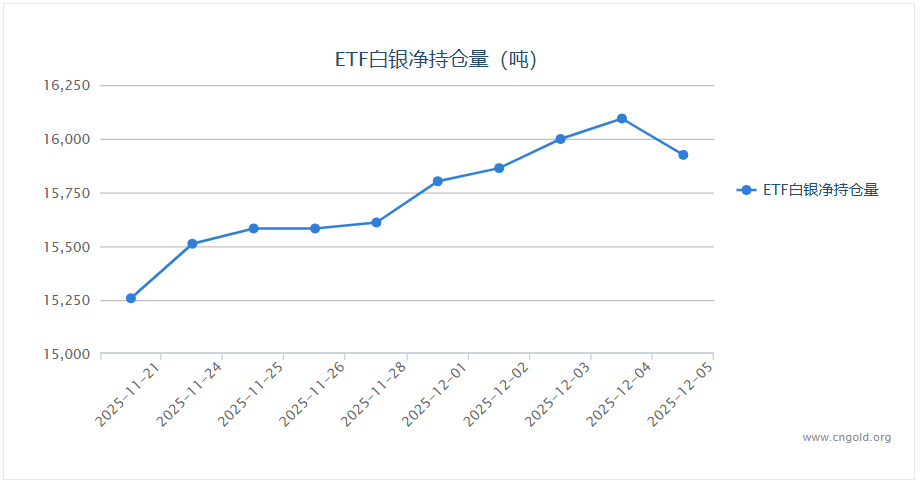
【白银etf持仓量】12月5日白银ETF较上一交易日减少169.24吨
Jin Tou Wang· 2025-12-08 11:10
Group 1 - The iShares Silver Trust, the world's largest silver ETF, reported a holding of 15,925.21 tons of silver as of December 5, a decrease of 169.24 tons from the previous trading day [1] - On December 5, the spot silver price closed at $58.28 per ounce, up 2.07%, with an intraday high of $59.32 and a low of $56.85 [1] Group 2 - The U.S. core PCE price index for September recorded an annual rate of 2.8%, below the market expectation of 2.9% and the previous value of 2.9% [3] - Consumer spending is showing signs of slowing down, indicating that the primary growth engine of the U.S. economy was already decelerating before the longest government shutdown began on October 1 [3] - The University of Michigan reported that the preliminary consumer confidence index for December rose from 51 in November to 53.3 [3] - The one-year inflation expectation for December from the University of Michigan is 4.1%, the lowest level since January of this year, compared to an expectation of 4.5% and a previous value of 4.5% [3]
瑞达期货不锈钢产业日报-20251208
Rui Da Qi Huo· 2025-12-08 10:45
Report Summary 1. Report Industry Investment Rating No relevant information provided. 2. Core View of the Report The report expects the stainless steel futures price to undergo a moderately strong adjustment, with attention on the resistance level of 12,600 [2]. 3. Summary by Relevant Catalogs a. Futures Market - The closing price of the stainless steel futures main contract was 12,510 yuan/ton, and the 01 - 02 contract spread was -115 yuan/ton, down 25 yuan/ton [2]. - The net long position of the top 20 futures holders was -13,850 lots, a decrease of 3,325 lots, and the main contract position was 85,685 lots, a decrease of 3,729 lots [2]. - The warehouse receipt quantity of stainless steel was 61,556 tons, a decrease of 63 tons [2]. b. Spot Market - The price of 304/2B coil (trimmed edge) in Wuxi was 13,300 yuan/ton, an increase of 100 yuan/ton, and the market price of scrap stainless steel 304 in Wuxi was 8,850 yuan/ton, unchanged [2]. - The basis of the SS main contract was 460 yuan/ton, an increase of 90 yuan/ton [2]. c. Upstream Situation - The monthly electrolytic nickel output was 29,430 tons, an increase of 1,120 tons, and the total monthly nickel - iron output was 2.29 million metal tons, an increase of 0.12 million metal tons [2]. - The monthly import volume of refined nickel and alloys was 9,939.65 tons, a decrease of 18,631.22 tons, and the monthly import volume of nickel - iron was 90.51 tons, a decrease of 18.02 tons [2]. - The SMM1 nickel spot price was 120,200 yuan/ton, an increase of 150 yuan/ton, and the average price of nickel - iron (7 - 10%) nationwide was 890 yuan/nickel point, an increase of 5 yuan/nickel point [2]. - The monthly output of Chinese ferrochrome was 75.78 tons, a decrease of 2.69 tons [2]. d. Industry Situation - The monthly output of 300 - series stainless steel was 180 tons, an increase of 3.73 tons, and the weekly total inventory of 300 - series stainless steel was 58.53 tons, a decrease of 1.23 tons [2]. - The monthly export volume of stainless steel was 45.85 tons, a decrease of 2.95 tons [2]. e. Downstream Situation - The cumulative monthly value of new housing construction area was 49,061.39 million square meters, an increase of 3,662.39 million square meters, and the monthly output of excavators was 3.09 million units, a decrease of 0.07 million units [2]. - The monthly output of large and medium - sized tractors was 2.19 million units, a decrease of 0.43 million units, and the monthly output of small tractors was 0.9 million units, a decrease of 0.1 million units [2]. f. Industry News - The US September core PCE price index rose 2.8% year - on - year and 0.2% month - on - month, in line with market expectations. September real personal consumption expenditure was unexpectedly flat month - on - month, and the previous value was revised down from 0.4% to 0.2%. In December, the one - year inflation expectation of the University of Michigan dropped to 4.1%, and the five - year inflation expectation dropped to 3.2% [2]. - Chinese Minister of Commerce Wang Wentao said that during the "15th Five - Year Plan" period, China will implement a special action to boost consumption, promote the expansion and upgrading of commodity consumption, and increase the intensity of inclusive policies directly benefiting consumers; focus on relaxing market access and format integration to expand service consumption. China will actively expand independent opening - up, promote innovative development of trade, and expand the space for two - way investment cooperation [2]. - Li Lecheng, Secretary of the Leading Party Members' Group and Minister of the Ministry of Industry and Information Technology, chaired a seminar to plan the work ideas and measures for the "15th Five - Year Plan" and its opening year. He emphasized efforts in strengthening the foundation and creating value, promoting the stable growth of the industrial economy, comprehensively deepening reforms with the focus on addressing "involution - style" competition, ensuring the security of key industrial chains and supply chains, and enhancing security capabilities in areas such as networks, data, and artificial intelligence [2]. - US Treasury Secretary Janet Yellen said that the US GDP growth rate will reach 3% this year, and the inflation rate is expected to drop significantly next year. The bond market is having its best performance since 2020 [2]. g. Viewpoint Summary - At the raw material end, the Philippines is gradually entering the rainy season, and the nickel ore grade is decreasing. The raw material inventory of domestic nickel - iron plants is tightening. However, the nickel - iron output in Indonesia remains high, and the amount flowing back to China is expected to increase. Recently, the nickel - iron price has dropped significantly, and the raw material cost has decreased [2]. - At the supply end, the production profit of stainless steel plants has improved. Although the traditional peak demand season has passed, the actual decline in output is expected to be limited, and the supply pressure is increasing [2]. - At the demand end, downstream demand is gradually entering the off - season, and the stainless steel export volume is showing a downward trend. The impact of previous export squeezes is beginning to appear. Market purchasing willingness is low, and overall inquiries and transactions are average. Therefore, the national stainless steel social inventory is showing a narrow increase [2]. - Technically, the position is stable while the price is rising, and the short - selling sentiment is decreasing [2].

瑞达期货沪锡产业日报-20251208
Rui Da Qi Huo· 2025-12-08 10:44
| | | 沪锡产业日报 2025-12-08 | 项目类别 | 数据指标 | 最新 | 环比 数据指标 | 最新 | 环比 | | --- | --- | --- | --- | --- | --- | | 期货市场 | 期货主力合约收盘价:沪锡(日,元/吨) | 319200 | 1700 1月-2月合约收盘价:沪锡(日,元/吨) | -610 | 40 | | | LME3个月锡(日,美元/吨) | 40175 | -365 主力合约持仓量:沪锡(日,手) | 48471 | -2317 | | | 期货前20名净持仓:沪锡(日,手) | -420 | -86 LME锡:总库存(日,吨) | 3085 | -90 | | | 上期所库存:锡(周,吨) | 6865 | 506 LME锡:注销仓单(日,吨) | 295 | -65 | | | 上期所仓单:锡(日,吨) | 7266 | 583 | | | | 现货市场 | SMM1#锡现货价格(日,元/吨) | 314000 | -800 长江有色市场1#锡现货价(日,元/吨) | 313290 | -1120 | | | 沪锡主力合约基差(日,元/吨) ...
瑞达期货沪镍产业日报-20251208
Rui Da Qi Huo· 2025-12-08 10:44
1. Report Industry Investment Rating - No relevant information provided 2. Core Viewpoints of the Report - The report predicts that Shanghai nickel will experience short - term shock adjustments, and investors should pay attention to the resistance level at 119,000 [3] - On the macro - front, the US September core PCE index increase is in line with expectations, actual personal spending is stagnant, and consumer short - term inflation expectations have dropped to the lowest point at the beginning of the year. On the fundamental side, nickel ore imports are on a downward trend due to the rainy season in the Philippines. The RKAB approval and possible export policy changes in Indonesia have limited actual impact on supply recently. The smelting end has a large supply pressure in the pure nickel market, while the demand end shows an upward trend [3] 3. Summary by Relevant Catalogs 3.1 Futures Market - The closing price of the main futures contract of Shanghai nickel is 118,030 yuan/ton, with a daily increase of 240; the price difference between the 01 - 02 contracts of Shanghai nickel is - 170 yuan/ton, with a daily decrease of 10 [3] - The price of LME 3 - month nickel is 14,970 US dollars/ton, with a daily increase of 85; the position of the main contract of Shanghai nickel is 111,585 lots, with a daily decrease of 6,051 [3] - The net buy volume of the top 20 futures positions of Shanghai nickel is - 26,832 lots, with a daily increase of 797; the LME nickel inventory is 253,116 tons, with no change [3] - The inventory of nickel in the Shanghai Futures Exchange is 42,508 tons (weekly), with an increase of 1,726 tons; the total cancelled warrants of LME nickel is 8,622 tons, with an increase of 6 tons [3] - The warehouse receipt quantity of Shanghai nickel is 34,500 tons, with a daily decrease of 264 tons [3] 3.2 Spot Market - The SMM 1 nickel spot price is 120,200 yuan/ton, with a daily increase of 150; the average spot price of 1 nickel plates in the Yangtze River is 120,200 yuan/ton, with a daily increase of 50 [3] - The CIF (bill of lading) price of Shanghai electrolytic nickel is 85 US dollars/ton, with no change; the bonded warehouse (warehouse receipt) price of Shanghai electrolytic nickel is 85 US dollars/ton, with no change [3] - The average price of battery - grade nickel sulfate is 27,500 yuan/ton, with no change; the basis of the NI main contract is 2,170 yuan/ton, with a daily decrease of 90 [3] - The LME nickel (spot/three - month) premium is - 190.98 US dollars/ton, with an increase of 0.28 US dollars/ton [3] 3.3 Upstream Situation - The monthly import volume of nickel ore is 468.28 million tons, with a decrease of 143.17 million tons; the total port inventory of nickel ore is 1,469.71 million tons (weekly), with a decrease of 17.62 million tons [3] - The average monthly import unit price of nickel ore is 57.33 US dollars/ton, with an increase of 0.61 US dollars/ton; the含税 price of Indonesian laterite nickel ore with 1.8% Ni is 41.71 US dollars/wet ton, with no change [3] 3.4 Industry Situation - The monthly output of electrolytic nickel is 29,430 tons, with an increase of 1,120 tons; the total monthly output of ferronickel is 2.29 million metal tons, with an increase of 0.12 million metal tons [3] - The monthly import volume of refined nickel and alloys is 9,939.65 tons, with a decrease of 18,631.22 tons; the monthly import volume of ferronickel is 90.51 million tons, with a decrease of 18.02 million tons [3] 3.5 Downstream Situation - The monthly output of 300 - series stainless steel is 180 million tons, with an increase of 3.73 million tons; the total weekly inventory of 300 - series stainless steel is 58.53 million tons, with a decrease of 1.23 million tons [3] 3.6 Industry News - The US September core PCE price index increased by 2.8% year - on - year and 0.2% month - on - month, in line with market expectations. The actual personal consumption expenditure in September was unexpectedly flat month - on - month. The one - year inflation expectation of the University of Michigan in December dropped to 4.1%, and the five - year inflation expectation dropped to 3.2% [3] - Minister of Commerce Wang Wentao stated that during the 15th Five - Year Plan period, China will implement a special action to boost consumption, expand and upgrade commodity consumption, and increase inclusive policies for consumers. It will also expand service consumption and promote trade innovation and two - way investment cooperation [3] - Minister of Industry and Information Technology Li Lecheng emphasized promoting the stable growth of the industrial economy, comprehensively deepening reforms, and ensuring the security of key industrial chains and supply chains [3] - US Treasury Secretary Janet Yellen said that the US GDP growth rate will reach 3% this year, and the inflation rate is expected to drop significantly next year [3]
邦达亚洲:美联储降息预期持续升温 美元指数微幅收跌
Xin Lang Cai Jing· 2025-12-08 09:59
Group 1: Consumer Confidence - The preliminary consumer confidence index for December rose from 51 in November to 53.3, exceeding the median forecast of 52 by economists [1] - The overall expectations index increased to 55, marking a four-month high, while the current conditions index fell to a historical low of 50.7, below the expected 52.1 [1] - There is a significant confidence gap between Democratic and Republican respondents, with Democrats expressing heightened concerns about the current economic situation [1] Group 2: Inflation Expectations - The one-year inflation expectation for December is at 4.1%, the lowest level since January, compared to an expectation of 4.5% [1] - The five-year inflation expectation is at 3.2%, slightly below the expected 3.4% [1] Group 3: PCE Inflation Data - The PCE price index for September increased by 0.3% month-over-month, matching expectations, and rose by 2.8% year-over-year, also in line with forecasts [2][7] - The core PCE price index, excluding food and energy, rose by 0.2% month-over-month and 2.8% year-over-year, consistent with Bloomberg's and Dow Jones' expectations [2][8] - The SuperCore PCE, which reflects more stable inflation trends, slightly decreased to 3.25% due to stagnation in financial services and accommodation sectors [8] Group 4: Currency Market Overview - The US dollar index experienced slight declines, trading around 98.90, influenced by expectations of a Fed rate cut in December [3][9] - The euro traded around 1.1650, facing pressure from profit-taking and cautious market behavior ahead of the Fed's rate decision [4][10] - The British pound saw a minor increase, trading at approximately 1.3340, supported by the Fed's rate cut expectations, although concerns about the Bank of England's potential rate cuts limited its upward movement [5][11]
海外关注12月FOMC,国内监管释放“扶优限劣”信号
Tong Guan Jin Yuan Qi Huo· 2025-12-08 09:27
海外关注 12 月 FOMC, 国内监管释放"扶优限劣"信号 核心观点 投资咨询业务资格 沪证监许可【2015】84 号 宏观周报 从业资格号:F3084165 投资咨询号:Z0016301 赵凯熙 从业资格号:F03112296 投资咨询号:Z0021040 何天 李婷 从业资格号:F0297587 投资咨询号:Z0011509 黄蕾 从业资格号:F0307990 投资咨询号:Z0011692 高慧 从业资格号:F03099478 投资咨询号:Z0017785 王工建 从业资格号:F03120615 投资咨询号:Z0022965 敬请参阅最后一页免责声明 1 / 10 2025 年 12 月 08 日 ⚫ 海外方面,美国9月核心PCE同比维持在2.8%,符合市场预 期,其中核心商品走高、核心服务降温,巩固12月降息25BP 的预期。密歇根12月消费者信心初值回升至53.3,结束四连 降;1年和5年通胀预期分别降至4.1%和3.2%,均回落至年 初低点,反映居民对未来财务状况与就业的判断有所改善, 通胀预期压力同步缓解。上述数据巩固市场对本月降息25bp 的押注,周五美股小幅走高,10Y美债利率回升至4.12 ...