就业市场

Search documents
Another big jobs report is coming up — and it probably won't look good either.
MarketWatch· 2025-09-06 12:00
Group 1 - The upcoming jobs report is expected to reveal a significant slowdown in job creation in the U.S. economy, indicating a negative trend [1][2] - The report will cover the period from April 2024 to March 2025, coinciding with the transition from the Biden administration to the Trump administration [2]


US job growth missed expectations in August amid economic uncertainty
Fox Business· 2025-09-05 12:51
Labor Market Overview - The U.S. economy added 22,000 jobs in August, significantly below the 75,000 estimate by economists [1] - The unemployment rate rose to 4.3% in August, up from 4.2% in July, aligning with expectations [1] Job Revisions - Job gains for June were revised down by 27,000, changing from a gain of 14,000 to a loss of 13,000; July's job creation was revised up by 6,000 from 73,000 to 79,000 [2] - Overall, employment in June and July was 21,000 jobs lower than previously reported [2] Sector Performance - Private payrolls added 38,000 jobs in August, falling short of the projected 75,000 [3] - Government payrolls declined by 16,000 jobs, with federal government employment down by 15,000 and state governments shedding 13,000 jobs [4] - The manufacturing sector lost 12,000 jobs, exceeding the estimated decline of 5,000 jobs [5] - Healthcare employment added 31,000 jobs, below the average monthly gain of 42,000 over the past year [5] - Social assistance employment increased by 16,000 jobs, reflecting growth in individual and family services [6] Labor Force Metrics - The labor force participation rate remained stable at 62.3%, while the employment-population ratio was unchanged at 59.6% [6] - Both metrics have declined by 0.4 percentage points over the year [6]

Weak Private Payrolls Data for August
ZACKS· 2025-09-04 16:01
Employment Data - The latest ADP report indicates an addition of +54K new private-sector jobs in August, missing expectations by 20K [1] - The four-month average for private-sector job growth is +55K, a significant decline from the previous average of +102K [2] - Large corporations added only +18K jobs, while medium-sized companies contributed +25K and small firms added +12K [3] Industry Performance - The Leisure/Hospitality sector saw the highest job growth with +50K new jobs, followed by Construction at +16K and Professional/Business Services at +15K [4] - The Trade/Transportation/Utilities sector experienced the largest decline with -17K jobs, and Education/Healthcare lost -12K jobs [4][5] Wage Trends - Job Stayers experienced an average earnings gain of +4.4%, while Job Changers saw a +7.1% increase, indicating a narrowing wage gap [6] Jobless Claims - Initial Jobless Claims rose to +237K, exceeding expectations and marking the highest monthly total since June [7] - Continuing Jobless Claims decreased to 1.940 million, remaining below the critical 2 million mark for 13 consecutive weeks [8] Productivity and Labor Costs - Q2 Productivity increased to a seasonally adjusted annualized rate of +3.3%, the strongest quarterly productivity since Q3 2024 [9] - Unit Labor Costs for the quarter were lower than expected at +1.0%, suggesting a favorable economic environment [9] Trade Deficit - The U.S. Trade Deficit widened to -$78.3 billion in July, a significant increase from the previous month's revised figure of -$59.1 billion [10]


美联储官员穆萨莱姆支持维持当前的利率立场
Xin Hua Cai Jing· 2025-09-03 13:35
Core Viewpoint - The Federal Reserve's recent decision to maintain high interest rates aligns with the current inflation being above target and a robust job market, with skepticism regarding potential rate cuts in the upcoming September meeting [1] Group 1: Federal Reserve's Position - Federal Reserve official Musalem expresses doubt about the likelihood of rate cuts in the near future despite previous indications from Chairman Powell [1] - The current employment market remains solid, characterized by a moderate unemployment rate and low initial jobless claims, despite a slowdown in job growth [1] Group 2: Inflation and Economic Uncertainty - There is significant uncertainty surrounding inflation, particularly due to tariff pressures, which could impact future economic conditions [1]
DLSM外汇平台:英国央行的困境,数据是否足以支撑其11月降息?
Sou Hu Cai Jing· 2025-09-02 10:54
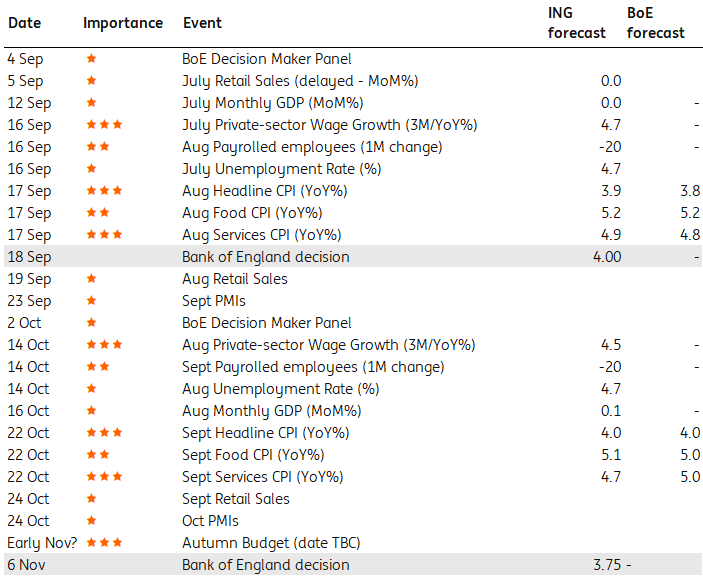
Group 1: Monetary Policy Outlook - DLSMARKETS anticipates a slight tilt towards a rate cut by the Bank of England (BoE) in November, with a forecast of a 25 basis point reduction [1] - The BoE has three upcoming meetings in September, November, and December, with expectations of maintaining the current rate in September [1] - Key economic indicators leading up to the November meeting include inflation rates, wage growth, and retail sales, which will influence the BoE's decision [1][2] Group 2: Inflation Trends - Overall inflation in the UK is projected to reach 4% in September, with food inflation expected to exceed 5% [2] - The BoE is particularly concerned about rising food prices, which could lead to increased inflation expectations and wage growth [2][6] - Service sector inflation may show more favorable trends, with expectations that actual inflation rates could be lower than the BoE's predictions [6][10] Group 3: Employment and Wage Growth - Employment numbers have declined in eight of the past nine months, raising concerns about the labor market [11] - The hospitality sector has seen significant job losses, but there are no widespread layoffs reported in other industries [14] - Wage growth is expected to slow down, with predictions of a decrease from approximately 5% to 3.5% by year-end [11][15] Group 4: Fiscal Policy and Budget Implications - The upcoming autumn budget may present a funding gap of at least £20 billion, potentially leading to increased taxation [17] - If the budget is announced before the November meeting, it could strengthen the case for further rate cuts by the BoE [18] - The budget's impact on economic growth and inflation will be closely monitored by the BoE [17] Group 5: Currency Outlook - The British pound faces downward risks due to the potential for a dovish shift in the BoE's stance and tightening fiscal policies [19][21] - Despite these risks, the pound may not experience significant declines against the dollar, especially if the Federal Reserve adopts a more dovish approach [19][21] - Predictions suggest the GBP/USD exchange rate could reach between 1.33 and 1.38 by year-end, influenced by broader market conditions [21]
鲍威尔于杰克逊霍尔“最后演讲”:为何市场读懂了降息,却忽视了滞胀风险?
Lian He Zi Xin· 2025-09-02 05:26
Group 1: Economic Indicators - The latest US Consumer Price Index (CPI) rose by 2.7% year-on-year in July, indicating persistent inflationary pressure[4] - The Producer Price Index (PPI) surged by 0.9% month-on-month, reaching a three-year high with a year-on-year increase of 3.3%[4] - Non-farm payrolls added only 73,000 jobs in July, significantly below expectations, with an average of 35,000 jobs added over the past three months, down from 168,000 per month in 2024[4][5] Group 2: Powell's Key Points - Powell acknowledged the significant slowdown in the labor market, emphasizing that the downward pressure on employment could lead to increased layoffs and rising unemployment rates[5] - He highlighted that tariffs have pushed up prices for certain goods, with the core Personal Consumption Expenditures (PCE) price index rising by 2.9% year-on-year as of July 2025[6] - Powell indicated that the balance of risks is shifting, suggesting that the Fed may prioritize supporting the labor market over solely focusing on inflation control[10] Group 3: Market Reactions - The bond market showed limited movement despite Powell's potential rate cut signals, possibly due to government intervention using tariff revenues to stabilize bond prices[11] - In contrast, the stock market reacted positively, with major indices rising significantly, particularly technology and growth stocks, reflecting investor optimism about liquidity support from the Fed[12] - The divergence in market reactions highlights differing expectations regarding future economic scenarios, with bond investors concerned about long-term inflation risks while stock investors focus on short-term liquidity improvements[16] Group 4: Implications for China - China should maintain ample macro policy space to respond to external shocks, given the rising uncertainty in US economic policies and global financial conditions[19] - Emphasis on expanding domestic demand is crucial for reducing reliance on external markets, which includes income distribution reforms and increased investment in new infrastructure and technology[20] - Strengthening Hong Kong's position as an international financial center can attract global capital and support technology financing, enhancing China's economic resilience[21]
通胀已非心腹大患?瑞银:美联储为保就业将开启“四连降”
智通财经网· 2025-09-02 02:54
Group 1 - UBS expects the Federal Reserve to begin a series of interest rate cuts starting in September, totaling a reduction of 100 basis points over four consecutive meetings [1][2] - The July core Personal Consumption Expenditures (PCE) index rose slightly to 2.9% year-on-year, while the overall PCE remained stable at 2.6%, indicating effective control of price pressures [1] - The current risks are more concentrated in the labor market, with recent indicators showing a softening in employment demand, despite the unemployment rate remaining low [1] Group 2 - The divergence in the Federal Open Market Committee (FOMC) regarding interest rate decisions was highlighted by two dissenting votes in July, marking the first such occurrence in over 30 years [2] - Recent statements from Fed officials, including Chairman Powell and Vice Chairman Williams, have leaned towards a more dovish stance, with indications that further rate cuts may be considered if employment data weakens [2] - Given the current inflation near target levels and a resilient yet slowing economic growth, UBS anticipates the Fed to restart its easing cycle in the upcoming meetings [2]

管涛:美联储正被置于三重险境 | 立方大家谈
Sou Hu Cai Jing· 2025-09-01 02:13
Core Viewpoint - The article discusses the challenges faced by the Federal Reserve (Fed) in maintaining its independence and credibility amid political pressures, particularly from former President Trump, and the implications for U.S. monetary policy and inflation expectations. Group 1: Federal Reserve Independence - The Fed's independence has been a cornerstone of the U.S. dollar's international credibility since the 1951 agreement that ended the binding of Fed rates to government bond rates [1] - Trump's interventions in Fed operations have contributed to a significant decline in the dollar index, indicating a potential loss of confidence in the dollar [1] - The Fed is currently in a precarious position with declining dollar credibility and a weakening dollar exchange rate [1] Group 2: Inflation and Economic Indicators - Inflation expectations have risen sharply, with one-year and five-year expectations reaching 6.6% and 4.4%, respectively, the highest since 1981 and 1991 [3] - The Consumer Price Index (CPI) rose by 2.7% year-on-year in July, with core CPI at 3.0%, indicating increasing inflationary pressures [3] - The Producer Price Index (PPI) showed a significant increase, suggesting that supply-side inflation effects from tariffs are beginning to manifest [3] Group 3: Employment Market Trends - The U.S. job market shows signs of cooling, with a downward revision of non-farm payrolls for May and June by 253,000 jobs, a reduction of 88.5% [4] - July's initial non-farm payroll increase was only 73,000, significantly below market expectations [4] - The unemployment rate remains low at 4.2%, but the labor participation rate has declined, indicating a potential labor supply issue [4] Group 4: Monetary Policy Challenges - Fed Chair Powell indicated potential interest rate cuts in September, citing upward inflation risks and downward employment risks [5] - The Fed's policy framework has shifted, moving away from the "flexible average inflation targeting" approach, emphasizing the need to combat inflation [6] - Powell's cautious stance reflects the delicate balance between a weakening labor market and persistent inflation pressures [6] Group 5: Political Interference and Market Reactions - Trump's aggressive trade policies and public criticism of the Fed have raised concerns about the politicization of monetary policy [9] - The potential for Trump to influence Fed decisions through appointments could undermine the Fed's independence and credibility [11] - Following Trump's dismissal of a Fed board member, market reactions included a steepening of the yield curve, indicating expectations for aggressive rate cuts [12]
新加坡华侨投资基金管理有限公司:美联储双重目标承压 降息时机临近
Sou Hu Cai Jing· 2025-08-31 14:38
Group 1 - Federal Reserve officials signal that the window for monetary policy adjustment is approaching, with San Francisco Fed President Mary Daly indicating readiness for interest rate cuts soon [1][3] - Daly emphasizes that inflation pressures from tariff measures are likely temporary, suggesting a need to recalibrate policies to align with current economic conditions [3][5] - Market expectations for a shift in Fed policy are rising, with an 86.9% probability of a 25 basis point rate cut at the upcoming policy meeting on September 16-17 [5] Group 2 - Recent economic data has heightened concerns about economic slowdown, with July employment figures falling short of expectations and previous months' data being revised down [5][7] - Fed Chair Jerome Powell's remarks at the global central bank conference reinforced rate cut expectations, indicating a shift in risk balance [7] - Upcoming August employment and inflation data are critical for informing the Fed's September policy decisions, with Daly's views reflecting mainstream opinions within the Fed [7]

标普与道指齐创新高,英伟达跌0.8%
第一财经· 2025-08-28 23:49
Core Viewpoint - The U.S. stock market continues its upward trend, with the S&P 500 and Dow Jones reaching all-time closing highs, driven by strong corporate earnings and economic data [3][4]. Market Performance - The S&P 500 index rose by 0.32% to close at 6501.86 points, marking a record for the second consecutive day [3]. - The Dow Jones Industrial Average increased by 0.16% to 45636.90 points, surpassing its previous high from August 22 [3]. - The Nasdaq Composite gained 0.53%, closing at 21705.16 points [3]. - Among the 11 sectors in the S&P 500, 7 sectors saw gains, with the communication services sector leading at 0.94% [3]. Company Earnings - Nvidia reported a 56% year-over-year increase in quarterly revenue, although its data center revenue fell short of market expectations, leading to a 0.79% drop in its stock price [3]. - Other AI-related tech stocks performed well, with Alphabet rising by 2.01%, Amazon by 1.08%, and Broadcom by nearly 3% [3]. - HP's stock surged by 4.6% due to better-than-expected quarterly revenue, benefiting from increased demand for AI PCs [4]. - Nike's stock fell by 0.2% as the company announced plans to lay off less than 1% of its workforce to address competitive pressures [4]. Economic Data - The U.S. GDP annualized growth rate for Q2 was revised up to 3.3%, driven by corporate investment and net exports [4]. - The annualized growth rate of Gross Domestic Income (GDI) reached 4.8%, indicating a recovery in corporate profits [4]. - Initial jobless claims fell to 229,000, below market expectations, suggesting a stable overall job market [4]. Commodity Prices - International oil prices rose, with NYMEX October WTI crude oil futures increasing by $0.45 to $64.60 per barrel, a 0.70% rise [5]. - ICE Brent October crude oil futures rose by $0.54 to $67.98 per barrel, a 0.80% increase [5]. - COMEX gold futures for the month rose by $25.70, or 0.75%, to $3474.30 per ounce [5].