世界模型

Search documents
Pony Ai(PONY) - 2025 Q3 - Earnings Call Transcript
2025-11-25 13:00
Financial Data and Key Metrics Changes - In Q3 2025, the company reported revenue of $25.4 million, a growth of 72% year-over-year, driven by robotaxi services and licensing [24][25] - Gross profit margin improved significantly from 9.2% in Q3 2024 to 18.4% in Q3 2025, with gross profit of $4.7 million [28][29] - The net loss for Q3 was $61.6 million, compared to $42.1 million in the same period last year [30] Business Line Data and Key Metrics Changes - Robotaxi services revenue reached $6.7 million, representing a growth of 89.5% year-over-year and 338.7% quarter-over-quarter, with fare charging revenue surging by 233.3% [25][26] - Robot truck service revenues were $10.2 million, growing by 8.7% [27] - Licensing and application revenues grew significantly by 354.6% to $8.6 million, driven by demand for the autonomous domain controller [28] Market Data and Key Metrics Changes - The company expanded its robotaxi presence to eight countries, including a new market entry in Qatar [11][12] - Daily net revenue per vehicle reached CNY 299, with an average of 23 orders per day [29][42] - The total number of registered users nearly doubled within a week of launching the Gen7 Robotaxi [7] Company Strategy and Development Direction - The company aims to scale its fleet to over 3,000 vehicles by 2026, leveraging the momentum from the successful Hong Kong IPO [4][32] - The focus is on expanding operational footprint in Tier 1 cities and exploring new markets through partnerships [11][36] - The company is committed to technological innovation and creating lasting value through efficient autonomous mobility services [14] Management's Comments on Operating Environment and Future Outlook - Management expressed confidence in achieving a city-wide unit economic break-even milestone, validating the business model [6][41] - The company anticipates sustained strong growth momentum through continuous fleet expansion and operational optimization [40][44] - The management highlighted the importance of partnerships and local government collaboration for future growth [62] Other Important Information - The company completed a dual primary listing on the Hong Kong Stock Exchange, raising over $800 million to support mass production and commercialization [4][32] - The Gen7 Robotaxi has achieved city-wide unit economics break-even in Guangzhou shortly after its launch [6][41] - The company is transitioning to a satellite model for fleet expansion, allowing for greater capital efficiency [32] Q&A Session Summary Question: Updates on fleet size and deployment plans for 2026 - Management expects to outperform the target of 1,000 robotaxis by year-end and aims for over 3,000 vehicles in 2026, driven by user experience improvements and partnerships [35][36] Question: Outlook for fare charging revenues - Fare charging revenue surged by 233% in Q3, driven by user demand and operational optimizations, with expectations for continued growth as fleet expands [38][39] Question: Details on unit economic break-even assumptions - The daily net revenue per vehicle is CNY 299, with 23 average orders per day, supported by operational cost management and hardware depreciation strategies [41][42] Question: Views on new entrants in the robotaxi space - The company sees new entrants as a positive sign for the industry but acknowledges significant barriers to entry, including business, regulatory, and technical challenges [45][46] Question: Factors behind faster operational area expansion - The company attributes rapid expansion to the number of robotaxi vehicles and the ability to handle corner cases effectively, emphasizing the importance of fleet density [52][53]
营收破亿,光轮智能完成数亿元 A 及 A+轮融资,揭秘机器人「数据荒」背后的生意经
Founder Park· 2025-11-25 12:38
Core Insights - The article highlights the recent funding news for Lightwheel Intelligence, a company specializing in simulation and synthetic data, which has completed several hundred million yuan in Series A and A+ financing [2] - The funding will primarily be used for scaling delivery capabilities, investing in technology research and development, and attracting high-level talent [2] - Lightwheel has established partnerships with leading companies in the industry, including NVIDIA, Google, and Toyota, and has seen exponential growth in order demand, with annual revenue surpassing 100 million yuan [2] Group 1: Industry Context - The article discusses the significance of Physical AI as a multi-billion dollar business addressing a multi-trillion dollar opportunity, as highlighted by NVIDIA's recent financial report [3][4] - NVIDIA's CEO emphasized that Physical AI represents the next growth engine for the company, indicating a strong market potential [4] Group 2: Challenges in Physical AI - A major challenge facing Physical AI is the data scarcity for developing robotic foundational models, which differs significantly from large language models that have ample internet text data for pre-training [9] - The lack of large datasets for physical world interactions poses a bottleneck for both embodied intelligence and world model development [9][10] Group 3: Solutions Offered by Lightwheel - Lightwheel aims to address the data shortage through simulation, allowing robots to learn faster in a simulated environment compared to real-world learning [12] - The company provides a comprehensive platform for robotics users to generate high-quality synthetic data and conduct simulations, effectively creating a "playground for robotics users" [13][15] - Lightwheel's technology integrates with NVIDIA's platforms, offering a rich library of physically accurate assets for various applications, ensuring that robots can transfer learned skills to real-world scenarios [16][19] Group 4: Strategic Partnerships - The frequent interactions between Lightwheel and NVIDIA underscore their strategic partnership, with Lightwheel contributing to NVIDIA's ecosystem by providing synthetic data support for various models [20] - This collaboration not only enhances Lightwheel's technological credibility but also positions it within the top-tier robotics ecosystem globally [20] Group 5: Future Outlook - Lightwheel's CEO expressed optimism about accelerating the development of the $50 trillion robotics industry through simulation technology [21] - The company plans to focus on building scalable delivery capabilities to meet the rapidly growing market demand, positioning itself as a leading data infrastructure provider in the Physical AI and world model data market [23]



六小龙的乌镇信号:AI创业从拼模型进入拼场景时代
3 6 Ke· 2025-11-25 09:54
Core Insights - The "Six Little Dragons" of Hangzhou, representing six innovative companies, showcased their collective vision at the World Internet Conference, emphasizing the shift from data accumulation to cognitive construction in the AI era [1][11][12] - The AI core industry in Zhejiang Province achieved a revenue of 494.4 billion yuan, marking a 22% year-on-year growth, with R&D expenses reaching 39 billion yuan, up 14% [1][11] Company Highlights - Yushutech exemplifies the rise of embodied intelligence, growing from 3 to over 1,000 employees since its inception in 2016, with a 29.5% year-on-year revenue increase in the robotics sector [2][3] - Qiangnao Technology focuses on brain-computer interface technology, aiding individuals with disabilities, and plans to expand into sleep products [3][4] - Qunkua Technology sees spatial intelligence as a crucial area for future development, essential for managing robots in physical environments [4][8] - Yundongchu Technology has transitioned from creating robotic dogs to developing humanoid robots for hazardous environments [5][8] - Game Science, led by CEO Feng Ji, highlights China's dominance in the gaming market, with four of the top ten highest-grossing games globally developed by Chinese teams [5][6] Industry Trends - The AI investment landscape is shifting, with embodied intelligence surpassing large models in attracting funding, indicating a preference for companies with revenue and production capabilities [7][8] - The focus is moving from isolated technological advancements to collaborative ecosystem building, as seen in the strategies of various companies [7][8] - The concept of "world models" is emerging, emphasizing the need for AI to understand and interact with the physical world rather than just processing text [11][12][13] Future Outlook - The AI industry is transitioning from a focus on model size to a deeper understanding of the world, with the next decade expected to prioritize spatial intelligence and real-world interactions [11][12][13] - The collective efforts of the "Six Little Dragons" signify a natural evolution in the AI sector, driven by Hangzhou's robust manufacturing capabilities and engineering culture [12][13]

西部证券晨会纪要-20251125
Western Securities· 2025-11-25 02:07
Core Conclusions - The non-farm employment in the U.S. unexpectedly increased by 119,000 in September, significantly exceeding the market expectation of 50,000, while the unemployment rate rose to 4.4%, the highest since 2021 [5][6] - The price of antimony has rebounded significantly, presenting potential investment opportunities in antimony-related sectors [2][4] Domestic Market Overview - The Shanghai Composite Index closed at 3,836.77, with a slight increase of 0.05%, while the Shenzhen Component Index rose by 0.37% to 12,585.08 [3] - The CSI 300 Index decreased by 0.12% to 4,448.05, indicating a mixed performance across major indices [3] International Market Overview - The Dow Jones Industrial Average closed at 46,448.27, up by 0.44%, while the S&P 500 and Nasdaq saw increases of 1.55% and 2.69%, closing at 6,705.12 and 22,872.01 respectively [3] Industry Insights - The Federal Reserve's October meeting minutes revealed significant disagreement among policymakers regarding the potential for a rate cut in December, with a 10 to 2 vote to lower the federal funds rate by 25 basis points [4] - The Congo has extended the ban on artisanal mining trade in conflict-affected provinces, impacting global supply chains for tin, tantalum, and tungsten, which are critical for electronics and aerospace industries [7] Market Trends - The North Exchange saw an average daily trading volume of 17.91 billion yuan, a decrease of 16.2% week-on-week, with the North Exchange 50 index dropping by 9.04% [8] - The top five gainers included Dapeng Industrial (up 1211.1%) and Beikang Testing (up 289.6%), while the largest losers were Luqiao Information (down 23.2%) and Taipeng Intelligent (down 19.8%) [8] Investment Recommendations - The North Exchange's policy support is expected to benefit specialized and innovative enterprises, with a focus on the net subscription status of thematic funds and the liquidity recovery opportunities from the launch of the "specialized and innovative" index funds [10] - The current market adjustment may provide a window for medium to long-term investment opportunities, particularly in high-growth sectors that have been undervalued [10]
LUMA AI完成由HUMAIN领投的9亿美元C轮融资,并将在沙特阿拉伯合作建设2吉瓦AI超级集群
机器之心· 2025-11-24 09:30
Core Insights - Luma AI has raised $900 million in Series C funding to accelerate its development towards multimodal AGI, which can simulate reality and assist humans in the physical world [1][3][4] - The partnership with HUMAIN aims to build Project Halo, a 2 GW AI supercluster in Saudi Arabia, which will support the training of large-scale world models [3][4][5] - The collaboration is expected to unlock significant opportunities across various sectors, including entertainment, marketing, education, and robotics, potentially worth trillions [1][4] Company Overview - Luma AI is focused on creating multimodal general intelligence capable of generating, understanding, and manipulating the physical world [8] - The flagship model, Ray3, has been successfully deployed in studios, advertising agencies, and brands, including integration with Adobe's global products [7][8] - HUMAIN, a PIF company, provides comprehensive AI capabilities across four core areas: next-generation data centers, high-performance infrastructure, advanced AI models, and transformative AI solutions [9] Funding and Infrastructure - The $900 million funding round was led by HUMAIN, with participation from AMD Ventures and previous investors like Andreessen Horowitz and Matrix Partners [1][3] - The Project Halo supercluster will represent a significant leap in multimodal AI infrastructure, enabling the training of peta-scale multimodal data [5][6] - Luma AI plans to expand its leadership in entertainment and advertising into simulation, design, and robotics with the new funding [7] Strategic Goals - The partnership aims to create AI systems that can learn from vast amounts of data, estimated at quadrillions of tokens, to enhance understanding and simulation of reality [5][6] - HUMAIN's investment philosophy emphasizes building a complete value chain to support the next wave of AI development [5] - The collaboration is set to establish new benchmarks for how capital, computing power, and capabilities can be integrated in the AI sector [5]

华为又投了一家具身智能机器人领域创企
Robot猎场备忘录· 2025-11-24 05:21
Core Viewpoint - The article highlights that GigaAI, a leading physical AI company in China, has successfully completed a series of financing rounds, including a recent A1 round of financing amounting to hundreds of millions, led by Huawei and Huakong Fund. This marks the company's fourth financing round in 2025, showcasing its rapid growth and strong investor interest in the physical AI sector [2][3][4]. Financing History - GigaAI has completed a total of six financing rounds, with four rounds occurring in 2025 alone. The recent A1 round raised approximately 100 million, while previous rounds included Pre-A and Pre-A+ rounds that raised several hundred million [2][3]. - The company has attracted investments from notable firms such as Guozhong Capital, CICC Capital, and others, indicating strong confidence from the investment community [3][4]. Company Overview - Founded in January 2023, GigaAI focuses on world model-driven physical intelligence and is the first company in China to specialize in the "world model x embodied brain" direction [6]. - The core team consists of experienced professionals with backgrounds in AI and robotics, including a founder with a PhD from Tsinghua University and a chief scientist recognized as a top global researcher [10][12]. Technology and Product Development - GigaAI is developing a comprehensive suite of products, including the GigaWorld platform for world modeling and the GigaBrain foundational model for embodied intelligence. These products aim to address data bottlenecks in embodied AI [10][15]. - The company plans to release the GigaWorld-0 platform and has already launched the GigaBrain-0 model, which utilizes world models for data generation and has achieved significant advancements in flexible long-range operations [15][16]. Hardware Development - GigaAI is set to launch its next-generation humanoid robot, the Maker H01, which features advanced sensor configurations and open interfaces for task adaptation [17][21]. - The robot's specifications include a size of 650mm x 550mm x 1620mm, multiple degrees of freedom, and a payload capacity of up to 5 kg, showcasing its potential for various applications [21]. Market Position and Future Outlook - GigaAI is positioned as a leader in the world model and VLA (Vision-Language-Action) model sectors, with significant collaborations established with major automotive manufacturers and other companies in the embodied intelligence space [22][24]. - The article suggests that the integration of world models into decision-making processes will be a key trend in the evolution of humanoid robots, with GigaAI at the forefront of this development [24][25].

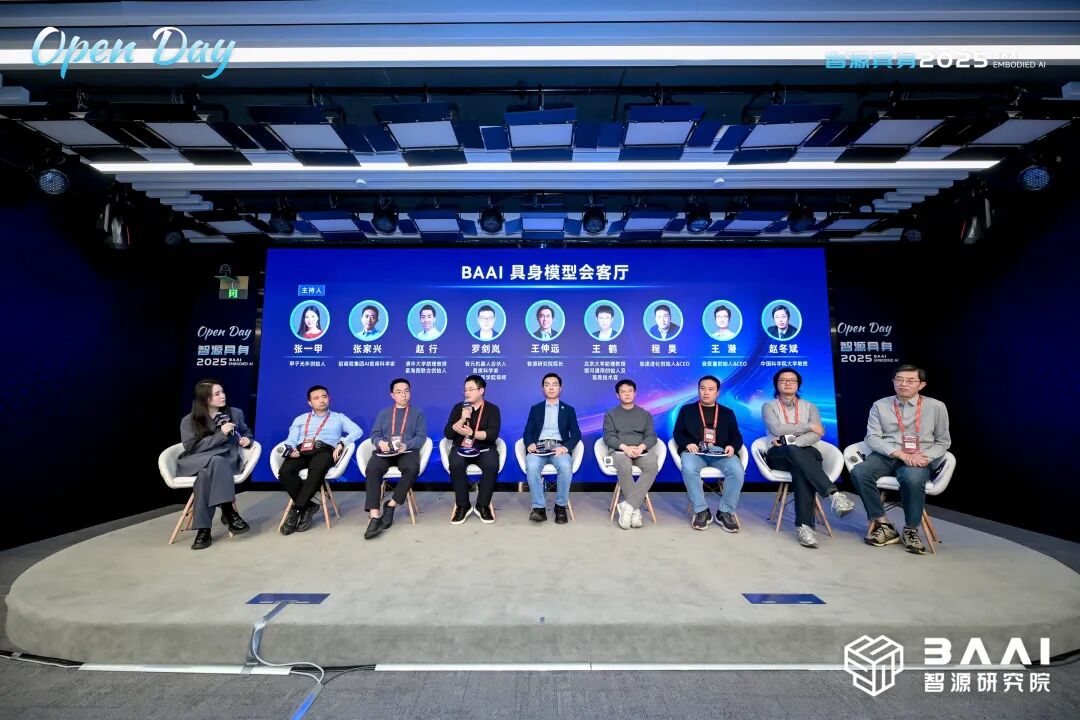
8位具身智能顶流聊起“非共识”:数据、世界模型、花钱之道
3 6 Ke· 2025-11-24 01:00
Core Viewpoint - The roundtable forum highlighted the importance of funding and data in advancing embodied intelligence, with participants discussing various strategies for utilizing a hypothetical budget of 10 billion yuan to drive development in the field [1][53]. Group 1: Funding and Investment Strategies - Participants expressed differing opinions on how to allocate 10 billion yuan for the advancement of embodied intelligence, with suggestions including investing in research institutions and building data engines [1][54][56]. - The CEO of Accelerated Evolution emphasized the need for collaboration, suggesting that 10 billion yuan may not be sufficient without partnerships [1][53]. - The focus on creating the largest self-evolving data flywheel was proposed as a key investment area [54]. Group 2: Data Challenges and Solutions - A significant discussion point was the scarcity of data, with varying opinions on the importance of real-world data versus synthetic data [2][29]. - The emphasis was placed on the necessity of high-quality, diverse data collected from real-world scenarios to enhance model training [30][32][36]. - The use of simulation data was also highlighted as a means to accelerate the development of embodied intelligence before sufficient real-world data can be gathered [43][44]. Group 3: World Models and Predictive Capabilities - The forum participants agreed on the critical role of world models in embodied intelligence, particularly in enabling robots to predict and plan actions based on future goals [5][12]. - There was a consensus that training data for these models should primarily come from the robots themselves to ensure relevance and effectiveness [5][12]. - The discussion included the potential for a unified architecture in embodied intelligence models, contrasting with the current fragmented approaches [7][15][27]. Group 4: First Principles and Decision-Making - Participants shared their foundational principles guiding decision-making in the development of embodied intelligence, emphasizing the importance of data scale and quality [48][49][51]. - The need for a physical world foundation model that accurately represents complex physical interactions was highlighted as essential for future advancements [26][27]. - The concept of a closed-loop model for embodied intelligence was proposed, contrasting with the open-loop nature of current language models [10][11].
认知驱动下的小米智驾,从端到端、世界模型再到VLA......
自动驾驶之心· 2025-11-24 00:03
Core Viewpoint - Xiaomi is making significant investments in intelligent driving technology, focusing on safety, comfort, and efficiency, with safety being the top priority in their development strategy [4][7]. Development Progress - Xiaomi's intelligent driving has progressed through several versions: from high-precision maps for highway NOA (version 24.3) to urban NOA (version 24.5), and moving towards light map and no map versions (version 24.10) [7]. - The company is advancing through three stages of intelligent driving: 1.0 (rule-driven), 2.0 (data-driven), and 3.0 (cognitive-driven), with a focus on VLA (Vision Language Architecture) for the next production phase [7][10]. World Model Features - The world model introduced by Xiaomi has three essential characteristics: diversity in generated scenarios, multimodal input and output, and interactive capabilities that influence vehicle behavior [8][9]. - The world model is designed to enhance model performance through cloud-based data generation, closed-loop simulation, and reinforcement learning, rather than direct action outputs from the vehicle [10]. VLA and Learning Models - VLA is described as an enhancement over end-to-end learning, integrating high-level human knowledge (traffic rules, values) into the driving model [13]. - Xiaomi's development roadmap includes various model training stages, from LLM pre-training to embodied pre-training, with recent advancements in MiMo and MiMo-vl models [13]. Community and Knowledge Sharing - The "Automated Driving Heart Knowledge Sphere" community aims to provide a comprehensive platform for learning and sharing knowledge in the field of autonomous driving, with over 4,000 members and plans to expand [15][26]. - The community offers resources such as technical routes, video tutorials, and Q&A sessions to assist both beginners and advanced learners in the autonomous driving sector [27][30].

8位具身智能顶流聊起「非共识」:数据、世界模型、花钱之道
36氪· 2025-11-23 12:56
Core Viewpoint - The article discusses the emerging industry revolution driven by embodied intelligence in the AI era, highlighting the diverse perspectives of top practitioners in the field regarding the allocation of significant funding for its development [5][6]. Group 1: Funding Allocation and Perspectives - During a roundtable forum, participants were asked how they would allocate 10 billion yuan to advance embodied intelligence, revealing varying strategies and priorities among industry leaders [5][6]. - Some participants emphasized the need for collaboration and building data ecosystems, while others focused on addressing data bottlenecks and creating self-evolving data systems [7][68]. Group 2: Data Challenges and Solutions - A significant discussion point was the "data scarcity" issue, with differing opinions on the importance of real-world data versus synthetic data for training models [9][10]. - Participants highlighted the necessity of high-quality, diverse data collected from real-world scenarios to enhance model performance, with some advocating for a combination of real and synthetic data [43][44][50]. Group 3: World Models and Embodied Intelligence - The concept of world models was debated, with some experts agreeing on their importance for embodied intelligence, while others suggested that they are not a mandatory foundation [14][17]. - The need for predictive capabilities in robots was emphasized, suggesting that training data must come from the robots' own experiences to be effective [16][18]. Group 4: Future Model Architectures - There was a consensus that embodied intelligence requires a unique model architecture distinct from existing large language models, with some advocating for a vision-first or action-first approach [19][20][21]. - The idea of a unified model that integrates various elements such as vision, action, and language was discussed, with the potential for a closed-loop system that allows for real-time feedback and adjustment [22][24][25]. Group 5: Long-term Vision and Data Collection - Participants expressed that the development of a powerful embodied intelligence model would depend on accumulating vast amounts of real-world data through practical applications and interactions [27][60]. - The importance of creating a "data flywheel" through the deployment of robots in real environments was highlighted as a means to gather diverse and extensive data [50][51][56].

李飞飞最新长文:AI很火,但方向可能偏了
创业邦· 2025-11-23 11:15
Core Viewpoint - The article discusses the limitations of current AI language models, emphasizing that while they are advanced in processing language, they lack true understanding of the physical world, which is essential for achieving genuine intelligence [5][6][7]. Group 1: Limitations of Current AI Models - Current AI language models, like ChatGPT and Google's Gemini, excel at predicting the next word based on statistical patterns but fail to understand basic physical concepts [6][7]. - The analogy of a scholar in a dark room illustrates that while these models can generate coherent text, they lack real-world experience and understanding [7][13]. - AI's reliance on language statistics rather than physical interactions leads to nonsensical outputs, highlighting the need for a deeper understanding of the world [8][13]. Group 2: The Concept of Spatial Intelligence - To advance AI, it is crucial to develop "spatial intelligence," which involves understanding and interacting with the physical world without relying solely on language [8][14]. - The article posits that true intelligence requires the ability to predict physical interactions and outcomes, akin to how humans learn through experience [14][15]. - Examples from child development and scientific discovery illustrate how spatial interactions lead to a deeper understanding of cause and effect [9][11]. Group 3: Future Directions for AI - The future of AI may shift from predicting the next word to predicting the next frame of the world, integrating physical laws and spatial reasoning [14][17]. - Developing a "world model" that incorporates spatial data and physical interactions could revolutionize AI capabilities, allowing for more accurate simulations and predictions [15][17]. - The article mentions ongoing efforts to extract spatial information from 2D videos to train AI models, indicating a significant area of research [17][18]. Group 4: Practical Applications and Opportunities - The emergence of AI with spatial intelligence could lead to practical applications in robotics, enhancing their ability to navigate and interact with real-world environments [20][21]. - Potential use cases include virtual scene generation for design, therapy, and educational purposes, showcasing the versatility of AI in various fields [21][22]. - The ability to convert imagination into tangible reality presents significant opportunities for innovation and entrepreneurship [22][23].