
量子科技

Search documents
10万亿千瓦时,普通人能从中感知什么
2 1 Shi Ji Jing Ji Bao Dao· 2026-01-17 12:11
Core Insights - The total electricity consumption in China is projected to reach 10.3682 trillion kilowatt-hours by 2025, marking a significant milestone as it is the first time the country's electricity consumption surpasses 10 trillion kilowatt-hours. This figure is more than double the annual electricity consumption of the United States and exceeds the combined annual consumption of the EU, Russia, India, and Japan [1][9]. Group 1: Energy Structure - The shift towards electric vehicles is evident, with non-fossil energy sources expected to account for over 60% of installed capacity by 2025, indicating a significant transition towards cleaner energy. One-third of the total electricity consumed will be green energy [3][11]. - In 2025, China's automobile production and sales are projected to reach historical highs of 34.531 million and 34.40 million units, respectively, with a year-on-year growth of 10.4% and 9.4%. New energy vehicle sales are expected to exceed 16 million units, making up over 50% of new car sales [3][11]. Group 2: Technological Transformation - The industrial sector, which is the largest consumer of electricity, is undergoing a technological revolution characterized by advancements in AI, quantum technology, and automation. In the past year, the electricity consumption of the secondary industry reached 66,366 billion kilowatt-hours, accounting for approximately 64% of total consumption [5][13]. - The computer, communication, and other electronic equipment manufacturing sectors are expected to consume over 50 billion kilowatt-hours of electricity in 2025, surpassing traditional industries like steel and chemicals [5][13]. Group 3: Quality of Life - The electricity consumption of the tertiary industry is projected to reach 19,942 billion kilowatt-hours by 2025, with a year-on-year growth of 8.2%. Urban and rural residential electricity consumption is expected to reach 15,880 billion kilowatt-hours, growing by 6.3% [6][14]. - The increase in electricity consumption in the service sector indicates a vibrant social and market environment, with the electric vehicle sector driving a nearly 50% increase in charging service electricity consumption [6][15].
晚间利空!超过十家上市公司发布减持、4家超过2.2%!
Sou Hu Cai Jing· 2026-01-17 05:40
Group 1 - Multiple listed companies announced shareholder reduction plans, with notable reductions including Ruimaite at 4.98%, Youyan Silicon at 3%, Chengdu Xian Dao at 2.51%, and Zhen Shitong at 2.24% [1] - Other companies such as Lianchuang Optoelectronics and Xiongdi Technology announced reductions of 2%, while several others planned reductions of 1% [3] - The reasons given for these reductions were primarily "personal funding needs," which may be interpreted negatively in a sensitive market environment [3] Group 2 - Some stocks, like Zhizhi New Materials, experienced significant price increases but later clarified that their business does not involve popular market concepts such as AI or quantum technology, which led to a denial of the narrative supporting their stock price surge [4] - Liou Co. faced a trading suspension due to a 96.77% price increase over ten trading days, with the company indicating that its AI-related revenue is minimal [4] Group 3 - Several companies, including Kunlun Wanwei and Shanghai Hanhua, forecasted significant losses for 2025, with Kunlun Wanwei expecting a loss between 1.9 billion to 2.4 billion [6][7] - The list of companies predicting profit declines or losses is growing, with Weiyuan Co. expecting a more than 2000% drop in net profit [8] Group 4 - On January 16, 2026, institutional investors showed mixed sentiments, with Meinian Health receiving a net buy of 579.4 million and Sanan Optoelectronics 552.4 million, while Jin Feng Technology faced a net sell of 1.097 billion [9][12] - The divergence in fund flows indicates a split in market sentiment among institutional investors [12] Group 5 - Industry-wide pressures are emerging, with a report indicating that the smartphone market will face tight supply and rising prices for memory chips starting in the second half of 2025, which may lead to decreased consumer demand [14] - The automotive sector also reported declines, with major brands like BMW, Mercedes-Benz, and Audi showing significant drops in sales in China [14] Group 6 - Global commodity price fluctuations, such as a 4.56% drop in NY crude oil prices, are impacting the profitability of energy and raw material companies in the A-share market [16] - Despite negative news, market activity continues with notable trading in stocks like Tongyu Communications and Hongxiang Shares, indicating ongoing volatility [16] Group 7 - The evening of January 16, 2026, presented a mixed market landscape with ongoing shareholder reductions, risk warnings from popular stocks, and a blend of positive and negative earnings forecasts [17]

中国移动链长基金战略加持,国内首台原子量子计算系统研发团队完成新一轮战略融资丨早起看早期
36氪· 2026-01-17 01:12
Core Viewpoint - The article highlights the significant advancements and commercialization of quantum computing technology by Zhongke Kuyuan Technology (Wuhan) Co., Ltd., particularly in atomic quantum computing, supported by a recent strategic financing round of nearly 100 million yuan [5][8]. Group 1: Company Overview - Zhongke Kuyuan is the first company in China to possess both research and industrialization capabilities in atomic quantum computing and quantum precision measurement [5]. - The core team originates from the Chinese Academy of Sciences and has over 20 years of experience in neutral atom quantum technology research [5]. Group 2: Market Potential - The global quantum technology market is projected to reach $8 billion in 2024, with China accounting for nearly 25% of this market [7]. - By 2035, the global market size is expected to exceed $900 billion, with China's industry scale potentially reaching $260 billion, representing nearly 30% of the global market share [7]. Group 3: Technological Advancements - Neutral atom quantum computing is recognized for its scalability, engineering feasibility, and system integration advantages, making it one of the fastest-growing systems in quantum computing development [7]. - Zhongke Kuyuan launched the "Hanyuan 1" atomic quantum computing system in 2024, which has been recognized as a landmark product in the quantum technology field [7]. Group 4: Future Developments - The company plans to release the next-generation atomic quantum computing system, "Hanyuan 2," which will enhance overall architecture, stability, and performance [8]. - A cloud platform for atomic quantum computing has been developed in collaboration with Wuhan Quantum Institute, allowing users to access "Hanyuan 1" for computational tasks [8]. Group 5: Funding Utilization - The recent funding will primarily accelerate hardware development, facilitate rapid iteration of new products and technologies, and enhance talent acquisition and application scenario exploration [8].

科技板块持续活跃
Tebon Securities· 2026-01-16 12:56
Market Analysis - The A-share market continues to show differentiation with a slight increase in trading volume, as of January 16, 2026, the Shanghai Composite Index fell by 0.26% to 4101.91 points, while the ChiNext Index decreased by 0.2% [4][3] - The overall market saw 2370 stocks rise and 2971 stocks fall, indicating a preference for profit-making opportunities [4] Sector Performance - The technology sector remains relatively strong, particularly in chip stocks, with TSMC expected to increase capital expenditure to between $52 billion and $56 billion in 2026 [7][8] - The market is characterized by a slow bull trend, supported by ample liquidity of 3 trillion, despite some restrictions from margin policy adjustments [8] Bond Market - The bond market showed a general upward trend, with the 10-year treasury futures rising by 0.01% to 108.065 [11] - The People's Bank of China announced a reduction in re-lending and rediscount rates by 0.25 percentage points, which is expected to lower the cost of funds for financial institutions [11][17] Commodity Market - The commodity market experienced a decline, with lithium carbonate prices dropping by 8.99% on January 16, 2026 [11] - The recent fluctuations in lithium prices are attributed to policy changes regarding the recycling of used batteries, which may positively impact the battery recycling industry [11] Investment Opportunities - Key sectors to watch include AI applications, commercial aerospace, nuclear fusion, quantum technology, brain-computer interfaces, and robotics, all of which are supported by government policies and technological advancements [16] - The report suggests that the market's slow bull trend is likely to continue, with a focus on sectors that have seen less trading activity recently [14]
格隆汇公告精选︱三角轮胎:拟投资32.19亿元在柬埔寨新建年产700万条高性能子午线轮胎项目;华胜天成:目前涉及AI业务的相关收入占公司整体营业收入的比例较低
Ge Long Hui· 2026-01-16 11:52
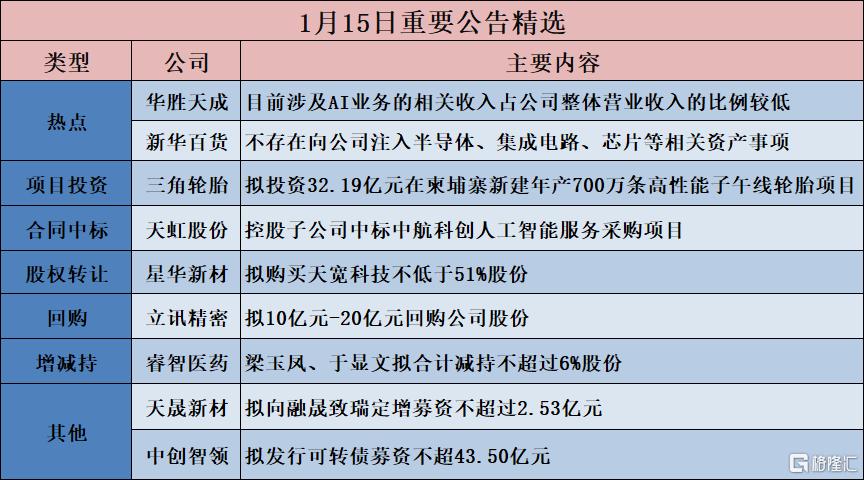
Group 1 - Huaseng Tiancheng's revenue from AI-related business currently accounts for a low proportion of the company's overall operating income [1] - Xinhua Department Store has no plans to inject assets related to semiconductors, integrated circuits, or chips into the company [1] - Triangle Tire plans to invest 3.219 billion yuan to establish a new project in Cambodia with an annual production capacity of 7 million high-performance radial tires [1] Group 2 - Tianhong Co., Ltd.'s subsidiary has won a bid for an AI service procurement project from AVIC Technology [1] - Xinghua New Materials intends to acquire at least 51% of Tian Kuan Technology's shares [1] - Luxshare Precision plans to repurchase company shares worth between 1 billion to 2 billion yuan [1] Group 3 - Rui Zhi Pharmaceutical's Liang Yufeng and Yu Xianwen plan to collectively reduce their holdings by no more than 6% [1] - Tian Sheng New Materials plans to raise no more than 253 million yuan through a private placement to Rongsheng Zhizhi [1] - Zhongchuang Zhiling intends to issue convertible bonds to raise no more than 4.35 billion yuan for investment in high-end components for the new energy vehicle industry [2]


计算机行业年度策略报告:AI商业化加速推进,量子科技前景广阔-20260116
Guoyuan Securities· 2026-01-16 10:14
Group 1: Industry Overview - The computer industry saw an 18.24% increase in the Shenwan index in 2025, outperforming the CSI 300 but underperforming the ChiNext and Sci-Tech 50 indices, ranking 14th among Shenwan industries [1][11] - AI technology is rapidly evolving, with DeepSeek achieving advanced performance at significantly lower costs than overseas competitors, leading to increased application across various sectors and a substantial rise in token consumption [1][11] - Domestic GPU manufacturers like Moer Thread and Muxi successfully went public, while leading domestic large model companies such as Zhipu and MiniMax are set to list in Hong Kong, indicating a robust push for domestic AI stack replacement [1][11] Group 2: AI Technology Development - Since early 2025, generative AI technology has accelerated, with significant improvements in model capabilities, reducing hallucinations and enhancing reliability, thus becoming a stable expert assistant [2][28] - Major US tech companies have significantly increased capital expenditures, with Amazon, Google, Meta, Microsoft, and Oracle showing rapid quarterly growth in spending on AI [2][62] - Domestic companies like Zhipu, DeepSeek, MiniMax, and Alibaba are also increasing investments and making breakthroughs in technology, with commercial progress accelerating and long-term growth potential being substantial [2][28] Group 3: Quantum Technology Prospects - Quantum computing is expected to become a core component of future computing systems, with significant investments from companies like Microsoft, Google, IBM, and NVIDIA, indicating promising commercial prospects [3][31] - The Chinese government has included quantum technology in its long-term industrial strategy, further supporting the industry's development [3][31] - Domestic companies such as Guoyi Quantum and Benyuan Quantum are making strides in technology and collaborating closely with downstream clients, gradually opening up commercialization opportunities [3][37] Group 4: Financial Performance - In the first three quarters of 2025, the computer sector achieved a total revenue of 938.614 billion yuan, a year-on-year increase of 9.19%, and a net profit of 24.414 billion yuan, up 30.37% [16][19] - The gross profit margin for the computer sector was approximately 23.26%, a decrease of 2.23 percentage points from the previous year, while the net profit margin increased by 1.03 percentage points to 2.60% [19][19] Group 5: Valuation Overview - As of December 31, 2025, the PE TTM for the computer sector was 54.70, ranking it among the highest in various industries, indicating a reasonable valuation level with good long-term investment potential [22][26] - The valuation levels for the computer sector have receded from their peak, but the growth attributes of the industry justify a higher valuation premium [26][27]

天融信20260115
2026-01-16 02:53
Summary of Tianrongxin Conference Call Company Overview - **Company**: Tianrongxin - **Industry**: Hyper-converged infrastructure, cloud computing, and network security Key Points and Arguments Industry and Market Trends - The hyper-converged infrastructure market is expected to grow at a compound annual growth rate (CAGR) of 9.2% over the next five years, reaching a market size of approximately $3.3 billion by 2029, with an estimated market size of around 15 billion yuan in 2024, reflecting a CAGR of about 12% [2][4] - The demand for software-defined storage and hyper-converged systems is on the rise, driven by the increasing need for integrated IT solutions [2][4] Company Strategy and Product Development - Tianrongxin has developed a comprehensive product matrix since 2015, including hyper-converged systems, desktop cloud, enterprise cloud, and intelligent computing cloud, covering all IT infrastructure scenarios [3] - The company plans to launch its intelligent computing cloud platform and integrated computing machines in 2025 to meet the needs of large model construction and private deployment [2][3] Competitive Advantages - Tianrongxin's technology architecture supports a wider range of CPU types, including domestic platforms, and is compatible with various operating systems, providing higher reliability, flexibility, and openness compared to VMware [7] - The company has obtained over 586 compatibility certificates and has completed adaptations with more than 60 domestic manufacturers, ensuring rapid response services [7] Transition Strategy from VMware - Tianrongxin has proposed a three-step strategy to simplify the transition from VMware to its hyper-converged solutions, starting with establishing a data center for backup or non-core operations, gradually expanding usage, and ultimately achieving full replacement [8][10] Achievements in Domestic Product Development - Since 2012, Tianrongxin has developed 372 domestic products across 83 categories, covering over 80% of its product lines, and has obtained over 3,900 compatibility certificates in the network security field [11] Challenges and Responses - The transition from VMware presents challenges such as technical difficulties and customer acceptance. Tianrongxin addresses these by starting with non-disruptive scenarios to gain customer trust and gradually moving to core business replacements [12] Future Development Trends - The company aims for full-stack development and intelligent empowerment, focusing on AI integration to enhance efficiency and service platform construction [13][14] Market Demand for Domestic Alternatives - There is an increasing urgency among customers for domestic alternatives, particularly in sectors like education and healthcare, which have smaller IT scales and simpler needs [15][16] Cost and Delivery Models - The cost for deploying a hyper-converged system can start from around 200,000 to 300,000 yuan for a minimal setup, with flexible expansion options available [17] Intelligent Computing Cloud Developments - Starting in 2025, Tianrongxin will offer intelligent computing cloud solutions tailored for private deployment, including integrated servers and software for secure data handling [18] Quantum Technology Initiatives - Tianrongxin is exploring quantum technology, focusing on quantum communication and post-quantum encryption algorithms, collaborating with various companies to develop related products [22][23] Additional Important Insights - The shift towards domestic products is becoming a default strategy in many industries, with large enterprises showing a marked increase in demand for domestic solutions despite economic pressures [21]

志特新材跌停 此前6日累计涨近200%
Zheng Quan Shi Bao Wang· 2026-01-16 02:52
Core Viewpoint - The stock of Zhite New Materials (300986) experienced a significant drop of 20% after resuming trading, following a period of six consecutive trading days of price increases, totaling nearly 200% [1] Group 1: Stock Performance - The stock price increased by 198.57% from January 5 to January 12, 2026, significantly deviating from the market index [1] - The stock reached a trading volume exceeding 1.3 billion yuan during the drop [1] Group 2: Risk Warning - The company issued a risk warning indicating that the stock price is severely misaligned with its fundamentals, suggesting an overheated market sentiment [1] - There is a notable "hot potato" effect in trading, indicating a high risk of a sharp decline in the stock price [1] Group 3: Business Operations - The company does not engage in AI applications, quantum technology, robotics, or commercial aerospace, and has not generated related revenue [1] - The main business activities include the research, production, and sales of aluminum molds, protective platforms, and prefabricated components, which have not changed since the company's listing [1] - The company and its subsidiaries are operating normally, with no undisclosed significant information [1]
侯喜保:实体经济“大树”根深叶茂
Jing Ji Ri Bao· 2026-01-16 00:05
Core Viewpoint - The "14th Five-Year Plan" emphasizes the importance of consolidating and strengthening the foundation of the real economy as a strategic task, highlighting its critical role in China's modernization efforts [1]. Group 1: Modern Industrial System - Building a modern industrial system is a strategic choice to strengthen the foundation of the real economy and is essential for promoting high-quality development [2]. - The focus should be on intelligent, green, and integrated development, promoting deep integration of technological and industrial innovation [2]. - Traditional industries need optimization and enhancement, while emerging industries should focus on cultivation and growth in sectors like new energy and aerospace [2]. Group 2: Manufacturing Sector - The manufacturing sector is fundamental to national strength and the core of the modern industrial system, with China's manufacturing value added accounting for nearly 30% of the global total [3]. - China has maintained its position as the world's largest manufacturer for 15 consecutive years, producing the majority of 504 major industrial products globally [3]. - The goal is to strengthen and optimize the manufacturing sector, ensuring it remains a backbone of the modern industrial system [3]. Group 3: Service Industry - The modern service industry is a crucial support for the modern industrial system, but it faces structural and systemic challenges [3]. - There is a need to promote high-quality development in the service sector, enhancing the integration of productive services with manufacturing [3]. - The focus should be on improving the quality and diversity of life services while advancing the digitalization of the service industry [3]. Group 4: Infrastructure Development - Infrastructure is essential for industrial development and must be optimized to support the real economy [4]. - A modern infrastructure system should leverage China's large market and existing facilities, focusing on new infrastructure construction and the digital transformation of traditional infrastructure [4]. - The goal is to enhance the resilience and adaptability of infrastructure to support China's modernization efforts [4].
国元证券股份有限公司 第十一届董事会第三次会议决议公告
Zhong Guo Zheng Quan Bao - Zhong Zheng Wang· 2026-01-15 23:37
Group 1 - The company held its 11th Board of Directors' third meeting on January 14, 2026, where all 14 directors participated in the voting process, confirming the legality and validity of the meeting [2][3] - The board approved a resolution to adjust the scale of the company's proprietary business, allowing proprietary equity securities and derivatives to not exceed 80% of the company's net capital, and non-equity securities and derivatives to not exceed 400% of the company's net capital [3][5] - The board authorized the management to allocate and adjust the proprietary business scale and actual fund usage based on market conditions and business development needs [3][4] Group 2 - The board approved the establishment of the Anhui Guoyuan Quantum Star Dynamic Equity Investment Partnership (Limited Partnership) with a planned scale of 207.2 million yuan, focusing on investments in high-tech enterprises in the quantum industry [11][13] - Guoyuan Equity Investment Co., Ltd. and Guoyuan Innovation Investment Co., Ltd. will contribute 34 million yuan and 41 million yuan respectively to the partnership, representing 16.41% and 19.79% of the total fund size [13] - The partnership is considered a related transaction, with certain directors abstaining from voting due to conflicts of interest [6][14] Group 3 - The partnership will be managed by Guoyuan Equity Investment Co., Ltd., and the fund will focus on direct equity investments in non-listed companies within the quantum technology sector [30][32] - The fund's management fee will be 0.4% of the investment amount during the investment period and the remaining investment amount during the exit period [33] - The fund aims to achieve a minimum return of 6% per year, with profit distribution structured to benefit all partners equitably [33] Group 4 - The company has engaged in related transactions amounting to 15,326.56 yuan with related parties since the beginning of the year, with a cumulative amount of 135.6 million yuan over the past twelve months [34][35] - The independent directors have expressed their support for the partnership, emphasizing its alignment with the company's strategic direction and the absence of adverse effects on the company's operations or financial status [36]
