贸易摩擦

Search documents
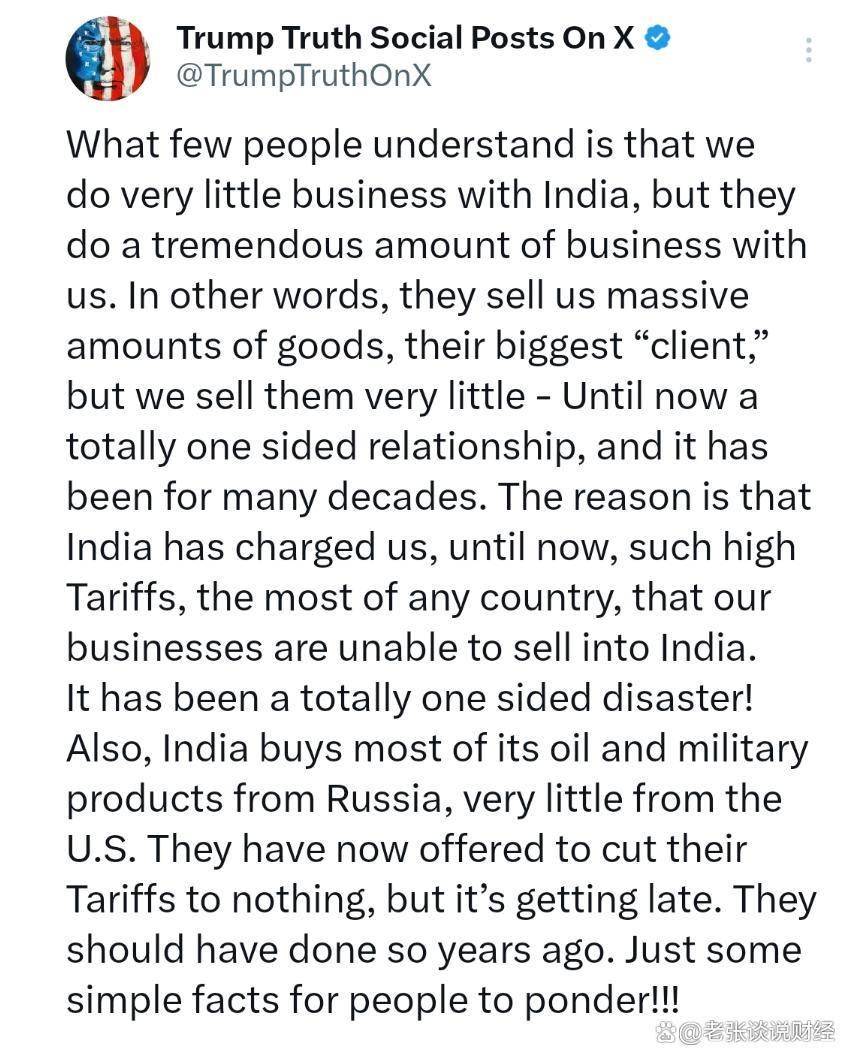
美国总统特朗普再次炮轰印度:很少有人明白,我们和印度的生意很少,但他们和我们的生意却非常多
Sou Hu Cai Jing· 2025-09-02 15:17
Core Viewpoint - The trade relationship between the United States and India is characterized by significant imbalances, with the U.S. exporting approximately $48 billion and importing around $95 billion from India in 2023, resulting in a trade deficit of nearly $47 billion [1]. Trade Imbalance - The U.S. has a substantial trade deficit with India, primarily due to high tariffs imposed by India on American products, particularly in sectors like automobiles [1]. - India's average tariff level is around 15%, one of the highest among major economies, reflecting its protectionist policies aimed at supporting domestic manufacturing [1]. Energy and Defense Relations - In 2023, over 35% of India's crude oil imports came from Russia, significantly more than from the U.S., indicating a strong reliance on Russian energy [3]. - India's long-standing defense relationship with Russia includes key military equipment such as Sukhoi aircraft and S-400 defense systems, complicating U.S. efforts to sell arms to India [3]. Historical Context - The U.S. revoked India's preferential trade status in 2019, leading to retaliatory tariff increases by India on 28 American products, highlighting ongoing trade tensions [5]. - Despite public displays of camaraderie, underlying trade disputes and disagreements persist between the two nations [5]. India's Stance - India's large market of 1.4 billion people provides leverage against U.S. pressure, as American companies are reluctant to completely withdraw from this market [7]. - Nationalist sentiments in India support protective tariffs, making it politically challenging for the government to concede to U.S. demands [7]. Future Outlook - The economic relationship between the U.S. and India is expected to continue with friction, especially if Trump returns to power and intensifies trade disputes [7]. - India is likely to seek alternative markets to mitigate U.S. pressure, which could shift the dynamics of U.S.-India relations beyond just trade issues [10].

印度刚对美国摆了脸子,特朗普就说要加 50% 关税,莫迪都插手了
Sou Hu Cai Jing· 2025-09-02 02:29
你说这印度,之前和美国的关系虽说不上铁得不行,但也还算过得去。可谁能想到,就因为一些事儿,双方 这矛盾 "蹭" 地一下就起来了。听说啊,印度在某些问题上没顺着美国的意思来,特朗普那脾气,一下子就 上来了,觉得印度这是没把他放在眼里,直接就拿关税开刀。这一加就是 50% 啊,好家伙,这对印度的出 口行业打击可不小。你想啊,印度好多产品出口到美国,这关税一涨,价格就上去了,竞争力自然就弱了。 印度这边也不傻,莫迪一看这情况,哪能就这么忍气吞声啊。他心里肯定在想,你美国不能说加就加啊,得 给个说法。莫迪也插手这事儿了,开始琢磨着怎么应对美国的这一 "狠招"。印度的一些官员也纷纷站出来 表态,说美国这做法不合理,不公平。你说美国凭啥就针对印度啊,世界上那么多国家,难道就印度买俄罗 斯石油了?这不是明显的双标嘛! 家人们,最近国际形势那叫一个风云变幻啊!今天咱就来唠唠美国和印度这俩国家之间的事儿。你们知道 不,印度刚对美国摆了脸子,特朗普那边就坐不住了,直接放出狠话要加 50% 的关税,这事儿闹得,连莫 迪都插手了,咱就一起来看看这到底是咋回事儿。 我记得之前美国和印度在贸易上也有不少摩擦,不过这次感觉特别严重。美国一 ...
中泰期货:黄金或继续创历史新高,短期调整提供配置机会
Qi Huo Ri Bao· 2025-09-02 00:46
Core Viewpoint - The gold market is experiencing a significant upward trend due to factors such as escalating trade tensions, geopolitical issues, and expectations of interest rate cuts by the Federal Reserve, with gold prices reaching historical highs [1][4]. Group 1: Gold Price Trends - From January to August 2025, London gold prices surged to a historical high of $3,500 per ounce, while Shanghai gold futures reached a record high of 841.28 yuan per gram, with overall increases of over 31% and nearly 27% respectively [1]. - The London gold price fluctuated between $2,614 and $3,500.12 per ounce, while Shanghai gold traded between 626 and 841.3 yuan per gram during the same period [1]. Group 2: Federal Reserve's Monetary Policy - Multiple factors are contributing to rising expectations for interest rate cuts by the Federal Reserve, including a dovish shift from Fed officials and weak employment data [2]. - The Fed is anticipated to initiate a new round of rate cuts, with expectations for two cuts in the second half of 2025, specifically in September and December [2]. Group 3: Global Trade Relations - The global trade environment remains uncertain, with the Trump administration's policies continuing to influence trade relations, leading to increased demand for gold as a safe haven [3]. - Although there have been temporary improvements in trade relations, the long-term outlook remains tense, which may continue to support gold prices [3]. Group 4: Market Outlook - The macroeconomic environment is expected to remain favorable for gold, with no significant bearish factors anticipated in the near term, suggesting a continued strong performance for gold prices [4]. - There is a possibility for gold prices to reach between $3,700 and $3,800 per ounce by the end of 2025, indicating that the bull market for gold is not over [4].
黄金或继续创历史新高 短期调整提供配置机会
Qi Huo Ri Bao· 2025-09-01 23:09
Group 1: Gold Price Trends - In the first eight months of 2025, gold prices surged significantly due to trade tensions, geopolitical issues, and expectations of Federal Reserve rate cuts, with London gold reaching a historical high of $3,500 per ounce and Shanghai gold hitting 841.28 yuan per gram [1] - The overall range for London gold prices was between $2,614 and $3,500.12 per ounce, reflecting an increase of over 31%, while Shanghai gold prices ranged from 626 to 841.3 yuan per gram, showing an increase of nearly 27% [1] Group 2: Federal Reserve's Monetary Policy - Multiple factors have led to heightened expectations for Federal Reserve rate cuts, including a dovish shift from Fed officials, which signals the potential for a new round of rate cuts [2] - The independence of the Federal Reserve is under pressure due to political influences, with expectations that the Fed may initiate a new rate cut cycle, potentially larger than anticipated [2] - Weak U.S. employment data has further fueled expectations for rate cuts, with July's non-farm payroll data indicating a significant weakening in the labor market [2] Group 3: Global Trade Relations - Global trade relations remain tense, primarily influenced by the Trump administration's policies, which have led to increased market volatility and heightened demand for gold as a safe haven [3] - Although there have been temporary improvements in trade relations, such as progress in negotiations with major economies, the long-term outlook remains uncertain, with potential for renewed tensions [3] - The fourth quarter is expected to see changes in trade dynamics that could positively impact gold prices [3] Group 4: Future Outlook for Gold - With the Federal Reserve likely to restart its easing cycle and ongoing geopolitical tensions, the macroeconomic environment is expected to remain favorable for gold [4] - There is a strong possibility that gold prices could reach new historical highs, with projections suggesting London gold may rise to between $3,700 and $3,800 per ounce [4] - The long-term bullish trend for gold is anticipated to continue, with no significant bearish factors emerging in the near term [4]
中美关税战“意外”转折?最大赢家浮出水面,美国订单竟被盟友截胡?
Sou Hu Cai Jing· 2025-09-01 04:02
Core Points - The US-China trade war has entered a "ceasefire" phase after three rounds of difficult negotiations, with Australia emerging as an unexpected beneficiary of the situation [1][6] - The US has faced significant economic losses due to the trade war, with small and medium-sized enterprises struggling and agricultural exports, particularly soybeans and corn, suffering from lost access to the Chinese market [4][9] - Australia's economy has shown steady growth, with increased exports of iron ore, coal, and wine to China, positioning it as a key player in the trade dynamics between the US and China [6][7] Summary by Sections US-China Trade Dynamics - The US has implemented aggressive tariff policies against China, with tariffs reaching as high as 145%, but China's strong response has challenged US economic dominance [3][4] - The trade war has resulted in significant economic repercussions for the US, including increased costs for businesses and a decline in agricultural exports [4][9] Australia's Economic Position - Australia has capitalized on the trade war, increasing its market share in China for key products like iron ore and coal, benefiting from China's demand for resources [6][8] - The trade relationship between Australia and the US is imbalanced, with Australia relying heavily on trade with China for economic growth [7][8] Market Opportunities - The structure of US tariffs has inadvertently allowed Australia to fill the void left by American products in the Chinese market, particularly in coal and agricultural goods [8][9] - Australia's agricultural exports, including soybeans and beef, have surged as Chinese companies seek alternatives to US products due to increased costs from tariffs [9][10]
美瑞贸易摩擦加剧,瑞士黄金业界反对将产能转移美国
Feng Huang Wang· 2025-08-30 23:49
Core Viewpoint - The Swiss gold refining industry opposes relocating part of its operations to the U.S. due to the high tariffs imposed by the Trump administration, which could significantly harm the Swiss economy and businesses [1]. Group 1: Tariff Impact - The U.S. has announced tariffs as high as 39% on Swiss goods, which is higher than tariffs imposed on most other countries and an increase from the previously announced 31% [1]. - Switzerland exports 19% of its goods to the U.S., making it the largest export market for the country, and the high tariffs could lead to economic damage [1]. - UBS has revised its economic outlook for Switzerland, lowering the GDP growth forecast for 2026 from 1.2% to 0.9% due to concerns over tariff impacts [1]. Group 2: Trade Balance and Gold Refining - The U.S. is one of the largest trade surplus countries with Switzerland, with a trade deficit of nearly $48 billion in the first half of the year, primarily driven by gold trade [1]. - Switzerland is a major global player in gold refining, and gold significantly impacts the country's trade balance [1]. - Gold exported from Europe to the U.S. must be re-cast due to differing standards between the London market and the U.S. Comex exchange [1]. Group 3: Industry Response - Christoph Wild, president of the Swiss Precious Metals Production and Trade Association, advises against hasty decisions by the Swiss government regarding relocating refining capacity to the U.S. [1]. - Wild notes that the significant surplus in gold exports to the U.S. at the end of 2024 and early 2025 is an anomaly, driven by traders rushing to export metals before potential tariffs [2]. - Wild also states that the establishment of new refining capacity in the U.S. would have limited impact, despite the U.S. Customs and Border Protection indicating that Swiss gold bars could be subject to the new tariffs [3].
莱伯泰科2025H1财报:微塑料、稀土、半导体...多领域布局
仪器信息网· 2025-08-30 03:57
Core Viewpoint - The company, Leibertai Technology, reported a decline in revenue and profit for the first half of 2025, primarily due to a significant drop in the laboratory solutions segment, which saw a revenue decrease of 57.02% year-on-year [2][3][6]. Financial Performance - The total revenue for the first half of 2025 was 191.96 million yuan, a decrease of 10.33% compared to the same period last year [3][4]. - The net profit attributable to shareholders was 21.09 million yuan, down 11.53% year-on-year [3][4]. - The net profit after deducting non-recurring gains and losses was 18.88 million yuan, a decrease of 12.45% compared to the previous year [3][4]. - The net cash flow from operating activities was -7.84 million yuan, indicating a worsening cash flow situation [4]. Revenue Breakdown - The revenue from the laboratory analysis instruments business accounted for 79.40% of total revenue, with a slight decrease of 2.02% year-on-year [4]. - The clean and environmental laboratory solutions segment represented 7.94% of total revenue, experiencing a drastic decline of 57.02% [4][6]. - The consumables and customer service segment contributed 12.66% to total revenue, with a growth of 4.37% year-on-year [4]. Market Expansion and Challenges - The company has established subsidiaries in the United States and Hong Kong to expand its overseas market, focusing on Europe and the U.S. for exports [5]. - The ongoing U.S.-China trade tensions have led to increased tariffs on certain products, which could impact the company's cost structure and market competitiveness [5]. - Despite the tariff fluctuations, there has been no substantial impact on the company's business in the first half of 2025 [5]. Research and Development - Research and development expenditures reached 23.62 million yuan, accounting for 12.30% of total revenue, indicating a focus on innovation [7]. - The company is actively developing new products and expanding its application areas, including collaborations with various institutions for environmental safety and industry-specific applications [6][10].

AUS Global:巴西启动关税应对机制
Sou Hu Cai Jing· 2025-08-29 13:02
Core Viewpoint - Brazil's recent trade policy actions indicate a deepening uncertainty in the global economic landscape, as the country seeks to respond to U.S. tariffs on Brazilian goods through its "reciprocity law" [1][4]. Trade Policy Developments - The Brazilian Ministry of Foreign Affairs has formally requested the trade agency Camex to analyze whether to implement targeted measures under the "reciprocity law" in response to U.S. tariffs [1]. - The "reciprocity law" provides Brazil with a legal framework to impose countermeasures, including tariffs, against unilateral trade barriers [1]. Impact on Trade and Markets - U.S. tariffs on certain Brazilian products have heightened uncertainty in Brazil's export environment, despite some key exports like orange juice and aircraft being temporarily exempt [4]. - The tariff adjustments are expected to affect not only bilateral trade flows but also commodity market prices, multinational supply chain strategies, and investor confidence in Latin American markets [4]. Future Actions and Implications - Camex is set to complete its report within 30 days to evaluate the potential use of the reciprocity law, which may lead to measures targeting specific industries and products [7]. - The initiation of this process signals Brazil's more proactive stance in trade policy, potentially seeking measures in agriculture, mining, or manufacturing sectors [7]. Broader Economic Context - This dynamic increases uncertainty in global trade tensions, with potential short-term volatility in commodity prices such as agricultural products and metals [10]. - The actions taken by Brazil reflect a shift in the stance of emerging market economies in the international trade landscape, possibly encouraging other countries to adopt similar legal mechanisms in future trade disputes [10].

美联储独立性面临严峻挑战 贵金属市场表现亮眼
Jin Tou Wang· 2025-08-28 07:26
Core Insights - The US dollar index showed a typical inverted V-shape pattern, closing slightly down by 0.06% at 98.147 points [2][3] - Precious metals, particularly gold and silver, experienced upward momentum due to challenges to the independence of the Federal Reserve, with gold rising by 0.11% to $3397.46 per ounce and silver increasing by 0.12% to $38.61 per ounce [2][3] Market Overview - The dollar index displayed a stable trend, influenced by uncertainties surrounding the frequent changes in the Federal Reserve's leadership and a data-dependent monetary policy stance, leading to doubts about the independence of monetary policy and future interest rate cuts [3] - Progress in tariff agreements between the US and Europe, along with positive negotiations regarding auto tariffs with Japan, may alleviate current trade tensions [3] - However, US pressure on India to cease oil transactions with Russia in exchange for tariff relief poses a potential risk of reigniting trade conflicts, which could lead to significant volatility in the precious metals market [3] Economic Context - The global economic landscape is delicately balanced, with varying policy adjustments from central banks and intertwined geopolitical risks and trade disputes [3] - Investors are advised to remain vigilant and closely monitor changes in policy indicators and international trade dynamics, as minor policy adjustments or unexpected events could disrupt market equilibrium and lead to substantial asset price fluctuations [3] Trading Strategy - The demand for precious metals as a safe haven is supported by policy uncertainty and geopolitical trade risks, but specific trends will depend on forthcoming US economic data and policy signals [4] - In the short term, precious metals are expected to maintain a strong oscillating trend, with gold anticipated to outperform silver [4] - Key technical levels to watch include the $3450 per ounce resistance for gold and the $39 per ounce resistance for silver, with potential upward momentum if these levels are effectively breached [4]
印度面临特朗普高关税冲击 出口与就业承压
Sou Hu Cai Jing· 2025-08-27 15:44
Core Viewpoint - The imposition of high tariffs by the U.S. on Indian goods has significantly strained U.S.-India relations, impacting various sectors of India's export industry and threatening economic growth [3][4]. Group 1: Tariff Impact - Starting Wednesday, the U.S. has raised tariffs on Indian imports to 50%, which includes a 25% retaliatory tariff and an additional 25% due to India's oil purchases from Russia [3]. - The global trade research initiative estimates that affected exports account for two-thirds of India's $90 billion exports to the U.S., potentially reducing annual export value by nearly $40 billion, which could lower India's economic growth rate by nearly 1 percentage point for the fiscal year ending March 2026 [3]. Group 2: Affected Industries - The tariff increase severely impacts labor-intensive sectors such as textiles, apparel, furniture, shrimp farming, and diamond processing, with significant employment risks for workers in these industries [3]. - Indian textile industry representatives have raised concerns about existing orders and who will bear the cost of the tariffs, noting that tariffs on U.S. imports of Indian apparel have now exceeded 60%, far higher than competitors like Vietnam and Bangladesh [3]. Group 3: Government Response - Prime Minister Modi emphasized the importance of not sacrificing the interests of farmers, livestock owners, and fishermen, urging citizens to support local products and promote national self-reliance [3]. - Despite government efforts, there are fears within the export sector that India's market share in the U.S. will rapidly decline [3][4].