算力

Search documents
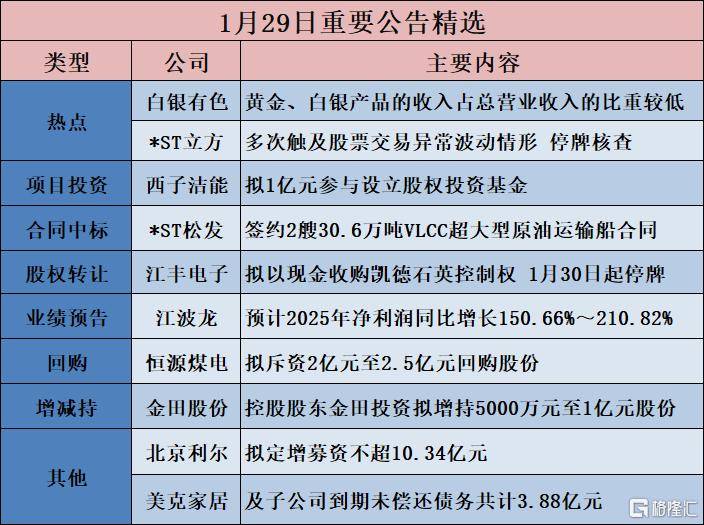
公告精选︱江波龙:预计2025年净利润同比增长150.66%~210.82%;白银有色:黄金、白银产品的收入占总营业收入的比重较低
Sou Hu Cai Jing· 2026-01-29 14:28
Group 1 - Silvercorp's revenue from gold and silver products accounts for a low proportion of total operating income [1] - ST Cube has repeatedly triggered abnormal stock trading fluctuations and is under suspension for verification [1] - Xizi Energy plans to invest 100 million yuan to establish an equity investment fund focusing on computing power, energy, AI, and embodied intelligence industries [1] Group 2 - ST Songfa has signed contracts for two 30.6 million ton VLCC super-large crude oil transport ships [1] - Jiangfeng Electronics intends to acquire control of Kaide Quartz for cash and will suspend trading from January 30 [1] - Jiangbolong expects a net profit growth of 150.66% to 210.82% year-on-year for 2025 [1] Group 3 - Hengyuan Coal Power plans to repurchase shares worth 200 million to 250 million yuan [1] - Jintian Co., Ltd. intends to increase its holdings by 50 million to 100 million yuan [1] - Beijing Lier plans to raise no more than 1.034 billion yuan through a private placement [1][2]


西子洁能(002534.SZ)拟1亿元参与设立股权投资基金 重点围绕算力、能源、AI、具身智能相关产业
Ge Long Hui A P P· 2026-01-29 13:33
Core Viewpoint - Xizi Clean Energy (002534.SZ) plans to invest in a new equity investment fund, focusing on technology innovation and strategic emerging industries [1] Group 1: Investment Details - The company will act as a limited partner in collaboration with Xi Jun Capital and Zhejiang Direction Investment Co., Ltd. to establish the Zhejiang Xi Jun Xijie Equity Investment Fund [1] - The total committed capital for the fund is RMB 240 million, with the company contributing RMB 100 million, representing 41.67% of the total commitment [1] Group 2: Investment Focus - The fund will primarily invest in equity of technology innovation enterprises, targeting projects that combine technological innovation with industrial upgrading [1] - Key focus areas include computing power, energy, artificial intelligence, and embodied intelligence industries, particularly in strategic emerging industries supported by national policies [1]

半导体设备ETF(159516)净流入超6.5亿份,近20日吸金超93亿元,AI浪潮推动算力需求爆发
Mei Ri Jing Ji Xin Wen· 2026-01-29 10:12
Group 1 - The core viewpoint of the article highlights the significant investment inflow into the semiconductor equipment ETF (159516), with a net inflow of 660 million shares, indicating strong market interest in this sector [1] - The AI wave is driving a surge in computing power demand, leading to increased value in segments such as servers, AI chips, optical chips, storage, and PCBs [1] - Nvidia's Rubin platform AI chip production is expected to enhance computing speed significantly while reducing costs, indicating a transformative impact on the industry [1] Group 2 - The storage prices have reached a bottom and are beginning to recover, while the utilization rate in the packaging and testing segment is gradually improving, driven by the growth in demand for advanced packaging related to AI chips [1] - TSMC's fourth-quarter revenue exceeded expectations, benefiting from a surge in AI application demand, and the next three years will focus on expanding advanced processes as a key strategy [1] - The passive components, digital SoC, and RF sectors are showing signs of recovery, indicating a positive trend in the upstream semiconductor industry [1] Group 3 - The semiconductor equipment ETF (159516) tracks the semiconductor materials and equipment index (931743), which includes publicly traded companies involved in semiconductor material research, production, sales, and equipment manufacturing [1]
精达股份(600577.SH):有部分产品直接或间接供货于汽车及AI头部企业
Ge Long Hui· 2026-01-29 07:53
Group 1 - The core viewpoint of the article is that Jingda Co., Ltd. (600577.SH) supplies certain products directly or indirectly to leading companies in the automotive and AI sectors, and the company plans to continue expanding in humanoid robots, AI, and computing power fields [1] Group 2 - The company has indicated its involvement in the automotive and AI industries, which are key growth areas [1] - Jingda Co., Ltd. aims to deepen its engagement in humanoid robotics and AI technologies, signaling a strategic focus on innovation and market leadership [1]

精达股份:有部分产品直接或间接供货于汽车及AI头部企业
Ge Long Hui· 2026-01-29 07:43
Group 1 - The company, Jingda Co., Ltd. (600577.SH), has indicated that some of its products are supplied directly or indirectly to leading companies in the automotive and AI sectors [1] - The company plans to continue its deepening and expansion in the fields of humanoid robots, AI, and computing power [1]
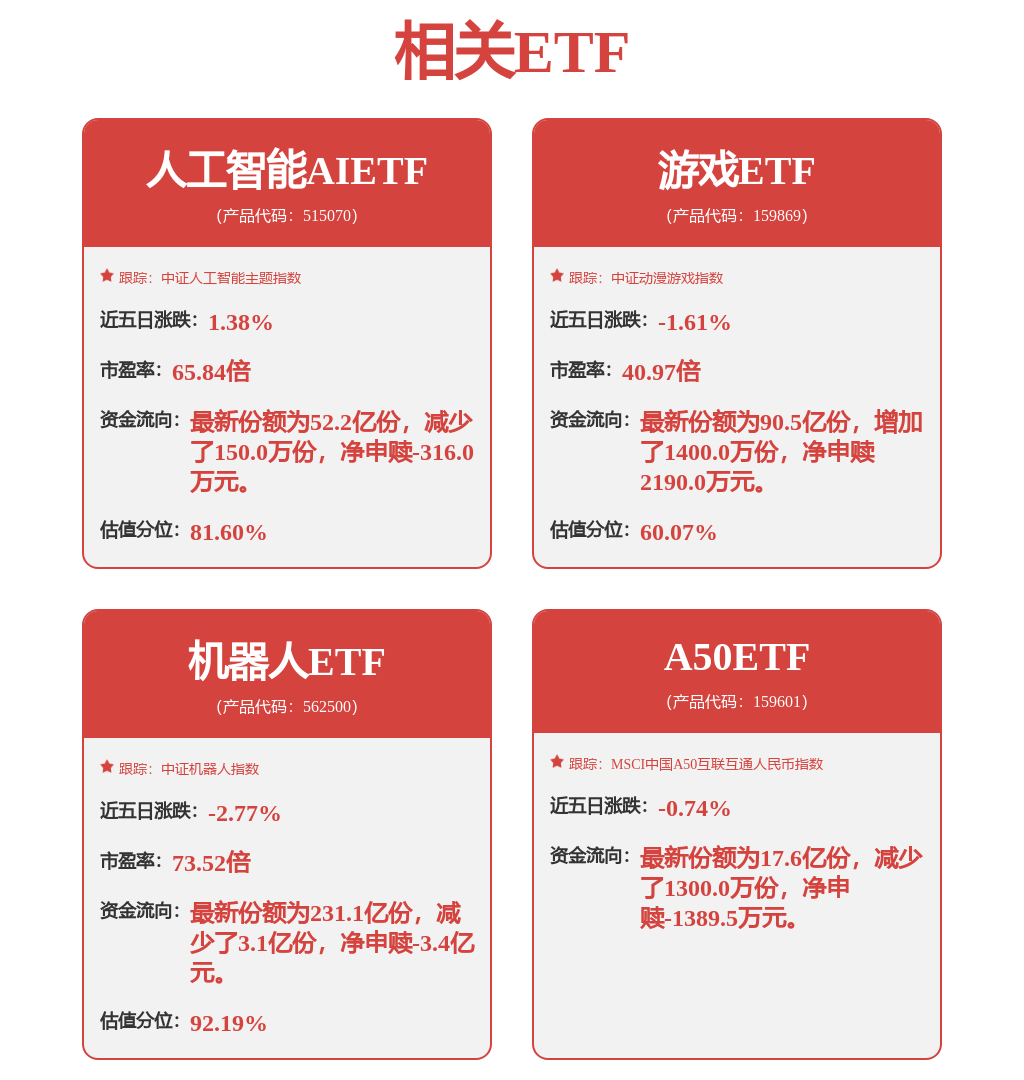
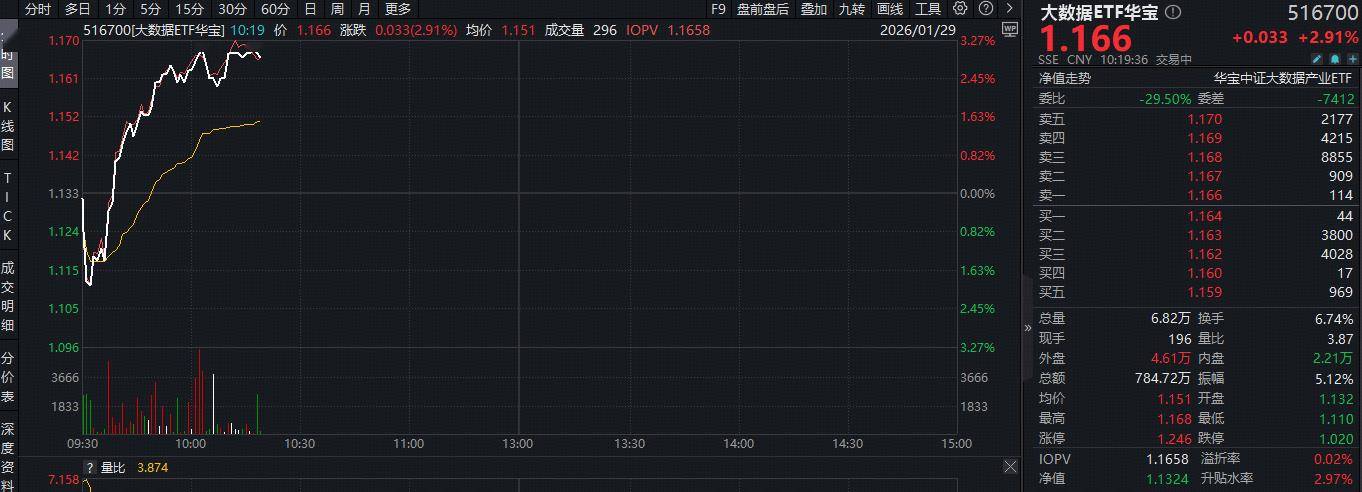
ETF盘中资讯|谷歌打响“云涨价”第一枪!国产云厂商有望跟进!大数据ETF华宝(516700)盘中大涨3%,科大讯飞涨停
Sou Hu Cai Jing· 2026-01-29 02:46
Group 1 - The core viewpoint of the news highlights the strong performance of the Huabao Big Data ETF (516700), which focuses on computing power and AI applications, with a notable increase in its stock price and significant gains among its constituent stocks [1][6] - Amazon Web Services (AWS) has raised its EC2 machine learning capacity block prices by approximately 15%, while Google Cloud plans to double data transfer prices in North America starting in May [3][4] - The increase in cloud service prices by AWS and Google is expected to prompt domestic cloud providers to follow suit, driven by rising CPU and storage costs and a surge in computing power demand due to complex task execution [4] Group 2 - The Huabao Big Data ETF's index composition shows that computing power concepts account for 40.91% and AI application concepts account for 37.43% as of the end of 2025 [5] - The ETF is positioned to track the CSI Big Data Industry Index, focusing on sectors such as data centers, cloud computing, and big data processing, with major holdings in leading companies like Inspur, iFlytek, and China Software [6] - The industry is witnessing a robust growth trend in the data center sector, driven by increased demand for computing power, particularly in North America and China, with significant projects still pending in overseas markets [4]

国联民生证券2026年电子业策略:把握AI创新 找寻价值扩张方向
Zhi Tong Cai Jing· 2026-01-29 01:52
Core Insights - The report from Guolian Minsheng Securities emphasizes the importance of the computing power industry as a foundation for technology, expressing a long-term positive outlook and deep tracking of the sector [1] - The firm suggests actively seeking investment opportunities in segments with value expansion and increased capital expenditure, maintaining a focus on "speed + power" as the main theme [1] Group 1: Future Opportunities in Computing Power - In the coming year, the firm highlights the need to observe the commercial closure rhythm of CSPs and large model manufacturers to grasp the overall industry beta [1] - The analysis of capital expenditure (Capex) and return on investment (ROI) is crucial, with demand for computing power primarily driven by the number of tokens and Capex [1] - Companies with strong commercial closures, such as Google, have established a positive cycle of "expenditure → computing power → tokens → revenue → reinvestment" [1] Group 2: Investment Themes in AI and Computing Power - The firm continues to focus on "speed + power" in overseas computing power investments, emphasizing trends in optical technology and PCB upgrades [2] - Key trends include the performance line of optical modules, shortages in optical chips, and the increasing penetration of silicon photonics [2] - The report notes that the power density of single cards and cabinets is continuously increasing, leading to new requirements for power architecture and making liquid cooling a standard in data centers [2] Group 3: Domestic Computing Power Growth - The domestic computing power sector is expected to experience rapid growth in 2026, driven by advancements in large models and positive capital expenditure outlook from cloud manufacturers [3] - The supply side is transitioning from single-point breakthroughs to multiple points of growth in advanced domestic processes [3] - The report also highlights the semiconductor sector, focusing on the super cycle of storage empowered by AI and the benefits to equipment manufacturers from original factory expansions [3]

盘前公告淘金:工业富联AI服务器业务狂飙!2025年四季度营收环比增长超50%,同比增长超5.5倍;海峡创新2025年净利同比预增超16倍
Jin Rong Jie· 2026-01-29 01:29
Group 1 - The core viewpoint of the news highlights significant projected profit increases for various companies in 2025, driven by rising production and sales in precious metals and advancements in technology sectors [1][3]. Group 2 - Xiaocheng Technology anticipates a net profit increase of 93%-179% year-on-year in 2025, with growth in gold production, sales, and international gold prices [1]. - Hunan Silver expects a net profit increase of 67.88%-126.78% in 2025, supported by rising silver and gold production and sales [3]. - Industrial Fulian projects a 56%-63% year-on-year increase in net profit for Q4 2025, with AI server revenue growth exceeding 50% quarter-on-quarter and over 5.5 times year-on-year [3]. - Keda Xunfei forecasts a net profit increase of 40%-70% in 2025, benefiting from the scaling of artificial intelligence applications [3]. - Albitex anticipates a net profit increase of 100.96% in 2025, primarily due to its focus on aerospace and expansion into the civilian market [3]. - Companies like Hainan Mining and Meixin Sheng are also making strategic acquisitions and investments to enhance their market positions [3].



2026年度投资策略:把握AI创新,找寻价值扩张方向
Guolian Minsheng Securities· 2026-01-28 15:40
Core Insights - The report emphasizes the importance of "speed + power" as the core contradiction in the future development of the AI industry, highlighting significant market movements in both speed and power sectors over the past year [1][9] - For 2026, the focus should be on observing the commercial closure rhythms of CSPs and large model vendors to grasp the overall industry beta, while actively seeking value expansion and capital expenditure shifts in specific segments [1][10] - The report suggests that capital expenditure (Capex) and return on investment (ROI) are critical variables in understanding computing power demand, which is primarily driven by token counts and Capex [1][10] Investment Strategy - The computing power industry is viewed as the foundation of technology, with a long-term positive outlook. The report recommends actively seeking value expansion and capital expenditure shifts in specific segments, maintaining the focus on "speed + power" [3][12] - Key areas of investment include domestic computing power, semiconductor equipment, storage, and AI terminals [3][12] Capital Expenditure Analysis - Major cloud service providers (CSPs) have significantly increased their capital expenditures, with the top five CSPs' combined Capex reaching $308.1 billion in Q3 2025, a 75% year-on-year increase [24][27] - Google, Microsoft, Amazon, Meta, and Oracle are leading this trend, with Google and Microsoft showing particularly aggressive Capex growth to support AI infrastructure [27][28] - The report highlights that Google’s Capex for 2024 is projected to be $52.5 billion, a 63% increase year-on-year, while Microsoft’s Capex is expected to reach $75.6 billion, an 84% increase [27][28] AI Model and Chip Development - The report discusses the rapid iteration of Google's Gemini model family, which has introduced significant advancements in AI capabilities, including multi-modal understanding and enhanced reasoning abilities [36][41] - NVIDIA is identified as a key player in the computing power landscape, with its customer base including CSPs, large model vendors, and government clients, driving substantial revenue growth [24][30] - The report notes that the demand for AI chips is expected to grow, with companies like OpenAI forming strategic partnerships with major chip manufacturers to enhance their infrastructure [62][63] Domestic Computing Power Growth - The report anticipates a breakthrough year for domestic computing power in 2026, driven by the acceleration of domestic large models and positive capital expenditure outlook from cloud vendors [2][6] - The supply side is expected to transition from single-point breakthroughs to multi-point developments, indicating a robust growth trajectory for domestic computing power vendors [2][6] Semiconductor and Storage Opportunities - The semiconductor sector is highlighted as benefiting from an AI-driven storage supercycle, with equipment manufacturers poised to gain from original factory expansions [2][8] - The report emphasizes the importance of AI in driving growth in the storage industry, predicting rapid expansion in this sector [2][8]





吉大通信(300597.SZ):预计2025年净亏损5960万元-8920万元
Ge Long Hui A P P· 2026-01-28 14:40
Core Viewpoint - Jida Communication (300597.SZ) expects a net profit attributable to shareholders of the listed company to be between -89.20 million and -59.60 million yuan for 2025, with a net profit excluding non-recurring gains and losses expected to be between -92.20 million and -62.60 million yuan [1] Group 1: Company Performance - The company's overall operations are significantly impacted by multiple factors including changes in the industry environment, intensified market competition, rising labor costs, external shocks, and strategic investments [1] - The traditional business represented by communication design and engineering services has been affected, leading to a decrease in profitability [1] Group 2: Industry Trends - The national communication and information industry is undergoing a deep structural adjustment, with the focus of industry development shifting from traditional infrastructure to emerging areas such as computing power and AI large models [1] - The ongoing industry transformation is resulting in increased market competition and a temporary compression of overall profit margins [1] Group 3: External Challenges - The overseas business has incurred losses due to multiple external factors, including declining project prices, increased workload, natural disasters, exchange rate fluctuations, and adjustments in local labor policies [1] - The company is continuously investing in research and development to promote business transformation, which is impacting overall profits in the short term [1]