
金融强国

Search documents
【专访】刘劲:建设金融强国,应聚焦国际化与市场化两大方向 | 前瞻十五五⑰
Sou Hu Cai Jing· 2025-11-14 02:38
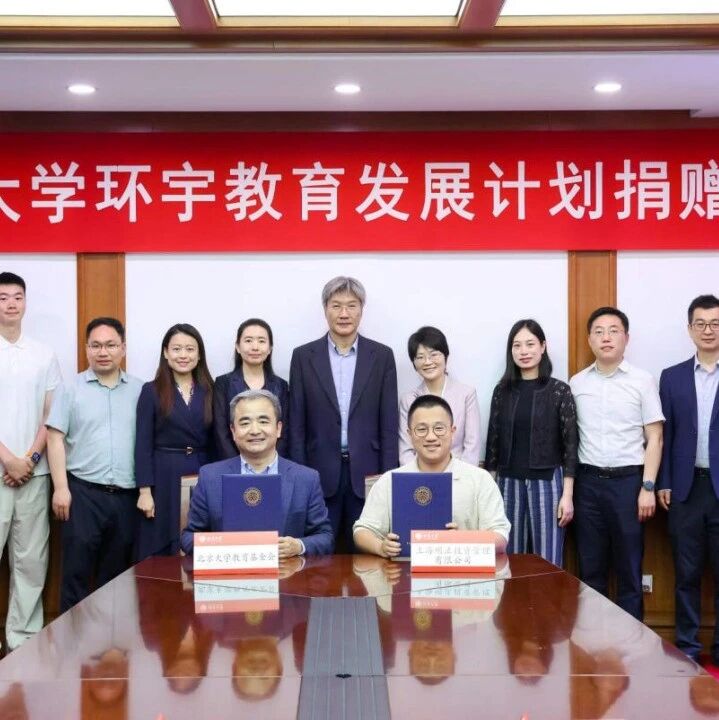
Core Viewpoint - The article emphasizes the urgent need for China to accelerate the construction of a financial powerhouse, highlighting the importance of financial reform and innovation in the context of international geopolitical challenges and the necessity for technological advancement [1][6]. Group 1: Financial Development Strategies - The main development focus for a financial powerhouse should be on internationalization and marketization [2]. - Marketization involves gradually replacing indirect financing with direct financing, creating a multi-layered financial system to support high-tech and strategic emerging industries [2][10]. - Internationalization aims to promote the international use of the Renminbi and establish an independent payment system [3][10]. Group 2: Achievements in Financial Reform - Significant progress has been made in the past five years, including the internationalization of the Renminbi and the establishment of a multi-layered financial system [8]. - The introduction of new market rules has adapted to the needs of a multi-layered financial system, allowing for different requirements for technology companies compared to traditional markets [8][12]. - High-quality opening-up has been achieved by relaxing restrictions on foreign financial institutions [9]. Group 3: Challenges and Future Directions - The current financial resource allocation primarily relies on the banking system, which needs to evolve to include stock markets, bond markets, and derivatives markets [10]. - Establishing an independent payment system is crucial for enhancing the international acceptance of the Renminbi, which requires creating a favorable market environment [10][11]. - The development of a robust derivatives market is essential for risk management, but it must be accompanied by strong regulatory frameworks to mitigate systemic risks [14][15]. Group 4: Balancing Traditional and Emerging Industries - The shift in focus from merely promoting high-tech industries to also enhancing traditional industries reflects a deep understanding of current economic realities, particularly regarding employment [16][17]. - Traditional industries play a vital role in job creation and economic stability, which is crucial for maintaining consumer spending and overall economic health [17].


中金 | 深度布局“十五五”:非银金融篇
中金点睛· 2025-11-14 00:18
Core Viewpoint - The article emphasizes that the high-quality development of the capital market will provide critical support for the "14th Five-Year Plan" period, enabling Chinese securities firms to embark on a journey towards becoming first-class investment banks [9][10]. Group 1: High-Quality Development of Capital Markets - The capital market is positioned as a crucial hub for modern economy and finance, facilitating precise resource allocation to strategic sectors, promoting technological innovation, and enhancing wealth accumulation for residents [3][4]. - The "14th Five-Year Plan" highlights the need for a financial powerhouse, advocating for the development of technology finance, green finance, inclusive finance, pension finance, and digital finance [3][4]. - The focus during the "14th Five-Year Plan" will be on three main directions: the dual expansion of quality assets and funds, steady advancement of high-level institutional openness, and continuous optimization of market ecology under strong regulation [4][5]. Group 2: Asset and Fund Expansion - The article notes that the demand for quality investment and financing tools will continue to grow, with a focus on nurturing a group of quality listed companies and enhancing the direct financing of equity and bonds [5][6]. - Specific measures include deepening reforms in the Sci-Tech Innovation Board and the Growth Enterprise Market, improving the identification and pricing mechanisms for technology innovation enterprises, and developing private equity and venture capital funds [5][6]. Group 3: High-Level Institutional Openness - The article discusses the ongoing emphasis on openness in China's capital market, with significant achievements during the "13th Five-Year Plan" period, such as the removal of foreign ownership limits and the optimization of the Qualified Foreign Institutional Investor system [6][7]. - The "14th Five-Year Plan" aims to further expand institutional openness, supporting the coordinated development of onshore and offshore markets and enhancing the international competitiveness of China's capital market [6][7]. Group 4: Regulatory Environment - The article highlights that a precise and efficient regulatory framework is essential for the stable operation of the capital market, with a focus on enhancing financial regulation and risk prevention mechanisms [7][8]. - The "14th Five-Year Plan" proposes a comprehensive strengthening of financial regulation, emphasizing the need for collaboration between central and local regulatory bodies [7][8]. Group 5: Opportunities for Securities Firms - The high-quality development of the capital market is expected to provide significant opportunities for Chinese securities firms, enabling them to transform their business models and expand their operational scope [9][10]. - The article suggests that the dual expansion of quality assets and funds will drive the transformation of securities firms, while high-level openness will help them break through local boundaries [9][10].

提升金融效能 护航“十五五”战略
Shang Hai Zheng Quan Bao· 2025-11-12 17:51
Core Viewpoint - The "15th Five-Year Plan" period is crucial for achieving socialist modernization and promoting high-quality financial development in China, necessitating a transformation in financial services to meet new demands from emerging factors, industries, and business models [1][2][3] Financial System Reform - The financial system must deepen reforms to enhance its effectiveness in serving the real economy, addressing structural contradictions such as excess funds but difficulty in investment and financing [2][5] - Five breakthroughs are needed to improve financial service efficiency: building a national credit market, enhancing service capabilities for new factors, adapting to new industry types, improving overall service integration, and forming a correct financial service concept [2][3][4] Achievements During the "14th Five-Year Plan" - Significant progress was made in financial service to the real economy, with improvements in the financial institutional framework and market scale [5][6] - By September 2025, China became the world's largest credit market with a credit balance exceeding 270 trillion yuan, and the bond market's scale surpassed 190 trillion yuan [6][7] Financial Institutions Development - Major state-owned financial institutions have strengthened, with the asset scale of the banking sector nearing 470 trillion yuan, and the securities industry rapidly developing [7][8] - Public funds have become the largest public investment product, with assets under management exceeding 36 trillion yuan, generating significant returns for investors [7][8] Financial Services for Innovation and Green Transition - Financial institutions are increasingly supporting technological innovation, with venture capital funds reaching 14.4 trillion yuan and supporting over 36,000 tech startups [8][9] - China has become the largest green credit market globally, with a significant increase in ESG investment practices among listed companies [8][9] Financial Market Opening - The financial system is expanding its openness, with over 160 licensed foreign financial institutions and significant foreign investment in domestic bonds and stocks [9][10] - Financial institutions are enhancing services for Chinese companies going abroad, facilitating cross-border transactions and listings [9][10] Enhancing Financial Service Capabilities - Financial institutions need to adapt to new economic dynamics by improving their service capabilities for new factors like data and technology, transitioning from real estate-focused services to those that support intangible assets [12][13] - There is a need for better valuation and pricing mechanisms for new asset types, with a focus on technology and data-driven investments [12][13] Addressing New Industry Types and Business Models - The shift towards new consumption and technology-driven industries requires financial institutions to innovate their service offerings, focusing on consumer experience and emotional value [15][16] - Financial services must evolve to support the unique characteristics of new technology firms, including high R&D costs and long development cycles [15][16] Improving Overall Financial Service Integration - Financial products need to be more integrated and adaptable to meet the diverse needs of enterprises, particularly in terms of flexible financing options [17][18] - There is a challenge in aligning financial services with the operational realities of businesses, especially for SMEs facing high entry barriers [17][18] Forming a Correct Financial Service Concept - A clear understanding of the relationship between finance and the real economy is essential, emphasizing that finance should serve as a tool for value creation [20][21] - The financial sector must balance profitability with its role in supporting national strategic goals and local economic needs [20][21]



保险业锚定“十五五”发展蓝图:筑牢民生保障与实体经济“安全网”
Jin Rong Shi Bao· 2025-11-12 02:17
Core Insights - The insurance industry has provided significant support to the national economy during the "14th Five-Year Plan" period, with total compensation reaching 9 trillion yuan and agricultural insurance covering 800 million farming households, laying a solid foundation for the upcoming "15th Five-Year Plan" [1][9] - The "15th Five-Year Plan" emphasizes the role of the insurance industry in enhancing financial strength, supporting rural revitalization, and improving social welfare through various insurance products [1][2] Group 1: Financial Strength and Economic Support - The "15th Five-Year Plan" suggests accelerating the construction of a financial powerhouse, focusing on technology finance, green finance, inclusive finance, pension finance, and digital finance to strengthen the real economy [2][3] - The insurance sector has effectively gathered resources towards new productive forces, with technology insurance providing over 10 trillion yuan in risk coverage and green insurance projected to exceed 330 trillion yuan in 2024 [2][3] Group 2: Risk Management and Social Stability - The insurance industry is expected to enhance its risk management capabilities, developing a comprehensive risk management system that includes pre-warning, response, and post-event support [3][4] - The focus on social governance through insurance products such as inclusive insurance, pension insurance, and health insurance aims to ensure that all residents have access to suitable and affordable insurance coverage [3][6] Group 3: Enhancing Welfare and Healthcare Systems - The "15th Five-Year Plan" highlights the need for a multi-tiered pension and healthcare system, with commercial insurance playing a crucial role in providing supplementary coverage [6][7] - The commercial health insurance sector has paid out 1.8 trillion yuan in economic compensation, supporting a multi-tiered healthcare system and covering 1.22 billion urban and rural residents through major illness insurance [7][8] Group 4: Agricultural Insurance and Rural Development - Agricultural insurance has provided coverage for 800 million farming households, with significant compensation for natural disasters, indicating a robust safety net for rural areas [9][10] - The insurance industry is encouraged to develop tailored products for rural infrastructure projects and provide inclusive pension and health insurance for farmers, addressing their specific needs [10]
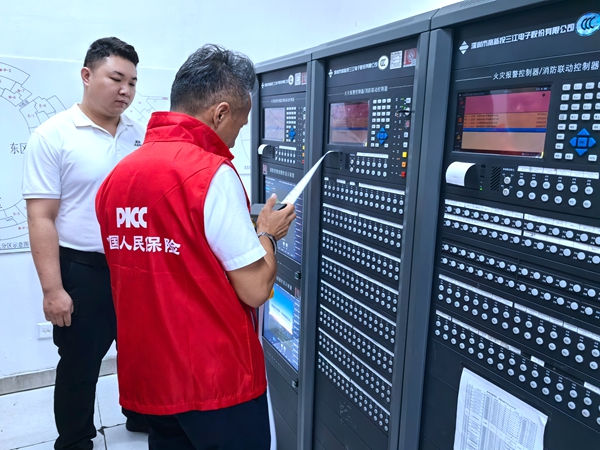
早新闻|000333,超30亿元分红
Zheng Quan Shi Bao· 2025-11-11 23:56
Macro Trends - The Ministry of Commerce plans to introduce more detailed measures to boost consumption, expand institutional openness, and promote trade innovation and investment cooperation [1] - The Financial Regulatory Bureau emphasizes the need for effective risk prevention in key financial areas and strengthening overall financial regulation [2] - The People's Bank of China aims to enhance macroeconomic governance efficiency through counter-cyclical adjustments and maintaining a balance between growth and risk prevention [2] Company News - Midea Group announces a profit distribution plan for mid-2025, proposing a dividend of 5 yuan per share, totaling 3.448 billion yuan [4] - Yonggui Electric signs a framework cooperation agreement with Zhiyuan Robotics [4] - Unigroup Guowei's HBM products for special industry applications are still in the development stage [4] - Yue Wanniang's controlling shareholder plans to reduce holdings by up to 3.66% [4] - Yonghui Supermarket's chairman's concerted action party intends to reduce holdings by less than 1% [4] - Shangwei New Materials' embodied intelligent robot business is still in product development [4] - Energy National Zhen plans to repurchase shares worth 50 million to 100 million yuan for capital reduction [4] - Zhonggu Logistics' controlling shareholder plans to reduce holdings by up to 3% [4] - Rejing Bio plans to repurchase shares worth 100 million to 200 million yuan [4] Stock Performance - Anker Innovation plans to issue H-shares and list on the Hong Kong Stock Exchange [5] - Qin'an Co., Ltd.'s controlling shareholder intends to transfer 5% of the company's shares [5] - Furui Co., Ltd.'s subsidiary faces ongoing loss risks [5] - Bangji Technology plans to terminate a major asset restructuring [5] - China Oil Engineering wins a joint bid for a project worth approximately 3.003 billion yuan in Kazakhstan [5] - Moen Electric reports no significant changes in the recent operating environment [5] - Bertley has achieved domestic production for most of its products' chips [5]

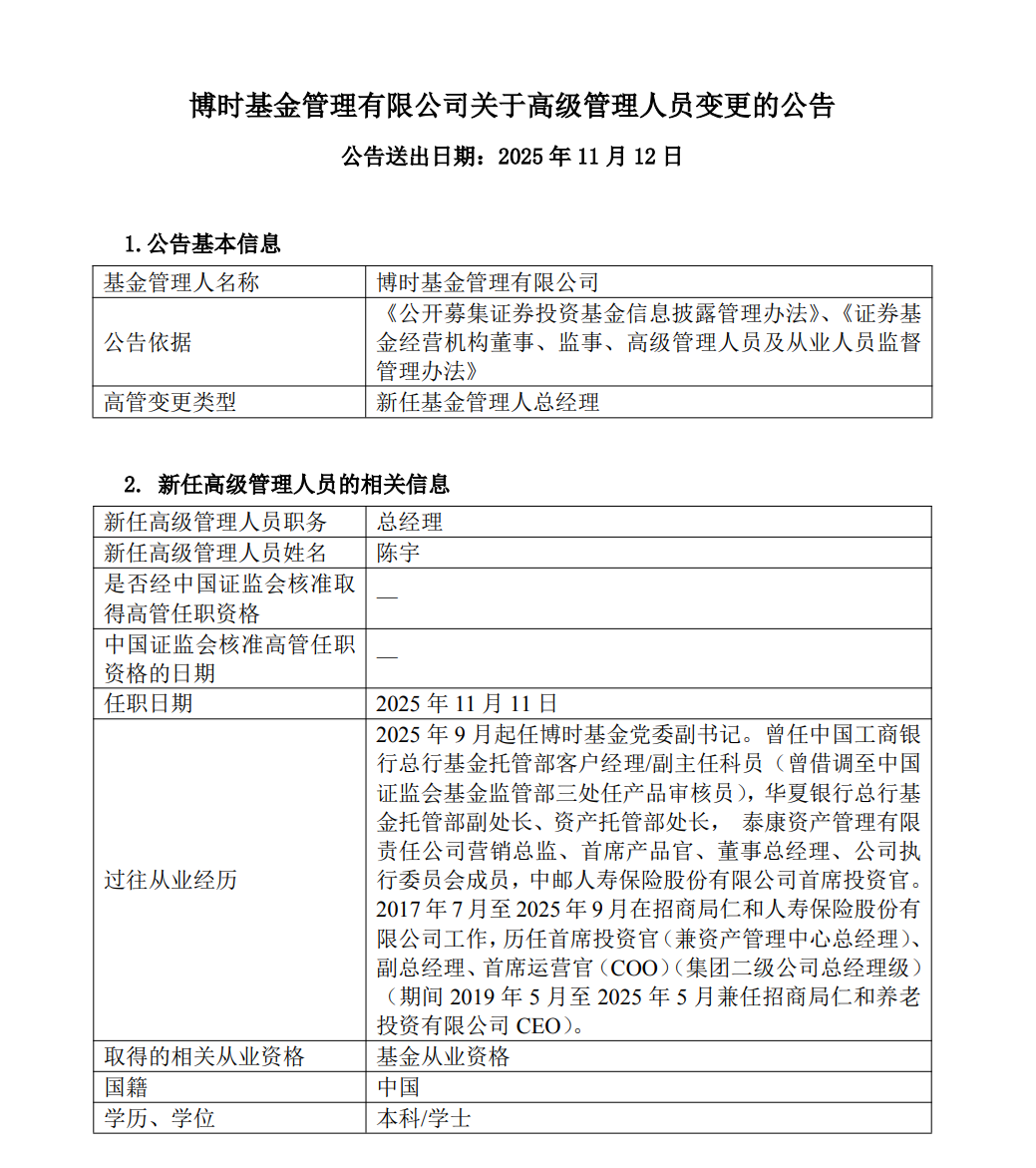
官宣!博时基金总经理定了
Zhong Guo Ji Jin Bao· 2025-11-11 18:16
Core Viewpoint - The appointment of Chen Yu as the new General Manager of Bosera Fund marks a significant leadership change in one of China's major fund management companies, which manages over 1.8 trillion yuan in assets, indicating a potential positive impact on the company's future development [1][2]. Group 1: Management Change - Chen Yu has officially taken over as General Manager of Bosera Fund, following the recent appointment of Zhang Dong as Chairman, completing a new leadership transition for the company [1][2]. - The change in management is expected to inject new vitality into Bosera Fund's ongoing development [1]. Group 2: Company Background - Bosera Fund is one of the first public fund companies established in China, currently managing 399 public funds with a total asset scale exceeding 1.8 trillion yuan and serving over 180 million clients [7]. - The company expresses confidence in the long-term stable growth of the Chinese economy and capital markets, aiming for high-quality development in alignment with national modernization efforts [7]. Group 3: Strategic Focus - Bosera Fund aims to create value for clients by prioritizing their interests, maintaining a long-term perspective, and matching products with client needs through quality service [8]. - The company plans to enhance its investment research capabilities and asset pricing abilities, providing multi-asset allocation solutions to discover investment value [8]. - Bosera Fund is committed to contributing to the construction of a financial powerhouse, actively participating in public fund reforms and innovations, and enhancing its international presence [9].
央行:强化宏观政策取向一致性 做好逆周期和跨周期调节
Sou Hu Cai Jing· 2025-11-11 09:11
Core Insights - The People's Bank of China (PBOC) released the monetary policy implementation report for Q3 2025, highlighting the challenges posed by external uncertainties and the need for stronger domestic economic recovery [1] Group 1: Economic Environment - The global economic landscape is facing significant challenges, with insufficient growth momentum and a divided performance among major economies [1] - China's economy continues to encounter risks and challenges, necessitating efforts to solidify the foundation for domestic economic recovery [1] Group 2: Policy Direction - The PBOC emphasizes the importance of maintaining strategic determination and confidence in achieving breakthroughs in tasks related to Chinese-style modernization [1] - Future monetary policy will be guided by Xi Jinping's thoughts on socialism with Chinese characteristics for a new era, focusing on the implementation of the 20th National Congress and other key meetings [1] Group 3: Financial Strategy - The PBOC aims to deepen financial reform and promote high-level opening-up, striving to build a strong financial nation and improve the central bank's system [1] - A comprehensive monetary policy framework and macro-prudential management system will be established to enhance the transmission mechanism of monetary policy [1] Group 4: Balancing Objectives - The PBOC will balance short-term and long-term goals, growth support and risk prevention, as well as internal and external equilibrium [1] - Emphasis will be placed on consistent macro policy orientation and effective governance to sustain growth, employment, and expectations [1]
“投资于人”!头部量化私募大动作
券商中国· 2025-11-10 23:43
Core Viewpoint - The article emphasizes the importance of accelerating the construction of a technology and financial powerhouse in China, highlighting the significant contributions of quantitative private equity firms in AI research and application, which not only drive the development of China's capital markets but also cultivate top-tier technology talent [1]. Group 1: Educational Initiatives - Minghong Investment has deepened its collaboration with universities, establishing various talent support programs, including scholarships at Shanghai Jiao Tong University and Fudan University, aimed at fostering technological innovation and supporting the cultivation of Chinese tech talent [2][4]. - The "Hui Ming Talent Support Program" at Fudan University has already funded over 20 senior experts and young scholars, covering various incentives such as named distinguished professor rewards and major achievement awards [8]. - Minghong's initiatives include the "Minghong Science and Technology Innovation Scholarship" at Shanghai Jiao Tong University, which directly incentivizes talent growth in fundamental disciplines [9]. Group 2: Collaborative Framework - Minghong Investment focuses on building a long-term collaborative mechanism with universities, emphasizing faculty development, discipline growth, and talent cultivation [4]. - The company has established the "Hui Ming Talent Support Program" at Fudan University and the "Hui Ming Education Development Plan" at Peking University, which aim to support various academic fields and promote interdisciplinary collaboration [4][8]. - Minghong's partnerships with universities are not limited to financial support but also include activities like campus visits and technical exchanges, fostering a dialogue between students and industry experts [7][11]. Group 3: Innovation Ecosystem - Minghong believes in creating an innovation ecosystem that encourages exploration, tolerates failure, and promotes breakthroughs, allowing academic freedom and industry insights to nourish each other [11][12]. - The company aims to provide a supportive environment for students to pursue their interests and develop their capabilities, emphasizing the importance of curiosity and self-exploration in education [11][12]. - Minghong's commitment to investing in people is seen as a long-term strategic choice, focusing on nurturing diverse talents who can contribute to societal progress [12][13]. Group 4: Future Directions - Minghong plans to continue its collaborative efforts with universities in talent cultivation, discipline development, and technological advancements, reinforcing its role in building a strong foundation for China's education, technology, and talent sectors [13]. - The company aims to create more opportunities for innovative talents, ensuring they can focus on exploration and creation without distractions [12][13].
深学细悟聚合力 笃信力行启新程——学习贯彻党的二十届四中全会精神中央宣讲团在豫座谈宣讲侧记
He Nan Ri Bao· 2025-11-08 23:36
Core Viewpoint - The article highlights the significance of the 20th Central Committee's Fourth Plenary Session and its implications for the financial sector, emphasizing the need for financial institutions to align with national strategies and enhance their roles in supporting economic development [1][4]. Group 1: Key Insights from the Session - The session featured a discussion led by Pan Gongsheng, focusing on the importance of the session's outcomes and the proposed guidelines for the 15th Five-Year Plan, which aims to bolster economic and social development [2][3]. - Pan emphasized the need for a scientific and stable monetary policy framework, noting that the People's Bank of China has implemented a moderately loose monetary policy this year to support economic stability [3]. - The session encouraged financial institutions to concentrate on their core businesses and improve governance, with specific suggestions for enhancing technology-driven financial services [3][4]. Group 2: Institutional Responses and Future Directions - Central to the discussions was the commitment of Zhongyuan Bank to integrate the session's spirit into its operational practices, focusing on political leadership and aligning with national strategies [4]. - The bank aims to provide targeted support for key areas such as technological innovation, green development, and inclusive finance, thereby contributing to the modernization of the Chinese economy [4]. - Feedback from participants indicated a strong motivation to enhance service quality and risk management practices in line with the session's teachings, reflecting a collective drive towards improving financial services [6].
记者手记 | 科技金融需要多种“化学反应”
Shang Hai Zheng Quan Bao· 2025-11-07 14:58
Core Viewpoint - The commercial aerospace sector is entering a "fueling era" of technology finance, supported by a robust ecosystem that facilitates various stages of financing and development for companies in this industry [1][2]. Group 1: Technology Finance Ecosystem - The development of commercial aerospace companies relies on a strong technology finance ecosystem, which includes early-stage VC and PE financing, bank loans for R&D projects, local platform funding, and IPO financing [1]. - The introduction of the fifth set of standards on the Sci-Tech Innovation Board has opened up IPO opportunities for unprofitable companies, particularly in the commercial aerospace sector [1]. Group 2: Accelerated IPO Process - The pace of IPOs for commercial aerospace companies has significantly accelerated this year, with several companies, including Beijing Xinghe Power Aerospace Technology Co., completing IPO counseling [2]. - Banks are providing unique value through technology loans to these companies, which require a strong risk management capability and willingness to lend [2]. Group 3: Collaborative Growth - A collaborative growth model is emerging among banks, investment institutions, and technology companies, where banks not only provide loans but also assist in subsequent financing rounds and listing guidance [2]. - The synergy between technology finance, policy, and market forces is essential for the growth of the commercial aerospace sector, particularly for small and medium-sized banks that need better support in various areas [3]. Group 4: Future Outlook - The continuous evolution of the technology finance system is expected to accelerate the development of the commercial aerospace industry, with a closer integration of technology innovation, market dynamics, and financial systems [3].