
高性能计算

Search documents
科研机构预算减半,特朗普2026预算提案或史无前例地“抠搜”?
Hu Xiu· 2025-05-11 12:17
Core Points - The proposed budget cuts by President Trump for the fiscal year 2026 represent unprecedented reductions in federal science funding, which could have immeasurable impacts on American science [1][4][18] - The budget proposal suggests a disproportionate reduction in federal science funding, with significant cuts to key agencies such as NSF, NIH, and EPA [1][7][9][15] Federal Science Funding Cuts - The overall non-defense spending is set to decrease by 23%, with the National Science Foundation (NSF) facing a 56% budget cut, the National Institutes of Health (NIH) budget reduced by approximately 40%, and the Environmental Protection Agency (EPA) budget cut by 55% [1][7][9][15] - The NSF's budget will drop by about $5 billion compared to 2024, primarily affecting climate science and clean energy projects [7] - NIH's budget is proposed to decrease from $48 billion in 2025 to $27 billion in 2026, marking the most severe cut in its history [9] Impacts on Specific Agencies - The NIH will consolidate its 27 institutes and centers into five new focus areas, eliminating funding for minority health and international research [10] - The CDC's budget is expected to be reduced by one-third, impacting chronic disease prevention programs [11] - NASA's budget will decrease by 24.3% to $18.8 billion, with significant cuts to its science departments and climate monitoring projects [12][13] - The Department of Energy (DoE) will see a nearly $5 billion reduction, particularly affecting climate science and clean energy research [14] - The EPA's budget will drop to $4.2 billion, with major cuts to environmental research and the dissolution of its Office of Research and Development [15] Congressional Response - The final federal budget will be determined by Congress, but there are indications that many members may support Trump's proposals [3][18] - Concerns have been raised by scientific policy experts regarding the long-term implications of these cuts on the future of American science and the message it sends to young scientists [4][18]
FC-BGA,需求大增
半导体行业观察· 2025-05-11 03:18
Core Viewpoint - The Japanese circuit board industry leader, IBIDEN, predicts significant growth in the AI server circuit board market, with sales expected to increase 2.5 times over the next 5 to 6 years, benefiting domestic companies like Samsung Electronics and LG Innotek [1][2]. Group 1: Market Growth and Projections - IBIDEN forecasts an 11% year-on-year increase in total sales for the fiscal year 2025, with the electronic division's sales, including FC-BGA, projected to reach $24 billion and operating profit to hit $3.3 billion, reflecting growth of 22% and 23% respectively compared to the previous year [1]. - By fiscal year 2030, sales of AI server substrates are expected to grow approximately 2.5 times from 2024, reaching $47.5 billion [2]. - The global FC-BGA market is anticipated to more than double from $8 billion in 2022 to $16.4 billion by 2030 [2]. Group 2: Technological Trends and Innovations - FC-BGA substrates are becoming essential in high-performance electronics due to their ability to provide higher I/O density and improved electrical performance compared to traditional packaging methods [3]. - The demand for miniaturization and enhanced functionality in consumer electronics, particularly in smartphones and IoT devices, is driving the adoption of FC-BGA substrates [3]. - The rise of 5G technology necessitates semiconductors capable of handling high-frequency signals, making FC-BGA substrates ideal for RF and millimeter-wave applications [4][5]. - The growth of automotive electronics, particularly in electric vehicles (EVs), is increasing the demand for efficient packaging solutions like FC-BGA that can manage higher power densities [6]. - High-performance computing (HPC) and AI workloads require low-latency processors, and FC-BGA substrates support heterogeneous integration of multiple chips, crucial for data centers and edge devices [7]. - Sustainability is becoming a key factor in semiconductor manufacturing, with FC-BGA substrates contributing to reduced material usage and improved energy efficiency [8]. Group 3: Challenges and Future Outlook - Despite the advantages of FC-BGA technology, challenges such as higher production costs and complexities in testing and inspection remain [8]. - The future of FC-BGA substrates looks promising, with emerging trends in heterogeneous integration and system-in-package (SiP) solutions expected to enhance performance [8]. - The semiconductor packaging landscape is undergoing a paradigm shift, with FC-BGA technology playing a critical role in meeting the complex demands of modern electronic devices and systems [8][9].

AI浪潮录丨人工智能为什么是年轻人的事业?专访95后师天麾
Bei Ke Cai Jing· 2025-05-09 00:52
Group 1 - Beijing is actively building itself as a "global open-source capital," with numerous research institutions and companies embracing open-source technology, which has penetrated various industries including automotive and robotics [1] - The AI industry is characterized by a significant presence of young talent, with 59.90% of active AI professionals being under 30 years old, indicating a shift towards a younger workforce in this sector [6] - The company Qingcheng Jizhi, founded by a group of Tsinghua University alumni, focuses on AI infrastructure and has an average employee age of under 30, reflecting the trend of youth in the AI field [7] Group 2 - The founder of Qingcheng Jizhi, Shi Tianhui, emphasizes the importance of innovation over traditional corporate structures, stating that large companies often impose constraints that hinder creativity [5] - The company has developed an open-source model inference engine called "Chitu," which allows for efficient deployment of AI models on both old NVIDIA GPUs and domestic chips, aiming to bridge the gap in computing power [17][19] - Qingcheng Jizhi's product offerings have shifted from training to inference services, with the emergence of DeepSeek leading to increased demand for their solutions, which are designed to be user-friendly and accessible to companies without specialized AI teams [14][15] Group 3 - The company aims to help domestic chips compete with NVIDIA by enhancing their capabilities through software solutions, rather than solely focusing on hardware advancements [19][21] - The current market shows a growing acceptance of domestic technology stacks, with state-owned enterprises beginning to procure domestic graphics card equipment, indicating a shift in market dynamics [20] - Qingcheng Jizhi's ultimate goal is to provide consistent performance across different hardware platforms, ensuring that users can achieve similar computational services regardless of the underlying technology [22]


华为招聘发布重要提醒!“内推实习”“实习推荐信”“远程实习”等都是假的
Mei Ri Jing Ji Xin Wen· 2025-05-08 01:35
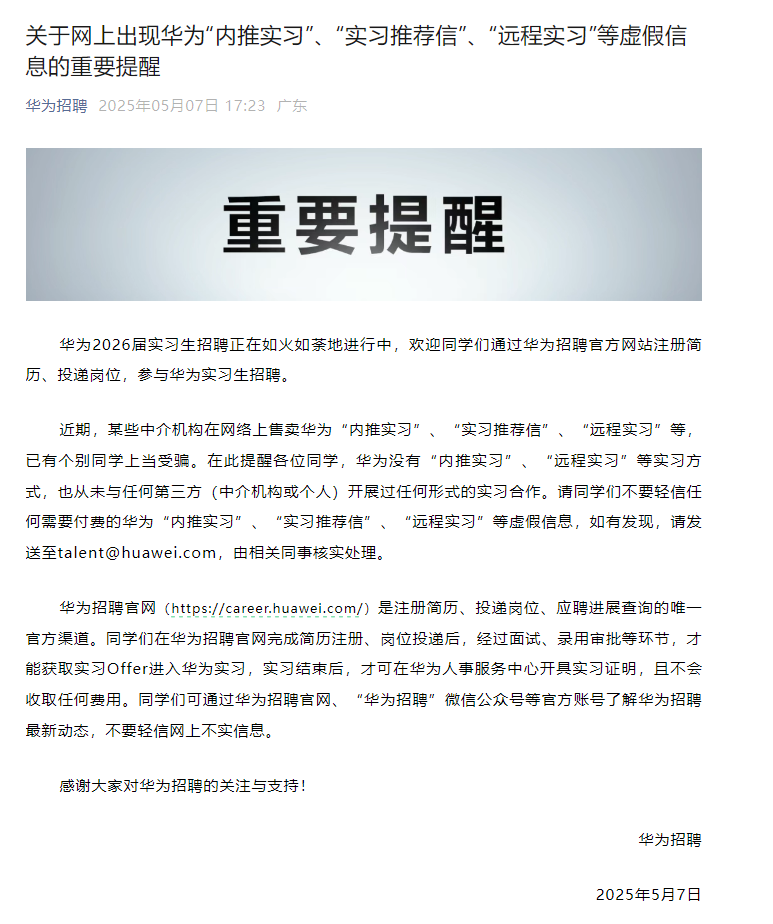
Group 1 - Huawei is actively recruiting interns for the 2026 cohort, encouraging students to apply through the official Huawei recruitment website [1] - There are reports of fraudulent activities by intermediaries selling fake internship opportunities related to Huawei, which the company denies [1] - Huawei emphasizes that the only official channel for internship applications is its recruitment website, and any fees for internship recommendations are scams [1] Group 2 - Huawei announced the opening of recruitment for over 10,000 positions for fresh graduates in 2025, with a focus on AI engineers and software developers, expecting a double-digit increase compared to 2024 [4] - The company aims to deepen talent acquisition in key areas such as AI models and high-performance computing, while also planning to train over 5,000 interns throughout the year [4] Group 3 - Huawei has developed a multi-layered training system and customized growth paths for its employees, with nearly 10,000 employees undergoing training and skill transformation in 2024 [5] - The company has established deep collaborations with over a hundred universities and various ecological enterprises, contributing to the development of a developer community exceeding ten million [5] - Huawei reported a global sales revenue of 862.1 billion RMB for 2024, marking a year-on-year growth of 22.4% [5]
存储,下一个 “新宠”
3 6 Ke· 2025-05-07 10:54
Group 1: Core Insights - The demand for data-centric workloads is increasing in the AI era, posing unprecedented challenges for modern servers, particularly in matching computing power with memory bandwidth [1] - A new memory technology, MRDIMM, has emerged, potentially becoming a key player in the AI storage industry and significantly impacting the memory market [1][2] Group 2: MRDIMM Technology Overview - MRDIMM is based on the LRDIMM architecture, evolving from DDR4 to DDR5, and utilizes a "1+10" configuration to achieve higher memory bandwidth [2] - The first generation of MRDIMM can reach speeds of 8800MT/s, while the second generation is expected to achieve 12800MT/s, with future generations projected to reach 17600MT/s by 2030 [3] Group 3: Performance Improvements - MRDIMM can operate two memory channels simultaneously, effectively doubling the data rate compared to standard DDR5 DIMMs, enhancing overall system performance [3][4] - In tests, MRDIMM demonstrated a 1.2 times improvement in computational efficiency over RDIMM, and a 1.7 times improvement when using TFF MRDIMM with doubled capacity [6][7] Group 4: Industry Developments - Major companies like Intel and AMD are launching processors that support MRDIMM, with Intel's Xeon 6 processors showing a performance increase of up to 33% when using MRDIMM [8][9] - Micron and Rambus have introduced MRDIMM products, with Rambus launching MRCD and MDB chips designed for 12800MT/s MRDIMM [9][10] Group 5: Future Prospects - The second generation of MRDIMM is expected to become the preferred memory solution for high-performance computing and AI applications, with increasing support from various CPU platforms [12] - MRDIMM is anticipated to coexist with HBM technology, offering advantages in capacity, cost-effectiveness, and scalability, thus driving innovation in the memory market [12]


台积电北美技术研讨会,全细节来了
3 6 Ke· 2025-05-05 23:13
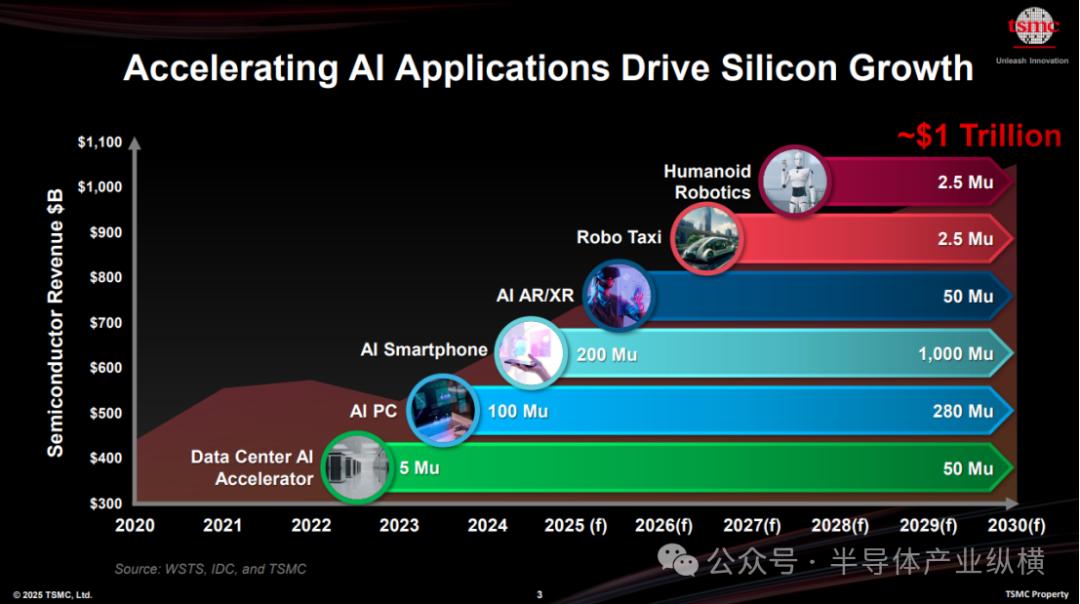
Group 1: Core Insights - TSMC's recent conference highlighted the rapid expansion of the semiconductor industry, projecting a market size of $1 trillion by 2030, driven primarily by high-performance computing (HPC) and artificial intelligence (AI) applications [2][4] - By 2030, HPC/AI is expected to dominate the semiconductor market, accounting for 45%, while smartphones will represent 25%, automotive electronics 15%, IoT 10%, and other sectors 5% [4][6] - The demand for semiconductors is accelerating due to AI-driven applications, including AI accelerators in data centers, AI PCs, AI smartphones, and long-term applications like robotic taxis and humanoid robots [4][6] Group 2: Advanced Process Technologies - TSMC's N3 series (3nm process) includes N3, N3E, and upcoming versions like N3P, which will enhance performance by 5% while reducing power consumption by 5% to 10% [7][9] - The N2 process (2nm) is expected to achieve a 10%-15% speed improvement or a 20%-30% power reduction compared to previous technologies, with transistor density increasing by 15% [12][18] - A16 technology, set for production in 2026, will utilize a super power rail architecture to improve logic density and efficiency, achieving an 8%-10% performance boost and a 15%-20% power reduction compared to N2P [19][20] Group 3: Advanced Packaging and System Integration Innovations - TSMC introduced the 3DFabric platform, which includes 2.5D and 3D integration technologies to overcome traditional design limitations and support high-density memory integration [24][30] - The CoWoS technology supports high-density interconnects and has been successfully applied in advanced products like Tesla's Dojo supercomputer [28][33] - Future applications, such as augmented reality glasses and humanoid robots, will require advanced packaging technologies to integrate numerous high-performance chips efficiently [37][40]

如何冷却1000W的CPU?
半导体行业观察· 2025-05-04 01:27
如果您希望可以时常见面,欢迎标星收藏哦~ 来源:本文编译自tomshardware,谢谢。 英特尔正在测试一种新方法,以应对其高耗电芯片不断增长的发热量。在最近的 Foundry Direct Connect 活动上,该公司展示了一种实验性的封装级水冷解决方案,旨在更高效地冷却 CPU。英 特尔拥有 LGA(平面栅格阵列)和 BGA(球栅阵列)两种 CPU 的工作原型,并使用英特尔酷睿 Ultra和至强服务器处理器进行了演示。 该冷却解决方案并非将冷却液直接喷洒在硅片上,而是在封装顶部放置一个专门设计的紧凑型冷却 块,其特征是铜制微通道,可精确引导冷却液流动。这些通道可进行优化,以针对硅片上的特定热 点,从而有可能在最关键的部位改善散热效果。 对于业内人士来说,这可能一开始没有意义,但看看未来的设计,在不同的工艺节点上可能会有不 同类型的tiles并执行不同的功能,有些区域比其他区域更热是有道理的,特别是因为每个tiles都可 以与周围的tiles相互作用。 目前,英特尔代工厂拥有多种热界面材料。"新型TIM"听起来像是液态金属。某些类型的TIM更适 合不同的应用,因此存在不同的选择也是合情合理的。 | Hi ...
台湾半导体材料,连续15年全球第一
半导体行业观察· 2025-05-01 02:56
如果您希望可以时常见面,欢迎标星收藏哦~ 来源:内容综合自网络,谢谢。 2024年全球半导体材料市场收入将达到675亿美元 根据SEMI的数据,2024年全球半导体材料市场收入将增长3.8%,达到675亿美元。 根据国际半导体产业协会(SEMI)材料市场数据订阅(MMDS)的数据,2024年全球半导体材 料市场收入增长3.8%,达到675亿美元。整体半导体市场的复苏,以及高性能计算和高带宽存储 器制造对先进材料需求的不断增长,支撑了2024年材料收入的增长。 台湾半导体材料产值达201亿美元,连续15年位居全球首位 中国台湾地区以201亿美元的营收连续15年成为全球最大的半导体材料消费地区。中国大陆地区 以135亿美元的营收继续实现同比增长,将在2024年位居第二;韩国则以105亿美元的营收位居 第三。除日本外,所有地区在2024年均实现了个位数增长。 | Region | 2024 | 2023 | YoY % Growth | | --- | --- | --- | --- | | Tawan | $20,090 | $18,734 | 7.2% | | China | $13.458 | $12,779 ...
英杰电气(300820):光伏业务短期承压 半导体领域积极拓展
Xin Lang Cai Jing· 2025-04-29 02:46
Core Viewpoint - The company reported a decline in net profit for 2024 and Q1 2025, while facing challenges in the domestic photovoltaic market and focusing on expanding its semiconductor business as a new growth avenue [1][2][3]. Financial Performance - In 2024, the company achieved revenue of 1.78 billion yuan, a year-on-year increase of 0.59%, while net profit attributable to shareholders was 323 million yuan, a year-on-year decrease of 25.19% [1]. - For Q1 2025, the company reported revenue of 325 million yuan, a year-on-year decline of 13.3%, and a net profit of 50 million yuan, down 36.84% year-on-year [1]. Industry Challenges - The domestic photovoltaic sector is experiencing significant pressure from price wars, leading to a 42% year-on-year decrease in order volume for photovoltaic equipment manufacturers in 2024 [2]. - The price war has spread from the silicon material segment to the mid and downstream sectors, causing a substantial contraction in profits across the entire industry chain [2]. Strategic Initiatives - To mitigate the impact of the domestic photovoltaic market downturn, the company is enhancing its overseas market expansion, achieving better order performance in Asia [2]. - The company is increasing its investment in the semiconductor sector, which is expected to benefit from a recovery driven by AI, high-performance computing, and 5G technologies, with the global semiconductor market projected to reach $628 billion in 2024, a year-on-year growth of 19.1% [3]. - The company is focusing on key semiconductor processes such as etching, chemical vapor deposition (CVD/PECVD), and ion implantation, while also exploring emerging fields like silicon carbide epitaxy and composite copper foil [3]. Investment Outlook - Revenue projections for the company from 2025 to 2027 are estimated at 2.56 billion yuan, 3.046 billion yuan, and 3.65 billion yuan, with net profits of 586 million yuan, 736 million yuan, and 903 million yuan respectively [4]. - The company is assigned a target price of 53.03 yuan based on a 20x PE ratio for 2025, maintaining a "Buy-A" investment rating [4].

华勤技术(603296)2024年年报与2025年一季报点评:2025Q1营收高速增长 打造全球智能产品平台
Xin Lang Cai Jing· 2025-04-29 02:40
Core Viewpoint - The company reported strong revenue growth driven by high-performance computing and effective cost control, with expectations for continued growth in 2025. Financial Performance - In 2024, the company achieved revenue of 109.878 billion yuan, a year-on-year increase of 28.76%, and a net profit of 2.926 billion yuan, up 8.1% year-on-year [1] - In Q4 2024, revenue reached 33.868 billion yuan, a year-on-year increase of 65.58%, with a net profit of 876 million yuan, up 21.25% year-on-year [1] - In Q1 2025, revenue was 34.998 billion yuan, a year-on-year increase of 115.65%, with a net profit of 842 million yuan, up 39.04% year-on-year [2] Business Segments - High-performance computing generated revenue of 63.2 billion yuan in 2024, a year-on-year increase of 28.79%, accounting for 57.54% of total revenue [4] - Data center revenue grew by 179% year-on-year, while the notebook and smart terminal segments also saw significant growth [4] - AIoT and other segments reported revenue of approximately 4.672 billion yuan, a year-on-year increase of 187.93% [4] - Automotive electronics revenue was approximately 1.562 billion yuan, a year-on-year increase of 91% [4] Strategic Initiatives - The company is advancing its "3+N+3" strategic upgrade, focusing on personal digital terminal hardware, office productivity hardware, and data center infrastructure [5] - Increased R&D investment and the establishment of a global R&D headquarters in Shanghai are part of the strategy to enhance product offerings and supply chain resilience [5] - The company anticipates overall revenue growth of over 20% in 2025, supported by a robust supply chain and inventory management [5] Profit Forecast - Revenue projections for 2025-2027 are 135.254 billion yuan, 162.791 billion yuan, and 191.553 billion yuan, respectively, with net profits of 3.538 billion yuan, 4.165 billion yuan, and 4.778 billion yuan [6] - The expected EPS for the same period is 3.48 yuan, 4.10 yuan, and 4.70 yuan per share, with corresponding PE ratios of 19, 16, and 14 [6]
