
不动产投资信托基金

Search documents
基金市场双周报:REITs市场跟踪双周报:三只REITs首发获批,二级市场小幅震荡-20250930
Shanghai Securities· 2025-09-30 07:44
Issuance Market - The report highlights the establishment of Huaxia Kaide Commercial REIT with a total issuance scale of 2.287 billion yuan and an average allocation ratio of 0.29%. A total of 16 REITs have been issued this year, representing a decrease of 5.88% in quantity and a decrease of 12.65% in total issuance scale compared to the same period last year, amounting to 33.548 billion yuan [1][7][10] - The report indicates that compared to franchise REITs, property REITs have a significant advantage in both quantity and scale this year, accounting for approximately 88% of the total issuance [7][10] Secondary Market - Currently, there are 75 REIT products in the market with a total scale of 221.253 billion yuan. Property REITs lead the market, with a scale of 130.744 billion yuan, while franchise REITs have a scale of 90.509 billion yuan, showing a gap of over 40 billion yuan [2][17] - The REIT market experienced a slight decline of 0.69% in this period, trailing behind major stock indices. Year-to-date, the overall increase in the REIT market is 12.83%, which is lower than major stock indices but better than the CSI Dividend Index [2][18] Dividend Situation - In this period, 17 REITs distributed dividends totaling 1.302 billion yuan, marking a 44% increase compared to the previous period. The total dividends for the REIT market in 2025 amount to 8.245 billion yuan, with a dividend yield of 4.53%, which is on par with the CSI Dividend Index [3][30][34] - Franchise REITs have a higher dividend yield of 5.92% compared to property REITs, which have a yield of 3.41%. The report notes that franchise REITs have consistently outperformed property REITs in terms of both dividend amount and yield [3][30][34] Investment Value Analysis - The latest valuation for all property REITs is 26.19, slightly lower than the previous period, indicating a higher valuation compared to major stock indices. The report notes that the valuation for affordable housing REITs is relatively high, while industrial park REITs have the lowest valuation [4][38] - The report also highlights that the dividend yield for property REITs, based on actual dividends over the past year, is 3.85%, which is significantly higher than stock indices. The dividend yield calculated based on available distributable amounts is 4.03%, with industrial park REITs showing the highest yield at 4.50% [4][38][39]
公募REITs周报(第36期):曲折下行,换手率下降-20250927
Guoxin Securities· 2025-09-27 08:39
1. Report Industry Investment Rating No relevant content provided. 2. Core Viewpoints - As market risk appetite continued to rise, the China Securities REITs Index fell 0.8% this week, with property - type REITs and franchise - type REITs averaging - 0.9% and - 0.8% respectively. All sectors closed down, with water conservancy facilities, municipal facilities, and affordable housing having the largest declines. The 9 - department joint issuance included community commercial infrastructure in the priority support scope for REITs, further expanding the underlying asset scope of REITs [1]. 3. Summary by Related Catalogs 3.1 Secondary Market Trends - **Index Performance**: As of September 26, 2025, the closing price of the China Securities REITs (closing) Index was 831.45 points, with a weekly decline of 0.8%, performing worse than the China Securities All - Bond Index (- 0.3%), the China Securities Convertible Bond Index (+ 0.9%), and the CSI 300 Index (+ 1.1%). Year - to - date, the performance order of major indices was: CSI 300 (+ 15.6%) > China Securities Convertible Bond Index (+ 15.3%) > China Securities REITs Index (+ 5.3%) > China Securities All - Bond Index (+ 0.0%). In the past year, the return of the China Securities REITs Index was 5.6% with a volatility of 7.2%. Its return was lower than that of the CSI 300 Index and the China Securities Convertible Bond Index but higher than that of the China Securities All - Bond Index; its volatility was lower than that of the CSI 300 Index and the China Securities Convertible Bond Index but higher than that of the China Securities All - Bond Index [2][7][8]. - **Market Value and Turnover**: The total market value of REITs decreased to 219 billion yuan on September 26, a decrease of 2.5 billion yuan from last week. The average daily turnover rate for the whole week was 0.33%, a decrease of 0.13 percentage points from the previous week [2][8]. - **REITs Performance by Attribute and Type**: From the perspective of different project attributes, property - type REITs and franchise - type REITs had average weekly changes of - 0.9% and - 0.8% respectively. All REITs sectors closed down, with water conservancy facilities, municipal facilities, and affordable housing having the largest declines. The top three REITs in terms of weekly gains were Bosera Jinkai Industrial Park REIT (+ 1.64%), CITIC Construction Investment SPIC New Energy REIT (+ 0.98%), and CICC Liandong Science and Technology Innovation REIT (+ 0.71%) [3][16][20]. - **Trading Activity and Fund Flow**: New infrastructure REITs had the highest trading activity this week, with an average daily turnover rate of 1.1%. Transportation infrastructure REITs had the highest trading volume ratio this week, accounting for 26.3% of the total REITs trading volume. The top three REITs in terms of net inflow of main funds were CJG First Agriculture REIT (14.67 million yuan), Southern Runze Technology Data Center REIT (10.93 million yuan), and Huaxia China Resources Commercial REIT (8.37 million yuan) [3][22][23]. 3.2 Primary Market Issuance As of September 26, 2025, there were 2 REITs products in the accepted stage, 1 in the in - inquiry stage, 3 in the feedback - received stage, 8 products that had passed and were awaiting listing, and 11 first - issued products that had passed and were listed [25]. 3.3 Valuation Tracking - **Valuation Indicators**: REITs have both bond and equity characteristics. As of September 26, the average annualized cash distribution rate of public - offering REITs was 6.2%. From the equity perspective, the relative net value premium rate, IRR, and P/FFO were used to judge the valuation of REITs. The relative net value premium rate reflects the relationship between the market value and the fair value of the fund, similar to the PB indicator of stocks; IRR is the internal rate of return calculated by the cash - flow discount method; P/FFO is the current price divided by the cash flow generated from operations [27]. - **Valuation by Project Type**: Different project types of REITs had different relative net value premium rates, P/FFO, IRR, and annualized dividend rates. For example, affordable housing had a relative net value premium rate of 44.1%, P/FFO of 34.7, IRR of 3.4%, and an annualized dividend rate of 3.3% [28]. - **Comparison with Benchmarks**: As of September 26, 2025, the dividend rate of property - type REITs was 81 basis points higher than the average dividend rate of CSI Dividend stocks, and the average internal rate of return of franchise - type REITs had a spread of 173 basis points compared with the 10 - year Treasury bond yield [30]. 3.4 Industry News - **Policy Update**: The Ministry of Commerce, together with eight other departments, issued a notice including community commercial infrastructure in the priority support scope for REITs, which helps expand the underlying asset scope of REITs and solve the capital problem in community commercial development [4][35]. - **Approved REITs Projects**: Huaxia China Overseas Commercial REIT was approved, providing a model for the transformation and upgrading of traditional real - estate enterprises. Huaxia Anbo Warehouse REIT was officially approved for issuance, with its underlying assets having obvious location advantages. Shenyang International Software Park Public - Offering REIT was approved, being the first successful public - offering REIT project in Northeast China [35].
中基协:7月ABS新增备案规模逾1400亿元
Zhong Guo Xin Wen Wang· 2025-08-27 11:36
Core Insights - In July 2025, the China Securities Investment Fund Industry Association (CSRC) reported that the newly registered Asset-Backed Securities (ABS) totaled 1440.49 billion RMB, with 153 new registrations [1] - The top three ABS underlying assets by registration scale were financing lease receivables (313.66 billion RMB), accounts receivable (309.34 billion RMB), and small loan receivables (247.95 billion RMB) [1] - As of the end of July 2025, there were 2557 ABS in existence, with a total scale of 21646.76 billion RMB [1] ABS Market Overview - The newly registered ABS included 6 public REITs focused on infrastructure, amounting to 147.33 billion RMB [1] - The existing ABS related to infrastructure public REITs totaled 79, with a scale of 1951.3 billion RMB [1] - The combined scale of ABS related to accounts receivable, real estate holding ABS, CMBS (Commercial Mortgage-Backed Securities), financing lease receivables, and small loan receivables accounted for 17066.48 billion RMB, representing 78.84% of the total existing scale [1]
公募REITs,本周震荡下行!
Zhong Guo Ji Jin Bao· 2025-08-22 15:05
Group 1 - The overall secondary market for public REITs experienced a downward trend this week, despite a strong stock market, with increased trading activity compared to the previous week [1][2] - The CSI REITs total return index fell by 1.74% week-on-week, while the REITs index decreased by 1.55% [2] - Various project types saw declines, with property rights down by 1.93% and franchise rights down by 1.10% [3] Group 2 - Among the 74 public REITs listed, only 9 saw an increase, with notable performers including China International Capital Corporation Chongqing Liangjiang REIT and Industrial Bank Galaxy North Expressway REIT, both rising over 1% [4][5] - Conversely, 64 products experienced declines, with China International Capital Corporation Xiamen Anju REIT and Huatai Suzhou Hengtai Rental Housing REIT dropping over 6% [6] Group 3 - The total transaction amount for REITs this week was 3.633 billion yuan, with a rebound in trading activity [6] - The newly listed Southern Universal Data Center REIT showed high trading activity, with an average turnover rate of 3.02% [6] Group 4 - The recent strength in the equity market, with the Shanghai Composite Index surpassing 3,800 points, has negatively impacted the REITs market, which is closely linked to the bond market [7] - A significant portion of public REITs' strategic placement shares will be unlocked from September to December 2025, totaling 3.83 billion shares, which may lead to selling pressure [7] Group 5 - The first public REIT for transportation infrastructure this year, Huaxia Hubei Traffic Chutian Expressway REIT, has been officially filed [8] - Hubei Province has actively promoted the issuance of public REITs, with a total of 8 REITs issued, raising 24 billion yuan, ranking among the top in the country [8]

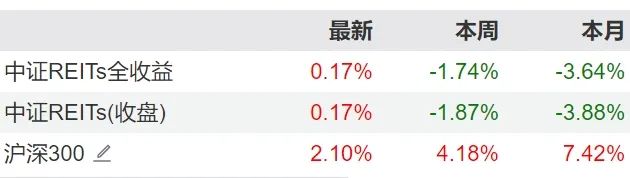
公募REITs,本周震荡下行!
中国基金报· 2025-08-22 14:45
Core Viewpoint - The public REITs market in China experienced a downward trend this week, despite a strong performance in the stock market, with overall trading activity increasing compared to the previous week [2][3]. Market Performance - The CSI REITs Total Return Index fell by 1.74% this week, while the REITs Index decreased by 1.55% [4]. - Year-to-date performance shows a decline of 3.64% for the CSI REITs Total Return Index and 3.88% for the closing index [5]. - All categories of REITs saw declines, with property rights down by 1.93% and concession rights down by 1.10% [5]. Sector Analysis - The performance of various sectors is as follows: - Industrial parks down by 1.41% - Warehousing and logistics down by 1.23% - Ecological and environmental protection down by 1.05% - Highways down by 0.78% - Energy down by 1.19% - Affordable rental housing down by 4.52% - Consumer sector down by 1.89% - Municipal sector down by 2.61% - Water conservancy down by 3.44% - Data centers down by 0.75% [5]. Individual REITs Performance - Among the 74 public REITs listed, only 9 saw an increase, with notable performers including: - China International Capital Corporation Chongqing Liangjiang REIT up by 2.33% - ICBC Hebei Expressway REIT up by 2.18% - CITIC Securities Mingyang Intelligent New Energy REIT up by 1.38% - Guotai Junan Dongjiu New Economy REIT up by 1.36% [6][7]. - Conversely, 64 REITs experienced declines, with the largest drops seen in: - China International Capital Corporation Xiamen Anju REIT down by 6.28% - Huatai Suzhou Hengtai Rental Housing REIT down by 6.18% - Huatai Shanghai Real Estate Rental Housing REIT down by 5.65% [8]. Trading Activity - Total trading volume for REITs this week was 3.633 billion yuan, with an increase in trading activity compared to the previous week [8]. - The newly listed Southern WanGuo Data Center REIT had a high trading activity with an average turnover rate of 3.02% [8]. Market Outlook - Analysts suggest that the recent strength in the equity market, with the Shanghai Composite Index surpassing 3,800 points, has negatively impacted the REITs market, which is closely linked to the bond market [9]. - A significant portion of public REITs will face a large-scale unlock of strategic placement shares from September to December 2025, totaling 3.83 billion shares, which may lead to selling pressure, particularly in the park infrastructure and transportation infrastructure categories [9]. New REITs Filing - The first public REIT for transportation infrastructure this year, Huaxia Hubei Traffic Chutian Expressway REIT, has been officially filed, marking a significant development in the REITs landscape [11].

畅链挖潜:私募REITs赋能不动产投融资新格局
Sou Hu Cai Jing· 2025-08-19 15:02
Core Viewpoint - The article discusses the significance and development path of private REITs in China's multi-tiered REITs market, emphasizing their role in revitalizing existing assets and broadening financing channels [1][3]. Group 1: Significance of Private REITs - The introduction of private REITs helps to revitalize corporate existing assets, alleviate debt pressure, and achieve equity financing, particularly for state-owned enterprises under the "one interest, five rates" policy [1][3]. - Private REITs enrich equity investment varieties, providing new allocation channels for long-term funds such as insurance and bank wealth management, promoting a virtuous investment cycle in the capital market [1][3]. - They fill the product gap between quasi-REITs and public REITs, enhancing the overall efficiency of the real estate investment chain [1][3]. Group 2: Product Positioning of Private REITs - Private REITs should be positioned as "real estate private equity investment" tools with standardized equity financial characteristics, emphasizing floating returns rather than fixed interest arrangements [5][6]. - The development direction of private REITs should focus on "standardization of private equity investment" rather than merely replicating public REITs, highlighting flexibility and market-oriented arrangements [5][6]. Group 3: Core Points of Private REITs - High asset quality requirements are essential for private REITs, suitable for stable cash flow and predictable income infrastructure projects [6]. - Transaction structures should be simplified to enhance issuance efficiency and lower participation barriers for investors while ensuring investor rights [6]. - Valuation methods must be reasonable and transparent to avoid significant fluctuations that could undermine investor confidence [6]. - Moderate leverage can enhance investor returns, with recommendations to refer to commercial bank mortgage rates and asset management regulations on equity product leverage limits [6]. - A multi-tier governance structure should be established to balance the rights and responsibilities among original equity holders, managers, and investors [6]. - Diverse exit mechanisms should be designed to ensure investor exit rights, including secondary market transfers and prioritized acquisition arrangements [6]. - Encouragement of diverse investors such as insurance, bank wealth management, securities, and funds is necessary to enhance market liquidity and pricing efficiency [6]. Group 4: Policy Recommendations for Promoting Private REITs - Establish a robust information disclosure mechanism to enhance transparency in asset valuation and product net value during the registration and operational phases [6]. - Improve asset operation governance and incentive mechanisms, including a classification management system for significant events and floating management fees [6]. - Promote liquidity construction by introducing market makers to enhance secondary market liquidity and ensuring smooth exit channels for investors [6]. - Allow flexible fundraising during the product's existence to ensure asset quality and valuation rationality while protecting existing holders' rights [6]. Group 5: Conclusion - Private REITs represent a crucial component of China's multi-tiered REITs market with significant development potential, aiming to serve the real economy and enhance direct financing ratios [7]. - Future efforts should focus on regulatory guidance to promote the orderly development of the private REITs market, creating a new real estate investment and financing landscape with Chinese characteristics [7].

基础设施REITs发展驶入快车道
Xin Hua Wang· 2025-08-12 06:26
Core Viewpoint - The State Council's recent opinion aims to promote the healthy development of infrastructure REITs, enhancing the efficiency of recommendations and reviews, and encouraging more eligible projects to be issued and listed [1][3]. Group 1: Infrastructure REITs Development - Infrastructure REITs have become a market hotspot since the first public offerings in June 2021, with 12 listed projects raising a total of 45.8 billion yuan [2]. - The issuance of infrastructure REITs provides a sustainable funding source for infrastructure investments, addressing the challenge of financing [2][4]. - The government is actively working to expand the pilot programs for infrastructure REITs, with various regulatory bodies collaborating to improve the system and broaden the scope [2][3]. Group 2: Policy Support and Market Expansion - The recent opinion emphasizes improving the efficiency of project recommendations and reviews, allowing for more flexibility in operational requirements for projects that stabilize supply chains and ensure public welfare [3]. - The establishment of a multi-tiered infrastructure REITs market is being explored, which could enhance the scale and attractiveness of public REITs products [3][4]. - The introduction of a mechanism for expanding fundraising is expected to facilitate the entry of quality infrastructure assets into the capital market [3]. Group 3: Diversification and New Projects - The recent announcement regarding the issuance of REITs for affordable rental housing marks a significant step in diversifying the types of infrastructure REITs available [5][6]. - The first batch of affordable rental housing REITs projects has been officially submitted for approval, indicating a breakthrough in expanding the REITs pilot projects [5]. - Financial institutions are actively participating in various REITs projects across multiple sectors, including water conservancy and rental housing [8]. Group 4: Challenges and Future Directions - The infrastructure REITs market is still in its early stages, with strict requirements for underlying asset projects and a lack of clarity in tax policies [9]. - Recommendations include gradually relaxing asset selection criteria, improving tax regulations, and increasing public investor participation to enhance market activity [9]. - The regulatory bodies are working on improving the rules and guidelines for REITs, aiming to strengthen the market and promote high-quality development of the multi-tiered capital market [9].
公募REITs总发行规模超千亿元 险资参与度有望持续提升
Xin Hua Wang· 2025-08-12 05:47
Core Viewpoint - The public REITs market in China is experiencing rapid expansion, with a total issuance scale exceeding 100 billion yuan, indicating strong interest from insurance capital [1][2][3] Group 1: Market Overview - As of March 6, 33 public REITs have been issued with a total scale of 107.426 billion yuan, and insurance capital has allocated approximately 14.79 billion yuan, accounting for 13.8% of the total issuance [1][2] - The number of REITs awaiting approval has reached 18, reflecting the ongoing growth of the market [1] Group 2: Insurance Capital Participation - Insurance institutions show high enthusiasm for participating in public REITs, with their investment as strategic investors and in offline placements nearing 14% of total fundraising [2] - Companies like Dajia Asset have been actively investing in public REITs since 2021, with total investments nearing 200 million yuan [2] Group 3: Investment Characteristics - Public REITs offer relatively stable returns, with volatility between fixed-income and equity products, aligning well with the investment attributes of insurance capital [3] - The adjustment of risk factors for insurance companies investing in public REITs has improved capital efficiency, further encouraging participation [3] Group 4: Future Challenges and Opportunities - The expansion of the REITs market presents broader allocation opportunities for insurance capital, but it also poses challenges regarding research and investment capabilities [4] - The need for optimized assessment mechanisms for REITs investments is highlighted, as traditional annual assessment methods may not effectively capture the long-term nature of these investments [4] Group 5: Recommendations - It is suggested that with the increase in public REITs, index-based operations could be developed to facilitate participation from institutional clients like insurance capital [5]

2025年公募REITs市场7月报:消费板块走势稳健,交通、保租房派息率提升-20250804
Shenwan Hongyuan Securities· 2025-08-04 13:44
1. Report Industry Investment Rating There is no information provided regarding the industry investment rating in the document. 2. Core View of the Report - In July 2025, the REITs index fluctuated and corrected, with the consumption sector showing steady performance. The dividend - payout ratio spread between REITs and CSI Dividend narrowed, and the dividend - payout ratios of transportation and rental housing for guaranteed occupancy increased. Guojun Lingang REIT's expansion will increase the distribution ratio in 2025. The first - time issuance of data center REITs saw a narrowing of the first - day listing gains [4]. 3. Summary by Relevant Catalogs 3.1 REITs Index Fluctuated and Corrected, Consumption Sector Showed Steady Performance - **Index Performance**: In the second half of July, the CSI REITs (closing) index and CSI REITs Total Return Index fell by 0.4%/0.2% cumulatively. In the last week of July, as the 10 - year Treasury yield and the stock market both fluctuated and declined, the REITs market regained its upward momentum. Since the beginning of 2025, the CSI REITs (closing) index and CSI REITs Total Return Index have risen by 10.4%/13.9% cumulatively, outperforming the CSI 300 Index [4][9]. - **Sector Performance**: - Consumption sector: It has maintained an upward trend for 7 consecutive months, with an average increase of 1.81% in July, and the number of rising REITs accounted for 67% [4][13]. - Ecological and environmental protection sector: The turnover rate reached 1.27% (month - on - month increase of 0.35 pct), with some individual REITs rising and some falling [4][17]. - Industrial park and warehousing logistics sectors: They have risen for 3 consecutive months, but the average increase has shown a narrowing trend [4][13]. - Transportation sector: It fell for the first time since 2025, with an average decline of 0.75%, and the number of falling REITs accounted for more than half [4][13]. - Rental housing for guaranteed occupancy and water conservancy facilities sectors: They corrected for the first time after rising for 4 consecutive months, with an average decline of 1.95%/1.49% in July [4][13]. - Energy sector: It had the deepest decline in July, with an average decline of 2.94% [4][13]. - **Dividend - Payout Ratio**: As of July 31, 2025, the average TTM dividend - payout ratios of equity - type and concession - type REITs were 3.72%/7.16% respectively. Among equity - type REITs, warehousing logistics and industrial parks had relatively high dividend - payout ratios, while rental housing for guaranteed occupancy had a relatively low but increasing ratio. Among concession - type REITs, transportation REITs' leading advantage in dividend - payout ratio further expanded [4][20]. - **Valuation**: For concession - type REITs, the energy sector had a relatively high valuation, while the transportation sector had an attractive IRR. For equity - type REITs, the industrial park sector's IRR returned to the historical central level [21][25]. 3.2 Guojun Lingang REIT's Expansion, Distribution Ratio in 2025 to Increase - **Expansion Plan**: On July 29, 2025, Guojun Lingang Industrial Park REIT announced an expansion plan, with a proposed issuance share limit of 446.1 million shares and a proposed fundraising of no more than 1.7235 billion yuan. The expansion asset is the Kangqiao project, with an evaluation value of 1.532 billion yuan, a 69.19% increase compared to the book value [4][37]. - **Distribution Ratio Forecast**: After the expansion, the predicted distributable amounts for the period from April - December 2025 and 2026 are 82.52 million yuan and 110.6 million yuan respectively. With a fundraising of 1.7235 billion yuan, the predicted distribution ratios for 2025 and 2026 are 4.11%/4.15%, and the 2025 distribution ratio is 0.39 pct higher than before the expansion [4][37]. 3.3 First - Time Issuance of Data Center REITs, Narrowing of First - Day Listing Gains - **New Issuance**: In July 2025, two data center REITs were issued for the first time, enriching the underlying asset types of REITs. The number of offline inquiry institutions reached a new high, but the effective subscription multiple decreased due to the large issuance scale of the new projects, and the配售 ratio increased slightly to 0.6% [4]. - **Market Performance**: Affected by the secondary - market adjustment, the two REITs listed in July did not trigger the daily limit, with an average first - day closing increase of 24.2%. From January to July 2025, the offline total returns for 0.5/1 billion yuan of funds were 1.4214 million yuan/2.8428 million yuan, with a return rate of 2.84%. The three REITs with the first - time strategic placement unlocking in July all had positive returns, with an average unlocking return rate of 46.39%. There are currently 11 first - time issuance REITs projects in the queue [4].
资产证券化系列报告一:我国资产支持证券存量规模超3万亿元,公募REITs从破冰到常态化发行,未来空间可期
Bank of China Securities· 2025-06-30 06:40
Investment Rating - The report suggests a positive outlook on the real estate sector, particularly focusing on the potential of asset-backed securities and public REITs as investment opportunities [3][4]. Core Insights - The asset-backed securities (ABS) market in China has surpassed 3 trillion yuan, indicating its significance in the capital market. The growth in public REITs is expected to provide better exit channels for real estate companies, especially those with substantial real estate holdings [2][3][27]. - The report emphasizes the advantages of real estate as a suitable asset for securitization due to its inherent rental properties that generate stable cash flows and potential for appreciation [13][14]. Summary by Sections 1. Asset Securitization Overview - Asset securitization has evolved into a crucial financing tool in China's capital market, with a focus on transforming illiquid assets into liquid securities [13][14]. - The report categorizes standardized asset securitization products into credit ABS, corporate ABS, and asset-backed notes (ABN), highlighting the differences in regulatory oversight and asset types [25][26]. 2. Market Scale and Growth - As of May 2025, the total scale of asset securitization products in China reached 3.09 trillion yuan, accounting for 6.2% of the total bond market [27][29]. - The issuance of asset securitization products saw a significant increase in 2024, with 2,085 products issued, totaling 1.98 trillion yuan, marking a year-on-year growth of 6.7% [36][38]. 3. REITs Development - The report outlines the development of REITs in China, noting the transition from initial trials to a more structured and regular issuance process, with a total of 66 public REITs issued by May 2025, amounting to approximately 1744 billion yuan [19][21][22]. - The expansion of REITs into various sectors, including rental housing and commercial real estate, is highlighted as a significant opportunity for real estate companies to optimize their asset management and liquidity [3][19]. 4. Investment Recommendations - The report recommends focusing on companies with stable and mature asset portfolios in the long-term rental apartment and commercial real estate sectors, such as China Resources Land, China Overseas Development, and Longfor Group [3][4].