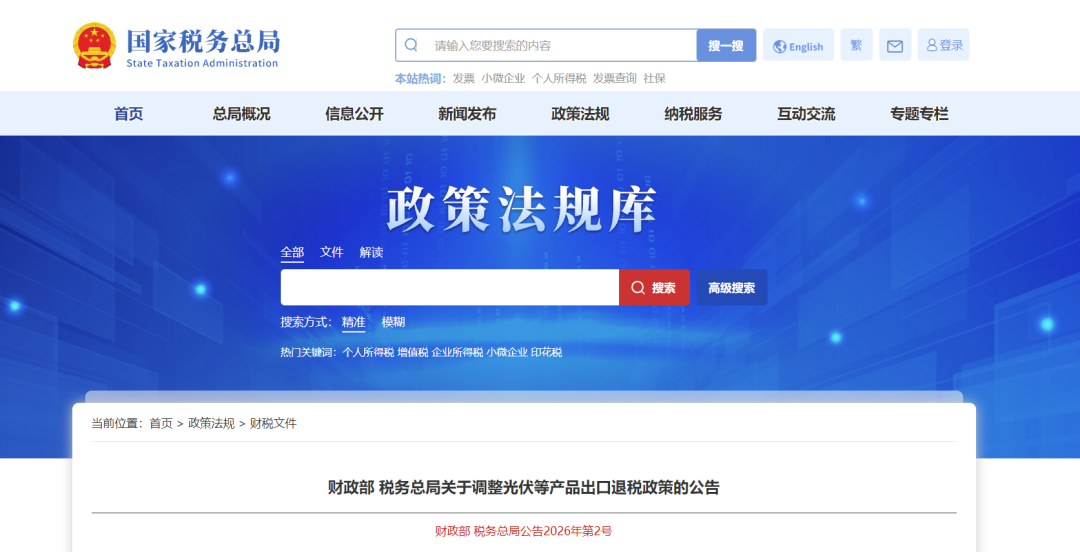
出口退税政策调整

Search documents
光伏出口退税再调,倒逼产业加速转型
中国能源报· 2026-01-19 13:08
Core Viewpoint - The cancellation of export tax rebates for photovoltaic products is expected to increase export costs in the short term, causing price disturbances. However, in the long run, it aims to shift the photovoltaic industry from a quantity-driven model to a quality-driven one, promoting a more sustainable and higher-value development path for the industry [2][3]. Policy Adjustment - The Ministry of Finance and the State Taxation Administration announced the cancellation of VAT export rebates for certain products, including photovoltaic products, effective April 1, 2026. This marks the second significant adjustment to the export tax rebate policy within a year, drawing considerable attention from the industry [3][5]. - The products affected primarily include monocrystalline silicon wafers with a diameter greater than 15.24 cm, unassembled solar cells, and photovoltaic modules, which are commonly traded in the market [5]. Market Response - The cancellation of approximately 9% export tax rebate is projected to increase the cost of photovoltaic products by 0.06 to 0.07 yuan per watt. To maintain reasonable profit levels, export prices would need to rise above 0.8 yuan per watt, impacting the pricing structure and profitability of companies [6]. - A transition period of about three months has been set, leading to expectations of a surge in exports before the new policy takes effect. Analysts predict a potential doubling of battery component exports in the first quarter of 2026 as companies rush to fulfill orders [8][9]. Industry Dynamics - The adjustment is seen as a response to the ongoing trend of increasing export volumes but decreasing prices, with the total export value of photovoltaic products declining by 13.2% year-on-year despite volume growth [9]. - The policy aims to guide the industry away from low-price competition and homogenization, pushing for a transition to high-quality development. This is crucial as the industry faces intense competition and declining prices in international markets [11]. Long-term Implications - The cancellation of export tax rebates is expected to accelerate industry differentiation, benefiting leading companies with pricing power while forcing low-margin firms reliant on subsidies to exit the market [12]. - The industry is encouraged to focus on technological innovation, product differentiation, and brand value rather than competing solely on price, which could lead to more sustainable growth and reduced trade friction [12].

回天新材:有望在行业调整期进一步巩固市场地位
Zheng Quan Ri Bao Wang· 2026-01-19 09:49
Group 1 - The core viewpoint of the article is that the adjustment of export tax rebate policies will promote the transformation of related industries towards high-quality development in the long term [1] - The company, Huaitian New Materials, believes it can further consolidate its market position during the industry adjustment period due to its technological advantages, product quality, and customer base [1] - The company plans to actively respond to the challenges and opportunities brought by policy changes through continuous technological innovation, product upgrades, and customer service [1]

集运指数(欧线)观点:弱势震荡,04滚动布空、10空单酌情持有-20260118
Guo Tai Jun An Qi Huo· 2026-01-18 13:32
Report Industry Investment Rating No relevant content provided. Core Viewpoints of the Report - The current view on the Container Shipping Index (European Line) is weak oscillation. For the 2604 contract, consider rolling short - selling, and for the 2610 contract, hold short positions as appropriate [1][4][9] - Although there is marginal positive news about the rush - export of photovoltaic and battery products in the first quarter, it cannot reverse the weak supply - demand balance in the European Line during the off - season from March to April [9] Summary by Directory Overview - The Container Shipping Index (European Line) is expected to oscillate weakly. For the 2604 contract, consider rolling short - selling, and for the 2610 contract, hold short positions as appropriate [4] - In January and February, the sailings of the AEU7 and FE4 routes at the end of January were generally delayed. After adjustment, the capacity statistics for the 5th week (January 26 - February 1) increased by 2 blank sailings, and the capacity statistics for February (February 2 - March 1) decreased by 2 blank sailings. Considering the sailings from January 26 to March 1 as a whole, the capacity remained unchanged. In March, there were 8 blank sailings and 1 pending. The weekly average capacity was revised up from 284,000 TEU/week last week to 295,000 TEU/week, a year - on - year increase of 9.5% and a month - on - month increase of 5.2%. The Spring Festival blank sailings are mainly concentrated from the end of February to the first week of March [4] Supply - By reviewing the capacity distribution in the 5 weeks before and after the Spring Festival from 2024 to 2026, it is found that the post - festival capacity growth rate is significantly higher than that before and during the festival, indicating greater post - festival capacity pressure. In 2026, the average capacities before, during, and after the Spring Festival were 306,000, 234,000, and 322,000 TEU respectively, with year - on - year growth rates of - 0.1%, 9.1%, and 26.3% [5] - The unstable situation in Iran has risen, and the geopolitical risk in the Middle East may recur. Maersk plans to structurally resume the operation of the MECL route connecting the US East Coast and India/Middle East at the end of January and has formulated contingency plans. There is still a possibility that shipping companies will selectively resume sailing in the Red Sea after the Chinese Spring Festival until the second quarter [5] Demand - Due to the adjustment of the export VAT rebate policy, the rush - export of photovoltaic components may lead to a transfer of 20,000 - 50,000 TEU of transportation demand on the European Line from Q2 to Q1, and a total of 40,000 - 70,000 TEU of transportation demand on the Europe - Mediterranean route may be advanced. The concentrated rush - export may occur from the end of February to March [7] - The probability of a full - load situation at the end of February and the shipping companies announcing a General Rate Increase (GRI) on March 1 is relatively low. The rush - export of photovoltaic products is difficult to change the pattern of over - capacity at the monthly level, and the probability of continuous full - load is almost zero. The advance of some Q2 transportation demand to Q1 is negative for the transportation demand after April [7] Valuation - The average FAK in the 4th week may be around $2,600/FEU. For the 2602 contract, assuming that the market center drops by a total of $700/FEU in the 5th and 6th weeks, considering the impact of sailing delays and cargo rejection, the valuation of the 2602 contract may be around 1,700 points, and it is expected to fluctuate with a narrow reduction in positions in the future [8] Viewpoints - For the 2604 contract, although there is marginal positive news about the rush - export of photovoltaic and battery products in the first quarter, it cannot reverse the weak supply - demand balance in the European Line during the off - season from March to April. In the next 1 - 2 months, consider rolling short - selling the 2604 contract, with the upper resistance level referring to the range of 1,200 - 1,250 points [9] - For the 2610 contract, last week's morning report suggested paying attention to the opportunity to establish short - position bottom positions, with the upper resistance level referring to the settlement price of 1,161 points for the 2510 contract. Affected by Maersk's MECL route resumption announcement, the expectation of resumption has increased, but the progress of the Gaza peace negotiation and the geopolitical situation in Iran still need to be monitored. Hold short positions as appropriate [9] - Strategy: For single - side trading, roll short - sell the 2604 contract and hold short positions of the 2610 contract as appropriate; for arbitrage, there is currently no opportunity [9] Revision Rules of the Container Shipping Index (European Line) Futures Standard Contract - According to the announcement of the Shanghai International Energy Exchange, the contract months are adjusted from "February, April, June, August, October, December" to "the nearest 1 - 6 consecutive months (excluding February) and the following two quarterly months", and the minimum price change is adjusted from "0.1 point" to "0.5 point" [20] - The adjustment of contract months will be implemented from February 10, 2026 (Tuesday), with the addition of EC2605, EC2607, and EC2609 contracts. Considering the switch of the main contract, EC2603 will not be added. On March 31, 2026 (Tuesday), EC2703 will be added, and the back - end months will be adjusted according to the contract regulations [20] - The impact on the futures market: The derived arbitrage trading may be more diverse. In addition to the conventional arbitrage opportunities between bi - monthly contracts, pay attention to potential positive arbitrage opportunities such as 8 - 9 and 9 - 10 [20] Price - The SCFIS index on January 19 mainly reflects the prices of sailings departing in the 3rd week. It is expected that the SCFIS index on the 19th will be flat or lower than that on the 12th, with a subjective prediction in the range of 1,850 - 1,950 points [28] - The average FAK in the 4th week may be around $2,600/FEU. The prices of major shipping companies show a downward trend [29][32] Demand Side - From the perspective of Asia's exports to Europe, in 2025, the container trade volume between Asia and Europe (Northwest Europe + Mediterranean) showed certain changes compared with previous years. The trade volume in some months increased year - on - year, while in others it decreased [43] - From the perspective of Asia's exports to North America, in 2025, the container trade volume between Asia and North America also showed different trends in each month compared with previous years, with some months showing growth and others showing decline [45] Supply Side Supply Chain Risk Events - There are geopolitical risks in the Middle East, such as Iran's warning and Houthi armed forces' threats. Maersk plans to resume the MECL route at the end of January, and diplomatic efforts to resolve the Gaza conflict are ongoing [50] European Line Sailing Schedule - In January and February, the sailings of the AEU7 and FE4 routes were delayed. The capacity statistics were adjusted accordingly, with an increase of 2 blank sailings in the 5th week and a decrease of 2 blank sailings in February. In March, there were 8 blank sailings and 1 pending, and the weekly average capacity increased [52] Capacity Comparison - By comparing the capacity before and after the Spring Festival from 2024 to 2026, it is found that the supply pressure in the 3 - 5 weeks after the Spring Festival may be greater than that before the Spring Festival [55] Turnover Efficiency - Information on the sailing speed of container ships, the number of idle container ships, and the congestion situation in various regions and ports is provided, which helps to understand the turnover efficiency of the shipping market [67][71][73] Static Capacity - Information on the delivery of new container ships of the top ten shipping companies in the past and future is provided, including the delivery of 12,000 - 16,999 TEU and 17,000 + TEU container ships [85][88]
出口退税逐步取消,产业链“抢出口”推高碳酸锂价格
Xin Jing Bao· 2026-01-16 12:49
Core Viewpoint - The Chinese government will eliminate the export VAT rebate for photovoltaic products and lithium battery products starting from April 1, 2026, with a transitional reduction in the rebate rate for battery products from 9% to 6% until the end of 2026, followed by a complete cancellation in 2027 [1][2]. Group 1: Policy Impact - The policy aims to reduce trade friction, promote industrial upgrading, and prevent "involution and externalization" of competitive advantages in the lithium battery sector [2][8]. - The expected impact on export VAT rebates is approximately $22 billion in 2026 and $66 billion in 2027, based on projected export growth rates [9]. - The transition period allows companies to adjust prices to mitigate the impact, potentially leading to a surge in exports before the policy takes full effect [2][4]. Group 2: Market Dynamics - The lithium battery export market is experiencing a shift from a traditional off-peak season to a peak season due to the new policy, which is expected to drive demand [3]. - A "scramble for goods" is occurring throughout the lithium battery supply chain, with companies preparing to increase production and stock up before the policy changes [4]. - The price of lithium carbonate futures has surged significantly, with a year-to-date increase of 37.25% as of mid-January 2026, indicating strong market demand [5][6]. Group 3: Industry Strategy - The policy is designed to guide companies away from price competition and towards technological upgrades and brand building, ensuring sustainable development of the industry [7][8]. - Major Chinese battery manufacturers are expanding their production capacity overseas, particularly in Southeast Asia and Europe, which will enhance their global competitiveness and profitability [4][8].
碳酸锂开年凶猛,冲破17万关口后向哪里去?
Tai Mei Ti A P P· 2026-01-15 11:26
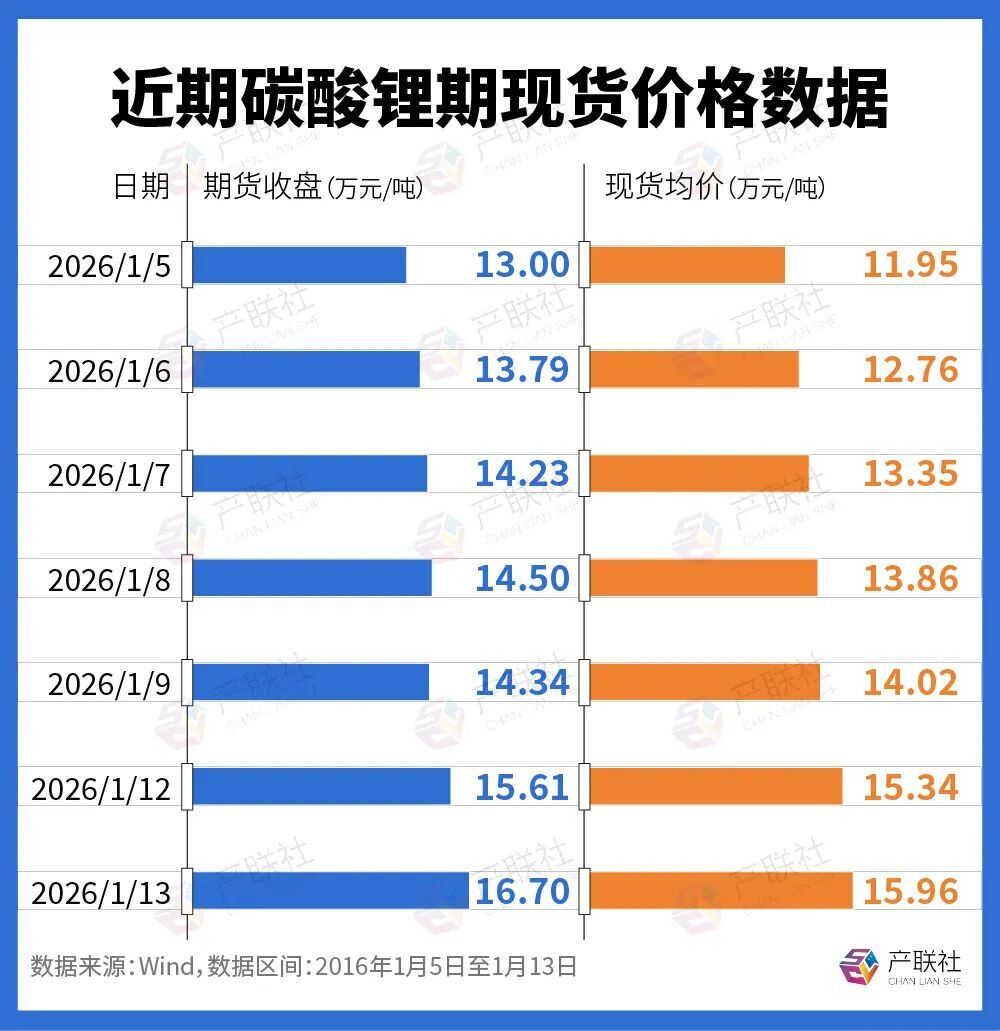
Core Viewpoint - The price of lithium carbonate futures has experienced a rapid increase, driven by multiple factors including policy adjustments, strong downstream demand, and supply disruptions, leading to significant impacts on the entire lithium battery supply chain [1][14]. Price Trends - Lithium carbonate futures prices rose from 130,000 yuan/ton on January 5, 2026, to a peak of 174,000 yuan/ton on January 13, 2026, marking a 33.8% increase within just eight trading days [1][3]. - From a low of 60,000 yuan/ton in the second half of 2025, prices have surged over 180% [3]. Policy Impact - The adjustment of the export tax rebate for battery products, effective April 1, 2026, from 9% to 6%, and its complete cancellation by January 1, 2027, has prompted downstream battery manufacturers to accelerate their procurement of lithium carbonate [6][14]. - This policy change is expected to create a concentrated demand surge before the tax adjustment, particularly benefiting the materials used in ternary batteries and energy storage [6]. Demand Growth - In 2025, China's retail sales of new energy passenger vehicles reached 12.809 million units, a year-on-year increase of 17.6%, with December exports soaring by 255% [8]. - Global sales of new energy vehicles are projected to reach 24.75 million units in 2026, continuing to drive demand for lithium battery materials [8]. - The new energy storage sector saw an addition of 34 GW/87 GWh in installed capacity in the first three quarters of 2025, reflecting a growth of over 65% [8]. Supply Disruptions - The cancellation of mining rights for 27 lithium mines in Yichun, Jiangxi, at the end of 2025 has raised concerns about short-term supply constraints, despite limited actual production capacity [9]. - Domestic lithium salt production decreased by 3.2% month-on-month in December 2025, coupled with maintenance at some enterprises, limiting supply growth [9]. Industry Chain Impact - The rise in lithium carbonate prices is expected to increase cost pressures on battery manufacturers, potentially leading to higher end-product prices for new energy vehicles [11]. - Midstream companies may enhance R&D investments to improve production efficiency and mitigate costs, while some smaller firms may face profit compression and exit the market [11]. - The overall market remains resilient, with consumer demand for new energy vehicles likely to continue growing despite price pressures [11]. Future Outlook - In the short term (Q1 2026), lithium carbonate prices are expected to remain high due to pre-export demand and post-holiday replenishment needs, with some forecasts suggesting prices could reach 180,000 to 200,000 yuan/ton [13]. - However, after the initial demand surge, prices may face downward pressure as inventory levels rise and production resumes [13]. - Long-term, the supply-demand gap is anticipated to widen due to slow new capacity releases, supporting a systemic increase in lithium prices [13].
烧碱日报:供需弱势出新低,跟踪生产企业减产情况-20260115
Guan Tong Qi Huo· 2026-01-15 11:07
Group 1: Report Industry Investment Rating - No relevant content Group 2: Core View of the Report - The caustic soda market is currently in a high-inventory and high-supply pattern, with short-term prices remaining weak due to low-cost warehouse receipts and pre-holiday inventory reduction pressure. However, beware of overshoot rebounds. Focus on tracking the production reduction of caustic soda manufacturers as well as the operating conditions of electrolytic aluminum and alumina enterprises [3][4] Group 3: Summary by Relevant Catalogs Fundamental Analysis - From January 2nd to 8th, the average capacity utilization rate of Chinese caustic soda sample enterprises with a capacity of 200,000 tons and above was 86.8%, a week-on-week increase of 0.4% [1] - From January 3rd to 9th, the alumina operating rate increased by 1.07% week-on-week to 85.74%. From January 5th to 8th, the viscose staple fiber operating rate increased by 3.01% week-on-week to 88.43%, and the printing and dyeing operating rate decreased by 0.72% week-on-week to 60.09% [1] - As of January 8th, the factory inventory of fixed liquid caustic soda sample enterprises with a capacity of 200,000 tons and above in the whole country was 495,200 tons (wet tons), a week-on-week increase of 1.96% and a year-on-year increase of 76.03% [1] - From January 2nd to 8th, the weekly average gross profit of Shandong chlor-alkali enterprises was 183 yuan/ton [1] Macroeconomic Analysis - The Ministry of Finance announced an adjustment to the export tax rebate policy for products such as photovoltaic products. As of April 1st, 2026, the VAT export tax rebate for products such as photovoltaic products will be cancelled, including various lithium compounds, methanol, polyvinyl chloride products, and some silicon products [2] Futures and Spot Market Analysis - The caustic soda market is in a high-inventory and high-supply pattern. Currently, the warehouse receipt cost is lower than the spot price. The short-term decline is due to low-cost warehouse receipts and pre-holiday inventory reduction pressure. The winter is the off-season for chlor-alkali enterprise maintenance, while spring (March - May) and autumn (September - October) are the traditional concentrated maintenance seasons for chlor-alkali enterprises. The futures price has reached a new low [3]
2026年4月1日起取消光伏等产品出口退税,企业抢单赶工
Sou Hu Cai Jing· 2026-01-15 02:17
Core Viewpoint - The Ministry of Finance and the State Taxation Administration announced the cancellation of VAT export tax rebates for photovoltaic products starting April 1, 2026, which is expected to reshape the competitive landscape of the industry [1][3]. Industry Impact - The policy adjustment is seen as a key measure to transform the competitive dynamics within the industry. The China Photovoltaic Industry Association noted that some companies have been using export tax rebates to enhance their bargaining power in overseas markets, effectively subsidizing foreign markets and increasing the risk of trade friction [3]. - The cancellation of export tax rebates is anticipated to help restore rational pricing in overseas markets [3]. Market Response - The impact of the policy has already been observed in the first quarter, with a company executive indicating that overseas buyers are placing orders in advance to avoid increased costs after April, leading to a "mini peak season" during a traditionally slow demand period [3]. - Companies are ramping up production and working overtime to meet the surge in overseas orders before the April 1 deadline [3]. Battery Products Adjustment - The export tax rebate policy for battery products will also undergo a phased adjustment, with the rebate rate decreasing from 9% to 6% from April 1 to December 31, 2026, and a complete cancellation of the rebate starting January 1, 2027 [3].
芳烃日报:苯乙烯超预期去库、纯苯历史级别高库存-20260114
Guan Tong Qi Huo· 2026-01-14 11:13
1. Industry Investment Rating - No specific industry investment rating is provided in the report. 2. Core Viewpoints - Pure benzene has significant supply - demand pressure, and although it rebounds due to overall sentiment, the upside space is limited. Consider hedging opportunities if it continues to rise [4]. - Styrene is short - term strong due to the short - term rebound of the overall commodity market, export disruptions, and unexpected de - stocking. Pay attention to the support of the 60 - day moving average on the daily K - line and look for low - buying opportunities [4]. 3. Summary by Directory Fundamental Analysis - From January 2nd to 8th, the total output of Chinese styrene factories was 355,700 tons, a month - on - month increase of 0.99%, and the factory capacity utilization rate was 70.92%, a month - on - month increase of 0.69% [1]. - From January 2nd to 8th, the consumption of EPS, PS, and ABS, the downstream products of styrene, increased by 0.31% month - on - month to 259,700 tons [1]. - As of January 8th, the styrene factory inventory was 162,300 tons, a 5.48% decrease from the previous week; as of January 12th, the styrene inventory at East China ports was 100,600 tons, a 23.96% decrease from the previous week [1]. - As of January 12th, the non - integrated profit of styrene was 250.79 yuan/ton, and the integrated profit was 660.46 yuan/ton [1]. - According to past industry rules, January - March is the off - season for styrene demand, with a high possibility of seasonal inventory accumulation. This year, due to the late Spring Festival, the time for seasonal production reduction is also late [1]. Macroeconomic Analysis - The Ministry of Finance announced an adjustment to the export tax - rebate policy for products such as photovoltaic. Starting from April 1st, 2026, the VAT export tax - rebate for products such as photovoltaic will be cancelled, including multiple chemical and electronic products [2]. Futures and Spot Market Analysis - No specific analysis content is provided in the given report.
碳酸锂期货一度突破17万大关 赣锋锂业、天齐锂业均涨近4%
Zhi Tong Cai Jing· 2026-01-14 04:03
Group 1 - Lithium stocks have risen again, with Tianqi Lithium (002466) up 3.81% to HKD 57.15 and Ganfeng Lithium (002460) up 3.72% to HKD 61.35 [2] - On January 13, the main contract for lithium carbonate futures on the Shanghai Futures Exchange broke through RMB 170,000 per ton, reaching a new high since October 2023 [2] - The latest price for battery-grade lithium carbonate (99.5% domestic) rose by RMB 12,080 to RMB 152,100 per ton on January 12, marking a new high in over two years and increasing for seven consecutive days [2] Group 2 - The Ministry of Finance and the State Taxation Administration announced a reduction in the export tax rebate rate for battery products from 9% to 6% starting April 1, 2026, and the cancellation of the rebate from January 1, 2027 [2] - According to Guosen Securities, there may be a short-term surge in export demand from overseas clients due to a policy buffer period, leading to a significant off-peak season in the industry chain [2]


草铵膦、精草铵膦、乙酰甲胺磷、氟苯虫酰胺等农药品种取消增值税出口退税!
Xin Lang Cai Jing· 2026-01-13 11:27
Core Viewpoint - The Ministry of Finance and the State Taxation Administration announced the adjustment of export tax rebate policies for photovoltaic and related products, effective April 1, 2026, which includes the cancellation of VAT export rebates for photovoltaic products and a reduction in the export tax rebate rate for battery products [1][4]. Summary by Categories Export Tax Rebate Policy Changes - From April 1, 2026, the VAT export tax rebate for photovoltaic products will be canceled [1][5]. - The export tax rebate rate for battery products will be reduced from 9% to 6% from April 1, 2026, until December 31, 2026, and will be completely canceled starting January 1, 2027 [4][5]. Products Affected - The announcement includes 18 pesticide-related products, such as glyphosate, acetochlor, and flufenacet, which will also be affected by the changes in export tax rebate policies [1][3]. - A detailed list of products subject to the changes is provided in the attachments, specifying the product codes and names along with their respective tax rates [5][6]. Consumption Tax Policy - The export consumption tax policy for the affected products will remain unchanged, continuing to apply the existing consumption tax rebate (exemption) policies [5].