
北上资金

Search documents
北上资金累计成交额突破187万亿元
Zheng Quan Shi Bao Wang· 2025-09-24 13:50
Group 1 - The core point of the article highlights that since the launch of the interconnection mechanism, the trading activity of northbound funds has remained active, with the cumulative transaction amount surpassing 187 trillion yuan for the first time [1] - On September 24, the daily trading volume of the Shanghai-Hong Kong Stock Connect reached 286.13 billion yuan, contributing to the cumulative total of 187.21 trillion yuan since the mechanism's inception [1]
资金跟踪系列之十二:北上活跃度回升,整体继续净卖出
SINOLINK SECURITIES· 2025-09-22 12:55
Macro Liquidity - The US dollar index has rebounded, and the degree of the China-US interest rate "inversion" has deepened, with inflation expectations also rising [1][14] - Offshore US dollar liquidity has generally loosened, while the domestic interbank funding situation remains balanced [1][19] Market Trading Activity - Overall market trading activity has increased, with most industry trading activities remaining above the 80th percentile [2][25] - Major indices' volatility has also risen, with the communication sector's volatility exceeding the 80th historical percentile [2][31] - Market liquidity indicators have declined, with all sectors' liquidity indicators below the 40th historical percentile [2][36] Institutional Research - The electronic, pharmaceutical, communication, non-ferrous metals, and automotive sectors have seen high research activity, while sectors like steel, electricity, utilities, machinery, light industry, building materials, and real estate have shown a rising trend in research activity [3][43] Analyst Forecasts - Analysts have continued to lower the net profit forecasts for the entire A-share market for 2025/2026, with the proportion of stocks with upward revisions increasing [4][50] - The net profit forecasts for sectors such as non-bank financials, chemicals, coal, and retail have been raised for 2025/2026 [4][21] - The net profit forecast for the Shanghai Stock Exchange 50 index for 2025/2026 has been adjusted upward [4][23] Northbound Trading Activity - Northbound trading activity has increased, but there continues to be a net sell-off overall [5][31] - Based on the top 10 active stocks, the buy-sell ratio in sectors like electronics, electric new energy, and communication has risen, while it has decreased in non-bank financials, pharmaceuticals, and non-ferrous metals [5][32] Margin Financing Activity - Margin financing has reached a high point not seen since September 2024, with a net purchase of 466.70 billion yuan last week [6][35] - The main net purchases in margin financing were in the electronic, non-bank financial, and machinery sectors, while net sales were seen in military, non-ferrous metals, and coal sectors [6][39] Active Equity Funds and ETFs - Active equity funds have increased their positions, particularly in coal, communication, and home appliance sectors, while reducing positions in computers, non-bank financials, and electronics [7][45] - ETFs have continued to see net subscriptions, primarily in personal ETFs, with significant net purchases in non-bank financials, non-ferrous metals, and machinery sectors [7][52]
机构持仓系列专场:外资跟踪策略
2025-09-02 14:41
Summary of Key Points from Conference Call Records Industry or Company Involved - The discussion primarily revolves around the foreign investment strategies in the A-share market, particularly focusing on the Northbound capital and QFII (Qualified Foreign Institutional Investor) strategies. Core Insights and Arguments - **Shift in Investment Preferences**: Northbound capital has shown a preference for the consumer manufacturing sector but has recently shifted towards the financial sector, including banks and non-bank financial institutions. This indicates a downward trend in market capitalization within their holdings [1][3][12]. - **Performance Metrics**: The annualized return from the Northbound capital following strategies is approximately 11%, with excess returns also at 11%. The period from 2017 to 2020 contributed significantly to these returns, while the subsequent three years saw negative excess returns, expected to normalize by 2024 [1][5]. - **QFII Holdings**: There are about 1,000 QFII institutions, predominantly from Hong Kong, with a gradual increase in their numbers. The total foreign capital held is around 200 billion, indicating a relatively small scale but revealing preferences for certain sectors [1][6]. - **Investment Characteristics**: QFII holdings tend to favor higher-risk stocks, including ST stocks, with a focus on sectors such as banking, electronics, pharmaceuticals, chemicals, food and beverages, and machinery. Their investment style leans towards high beta, large market capitalization, low volatility, and low turnover [1][7]. - **Selection Advantages**: Foreign investors benefit from a strong fundamental logic in stock selection, influence over pricing power, and a tendency for long-term operations that attract incremental capital, leading to price increases. The overall strategy shows strong stability with a maximum drawdown of 38%, which is 12 percentage points lower than the benchmark [1][8]. Other Important but Possibly Overlooked Content - **Changes in Data Disclosure**: Starting from May 2024, Northbound capital will no longer disclose net inflow data, and from August 2024, daily holding data will also cease, potentially affecting information transparency [1][4]. - **Investment Models**: The main foreign investment models in the A-share market include QFII/RQFII, strategic investors, and the mutual connectivity mechanisms like Shanghai-Hong Kong Stock Connect and Shenzhen-Hong Kong Stock Connect, with Northbound capital being a significant player [2][11]. - **Index Construction Based on QFII Holdings**: An index can be constructed based on QFII holdings by selecting stocks from a pool of 800 constituents weighted by market capitalization. This index has shown an annualized return of about 16% and excess returns of 11% [9][10]. This comprehensive summary encapsulates the key points discussed in the conference call, providing insights into the foreign investment landscape in the A-share market.
资金跟踪系列之九:两融活跃度续创“924”新高,加速买入趋势依然延续
SINOLINK SECURITIES· 2025-09-01 11:43
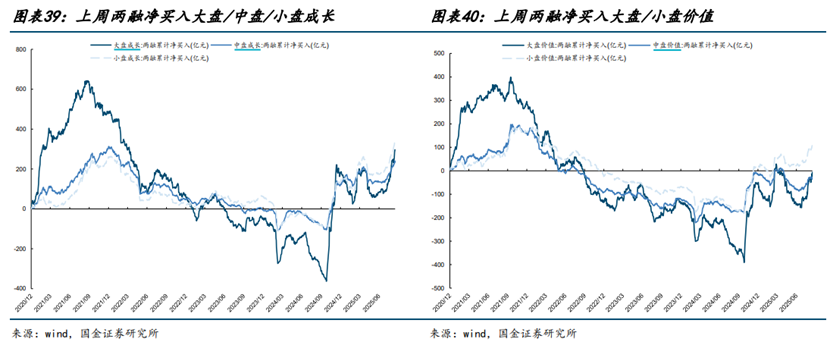
Group 1: Macro Liquidity - The US dollar index has rebounded, and the degree of the China-US interest rate "inversion" has narrowed. The nominal and real yields of 10Y US Treasuries have both declined, with inflation expectations remaining largely unchanged [1][15]. - Offshore dollar liquidity has tightened overall, while the domestic interbank funding environment remains balanced and loose. The term spread (10Y-1Y) has widened [1][15]. Group 2: Market Trading Activity - Market trading activity continues to rise, with most industry trading heat above the 80th percentile. Sectors such as TMT, consumer services, light industry, machinery, and automotive are performing particularly well [2][28]. - The volatility of major indices, except for the CSI 1000, has increased, while most industry volatilities remain below the 80th percentile [2][34]. Group 3: Institutional Research - The electronic, pharmaceutical, communication, automotive, and computer sectors are leading in research activity, with a rising trend in research heat for pharmaceuticals, communications, food and beverage, agriculture, home appliances, and chemicals [3][46]. Group 4: Analyst Forecasts - Analysts have simultaneously lowered the net profit forecasts for the entire A-share market for 2025/2026. However, sectors such as non-bank financials, metals, media, and communications have seen upward adjustments in their profit forecasts for the same period [4][19]. - The net profit forecasts for the Shanghai Stock Exchange 50 index for 2025/2026 have been raised, while those for the CSI 300 have been lowered. The net profit forecasts for the CSI 500 and ChiNext indices have been adjusted in opposite directions [4][23]. Group 5: Northbound Trading Activity - Northbound trading activity continues to rise, with a slight net sell-off overall. The trading volume ratio for electronic, communication, and computer sectors has increased, while it has decreased for pharmaceuticals, food and beverage, and electric power sectors [5][32]. - Northbound trading has mainly net bought sectors such as chemicals, metals, and pharmaceuticals, while net selling has occurred in electronics, computers, construction, and public utilities [5][33]. Group 6: Margin Financing Activity - Margin financing activity has reached a new high since September 2024, with net purchases primarily in the electronic, communication, and computer sectors. The financing buy-in ratio for electronics, textiles, and coal sectors has increased significantly [6][38]. - Margin financing continues to net buy across various styles of sectors, including large, mid, and small-cap growth and value stocks [6][39]. Group 7: Active Fund Positions - Active equity funds have slightly reduced their positions, primarily increasing allocations in chemicals, communications, and food and beverage sectors, while decreasing in military, oil and gas, and steel sectors [8][47]. - The correlation of active equity funds with large, mid, and small-cap value stocks has increased, while the correlation with growth stocks has decreased [8][48]. Group 8: ETF Activity - ETFs have seen overall net subscriptions, particularly in those related to brokers, CSI 300, and dividend strategies, while those tracking the Sci-Tech 50, CSI 500, and ChiNext have experienced net redemptions [8][52]. - The main net purchases in ETFs have been in non-bank financials, chemicals, and computers, while the main net sales have been in pharmaceuticals, electric power, and electronics [8][53].
A股两融余额突破2.1万亿元,券商:个人投资者是当前主要买入力量
Huan Qiu Wang· 2025-08-20 01:17
Group 1 - The core viewpoint of the articles highlights the significant increase in the margin financing scale in the A-share market, reaching a record high of 2.1 trillion yuan as of August 18, marking a notable recovery after 10 years [1][3] - As of August 18, the margin balance increased by approximately 39.7 billion yuan from the previous trading day, achieving the largest single-day increase in 2024 and the highest since October 8, 2024 [1] - The analysis from Guojin Securities indicates that the net buying in margin financing remains substantial, with a notable rise in trading activity, particularly among individual investors, while there is a significant return of northbound capital [3] Group 2 - The continuous increase in margin financing reflects a growing investor confidence and market enthusiasm, suggesting a bullish sentiment in the capital markets [1][3] - The report emphasizes the importance of monitoring the sustainability of the northbound capital inflow, which could impact future market dynamics [3]

6月份A股投资者数量环比增10.6%
Xin Hua Wang· 2025-08-12 06:25
Group 1 - The A-share market has shown positive signals since June, with a month-on-month increase in the number of new investors and accelerated inflow of northbound funds [1][2] - In June, the number of new investors reached 1.3303 million, a month-on-month increase of 10.6%, marking a recovery after two consecutive months of decline [1] - As of the end of June, the total number of A-share investors was 20.62391 million, with a cumulative increase of 8.8305 million new investors in the first half of the year [1] Group 2 - Northbound capital inflow has accelerated, with a net purchase of 75.36 billion yuan year-to-date, and 72.96 billion yuan in June alone [2] - The influx of foreign capital is attributed to concerns over the U.S. economy and high inflation, making the A-share market an attractive option due to its low valuation and economic recovery [2] - The balance of margin trading has also increased significantly, surpassing 1.6 trillion yuan, indicating a rise in market activity and investor confidence [2][3] Group 3 - The improvement in the two-margin business reflects a notable increase in market confidence, suggesting that A-shares may maintain a strong performance [3] - The rise in margin trading indicates that investors are willing to increase leverage in response to positive market sentiment and potential profit opportunities [3] - The overall market environment is conducive to a more significant upward trend, although caution is advised for retail investors regarding leverage usage [3]
国金证券:A股市场热度维持阶段高位 两融活跃度续创年内新高
智通财经网· 2025-08-04 22:48
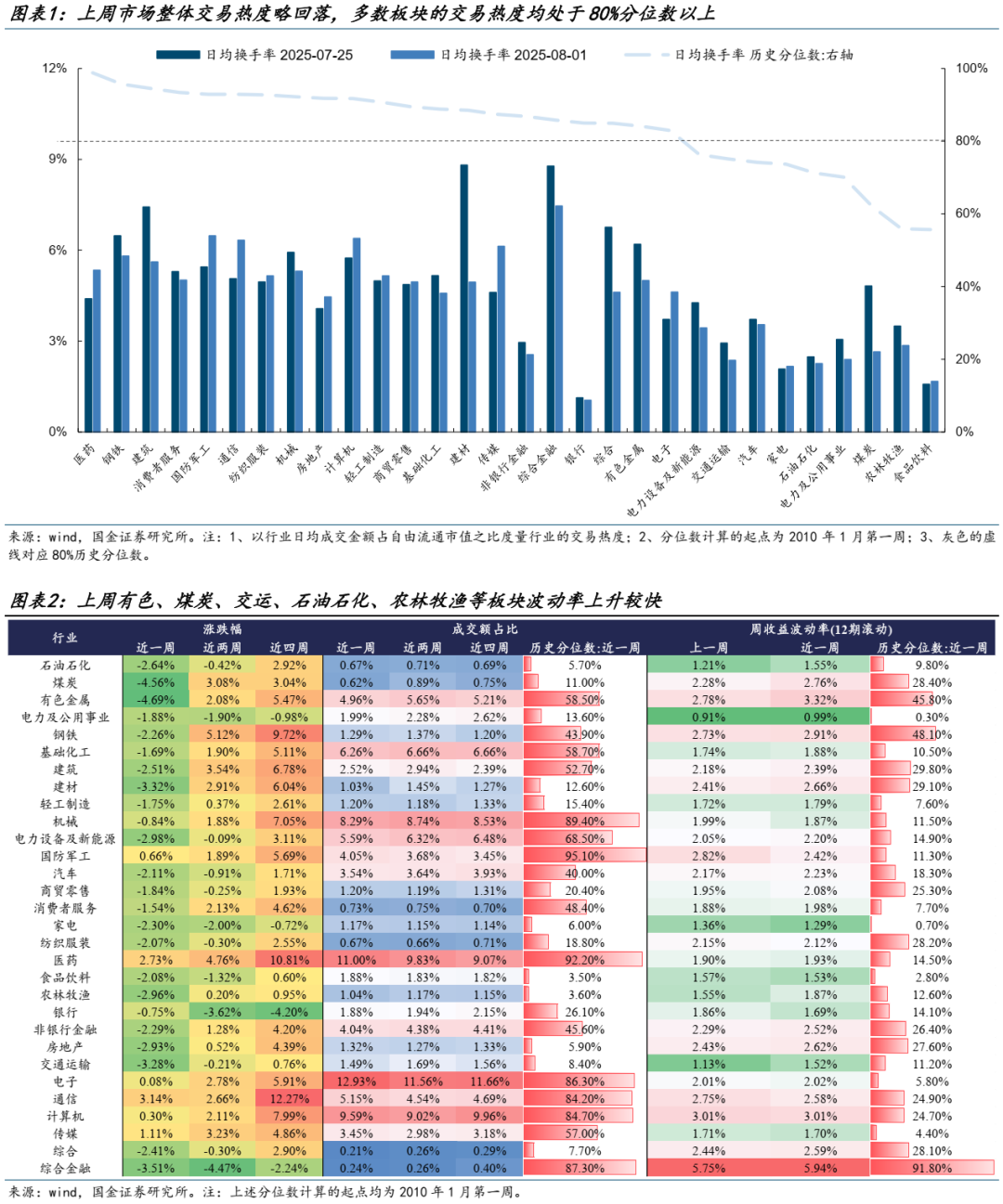
Trading Activity & Volatility - Market trading activity has slightly decreased but remains at a high point since March of this year, with major index volatility also declining. Sectors such as pharmaceuticals, steel, construction, consumer services, military, and telecommunications have trading activity above the 80th percentile, while most sectors have volatility below the 50th historical percentile [1]. Profit Forecasts - The net profit forecasts for the entire A-share market for 2025 and 2026 have been adjusted downwards. However, sectors including electricity and utilities, non-ferrous metals, pharmaceuticals, real estate, chemicals, coal, and light industry have seen their profit forecasts for 2025 and 2026 raised [4][10]. Northbound Capital Activity - Northbound capital activity has rebounded, with overall net selling of A-shares. Structurally, there has been significant net buying in sectors such as electronics, pharmaceuticals, and telecommunications, while net selling has occurred in food and beverage, agriculture, electricity, and utilities [12]. Margin Trading Activity - Margin trading activity has reached a new high for the year, with significant net buying in pharmaceuticals, electronics, and computers, while net selling has been observed in non-ferrous metals, coal, and non-bank financials [17]. 龙虎榜 Trading Activity - The trading activity on the龙虎榜 has continued to rise, with sectors like construction, steel, food and beverage, light industry, and telecommunications showing a relatively high and increasing proportion of trading volume [19][22]. Active Fund Positions - Active equity funds have seen a rebound in positions, with notable increases in sectors such as telecommunications, military, and steel, while reductions have been made in media, banking, and home appliances [23][35]. ETF Activity - Overall, ETFs have experienced net selling, primarily driven by institutional investors. The main net purchases have been in sectors like non-bank financials, food and beverage, and coal, while net selling has occurred in electronics, pharmaceuticals, and new energy [30][32].

资金跟踪系列之四:北上与 ETF 有所回流,个人投资者加速买入
SINOLINK SECURITIES· 2025-07-28 09:09
Group 1: Macro Liquidity - The US dollar index has declined again, and the degree of "inversion" in the China-US interest rate spread has narrowed, with inflation expectations continuing to rise [1][11][14] - Offshore dollar liquidity has marginally eased, while the domestic interbank funding situation has shown a pattern of first easing and then tightening [1][14] Group 2: Market Trading Activity - Overall market trading activity has continued to rise, with most industry trading heat above the 80th percentile [2][20] - The volatility of major indices has also increased, with most industry volatilities below the 40th historical percentile [2][26] Group 3: Institutional Research - The electronic, computer, retail, communication, and pharmaceutical sectors have seen high research activity, while real estate and non-bank sectors have also experienced a rise in research heat [3][36] Group 4: Analyst Forecasts - Analysts have simultaneously lowered the net profit forecasts for the entire A-share market for 2025/2026, while increasing forecasts for sectors such as non-ferrous metals, light industry, steel, and utilities [4][19] - The net profit forecasts for the CSI 500 index for 2025/2026 have been raised, while those for the CSI 300, SSE 50, and ChiNext have been lowered [4][23] Group 5: Northbound Trading Activity - Northbound trading activity has rebounded, with overall net purchases of A-shares, particularly in sectors like non-ferrous metals, pharmaceuticals, and chemicals [4][31] - The ratio of buy/sell amounts for the top 10 active stocks has increased in sectors such as non-ferrous metals and pharmaceuticals [4][32] Group 6: Margin Financing Activity - Margin financing activity has continued to rise, reaching a year-to-date high, with significant net purchases in sectors like machinery, non-ferrous metals, and pharmaceuticals [6][10] - The proportion of financing purchases in real estate, consumer services, and utilities has increased [6][38] Group 7: Fund Activity - Active equity funds have slightly reduced their positions, primarily increasing allocations in sectors like computers, electronics, and banks [5][45] - ETFs have seen overall net subscriptions, particularly in sectors such as construction, steel, and chemicals, while electronic, pharmaceutical, and banking sectors have experienced net redemptions [5][53]
资金跟踪系列之三:两融活跃度触及阶段高位,北上与ETF再度净流出
SINOLINK SECURITIES· 2025-07-21 14:03
Group 1: Macro Liquidity - The US dollar index continued to rise, with the degree of inversion in the China-US interest rate differential deepening, and inflation expectations rebounding [1][13] - Offshore dollar liquidity has marginally eased, while the domestic interbank funding situation tightened initially before easing, with the yield curve steepening [1][19] Group 2: Market Trading Activity - Overall market trading activity has rebounded, with most industry trading heat above the 80th percentile, particularly in sectors like computers, light industry, textiles, pharmaceuticals, communications, and machinery [2][26] - Major indices' volatility has decreased, with most industry volatilities below the 40th historical percentile [2][31] Group 3: Institutional Research - High research activity was noted in sectors such as electronics, pharmaceuticals, computers, communications, retail, and automotive [3][14] Group 4: Analyst Forecasts - Analysts have raised net profit forecasts for the entire A-share market for 2025/2026, with most sectors including non-ferrous metals, real estate, communications, pharmaceuticals, chemicals, machinery, building materials, light industry, electronics, transportation, electricity and utilities, retail, construction, steel, electric new energy, consumer services, and banking seeing upward revisions [3][4][19] - The proportion of stocks with upward revisions in net profit forecasts for 2025/2026 has increased across the A-share market [4][17] Group 5: Northbound Trading Activity - Northbound trading activity has increased, with overall net selling of A-shares; the buy/sell ratio in sectors like non-ferrous metals, communications, and computers has risen [4][5] - Northbound funds primarily net bought sectors such as military, automotive, and pharmaceuticals, while net selling was observed in computers, electronics, and media [4][33] Group 6: Margin Financing Activity - Margin financing activity has continued to rise, reaching the highest point since March of this year, with net purchases mainly in sectors like computers, machinery, and electronics [5][12] - The proportion of margin financing in sectors such as steel, communications, and home appliances has increased [5][38] Group 7: Fund Activity - Active equity funds have increased their positions, particularly in TMT, home appliances, and oil and petrochemicals, while reducing positions in pharmaceuticals, retail, and agriculture [6][45] - New equity fund establishment has significantly increased, with both active and passive equity fund sizes rising [6][50]
策略 谁在卖?
2025-07-16 06:13
Summary of Conference Call Notes Industry Overview - The discussion primarily revolves around the mutual fund industry, particularly focusing on equity funds and their performance in April 2025 [1][2][5]. Key Points and Arguments 1. **New Equity Fund Issuance**: In April 2025, new equity fund issuance reached 57 billion units, an increase from 50 billion units in the previous month, marking a 14% month-over-month growth and positioning it at the 95th percentile of the last three years [1]. 2. **Active vs Passive Funds**: The issuance of active equity funds in April was 3.974 billion units, a decrease of 6.6 billion units compared to the previous month, while passive equity funds saw an increase of over 45 billion units, up by 7.4 billion units [1][2]. 3. **Net Inflows in Equity ETFs**: Since March, net inflows into existing equity products totaled over 15 billion units, with the total of new and existing funds rising by 150 billion units. In April, net inflows into stock ETFs reached 197.3 billion yuan, a significant increase of over 230 billion yuan from the previous month [2]. 4. **Sector Allocation Trends**: By 2025, active equity funds have increased allocations in sectors such as automotive, non-ferrous metals, and electronics, while reducing exposure to power equipment, communications, and defense industries [2]. 5. **Margin Financing Trends**: As of the end of April, the total margin financing balance was 1.78 trillion yuan, reflecting a 6.9% decrease from the previous month. The net outflow for April was 131.5 billion yuan, with margin trading activity declining [3]. 6. **Investment Sentiment**: The overall sentiment in the market appears cautious, with the trading heat index at -0.15, indicating a position in the 26.6th percentile since the end of 2015 [5]. 7. **Bank Wealth Management Products**: In April, the issuance of wealth management products approached 6,000, a decrease of 3.6% from the previous month, while the number of products reaching maturity increased by 22% [4]. 8. **Industry Capital Movements**: In April, industrial capital saw a net reduction of 370 million yuan, with 10.6 billion yuan in purchases and 10.9 billion yuan in sales, indicating a narrowing trend compared to previous months [4]. Additional Important Insights - **Insurance Fund Trends**: As of December last year, the scale of insurance funds decreased, but upcoming policy changes are expected to lower investment risks in stocks, potentially increasing this segment's investment volume [6]. - **Overall Fund Flow Health**: Despite a reduction in margin financing, other fund types, including public funds and private equity products, are showing healthy issuance trends, suggesting a stable investment environment [7].