外国直接投资(FDI)

Search documents
暴跌99%!外资正在加速撤离这座坟场!
商业洞察· 2025-08-06 09:24
Core Viewpoint - The article highlights a significant decline in India's net foreign direct investment (FDI), which fell to a historic low of $35 million in May 2025, marking a 99% month-over-month and 98% year-over-year drop, raising concerns about the investment climate in India [4][10][12]. Group 1: FDI Data Analysis - In the fiscal year 2024-2025, India's net FDI is projected to be $353 million, a drastic decrease of 96.5% compared to nearly $10 billion in the previous fiscal year [10][11][12]. - The total FDI inflow for the fiscal year 2025 is expected to reach $81 billion, reflecting a year-over-year growth of 13.7% [12]. - The sharp decline in net FDI is attributed to a significant outflow of foreign capital, with local companies investing $29 billion abroad [16][19]. Group 2: Regulatory Environment - India has been characterized as a "graveyard for foreign investment," with stringent regulations and unpredictable policies leading to substantial penalties for foreign companies [19][20]. - For instance, Samsung was required to pay $601 million in taxes and fines, equivalent to its annual net profit in India, illustrating the harsh financial environment for foreign firms [21][22]. - The Indian government has implemented various measures, such as a digital services tax and restrictions on foreign ownership, which have increased the cost of investment for foreign companies [25][26]. Group 3: Investor Sentiment - Despite the negative reputation, foreign companies continue to invest in India due to its large population and market potential, driven by a sense of optimism and the belief that they can navigate the regulatory landscape [29][30]. - However, the recent military conflict with Pakistan has raised alarms among international investors, highlighting concerns over India's military capabilities and the safety of their investments [42][49]. - The Indian central bank's attempts to downplay the situation by emphasizing market liquidity and attractiveness are met with skepticism, as the reality of a 99% drop in net FDI cannot be ignored [50][52].


36氪出海·中东|阿联酋跃居全球FDI十强,打开中国企业的机遇之窗
3 6 Ke· 2025-07-18 14:18
Group 1 - The UAE has achieved a record high in foreign direct investment (FDI) inflow, reaching $45.6 billion in 2024, a significant increase of 48% compared to the previous year [2] - The UAE has become the 10th largest FDI destination globally, attracting 37% of the region's foreign investment, showcasing its strength as a regional investment hub [2] - The UAE's success is attributed to strategic leadership, investor-friendly policies, and a vision for economic diversification, aiming to attract $354 billion in FDI by 2030 [2] Group 2 - The Dubai IFZA Free Zone serves as an official bridge for international investors, particularly Chinese companies, to efficiently enter the UAE market [3] - IFZA offers a partner-centric service model and comprehensive business support within a robust legal framework, facilitating access to opportunities in the Middle East and North Africa [3] - IFZA provides unique advantages such as transparent and low registration fees, simplified registration processes, and a wide range of business activities under one license [5]

日媒:韩国对美投资骤减90%,成亚洲对美国外国直接投资降幅最大国家
Huan Qiu Shi Bao· 2025-07-14 22:48
Group 1 - South Korea has experienced the largest decline in foreign direct investment (FDI) to the U.S. among Asian countries, with a staggering 90% drop in 2024 compared to the previous year [1] - In 2024, total FDI to the U.S. from Asia is projected to be $23.2 billion, a 40% decrease year-on-year, while European investments remain dominant at $96.7 billion [1] - Japan, in contrast, has increased its investment in the U.S. to $18 billion, while China's investment has decreased by 9% to $589 million [1] Group 2 - The decline in South Korean investment is attributed to several factors, including market saturation, reduced demand in key industries like electric vehicle batteries, and increased uncertainty in U.S. policies [1][2] - South Korea was previously the largest investor in the U.S., with commitments of $21.5 billion in 2023, but recent shifts in U.S. policy under the Trump administration have led to a reassessment of investment strategies [2] - Despite the overall decline, some Asian companies, such as Hyundai Motor Group, are still pursuing expansion plans, with Hyundai announcing an additional $21 billion investment in the U.S. [3]
越南科技商业银行首席执行官表示,美国对越南征收20%的关税不会阻碍外国直接投资(FDI)流入。
news flash· 2025-07-09 03:57
Core Viewpoint - The CEO of Vietnam Technology Commercial Bank stated that the 20% tariffs imposed by the United States on Vietnam will not hinder foreign direct investment (FDI) inflow [1] Group 1 - The statement reflects confidence in Vietnam's ability to attract FDI despite external economic pressures [1] - The bank's leadership suggests that the impact of tariffs may be mitigated by other favorable investment conditions in Vietnam [1]
能源价格高昂、全球不确定性持续,英国吸引FDI项目创十八年新低
Di Yi Cai Jing· 2025-06-27 11:29
Group 1 - High energy prices and ongoing global uncertainty have weakened the flow of foreign direct investment (FDI) globally [1][3] - In the fiscal year ending March 2023, the UK saw 1,375 FDI projects, a 12% decrease from the previous year, marking the lowest level in 18 years [1] - The IT and financial services sectors attracted the most FDI projects, but new project numbers declined by 2.3% and 5% respectively [1] Group 2 - The high cost of energy is a significant factor impacting investment interest, with UK industrial consumers facing an average electricity price of 25.8 pence per kWh, nearly 50% higher than France and Germany, and four times that of the US and Canada [3] - The UK manufacturing sector has seen a one-third decline in output for energy-intensive industries since early 2021, reaching the lowest level since 1990 [3] - A ten-year industrial development strategy by the UK government aims to reduce energy costs and optimize energy infrastructure to support key industries [3] Group 3 - Other European countries are also struggling to attract FDI, with a reported 58% drop in FDI inflows [4][5] - The UNCTAD's 2025 World Investment Report indicates a slight global FDI growth of 4% in 2024, but a real decline of 11% when excluding certain European financial transactions [5] - The EY's 2025 European Attractiveness Survey shows a 5% decrease in overall FDI projects in Europe, the lowest in nine years, with a 16% drop in jobs created by FDI [5]
2024年全球外国直接投资(FDI)下降11%
Shang Wu Bu Wang Zhan· 2025-06-25 15:54
Group 1 - The UN Conference on Trade and Development reports a global FDI decline of 11% in 2024, totaling $1.493 trillion, influenced by geopolitical tensions and trade fragmentation [1] - Developed economies experienced a 22% drop in FDI, with Europe facing a significant decline of 58%, while North America saw a 23% increase driven by the US [1] - Africa's FDI surged by 75% to a record $97 billion, accounting for 6% of global FDI, with Egypt leading in FDI stock at $205.2 billion [1] Group 2 - International financing for key sectors is declining, with infrastructure projects down 26%, renewable energy by 31%, transportation by 32%, and water and sanitation facilities by 30% in 2024 [2] - The UNCTAD Secretary-General highlights that many economies are overlooked not due to lack of potential but because capital is directed to easier access points rather than areas of need [2] - The digital economy is one of the few growing sectors, with a 14% increase in global FDI in 2024, although this growth is concentrated in 10 countries that account for 80% of new projects [2]
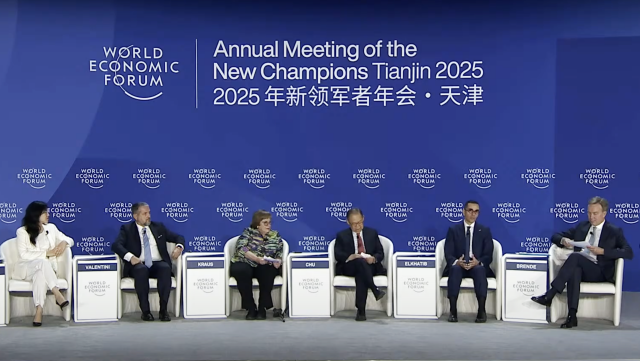
达沃斯热议贸易战无赢家,关税和地缘局势导致FDI降温|2025夏季达沃斯
Di Yi Cai Jing· 2025-06-25 06:19
Core Viewpoint - The deadline for US-EU trade negotiations is likely to be postponed, with significant tariffs looming if no agreement is reached, highlighting the complexities and uncertainties in global trade dynamics [1][3]. Group 1: Trade Negotiations and Tariffs - The EU faces a deadline on July 9 for trade negotiations with the US, with potential tariffs of up to 50% on EU exports if no agreement is reached [1]. - Valentino Valentini emphasizes that dialogue is essential, and the current strategy of postponing deadlines creates unnecessary anxiety [1]. - The use of tariffs as a tool to fill fiscal deficits rather than to balance trade is concerning, as it may lead to broader economic repercussions [3]. Group 2: Impact on Investment and Supply Chains - The sudden imposition of tariffs has dampened investment confidence and accelerated supply chain restructuring, shifting from a "just-in-time" to a "just-in-case" model [3]. - The uncertainty surrounding tariff policies is causing companies to pause new investments, particularly in emerging markets, which are already facing economic challenges [6][7]. - The World Bank reports that foreign direct investment (FDI) inflows to developing countries have dropped to their lowest level since 2005, with developed economies also experiencing significant slowdowns [6]. Group 3: Geopolitical Risks and Economic Outlook - Geopolitical uncertainties and trade barriers are contributing to a decline in global investment, with private equity exits becoming more challenging [6]. - Emerging markets are particularly affected, as high inflation and debt accumulation hinder their economic recovery, while FDI continues to flow into safer, mature markets [7]. - The future of FDI is contingent on the resolution of geopolitical tensions, which currently disrupt traditional investment patterns [7].
2024年全球外国直接投资下降11%!亚洲仍是全球外资流入主要目的地
第一财经· 2025-06-19 12:18
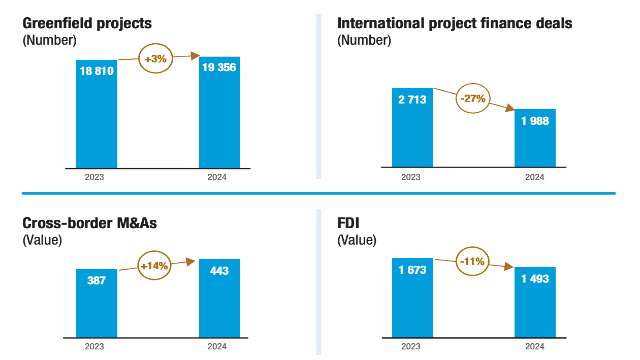
Core Viewpoint - The UNCTAD report indicates a slight increase in global foreign direct investment (FDI) by 4% in 2024, reaching $1.5 trillion, but a significant actual decline of 11% when excluding large financial transactions from certain European economies, marking two consecutive years of double-digit declines [1] Group 1: Global Investment Trends - The report highlights that the global economy is facing complex challenges, including rising debt, sluggish GDP growth, geopolitical tensions, and structural changes in trade and investment flows [1] - Early data for Q1 2025 shows that transaction and project activities have hit historical lows, indicating a pessimistic outlook for international investment [1] Group 2: Regional FDI Insights - Developed economies saw a 22% drop in FDI inflows in 2024, with European FDI plummeting by 58% when excluding financial transaction fluctuations, while North America experienced a 23% increase [5] - Developing economies in Asia remain the primary destination for global FDI, accounting for 40% of total FDI, although the region's FDI inflows decreased by 3% to $605 billion in 2024 [5] - ASEAN countries saw a significant FDI increase of 10%, reaching a record high of $225 billion, while Africa's FDI surged by 75% to $97 billion, driven by a major project in Egypt [5] Group 3: Sectoral Investment Dynamics - Greenfield investment projects in the industrial sector rose by 3% but saw a 5% decline in total value, maintaining a high level of $1.3 trillion [3] - International project financing (IPF) continued to decline, dropping by 26%, influenced by uncertainties in exchange rates and interest rates [3] - Cross-border M&A transactions increased by 14% to $443 billion, yet remained below the average levels of the past decade, indicating a shift towards domestic and nearshore investments due to rising policy risks and regulatory scrutiny [3] Group 4: Digital Economy and Investment - The digital economy is identified as a growth and transformation engine, with investments in this sector growing at an annual rate of 10% to 12%, outpacing global GDP growth [10] - Developing countries attracted $531 billion in greenfield projects in the digital economy from 2020 to 2024, with a concentration of investments in ten economies that accounted for nearly 80% of total investments [8] - Data centers emerged as the primary investment target in developing countries, followed by digital services and ICT infrastructure [8] Group 5: Policy and Regulatory Environment - The global investment policy landscape remains heavily influenced by geopolitical tensions and industrial policy objectives, with 174 new investment policy measures introduced in 2024, 78% of which favor investors [10] - As of the end of 2024, the total number of investor-state dispute settlement (ISDS) cases exceeded 1,400, with a significant portion occurring in the extractive and energy sectors [10]

2024年全球FDI下降11%,联合国机构报告:亚洲仍是全球外资流入主要目的地
Di Yi Cai Jing· 2025-06-19 11:46
Group 1 - In 2024, global Foreign Direct Investment (FDI) is projected to reach $1.5 trillion, reflecting an 11% decline when adjusted for significant financial transaction fluctuations in major European economies [1] - The report indicates that the international investment outlook for 2025 is pessimistic, with trade tensions leading to downward adjustments in most FDI outlook indicators [1][2] - Developed economies saw a 22% drop in FDI inflows in 2024, while North America experienced a 23% increase [4] Group 2 - Asia remains the primary destination for global foreign investment, accounting for 40% of total FDI, although it saw a 3% decline to $605 billion in 2024 [4] - ASEAN countries experienced a significant FDI increase of 10%, reaching a record high of $225 billion [4] - Africa's FDI grew by 75% to $97 billion, driven by a large project in Egypt [4] Group 3 - Greenfield investment projects in the industrial sector increased by 3%, but their total value decreased by 5%, maintaining a high level of $1.3 trillion [2] - International project financing (IPF) declined by 26%, influenced by uncertainties in exchange rates and interest rates [2] - The number of infrastructure projects decreased by 9%, while digital infrastructure projects increased by 4% [4] Group 4 - Renewable energy and critical minerals sectors saw a decline in greenfield project announcements by 12% and nearly 50%, respectively [5] - The semiconductor sector experienced a resurgence with four of the ten largest announced projects, totaling $70 billion in capital expenditure [5] - Investment in health and education sectors grew by approximately 25%, although total investment remained low at under $15 billion [5] Group 5 - Digital economy investments are identified as a key growth and transformation engine, growing at an annual rate of 10% to 12%, outpacing global GDP growth [8] - Over the past decade, major tech companies have increased their share of sales and assets among the largest multinational corporations [6] - From 2020 to 2024, developing countries attracted $531 billion in greenfield projects, with a concentration in ten economies that accounted for nearly 80% of total investments [6]
印尼国家经济委员会主席卢胡特答一财:中印尼合作正加速推动印尼下游产业发展
Di Yi Cai Jing· 2025-05-29 08:14
Core Insights - Indonesia is increasingly relying on foreign direct investment (FDI) to transform its economy, with China being the second-largest source of foreign investment after Singapore [1][5] - The successful collaboration between China and Indonesia, exemplified by the Jakarta-Bandung High-Speed Railway, is enhancing bilateral relations and contributing to regional development [3][4] Investment and Economic Cooperation - China has become the second-largest source of foreign investment in Indonesia, rising from 12th place in 2013, with an average annual growth rate of 59% over the past decade [5] - The Jakarta-Bandung High-Speed Railway, a flagship project, has significantly reduced travel time and is seen as a model for future infrastructure projects [3][4] - Indonesia is exploring further extensions of the high-speed railway to enhance connectivity, with plans to reduce travel time to Surabaya from 10 hours to 3.5 hours [4] Impact on Human Resources and Technology - Chinese investments are not only focused on infrastructure but also on developing Indonesia's downstream industries and enhancing local human resources through technology transfer [4] - A joint research laboratory for new energy materials and metallurgy has been established to cultivate local technical talent, addressing the skills gap in Indonesia's mining sector [4] Sovereign Fund and Investment Climate - Indonesia's newly established sovereign fund, Danantara, aims to improve the management of state-owned enterprises and enhance transparency, with an initial capital of $20 billion [5] - Despite positive FDI growth, concerns remain about Indonesia's investment environment, prompting discussions on introducing internationally certified professionals for arbitration to boost investor confidence [6]