多元化布局

Search documents
日系三巨头千亿押注印度,与深化中国布局双轨并行
3 6 Ke· 2025-11-18 08:53
Core Insights - Japanese automakers Toyota, Honda, and Suzuki are significantly increasing investments in India, exceeding $10 billion, to expand production capacity and establish India as a hub for global electric and hybrid vehicle manufacturing [1][2] Investment Strategies - Toyota plans to invest approximately $3 billion in India, adding a third production line in its southern factory to increase annual capacity by 100,000 units, with a goal to boost local production to over 1 million units by 2030 and launch 15 new or updated models [2] - Suzuki is investing around $8 billion to expand its annual production capacity from 2.5 million to 4 million units, aiming to enhance exports and establish India as its global production center [2] - Honda is positioning India as the global production and export base for its electric vehicle "zero series" models, with plans to start exports to Japan and other Asian markets by 2027 [2] Supply Chain Localization - Direct investment from Japan in India's transportation sector is projected to increase more than sevenfold from 2021 to 2024, indicating a shift towards local supply chain integration [3] - Japanese companies are adapting product standards from "global uniform" to "local specifications" to accelerate the development of India's domestic supply chain [3] Competitive Landscape - The strategic shift by Japanese automakers is driven by intensified competition from Chinese brands and rising supply chain risks, with local Indian brands also strengthening their market positions [4][5] - India's protective stance against Chinese electric vehicles and manufacturing investments provides a unique opportunity for Japanese brands to expand their presence [4] Market Potential - The Indian passenger vehicle market is expected to grow, with a reported 11% year-on-year increase in sales to 557,000 units by October 2025, indicating strong consumer demand [4] Challenges Ahead - Despite the potential, the competitive environment in India remains challenging, as evidenced by the exit of American automakers like Ford and General Motors due to market difficulties [5]


澄天伟业:智能卡海外收入占比超60%,通过多元化布局降低客户集中风险
2 1 Shi Ji Jing Ji Bao Dao· 2025-11-17 06:15
Core Viewpoint - The company has established a strong competitive advantage in the smart card business through long-term strategic partnerships with major global players and a significant overseas revenue contribution [1] Group 1: Business Performance - The overseas revenue share of the company's smart card business has consistently exceeded 60% [1] - The revenue concentration from the top five customers has decreased from 87.92% in 2023 to 77.75% in 2024, indicating an improvement in customer diversification [1] Group 2: Strategic Initiatives - The company has formed long-term strategic partnerships with leading smart card system companies such as THALES and IDEMIA [1] - The company is expanding into new business areas such as semiconductor packaging and liquid cooling, which helps reduce reliance on the single smart card business and enhances overall operational stability [1]
中国重卡在俄遭遇冰点时刻
Zhong Guo Qi Che Bao Wang· 2025-11-14 08:16
Core Viewpoint - The "honeymoon period" for Chinese heavy-duty trucks in the Russian market has ended, with exports rapidly declining due to a significant drop in overall demand and increasing policy barriers from Russia [1][2]. Group 1: Market Adjustment - The Russian heavy-duty truck market, previously dominated by local and Western brands, saw a historic shift in 2022 due to the Ukraine conflict, which limited local production capacity and created a market vacuum that Chinese companies quickly filled, increasing their market share from under 10% to over 60% [2][3]. - In 2025, the growth of Chinese heavy-duty trucks in Russia has sharply slowed, with sales of new heavy-duty trucks dropping by 57% year-on-year in the first nine months, totaling 32,868 units [3]. - Forecasts predict a 29% decline in demand for heavy-duty trucks over 16 tons in 2025 compared to 2024, with total sales expected to be around 72,000 units, and in a pessimistic scenario, sales could drop to 60,000 units [3]. Group 2: Policy Barriers - The Russian government has implemented multiple protectionist policies since last year, including new regulations that block foreign brands from entering through Kyrgyzstan and significant increases in import taxes, which have raised the overall cost of Chinese trucks by over 30% [4][5]. - Certification standards for non-local trucks have tightened, with mandatory testing requirements extended from 6 months to 12 months, and additional requirements for satellite positioning systems [5]. - The Russian market's tightening policies are seen as a response to the increasing presence of Chinese heavy-duty trucks, reflecting a desire to protect local industries [6]. Group 3: Strategic Shift - The previous growth phase for Chinese heavy-duty trucks in Russia is transitioning into a more complex competitive landscape, where the focus is shifting from volume expansion to value reconstruction [7]. - Despite the decline in market share, four Chinese heavy-duty truck brands still ranked among the top five in new truck sales in July, indicating that demand for Chinese trucks remains [7]. - The current challenges present an opportunity for Chinese companies to rethink their strategies, emphasizing the need for deeper localization and diversification to mitigate risks and adapt to market changes [8][9].
秦安股份豪赌光电转型生变:8.85亿现金收购,卖方“质押持股”对赌3年2.4亿业绩
Tai Mei Ti A P P· 2025-11-12 11:51
Core Viewpoint - Qin'an Co., Ltd. has made significant adjustments to its acquisition strategy of 99% equity in Yigao Optoelectronics, shifting from a mixed payment of shares and cash to a pure cash acquisition through a newly established wholly-owned subsidiary, with a transaction price of 885 million yuan [2][6]. Group 1: Acquisition Strategy - The new acquisition plan aims for a quick completion to avoid the lengthy process associated with issuing shares, which is crucial given the company's declining operational performance [2][6]. - The performance commitment for Yigao Optoelectronics has been adjusted to a cumulative net profit of 240 million yuan over three years, reflecting the urgency for Qin'an to enhance its financial performance [4][9]. - The company plans to apply for a bank loan of up to 800 million yuan to finance the acquisition, indicating a strategic move to improve capital efficiency [4][8]. Group 2: Financial Performance - In 2024, Qin'an reported a revenue of 1.6 billion yuan, a year-on-year decline of 8.04%, and a net profit of 173 million yuan, down 33.7%, marking the first time since 2018 that both revenue and profit have decreased [9]. - For the first three quarters of 2025, the company achieved a revenue of 991 million yuan, a year-on-year decrease of 16.89%, while the net profit increased slightly by 2.60% to 131 million yuan, indicating ongoing operational challenges [9]. - The decline in performance is attributed to intensified industry competition, rising commodity prices, and a concentrated customer base, particularly the underperformance of its key client, Changan Ford [9][10]. Group 3: Market Context - The automotive industry is undergoing a transformation with a decline in traditional fuel vehicles and a rise in electric vehicles, which has highlighted the challenges faced by Changan Ford and, consequently, its suppliers like Qin'an [10]. - The need for Qin'an to diversify its business through cross-industry acquisitions is becoming increasingly critical to find new growth opportunities [10].


华源控股多元布局拟3亿设子公司 单季盈利增124%加码海外市场布局
Chang Jiang Shang Bao· 2025-11-04 23:31
Core Viewpoint - Huayuan Holdings plans to establish a wholly-owned subsidiary, Suzhou Xinyuan Technology Co., Ltd., to enter the semiconductor sector, aiming to enhance its business diversification and competitiveness [1][2]. Group 1: Investment and Subsidiary Establishment - The company intends to invest 300 million RMB to set up Xinyuan Technology, which will focus on the research, production, and sales of specialized temperature control equipment, rapid thermal processing equipment, packaging and testing equipment, and consumables for integrated circuits and information technology [2][3]. - The funding for this subsidiary will come from the company's own funds and will be implemented in phases, indicating a cautious approach to its transformation [2]. Group 2: Financial Performance - In Q3 2025, Huayuan Holdings reported a net profit attributable to shareholders of 37.1 million RMB, a significant increase of 124.19% year-on-year, despite a 5.34% decline in revenue to 612 million RMB [3]. - The company’s cash flow from operating activities reached 392 million RMB in the first three quarters, a substantial increase of 841.47% year-on-year, supported by the maturity of bank acceptance bills [2]. Group 3: International Expansion - Huayuan Holdings is accelerating its overseas market expansion, evidenced by a recent capital increase in its wholly-owned subsidiary in Singapore, which will raise its registered capital to 5 million USD [3]. - The Singapore subsidiary has shown promising growth, achieving revenue of 49.4 million RMB and a net profit of 616,800 RMB in the first three quarters of 2025, marking a turnaround from previous losses [3]. Group 4: Future Outlook - With ongoing performance growth and international market expansion, Huayuan Holdings is expected to strengthen its domestic market position while enhancing its influence in international markets [4].

华源控股(002787.SZ):拟出资3亿元设立芯源科技 持有芯源科技100%的股权
Ge Long Hui A P P· 2025-11-03 14:53
Core Viewpoint - Huayuan Holdings (002787.SZ) announced the establishment of a wholly-owned subsidiary, Chip Source Technology, with a registered capital of 300 million RMB to enhance its strategic development and diversify its business layout [1] Group 1: Investment and Strategic Development - The investment decision is based on the company's overall business planning and operational needs, aimed at enriching the industrial layout and supporting diversified high-quality development [1] - The establishment of Chip Source Technology will serve as an operational entity for the company's transformation and upgrade in integrated circuits and information technology [1] Group 2: Business Operations and Objectives - Chip Source Technology will focus on the research, production, and sales of specialized temperature control equipment, rapid thermal processing equipment, packaging and testing equipment for integrated circuits, as well as related consumables [1] - The new subsidiary will act as a holding platform to integrate existing and planned investments in integrated circuits and information technology projects [1] Group 3: Impact on Company Performance - This investment is expected to expand the company's business segments, enhance sustainable development capabilities, and improve overall competitiveness [1] - The establishment of the subsidiary is anticipated to optimize the company's business and management structure, positively impacting its operations [1]
华源控股:拟3亿元设立全资子公司拓展业务版图
Xin Lang Cai Jing· 2025-11-03 13:15
华源控股公告称,为满足战略发展需要,推动多元化布局,拟出资3亿元设立全资子公司苏州芯源科技 有限公司,暂定名,法定代表人为张健。公司持有其100%股权,经营范围涉及半导体、电子设备等。 该事项已获第五届董事会第十二次会议全票通过,无需股东会审议。本次投资不构成关联交易和重大资 产重组,资金为自有资金,分年度投入,对本年度财务无重大影响,但子公司经营有不确定性。近三月 公司相关人员持股无变化,未来三月无股份解禁,暂无减持计划。 ...
贝泰妮业绩陷颓势:前三季度业绩双降、销售费用率破新高达53% 上半年全渠道承压且薇诺娜销售额下滑
Xin Lang Zheng Quan· 2025-10-31 09:47
Core Viewpoint - Beitaini is experiencing significant operational challenges, reflected in its declining revenue and net profit for the first three quarters, despite a slight recovery in the third quarter [1][4][10] Financial Performance - For the first three quarters, Beitaini reported revenue of 3.464 billion yuan, a year-on-year decrease of 13.78%, and a net profit of 272 million yuan, down 34.45% year-on-year [1][4] - In the third quarter alone, the company achieved a net profit of 25.22 million yuan, marking a return to profitability, but this does not offset the overall performance decline [1][4] Market Position and Valuation - Beitaini's market capitalization has dropped significantly from over 120 billion yuan at its peak to approximately 19 billion yuan, indicating a loss of over 100 billion yuan in market value since its IPO [2][4] - The stock price has fallen below its initial offering price, reflecting investor concerns about the company's growth prospects [2] Revenue Channels - All three major revenue channels (online, OMO, and offline) have shown declines, with offline sales plummeting by 41.6% [6] - Specific declines in major e-commerce platforms include a 10.5% drop in Alibaba, 22.1% in JD.com, and 18.9% in Vipshop, while Douyin was the only platform to show a 7.4% increase [6] Product Performance - The core product categories, skincare and cosmetics, saw revenue declines of 12.0% and 7.1%, respectively, with skincare accounting for 85% of total revenue [6][7] - The primary brand, Winona, generated 1.95 billion yuan in revenue for the first half of 2025, representing 82.17% of total revenue, but its growth has slowed significantly [7] Strategic Initiatives - To mitigate reliance on its main brand, Beitaini is diversifying its product offerings, including launching new brands and acquiring existing ones [7] - However, the development of new brands requires substantial investment and may take time to yield results, leading to revised profit forecasts for 2025-2027 [7][9] Profitability Challenges - Despite a slight increase in gross margin to 74.3%, the company's expense ratio has risen to 67.7%, with sales expenses reaching a record high of 53.1%, squeezing profit margins [10][12] - The sales expense ratio has increased significantly over the years, indicating that a large portion of revenue is being consumed by marketing without driving growth [12]

“举高高”引爆30城,海底捞“红石榴计划”跑出真正第二增长曲线!
Jiang Nan Shi Bao· 2025-10-29 08:05
Core Insights - Haidilao is successfully replicating its next "Haidilao" with the launch of "Jugaogao Self-Service Hotpot," which has quickly become a phenomenon in the market [2][13][19] Company Overview - Haidilao's new brand "Jugaogao" has expanded to over 50 locations across 9 provinces within six months, demonstrating a rapid growth trajectory [2][14] - The brand's first store in Wuhan achieved a remarkable 11 rounds of table turnover, while the first store in Xi'an saw over 4,000 tables queued [2][5] Market Dynamics - The self-service hotpot segment is gaining traction, with the market for small hotpot restaurants exceeding 56,000 locations and a market size nearing 100 billion, growing by 30% year-on-year [16] - Jugaogao's pricing strategy at approximately 60 yuan per person positions it well within the competitive landscape, appealing to a broader consumer base [16][10] Innovation and Strategy - The launch of Jugaogao is part of Haidilao's broader "Pomegranate Plan," aimed at diversifying its offerings and exploring new business models [13][18] - Jugaogao's unique product offerings and service enhancements, such as timely clearing of empty plates and customer care, differentiate it from traditional self-service hotpot experiences [10][12] Competitive Advantage - Jugaogao's rapid expansion and ability to replicate its business model across regions highlight its potential as a significant growth driver for Haidilao [14][15] - The brand's focus on high-quality ingredients and innovative menu items has redefined customer expectations in the self-service hotpot category [9][12] Future Outlook - The success of Jugaogao in Xi'an is seen as a testament to the city's potential as a culinary hub and a fertile ground for Haidilao's expansion [4][20] - Jugaogao is positioned to become a key player in Haidilao's portfolio, contributing to the company's second growth curve and opening new revenue streams [13][17]

兆易创新Q3营收同比增长31%,净利润增长61%,DRAM价量齐升 | 财报见闻
Hua Er Jie Jian Wen· 2025-10-28 11:09
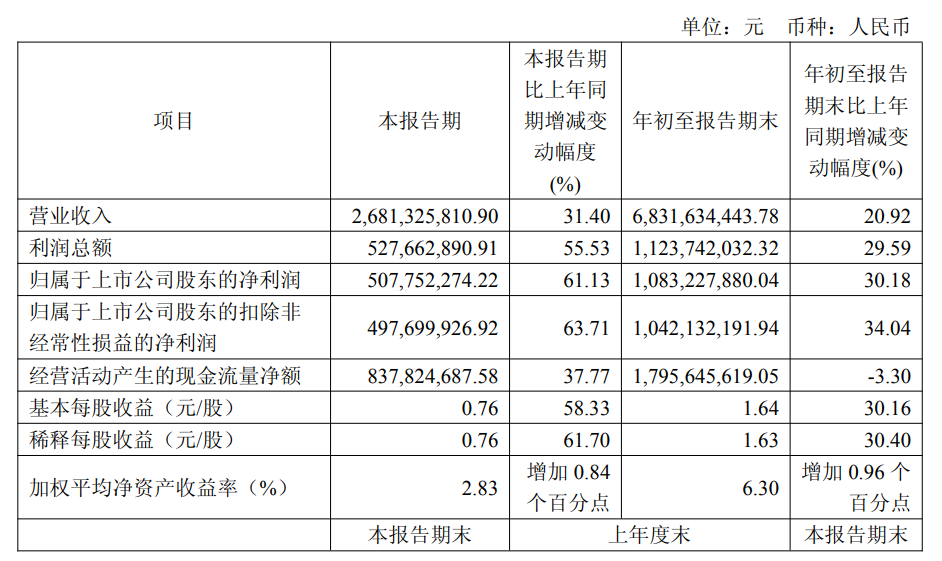
Core Viewpoint - The company reported strong Q3 performance with revenue of 2.681 billion yuan, a year-on-year increase of 31.40%, and a net profit of 508 million yuan, up 61.13%, driven by improvements in the DRAM industry supply chain [1][2][3] Financial Performance - Q3 revenue reached 2.681 billion yuan, representing a 31.40% year-on-year growth; net profit was 508 million yuan, soaring 61.13% [2][3] - For the first three quarters, total revenue was 6.832 billion yuan, up 20.92%, and net profit was 1.083 billion yuan, increasing by 30.18% [2][3] - Q3 gross margin improved significantly, with a non-recurring net profit growth rate of 63.71% and a weighted average ROE of 6.30%, up 0.96 percentage points year-on-year [2][3] Business Drivers - The improvement in the DRAM industry supply chain has created a favorable "price and volume increase" situation, leading to higher shipment volumes and significant price increases [2][3] - The company is seeing growth in diverse product lines, including consumer, industrial, and automotive sectors, which are effectively collaborating with the main business [4][5] Profitability - The Q3 net profit of 508 million yuan grew at nearly double the rate of revenue growth, indicating high-quality earnings growth not reliant on non-recurring gains [3] - The proportion of operating costs to revenue decreased in Q3, with total operating costs for the first three quarters at 4.195 billion yuan, accounting for 61.4% of revenue, an improvement from 60.5% year-on-year [3] Investment and R&D - R&D expenses for the first three quarters were 860 million yuan, a slight increase of 1.7%, accounting for 12.6% of revenue, down from 15.0% year-on-year [7] - Long-term equity investments increased from 137 million yuan at the beginning of the year to 312 million yuan, a growth of 127%; other investments also saw increases [8]