
房地产投资

Search documents
房地产在外国投资中占比下降
Shang Wu Bu Wang Zhan· 2025-12-17 08:14
Core Insights - The share of real estate in Greece's overall foreign direct investment has significantly decreased this year [1] Investment Overview - Total foreign investment in the Greek economy for the first half of this year amounted to €2.8 billion, with €938.3 million (33.4%) related to real estate [1] - This represents a nearly 50% decline (-42.2%) compared to the same period last year [1] Market Trends - Foreign capital investment in Greek real estate is shifting from speculative to long-term [1] - There is a notable increase in demand for vacation homes and luxury properties [1]
地产 11 月观察及数据点评:延续趋势,金融风险减少
GUOTAI HAITONG SECURITIES· 2025-12-16 03:09
Investment Rating - The report assigns an "Accumulate" rating for the real estate industry [4] Core Insights - The industry continues to face downward pressure, but there is a reduction in expenditure pressure, which is expected to persist and provide a favorable financial environment for the macro economy [2] - The overall industry operation is still under downward pressure, with significant declines in development investment and sales figures [53] - The report anticipates that the real estate sector will not contribute to systemic financial risks in 2026, maintaining a favorable environment [53] Summary by Sections Investment Highlights - The report highlights that the real estate investment for January to November 2025 has decreased by 15.9% compared to the same period in 2024, with a notable decline in sales and new construction areas [7][11] - The anticipated trends for 2026 include continued financial risk reduction and persistent economic pressure, with a focus on financial risks in the real estate sector [53] Industry Data - For January to November 2025, the cumulative development investment reached 78,591 billion, with a year-on-year decrease of 15.9% [10] - The sales area of commercial housing for the same period was 787 million square meters, reflecting a year-on-year decline of 7.8% [23] - The report notes that the total funds available for real estate development decreased by 11.9% year-on-year, indicating a tightening financial environment [39] Recommendations - The report recommends several companies for investment, including: 1. Development: Vanke A, Poly Developments, China Overseas Development 2. Commercial and Residential: Longfor Group 3. Property Management: Wanwu Cloud, China Resources Mixc Life 4. Cultural Tourism: Overseas Chinese Town A [53]






前11个月固定资产投资降幅有所扩大,政策将加力推动投资止跌回稳
Sou Hu Cai Jing· 2025-12-15 02:49
Group 1: Fixed Asset Investment - National fixed asset investment decreased by 2.6% year-on-year from January to November, with the decline widening by 0.9 percentage points compared to the previous ten months [1] - Infrastructure investment (excluding electricity, heat, gas, and water production and supply) fell by 1.1% year-on-year, with the decline expanding by 1.0 percentage points compared to the first ten months [2] - The central economic work conference proposed measures to "stop the decline and stabilize investment," including increasing central budget investment and optimizing local government special bond management [4] Group 2: Real Estate Investment - National real estate development investment dropped by 15.9% year-on-year from January to November, with the decline widening by 1.2 percentage points compared to the previous ten months [4] - New commercial housing sales area was 78,702 million square meters, down 7.8% year-on-year; sales amount was 75,130 billion yuan, a decrease of 11.1% [5] - The decline in real estate investment is attributed to weakened support measures and cash flow issues in the market, leading to a lack of confidence among developers [5][6] Group 3: Manufacturing Investment - Manufacturing investment grew by 1.9% year-on-year from January to November, but the growth rate fell by 0.8 percentage points compared to the previous ten months [6] - The decline in manufacturing investment growth is influenced by external economic conditions, constraints on overcapacity industries, and reduced impact from last year's large-scale equipment updates [6] - The current downturn is seen as a necessary adjustment after years of rapid growth in manufacturing investment, with expectations of negative growth in December [6]

中泰证券戴志锋:未来城市更新将更加注重功能完善和品质提升
Zheng Quan Shi Bao Wang· 2025-12-14 14:18
(原标题:中泰证券戴志锋:未来城市更新将更加注重功能完善和品质提升) 人民财讯12月14日电,12月14日,中泰证券研究所所长、金融研究大组组长戴志锋表示,今年的中央经 济工作会议将"坚持内需主导,建设强大国内市场"列为明年首要任务,充分体现了扩大内需在经济工作 全局中的重要地位。投资端"推动投资止跌回稳"的表述直指当前痛点。今年以来固定资产投资增速持续 放缓,特别是房地产投资和民间投资压力较大。"高质量推进城市更新"被单独提出,其深意在于:城市 更新不同于传统的大拆大建,更加注重功能完善和品质提升,投资周期长、带动效应强,能够成为对冲 房地产投资下行的重要抓手。 ...

滨江集团(002244):三季报点评:收入利润大幅增长,财务状况保持稳健
ZHONGTAI SECURITIES· 2025-12-14 09:49
Investment Rating - The investment rating for the company is "Buy" (maintained) [3][10] Core Views - The company has shown a significant increase in revenue and profit, with a 60.64% year-on-year growth in revenue and a 46.60% increase in net profit attributable to shareholders for the first three quarters of 2025 [4][6] - The company maintains a healthy financial structure with a net debt ratio of 7.03% and a cash-to-short-term debt ratio of 3.14 times, indicating low short-term repayment pressure [6] - The company is focused on land acquisition in Zhejiang, particularly in Hangzhou, where it holds a leading position [6] Summary by Sections Financial Performance - For 2023A, the company reported revenue of 70,443 million yuan, with a projected decline to 69,152 million yuan in 2024A, followed by a slight recovery to 69,912 million yuan in 2025E [3] - The net profit attributable to shareholders is forecasted to increase from 2,529 million yuan in 2023A to 2,879 million yuan in 2025E, reflecting a growth rate of 13% [3] - The company's gross profit margin improved to 12.4%, up by 2.0 percentage points year-on-year [6] Sales and Market Position - The company's total sales for the first three quarters of 2025 reached 786.3 billion yuan, a slight decrease of 1.87% year-on-year, ranking it 10th nationally [6] - The company has increased its land acquisition efforts, with new land value reaching 580.1 billion yuan, a 31.16% increase year-on-year [6] Financial Health - The company’s asset-liability ratio stands at 57.8%, with "three red lines" indicators consistently in the green zone [6] - The average financing cost has decreased to 3.1%, down by 0.3 percentage points from the previous year [6] Future Projections - The projected net profits for 2025-2027 are 2,879 million yuan, 3,142 million yuan, and 3,425 million yuan respectively, with corresponding EPS of 0.93, 1.01, and 1.10 yuan [3][6]

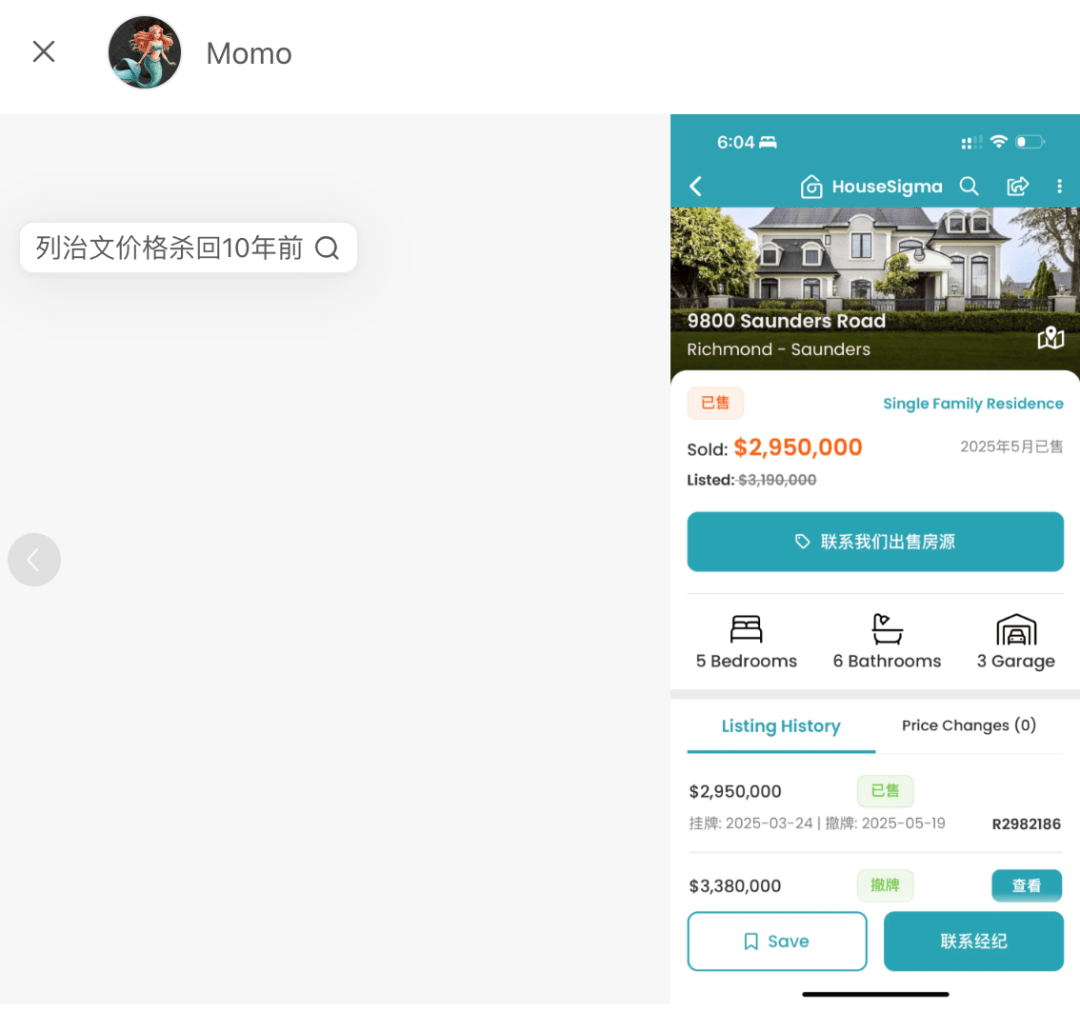
血亏离场!列治文3房不到60万?!
Sou Hu Cai Jing· 2025-12-09 03:44
Core Insights - The real estate market in Richmond is experiencing significant price declines, with properties that were once highly valued now selling for much less than their purchase prices [4][7] - A recent listing in Richmond offers a three-bedroom property for under CAD 600,000, which is considered an attractive deal given its location and amenities [2] - The trend of decreasing property values is evident across various types of housing, including newly built homes and independent houses, indicating a broader market correction [4][7] Summary by Category Property Listings - A three-bedroom, two-bathroom property in Brighouse South, Richmond, is listed for under CAD 600,000, with a government valuation of CAD 635,000, reflecting a significant discount [2] - A newly built property purchased for CAD 868,000 in 2022 is now pending sale at CAD 700,000, indicating a loss of CAD 168,000, which could exceed CAD 200,000 when accounting for taxes and interest [4] Market Trends - Independent houses in Richmond are also seeing price drops, with one property purchased for nearly CAD 2 million in 2022 now being offered for around CAD 1.6 million, reverting to prices seen a decade ago [7] - The overall sentiment among potential buyers is negative, with many expressing doubts about the investment value of condominiums in Canada, citing rising management fees and overall costs [9]
国家统计局原局长邱晓华:国内投资40多年首现负增长,房地产成主要拖累
Xin Lang Cai Jing· 2025-12-07 07:07
Core Viewpoint - The 2025 economic outlook for China is optimistic, with a projected growth target of around 5% for the year, supported by effective macroeconomic policies, strong export performance, and enhanced domestic market resilience [3][7]. Group 1: Economic Support Factors - Three main factors are identified as supporting the achievement of the economic target: 1. Proactive fiscal policies, moderately loose monetary policies, and consumption and investment policies provide strong support for economic recovery [3][7]. 2. Export performance has exceeded expectations [3][7]. 3. The resilience of the domestic market has improved [3][7]. Group 2: Economic Challenges - Two significant challenges facing the economy are highlighted: 1. Persistently low price levels, with both production and consumer prices not returning to normal levels, which constrains investment, consumption, and corporate profitability [3][7]. 2. Insufficient domestic effective demand, with investment demand experiencing its first negative growth in over 40 years, showing a decline of approximately 2% from January to November, primarily due to a double-digit decrease in real estate investment, which accounts for one-third of total investment [3][7]. Group 3: Future Focus - Addressing the impact of declining real estate investment will be a key focus moving forward [4][8].

邱晓华:2025经济增速5%无悬念,受房地产拖累投资负增长40年首现丨和讯2025年会
Sou Hu Cai Jing· 2025-12-07 03:11
Core Viewpoint - The overall performance of China's economy in 2025 is expected to be satisfactory, with a target growth rate of around 5% achievable based on current development trends [1]. Economic Support Factors - Three main factors supporting the achievement of economic goals are identified: 1. Proactive macro policies, including active fiscal policy, moderately loose monetary policy, and supportive consumption and investment policies, provide strong support for economic recovery [3]. 2. Export performance has exceeded expectations, with a "dual抢效应" from enterprises and importers maintaining positive growth despite initial pressures from the US "tariff war" [3]. 3. Increased resilience in the domestic market contributes positively to economic stability [3]. Current Economic Challenges - Two prominent issues facing the economy are highlighted: 1. Persistently low price levels, with both production and consumer prices not returning to normal, which constrains investment, consumption, and corporate profitability [3]. 2. Insufficient domestic effective demand, with investment demand experiencing a negative growth for the first time in over 40 years, showing a decline of approximately 2% from January to November, primarily due to a double-digit decrease in real estate investment, which accounts for one-third of total investment [3]. Focus on Real Estate Investment - Addressing the impact of declining real estate investment will be a key issue that needs to be resolved moving forward [4].

房价从2.1万元跌到9千元,业主崩溃:后悔了,只要接盘免费送
Sou Hu Cai Jing· 2025-12-04 14:42
根据中原地产研究中心数据显示,2021年楼市调控高达651次,刷新了历史记录,同比涨幅高达33%。 而在这样密集的调控下,楼市也发生了很大的变化。首先从整体房价来说,在2021年初时,我国的平均 房价为11220元/平方米,而到了年末时,平均房价回落到了9749元/平方米。 可以说,我国的平均房价突破万元大关后,又重新回落到万元以内的水准。那究竟是从什么时候开始下 跌的呢?根据2021年9月份70城房价数据显示:"新房方面,27个城市新房房价环比上涨,7个城市新房 房价环比持平,36个城市新房房价环比下跌。而二手房方面,17个城市二手房房价环比上涨,1个城市 二手房房价环比持平,52个城市二手房房价环比下跌。" 从这我们就可以看出,在2021年下半年时,房价已经出现了普遍下跌的局面,甚至房价下跌的城市,占 据了最大比重。为何会出现这样的局面呢?主要还是因为调控政策收紧的情况下,那些投资者开始退出 房地产行业,而真正的购房者数量又不是很多,使得楼市出现了供给大于需求的局面,才导致房价出现 了下跌的局面。 要知道,这些年来,我国的房地产行业发展无疑是非常迅速的。在2000年我国的平均房价为2000元/平 方米,而 ...
上海建工:下属子公司2.64亿元竞得都江堰地块使用权
Xin Lang Cai Jing· 2025-12-03 07:38
上海建工公告称,2025年12月3日,其下属子公司沪建(都江堰)置业有限公司竞得都江堰 市"DJY2025-12(0701)"地块国有建设用地使用权。地块位于都江堰市幸福街道联盟社区,面积35,243.38 平方米,建筑面积大于35,243.38平方米且不大于88,108.45平方米,用途为住宅,使用年限70年,成交总 价26,432.55万元。该投资纳入2025年度投资计划额度,虽可能受多种因素影响收益,但符合业务发展策 略。 ...
