文化强国

Search documents
2026年传媒年度策略:十五五启幕AI赋能媒介与内容新叙事
Huaxin Securities· 2025-11-11 12:02
Group 1 - The report emphasizes the transition into the AI era, highlighting the need for media and content industries to adapt to new user demands and leverage AI for growth opportunities [3][4][5] - The cultural media sector is positioned for growth due to two main variables: the initiation of the 14th Five-Year Plan and the empowerment of AI technology, which is shifting from market-driven to policy-driven [4][7] - State-owned enterprises are expected to play a crucial role in the cultural media sector, with companies like Oriental Pearl and Mango TV being highlighted as key players benefiting from AI integration [6][11] Group 2 - The report outlines the performance of the cinema sector, noting that while 2025 saw some challenges, the upcoming 2026 year is expected to bring new content supply and potential growth [30][31] - The digital marketing and e-commerce sectors are experiencing a transformation driven by AI, with significant growth projected in the smart marketing space, expected to reach 1.49 trillion yuan by 2026 [55] - The gaming industry is highlighted as needing to focus on high-quality content production, with companies like miHoYo and Lilith Games being noted for their successful titles, indicating a shift towards content-driven gaming experiences [58][59] Group 3 - The report discusses the importance of long and short video platforms, with significant user engagement noted, particularly in the short video segment, which has reached 1.129 billion monthly active users [36][37] - The audio content market is projected to grow significantly, with the long audio market expected to reach 649.77 billion yuan by 2026, indicating a shift in consumer preferences towards immersive audio experiences [40] - Companies like Bilibili and Xiaohongshu are expanding into audio content, which is expected to drive new user engagement and revenue streams [40][42] Group 4 - The report identifies key companies to watch in the cultural media sector, including state-owned enterprises and digital marketing firms, emphasizing their strategic importance in the evolving landscape [11][12] - The cinema sector is expected to see a rebound in 2026, with new film releases anticipated to drive box office performance, particularly following a low base effect from 2025 [30][31] - The gaming sector is under pressure to innovate and produce high-quality content, with a focus on new product launches and the integration of AI technologies to enhance user experiences [58][59]


聚焦“十五五”规划建议|为基本实现社会主义现代化夯实基础、全面发力——从“十五五”规划建议看奋力开创中国式现代化建设新局面
Xin Hua Wang· 2025-10-29 00:27
Core Points - The "15th Five-Year Plan" is crucial for laying a solid foundation for achieving socialist modernization by 2035, as emphasized by Xi Jinping [1] - The plan outlines systematic strategies for economic and social development, focusing on high-quality growth, technological self-reliance, and enhanced national security [2][3] Economic and Social Development Goals - The plan sets seven main goals for the "15th Five-Year" period, including significant achievements in high-quality development, technological independence, and improved living standards [2] - It aims for per capita GDP to reach the level of middle-developed countries by 2035, indicating a substantial increase from current levels [3] Modern Industrial System - Emphasis on building a modern industrial system as the material and technical foundation for Chinese-style modernization, focusing on the real economy and advanced manufacturing [4] - The plan anticipates an additional market space of approximately 10 trillion yuan over the next five years through the effective upgrading of traditional industries [4] Technological Innovation - The plan highlights the importance of technological modernization, aiming to enhance the national innovation system and boost self-innovation capabilities [6] - Key areas for technological breakthroughs include integrated circuits, advanced materials, and biomanufacturing [6][7] Domestic Market Development - Strengthening the domestic market is identified as a strategic foundation for modernization, with a focus on expanding domestic demand and improving consumption [8][9] - The plan includes measures to enhance investment efficiency and increase the proportion of government investment in people's livelihoods [9] High-Level Opening Up - The plan emphasizes expanding high-level openness and cooperation, aiming to enhance trade and investment while maintaining a focus on domestic strengths [14][15] - Specific initiatives include optimizing trade structures and promoting digital trade [15] Agricultural Modernization - The plan prioritizes agricultural modernization and rural revitalization, aiming to improve agricultural productivity and living conditions in rural areas [16][17] - It includes measures to ensure food security and promote sustainable agricultural practices [17] Regional Economic Coordination - The plan aims to optimize regional economic layouts and promote coordinated development across regions, enhancing the synergy between urban and rural areas [18][19] - It includes initiatives for urbanization and improving infrastructure in rural areas [20] Cultural Development - Cultural prosperity is highlighted as a key aspect of modernization, with a focus on enhancing cultural innovation and public cultural services [21][22] Social Welfare and Quality of Life - The plan emphasizes improving living standards and social welfare, aiming for equitable access to resources and services [23][24] - It includes strategies for enhancing education, healthcare, and housing quality [24][25] Environmental Sustainability - The plan stresses the importance of green development and ecological protection, aiming for significant progress in building a "Beautiful China" [26][27] - It outlines measures for carbon neutrality and sustainable resource management [27] National Security - Strengthening national security is a key focus, with strategies to enhance the national security system and address various risks [28][29] - The plan emphasizes the need for a comprehensive approach to security that integrates development and safety [29][30] Defense Modernization - The plan outlines goals for modernizing national defense and the military, emphasizing the importance of a strong military for national security [31][32] Party Leadership - The plan underscores the necessity of the Party's leadership in driving modernization efforts, ensuring that all initiatives align with the Party's directives [33][34] - It emphasizes the importance of maintaining a unified approach to governance and policy implementation [34][35]
中共中央关于制定国民经济和社会发展第十五个五年规划的建议
中汽协会数据· 2025-10-28 14:35
Core Viewpoint - The "15th Five-Year Plan" period is crucial for achieving basic socialist modernization, building on the significant achievements of the "14th Five-Year Plan" and addressing complex domestic and international challenges [2][3][4]. Group 1: Achievements and Challenges - The "14th Five-Year Plan" saw major accomplishments in economic stability, high-quality development, technological innovation, and social governance despite the pandemic and various risks [2]. - The "15th Five-Year Plan" will focus on consolidating advantages, breaking bottlenecks, and addressing weaknesses to secure strategic initiatives in international competition [3][4]. Group 2: Economic and Social Development Guidelines - The guiding ideology for the "15th Five-Year Plan" emphasizes Marxism, Xi Jinping's thoughts, and the goal of building a modern socialist country while promoting high-quality development and reform [6][7]. - Key principles include maintaining the Party's leadership, prioritizing people's needs, ensuring high-quality development, and deepening reforms [7][8]. Group 3: Major Goals - Significant improvements in high-quality development, technological self-reliance, and comprehensive reforms are expected, alongside enhanced cultural confidence and living standards [8][9]. - The plan aims for a substantial increase in economic strength, technological capabilities, and national security by 2035, with a focus on achieving a middle-income level for citizens [9]. Group 4: Modern Industrial System - The establishment of a modern industrial system is essential, focusing on the real economy and promoting intelligent, green, and integrated development [10][11]. - Traditional industries will be optimized, and new and future industries will be cultivated to enhance competitiveness and innovation [11][12]. Group 5: Technological Self-Reliance - The plan emphasizes the importance of technological modernization, with a focus on original innovation and breakthroughs in key technologies [14][15]. - Integration of technological and industrial innovation is crucial for enhancing the national innovation system and fostering a competitive environment for enterprises [15][16]. Group 6: Domestic Market Development - Strengthening the domestic market is a strategic priority, with efforts to boost consumption and investment while ensuring a positive interaction between supply and demand [18][19]. - The plan includes measures to enhance consumer capacity and optimize investment structures to support economic growth [19][20]. Group 7: High-Level Socialist Market Economy - The establishment of a high-level socialist market economy is vital for ensuring sustainable high-quality development, with a focus on enhancing the vitality of various economic entities [22][23]. - The plan aims to improve the market-oriented allocation of resources and enhance macroeconomic governance [23][24]. Group 8: Open Cooperation - Expanding high-level openness and cooperation is essential for mutual benefit, with a focus on aligning with international trade rules and enhancing trade and investment [25][26]. - The plan includes initiatives to promote trade innovation and expand investment cooperation, particularly in the context of the Belt and Road Initiative [27]. Group 9: Agricultural Modernization - Agricultural modernization is a key focus, with efforts to enhance production capacity and quality while promoting rural revitalization [28][29]. - The plan aims to improve living conditions in rural areas and ensure sustainable agricultural development [30]. Group 10: Regional Economic Layout - Promoting regional coordinated development is essential, with strategies to enhance the economic layout and optimize resource allocation across regions [31][32]. - The plan emphasizes the importance of urbanization and the development of coastal and border areas [33]. Group 11: Cultural Development - Cultural prosperity is a significant aspect of modernization, with initiatives to promote socialist core values and enhance cultural confidence [34][35]. - The plan aims to foster a vibrant cultural ecosystem and improve the quality of cultural services [36]. Group 12: Improving People's Livelihoods - Enhancing the quality of life for citizens is a primary goal, with a focus on employment, income distribution, and social security [37][38]. - The plan includes measures to improve education and social welfare systems to ensure equitable access to resources [39][40].


“十五五”怎么干?专家热议中国经济
Zhong Guo Jing Ji Wang· 2025-10-28 14:27
Group 1 - The "14th Five-Year Plan" period stabilized the economy under complex conditions, while the "15th Five-Year Plan" aims to leverage existing advantages for high-quality development [2][3] - The strategic task of the "15th Five-Year Plan" emphasizes building a modern industrial system and strengthening the foundation of the real economy, responding to profound changes in the international environment [2] - There is a focus on seizing opportunities in new technological revolutions and industrial transformations, particularly in fields like information technology, artificial intelligence, quantum technology, and biomedicine [2] Group 2 - The core of great power strategic competition lies in the contest of comprehensive strength, with an emphasis on maintaining strategic determination and enhancing economic and technological capabilities [3] - The establishment of a unified national market is crucial for promoting domestic circulation and transforming the domestic market from large to strong [3] - Strategies to expand domestic demand include increasing public service spending, raising disposable income proportions, and enhancing consumer spending within total demand [3] Group 3 - Enterprises are encouraged to align their development directions with the "15th Five-Year Plan" and identify key tasks for future growth [4] - Companies should explore international markets and leverage policy benefits such as financial subsidies, tax incentives, and project funding [4] - Cultural enterprises are presented with opportunities to enhance cultural exchange and storytelling, contributing to the construction of a culturally strong nation [4]
中共中央关于制定国民经济和社会发展第十五个五年规划的建议|宏观经济
清华金融评论· 2025-10-28 09:32
Core Viewpoint - The "15th Five-Year Plan" period is crucial for achieving basic socialist modernization, building on the significant achievements of the "14th Five-Year Plan" period, and addressing complex domestic and international challenges [3][4][5][6]. Group 1: Achievements and Challenges - The "14th Five-Year Plan" period saw major achievements in economic stability, high-quality development, technological innovation, and social governance despite facing severe challenges such as the pandemic [4]. - The "15th Five-Year Plan" period is positioned as a key phase for consolidating these achievements and addressing bottlenecks to ensure strategic advantages in international competition [5][6]. Group 2: Economic and Social Development Goals - The guiding principles for the "15th Five-Year Plan" include adhering to Marxism, promoting high-quality development, and ensuring that the benefits of modernization reach all citizens [10][11][12]. - Key goals include significant improvements in high-quality development, technological self-reliance, and social welfare, with a focus on enhancing the quality of life for citizens [13][14][15]. Group 3: Modern Industrial System - The establishment of a modern industrial system is essential, emphasizing the development of advanced manufacturing and the optimization of traditional industries [17][18]. - New and emerging industries will be cultivated, focusing on strategic sectors such as renewable energy and advanced materials [18][19]. Group 4: Technological Innovation - The "15th Five-Year Plan" emphasizes the importance of technological modernization, with a focus on original innovation and the integration of technology with industry [20][21]. - Strengthening the national innovation system and enhancing the role of enterprises in technological development are key strategies [22][23]. Group 5: Domestic Market Development - A strong domestic market is identified as a strategic foundation for modernization, with initiatives aimed at boosting consumption and investment [26][27]. - Efforts will be made to eliminate barriers to market integration and enhance the efficiency of resource allocation [29]. Group 6: High-Level Opening Up - The plan advocates for expanding international cooperation and trade, with a focus on high-standard trade agreements and investment facilitation [34][35]. - The "Belt and Road" initiative will be further developed to enhance connectivity and economic collaboration with partner countries [36]. Group 7: Agricultural Modernization - Agricultural modernization is crucial for overall development, with strategies aimed at improving production capacity and rural living conditions [37][38]. - Policies will focus on enhancing agricultural productivity and ensuring sustainable rural development [39][40]. Group 8: Regional Economic Coordination - The plan emphasizes the need for regional economic coordination to promote balanced development across different areas of the country [41][42]. - Infrastructure connectivity and collaborative development among urban and rural areas will be prioritized [43]. Group 9: Cultural Development - Cultural prosperity is highlighted as a key aspect of modernization, with initiatives aimed at promoting core socialist values and enhancing cultural innovation [45][46]. - The development of a robust cultural industry and the promotion of traditional culture are essential components of the strategy [47][48]. Group 10: Social Welfare and Equity - The plan aims to improve social welfare systems and ensure equitable access to resources, focusing on employment, income distribution, and education [49][50]. - Policies will be implemented to enhance the quality of life for all citizens and promote common prosperity [51][52].

中共中央关于制定国民经济和社会发展第十五个五年规划的建议
国家能源局· 2025-10-28 09:18
Core Viewpoint - The "15th Five-Year Plan" period is crucial for achieving basic socialist modernization, building on the significant achievements of the "14th Five-Year Plan" period, and addressing complex domestic and international challenges [3][4][5]. Group 1: Achievements and Challenges - The "14th Five-Year Plan" period saw major achievements in economic stability, high-quality development, technological innovation, and social governance, despite facing severe challenges such as the pandemic [3]. - The "15th Five-Year Plan" period will focus on consolidating advantages, breaking bottlenecks, and addressing weaknesses to secure strategic initiatives in international competition [4][5]. Group 2: Economic and Social Development Goals - The guiding principles for economic and social development during the "15th Five-Year Plan" include adhering to Marxism, promoting high-quality development, and ensuring that modernization benefits all people [8][9]. - Key goals include achieving significant results in high-quality development, enhancing self-reliance in technology, and improving the quality of life for citizens [11][12][13]. Group 3: Modern Industrial System - The establishment of a modern industrial system is essential, focusing on optimizing traditional industries, fostering emerging industries, and enhancing service sector development [14][15][16]. Group 4: Technological Innovation - Accelerating technological self-reliance and innovation is vital, with an emphasis on original innovation and the integration of technology with industry [17][18][19]. Group 5: Domestic Market Development - Strengthening the domestic market is a strategic priority, with initiatives aimed at boosting consumption, expanding effective investment, and removing barriers to market integration [21][22][23][24]. Group 6: High-Level Socialist Market Economy - Building a high-level socialist market economy involves enhancing the vitality of various economic entities, improving the market allocation of resources, and ensuring sustainable fiscal policies [25][26][27][28]. Group 7: Opening Up and International Cooperation - Expanding high-level openness and cooperation is essential, focusing on trade innovation, investment cooperation, and the Belt and Road Initiative [29][30][31]. Group 8: Agricultural Modernization - Promoting agricultural modernization is crucial for overall modernization, with efforts to enhance agricultural productivity and improve rural living conditions [32][33][34][35]. Group 9: Regional Economic Coordination - Optimizing regional economic layouts and promoting coordinated development across regions are necessary for achieving balanced growth [36][37][38]. Group 10: Cultural Development - Fostering cultural innovation and development is a key aspect of modernization, emphasizing the promotion of socialist core values and cultural industries [39][40][41]. Group 11: Improving People's Livelihoods - Enhancing the quality of life for citizens through employment, income distribution, education, and social welfare is fundamental to achieving common prosperity [42][43][44][45].
中共中央关于制定国民经济和社会发展第十五个五年规划的建议
Wind万得· 2025-10-28 09:07
Core Viewpoint - The article emphasizes the importance of the 15th Five-Year Plan as a critical period for achieving socialist modernization in China, highlighting the need for strategic initiatives to address both opportunities and challenges in the domestic and international landscape [5][6][7]. Group 1: Achievements and Context - The 14th Five-Year Plan has led to significant achievements in China's development, including economic stability, technological innovation, and improved living standards, despite facing challenges such as the pandemic and international tensions [5]. - The 15th Five-Year Plan is positioned as a transitional phase that builds on past successes while addressing existing challenges to lay a solid foundation for future modernization efforts [6]. Group 2: Development Environment - The international landscape is characterized by rapid changes, including shifts in global power dynamics, technological revolutions, and rising protectionism, which pose both risks and opportunities for China's development [7]. - Domestically, China maintains a strong economic foundation but faces issues such as uneven development, insufficient demand, and demographic changes that require strategic responses [7]. Group 3: Guiding Principles and Goals - The guiding principles for the 15th Five-Year Plan include upholding the leadership of the Communist Party, prioritizing people-centered development, and focusing on high-quality growth [9][10]. - Key goals include achieving significant advancements in high-quality development, technological self-reliance, and comprehensive reforms, alongside improvements in social welfare and environmental sustainability [13][14]. Group 4: Economic Structure and Innovation - The plan emphasizes the need to strengthen the real economy, enhance traditional industries, and foster emerging sectors, with a focus on innovation and sustainability [15][16]. - A modernized industrial system is essential for supporting China's unique modernization, with an emphasis on advanced manufacturing and the integration of digital technologies [15][18]. Group 5: Domestic Market and Investment - Strengthening the domestic market is crucial for driving economic growth, with initiatives aimed at boosting consumption and effective investment [23][24]. - The plan outlines strategies to eliminate barriers to market integration and enhance the efficiency of resource allocation across various sectors [25][27]. Group 6: Social Development and Welfare - The plan prioritizes improving living standards and social welfare, with a focus on employment, income distribution, and education [41][42]. - Enhancing the social security system and ensuring equitable access to resources are key components of the strategy to achieve common prosperity [44].

重磅!“十五五”规划建议全文公布
中国基金报· 2025-10-28 08:55
Core Viewpoint - The "15th Five-Year Plan" period is crucial for achieving basic socialist modernization, building on the significant achievements of the "14th Five-Year Plan" and addressing complex domestic and international challenges [2][3][4]. Group 1: Achievements and Challenges - The "14th Five-Year Plan" saw major accomplishments, including stable economic growth, advancements in technology and innovation, and improvements in social governance and national security [2]. - The "15th Five-Year Plan" will focus on consolidating advantages, overcoming bottlenecks, and addressing shortcomings to secure strategic advantages in international competition [3][4]. Group 2: Economic and Social Development Guidelines - The guiding ideology for the "15th Five-Year Plan" emphasizes the importance of Marxism, Xi Jinping's thoughts, and the goal of building a modern socialist country [6]. - Key principles include maintaining the Party's leadership, prioritizing people’s needs, promoting high-quality development, and deepening reforms [7][8]. Group 3: Economic Goals - Significant improvements in high-quality development are expected, with economic growth maintained within a reasonable range and increased domestic consumption driving growth [9]. - The plan aims for substantial advancements in self-reliance in technology, with a focus on innovation and integration of technology and industry [9]. Group 4: Modern Industrial System - The establishment of a modern industrial system is essential, focusing on the real economy and promoting intelligent, green, and integrated development [11]. - Traditional industries will be optimized, and new and future industries will be cultivated to enhance competitiveness [12][13]. Group 5: Domestic Market Development - Strengthening the domestic market is a strategic priority, with initiatives to boost consumption and effective investment [19][20]. - The plan includes measures to eliminate barriers to a unified national market and enhance market efficiency [22]. Group 6: High-Level Open Economy - Expanding high-level openness and cooperation is vital, with a focus on aligning with international trade rules and enhancing trade and investment [26][27]. - The plan emphasizes the importance of the Belt and Road Initiative and international collaboration in various sectors [28]. Group 7: Agricultural Modernization - Agricultural modernization is a key focus, with efforts to enhance production capacity and quality while ensuring rural revitalization [28][29]. - Policies will be implemented to improve living conditions in rural areas and support sustainable agricultural practices [30]. Group 8: Cultural Development - Promoting cultural innovation and development is essential for modernizing society, with a focus on core socialist values and enhancing cultural confidence [35][36]. - The plan aims to foster a vibrant cultural ecosystem and improve the quality of cultural services [37]. Group 9: Social Welfare and Common Prosperity - Enhancing social welfare and ensuring common prosperity are central to the plan, with strategies to improve employment, income distribution, and education [39][40][41]. - The establishment of a comprehensive social security system is prioritized to support vulnerable populations and promote social equity [42].
中共中央关于制定国民经济和社会发展第十五个五年规划的建议
财联社· 2025-10-28 08:45
Core Viewpoint - The "15th Five-Year Plan" period is crucial for achieving basic socialist modernization, building on the significant achievements of the "14th Five-Year Plan" and addressing complex domestic and international challenges [3][4][5]. Group 1: Achievements and Challenges - The "14th Five-Year Plan" saw major accomplishments in economic stability, high-quality development, technological innovation, and social governance despite the severe impact of the pandemic [3]. - The "15th Five-Year Plan" will focus on consolidating advantages, overcoming bottlenecks, and enhancing weaknesses to secure strategic initiatives in international competition [4]. - The development environment is characterized by profound changes, with both strategic opportunities and risks present, necessitating a proactive approach to navigate uncertainties [5][6]. Group 2: Guiding Principles and Goals - The guiding ideology for the "15th Five-Year Plan" emphasizes Marxism, Xi Jinping's thoughts, and the goal of building a modern socialist country while promoting high-quality development and comprehensive reforms [7][8]. - Key goals include achieving significant results in high-quality development, enhancing self-reliance in technology, and improving the overall governance system [10][11]. Group 3: Economic and Social Development - The plan aims for a notable increase in economic growth, productivity, and consumer spending, with a focus on building a unified national market and promoting new industrialization [10][12]. - The emphasis will be on fostering emerging industries, optimizing traditional sectors, and enhancing service industry quality [13][19]. Group 4: Infrastructure and Technological Advancement - A modernized infrastructure system will be developed, focusing on integrating new technologies and enhancing resilience [14]. - The plan prioritizes technological self-reliance, with significant investments in key areas such as semiconductor technology and advanced materials [15][16]. Group 5: Domestic Market and Investment - Strengthening the domestic market is essential, with strategies to boost consumption and effective investment [20][21]. - The plan includes measures to eliminate barriers to market integration and enhance the investment environment for both domestic and foreign entities [22][23]. Group 6: Rural Modernization and Regional Development - Agricultural modernization is a priority, with efforts to improve production capacity and quality while ensuring rural revitalization [29][30]. - The plan promotes regional coordination, aiming to balance development across different areas and enhance infrastructure connectivity [32][33]. Group 7: Cultural and Social Development - Cultural innovation and the promotion of socialist values are highlighted as key components of modernization [35][36]. - The plan aims to improve living standards and social welfare, ensuring that development benefits all citizens [38][39].

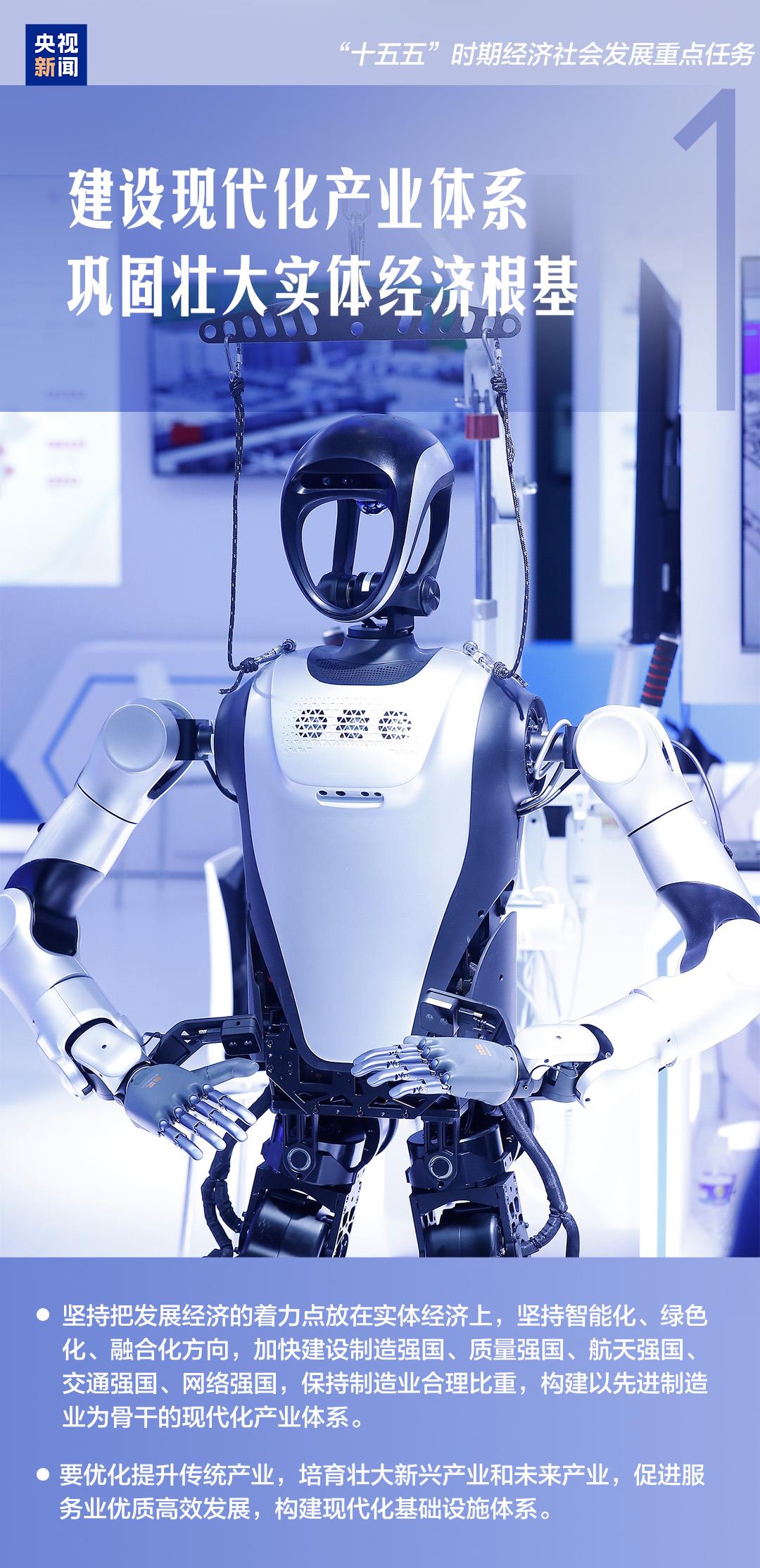
“十五五”这样干!一组图带你了解未来五年重点任务
Yang Shi Xin Wen Ke Hu Duan· 2025-10-25 12:20
Group 1 - The core focus during the "Fifteen Five" period is to strengthen the foundation for socialist modernization and to fully exert efforts in economic and social development [1][5] - Emphasis on developing the real economy, with a focus on intelligent, green, and integrated directions, aiming to build a strong manufacturing nation and a modern industrial system [5][10] - The strategy includes optimizing traditional industries, nurturing emerging industries, and promoting high-quality development in the service sector [5][7] Group 2 - The plan aims to seize opportunities from the new round of technological revolution and industrial transformation, enhancing the national innovation system and self-innovation capabilities [7][10] - There is a strong emphasis on original innovation and tackling key core technologies, integrating technological and industrial innovation [7][10] Group 3 - The strategy includes expanding domestic demand as a strategic basis, promoting consumption and investment, and ensuring a positive interaction between supply and demand [11][14] - Efforts will be made to boost consumption and effective investment while removing barriers to the construction of a unified national market [11][14] Group 4 - The plan calls for expanding high-level opening-up and maintaining a multilateral trade system to enhance international circulation [13][16] - It emphasizes the importance of self-initiated opening-up and promoting trade innovation and high-quality cooperation in the Belt and Road Initiative [17][16] Group 5 - The focus is on modernizing agriculture and rural areas, ensuring the integration of urban and rural development, and enhancing agricultural production capacity [18][22] - The strategy aims to consolidate and expand the achievements of poverty alleviation and improve living conditions in rural areas [22][24] Group 6 - The plan includes promoting cultural innovation and development, enhancing the influence of Chinese culture, and fostering a strong cultural identity [25][28] - It emphasizes the importance of Marxism in the ideological field and the promotion of socialist core values [28][31] Group 7 - The strategy aims to improve people's livelihoods and promote common prosperity, addressing urgent issues faced by the populace [27][31] - It includes enhancing employment quality, improving income distribution, and ensuring access to quality education and social security [31][32] Group 8 - The plan focuses on achieving a comprehensive green transformation and building a beautiful China, emphasizing ecological safety and sustainable development [32][35] - It aims to promote carbon neutrality and establish a new energy system while enhancing green development momentum [35][32] Group 9 - The strategy includes modernizing the national security system and capabilities, ensuring social order and vitality [34][38] - It emphasizes the importance of a comprehensive national security strategy and improving public safety governance [38][41] Group 10 - The plan aims for high-quality advancement of national defense and military modernization, adhering to the leadership of the Communist Party [39][41] - It includes enhancing combat capabilities and modernizing military governance [41][42]