
权益投资

Search documents
中邮基金换帅!权益规模下降,中邮核心成长混合为何业绩垫底?
Sou Hu Cai Jing· 2025-12-21 03:46
文/每日财报 楚风 12月17日,中邮基金公告,原董事长毕劲松因年满退休正式离任,由张涛接任董事长一职。此次调整与控股股东首创证券的近期人事变动一脉相承:毕劲 松于11月卸任首创证券董事长,张涛随后接棒并于12月兼任中邮基金董事长。 毕劲松担任中邮基金董事长时长5年,公司管理规模从400多亿元增长至700多亿元,相比同规模的基金公司并不突出。从产品类型来看,债券基金成为规 模增长的主要推动力,当前规模占比超过七成。 12月17日,中邮基金发布高管变动公告显示,毕劲松因年满退休,不再担任公司董事长的职务。自12月16日起,公司董事长由张涛接任。中邮基金是首创 证券的控股子公司,该高管变动与首创证券一脉相承。 《每日财报》曾撰文《首创证券"将帅齐换"背后:资管业务收入"腰斩",投行业务成为短板》提到,11月20日,首创证券董事长毕劲松因退休离职,张涛 从总经理职位升任董事长,并担任法定代表人。 作为证券业"老将",张涛并不具备基金公司从业经验。资料显示,张涛曾在华泰证券任职,历任总裁办公室总裁秘书、投资银行一部业务经理、上海总部 投资银行业务部副总经理等多个职位,后加入东兴证券,曾担任财务负责人、董事、总经理等职 ...


2026年度策略会年度策略报告巡礼之金融篇
2025-12-17 15:50
2026 年度策略会年度策略报告巡礼之金融篇 20251217 摘要 2025 年证券板块内部出现分化,A 股广发证券表现最佳,H 股广发证券 涨幅显著,而部分股票如国联民生、财富趋势、招商证券则出现下跌, 反映市场对不同券商的业绩和发展前景存在差异化预期。 2026 年证券行业展望:各类资金持续入市,推动成交量维持高位;经 纪业务受益于客户保证金扩张和线上获客能力提升;两融余额预计提升, 增加利润贡献;资管业务通过丰富投资策略和向主动管理转型提升业绩。 保险资金入市方面,大型国有保险公司新增保费的 30%需投资股票,居 民存款搬家潜力巨大,有望推动增量资金入市。经纪业务收入与利润贡 献预计保持重要地位,线上化、AI 化趋势明显。两融余额持续增长,资 管业务需通过丰富投资策略及向主动管理转型来提升业绩。 2025 年前三季度港股日均成交额同比增长显著,南向资金占比提升, 港股 IPO 发行大幅增长,A 股上市公司赴港二次 IPO 占比超 70%。预计 港股市场发行将持续扩张,美联储降息将保持港股流动性充裕。 2025 年 A 股保险股表现平稳,港股保险股超额收益显著,受顺周期属 性和高估值性价比驱动。新华保险 ...
加强权益投资,险资年内已举牌38次
Xin Lang Cai Jing· 2025-12-15 00:21
Core Insights - The core point of the article is that insurance companies, particularly Ruizhong Life Insurance, are increasingly engaging in shareholding activities, specifically targeting H-shares, with a notable trend expected to continue into 2026 [1][5]. Group 1: Shareholding Activities - Ruizhong Life Insurance announced it has acquired 5% of Qingdao Beer H-shares, totaling 32.764 million shares [2][9]. - Since 2025, there have been 38 instances of insurance companies acquiring shares, marking a new high since 2016, involving 14 insurance institutions and 27 listed companies [2][9]. - A significant portion of these acquisitions involves repeated purchases of the same stock, with companies like Hongkang Life and Ping An Life making multiple acquisitions of the same H-shares [2][9]. Group 2: Investment Trends - The trend of insurance companies favoring H-shares is evident, with 84% of the 38 acquisitions in 2025 targeting H-shares [3][11]. - H-shares are perceived as undervalued compared to A-shares, making them attractive for long-term investments focused on dividend income [3][11]. - Tax incentives, such as exemptions on corporate income tax for dividends from H-shares held for over 12 months, enhance the appeal of H-shares for insurance companies [4][12]. Group 3: Future Outlook - Industry experts predict that the enthusiasm for shareholding will persist into 2026, with a potential shift towards growth sectors while maintaining a strong focus on traditional sectors [5][13]. - The current low-interest-rate environment and regulatory encouragement for long-term equity investments are expected to drive continued growth in shareholding activities [6][13]. - Traditional sectors like finance, energy, and public utilities currently dominate insurance investments, but there is an anticipated gradual increase in allocations towards technology and growth sectors [6][14].
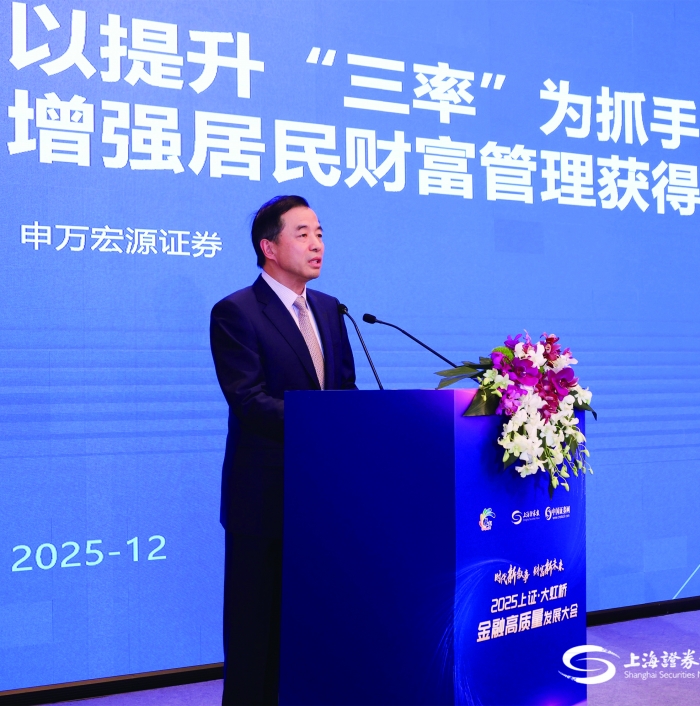
申万宏源监事会主席方荣义:以提升“三率”增强居民财富管理获得感
Shang Hai Zheng Quan Bao· 2025-12-14 19:43
方荣义 方荣义表示,近年来我国居民财富管理呈现三大趋势性新变化:一是居民理财投资者的队伍日渐壮大, 据贝恩咨询数据,中国全市场持有理财产品的投资者数量达1.39亿人;二是居民对权益投资的配置比重 有所提升,当前居民家庭资产配置中股票、基金等权益类资产占金融资产的比例已提升至15%左右;三 是居民理财需求综合化,居民对财富管理的诉求已经从单一的储蓄理财向多元资产配置转变。 尽管当前财富管理市场逐渐庞大,但在方荣义看来,金融体系在服务居民财富管理上还面临两大短板瓶 颈:一方面,财富管理产品的深度广度不足。目前市场上的理财产品多集中在高波动、中低收益区间, 且不同类型投资产品之间的风险关联度很高,低贝塔、低波动、稳定收益的产品供给严重不足,这在很 大程度上制约了居民中长期储蓄向金融投资的转化。另一方面,投资者信任与陪伴不足,尚未形成真正 的买方投顾服务体系。 基于上述判断,方荣义认为证券公司未来要以提升"三率"为抓手,助力居民提升金融投资收益:一是要 着力提升居民投资的含"权"率,为投资者提供更多元的具有中长期稳定收益的权益产品,并加大创设 ETF、指数基金等被动管理产品以降低投资门槛;二是要着力提升居民全球资产配 ...

加强权益投资 险资年内已举牌38次
Zheng Quan Ri Bao· 2025-12-14 15:53
Core Viewpoint - The announcement by Ruizhong Life Insurance indicates a significant trend in insurance capital actively acquiring shares in H-share listed companies, with expectations for this trend to continue into 2026 [1][5]. Group 1: Investment Activity - Ruizhong Life Insurance has acquired 3.2764 million shares of Qingdao Beer, representing 5% of the company's H-share capital, triggering a mandatory disclosure [2]. - Since 2025, there have been 38 instances of insurance capital acquisitions, the highest since 2016, involving 14 insurance institutions and 27 listed companies [2]. - Notable examples include Hongkang Life Insurance, which has made 16 additional purchases of Zhengzhou Bank H-shares, raising its stake to 22.14%, and China Ping An Life Insurance, which has made three acquisitions each in three different banks [2]. Group 2: Reasons for Frequent Acquisitions - Insurance capital tends to hold a significant stake in a single listed company to account for investments using the equity method, allowing them to share the net profits of the company without reflecting stock price fluctuations in their profit statements [3]. - Insurance companies view long-term capital from insurance funds as beneficial for enhancing market confidence in listed companies, with the potential for board representation to improve governance [3]. - The primary motivation for insurance capital acquisitions is to secure high dividend returns in a low-interest-rate environment rather than seeking control over the companies [3]. Group 3: Preference for H-shares - In 2025, 84% of insurance capital acquisitions targeted H-share companies, with a preference for these shares due to their relative undervaluation compared to A-shares [3]. - H-shares offer tax advantages, such as exemption from corporate income tax on dividends if held for over 12 months, enhancing actual returns for insurance capital [4]. - The diversification benefits of investing in H-shares, which do not move in sync with A-shares, help mitigate overall portfolio volatility for insurance companies [4]. Group 4: Future Trends - The trend of high acquisition activity is expected to continue into 2026, with a gradual shift towards growth sectors in the asset allocation of insurance capital [5]. - Traditional sectors like finance, energy, and utilities currently dominate insurance capital investments, but there is an increasing focus on growth and technology sectors [6]. - The investment strategy is anticipated to become more diversified, with a balanced approach between high dividend traditional sectors and growth-oriented investments [6][7].
保险业2026年度策略报告:攻守兼备,乘势而上-20251212
Ping An Securities· 2025-12-12 01:08
非银行金融 2025 年 12 月 12 日 【平安证券】行业点评-非银行金融-下调保险投资股 票风险因子,培育壮大耐心资本-强于大市 20251207 证券分析师 相关研究报告 【平安证券】行业半年度策略报告-非银行金融-高质 量发展引领价值重估,头部公司更具韧性——非银金 融行业 2025 年中期策略报告-强于大市 20250701 【平安证券】行业点评-非银行金融-人身险预定利率 再下调,分红险具备比较优势-强于大市 20250727 【平安证券】行业点评-非银行金融-中金拟吸收合并 东兴+信达,证券业供给侧改革加速-强于大市 20251120 保险业 2026 年度策略报告 攻守兼备,乘势而上 强于大市(维持) 行情走势图 | 李冰婷 | 投资咨询资格编号 | | --- | --- | | | S1060520040002 | | | LIBINGTING419@pingan.com.cn | | 许 淼 | 投资咨询资格编号 | | | S1060525020001 | | | XUMIAO533@pingan.com.cn | 平安观点: 行 业 报 告 行 业 年 度 策 略 报 证 券 研 ...
大成基金百亿名将年内5次“内部调整”,55%权益规模押注“三剑客”
Sou Hu Cai Jing· 2025-12-09 03:13
Core Viewpoint - Dachen Fund Management, once a prominent player in equity investment, is currently facing multiple challenges, including significant internal management changes and underperformance of its funds [2][12]. Group 1: Management Changes - Wei Qingguo, a former fund manager, has been removed from all public fund management roles after five internal adjustments in 2025, with the latest occurring on November 4 and 6 [2][5]. - Wei managed a total of 11 funds during his tenure, with a peak management scale exceeding 11 billion [3]. Group 2: Fund Performance - As of November 13, 2025, the combined management scale of three key fund managers—Xu Yan, Liu Xu, and Han Chuang—reached 64.281 billion, accounting for approximately 55% of the company's equity fund total [2][12]. - Xu Yan's managed products have all underperformed against their benchmarks, with the newly established Dachen Xingyuan Qihang fund criticized for missing out on the "bull market" [2][12]. - Dachen Industry Pioneer, managed by Wei, reported a return of 32.53% since inception, but has shown negative returns over the past year, two years, and three years [6][10]. Group 3: Investment Strategy - The investment strategy of Dachen Fund appears to be heavily reliant on traditional value stocks and large-cap stocks, with a lack of diversification into growth sectors [18]. - High turnover rates in funds, particularly Dachen Industry Pioneer, indicate a potential lack of a stable investment framework, which may lead to increased trading costs and risks [10][18]. Group 4: Recent Developments - Dachen Fund's total public fund management scale is currently 473.877 billion, ranking 26th among 188 public funds [19]. - Despite past successes, the company has seen a decline in its asset ranking, now fluctuating around the 30th position [19][26]. - Newer fund manager Guo Weiling has shown promising results with the Dachen Technology Innovation fund, achieving a return of 120.2% over the past year, significantly outperforming peers [24][25].
信达澳亚权益投资实力行业领跑 产品矩阵匹配多元需求
Cai Fu Zai Xian· 2025-12-08 11:06
Core Insights - The annual performance landscape of public equity funds is becoming clearer as 2025 approaches, with Xinda Australia Fund demonstrating robust growth and risk resilience through a long-term investment perspective [1] - Xinda Australia Fund has achieved a cumulative return of 312.38% over the past ten years, ranking first in the industry, and has received a five-star rating for its stock investment capabilities over the same period [1] Product Performance - Xinda Australia Fund's equity products cover various sectors including new energy, transformation innovation, and growth, catering to different investor risk preferences and holding needs [2] - The Xinda Australia New Energy Industry A fund has a ten-year return of 348.99%, ranking 3rd among 127 similar actively managed stock open-end products [1][2] - The Xinda Australia Transformation Innovation Stock A fund ranks in the top 8% of similar products with a one-year return, while the Xinda Australia Performance Driven A fund has a one-year return of 139.57%, ranking 4th among 3902 similar strong stock mixed products [2] Investment Philosophy - The company adheres to a "professional research-driven" philosophy, achieving performance breakthroughs in the active equity sector, reflecting its grasp of market trends and the stability of its research and investment system [2] - Xinda Australia Fund aims to continue enhancing research and optimizing management to create sustainable long-term investment returns for investors [2]
举牌潮再现 险资偏好H股和银行股
Jin Rong Shi Bao· 2025-12-04 02:14
从举牌对象来看,高股息红利股备受险资青睐,特别是金融类上市公司。以举牌次数最多的平安人寿为 例,据统计,今年以来平安人寿举牌次数达到12次,分别举牌中国太保H股两次、农业银行H股3次、中 国人寿H股1次、邮储银行H股3次、招商银行H股3次。 "从H股上市公司半年报披露的数据看,保险公司进入大股东名录的标的股票,涵盖金融、公用事业、 交通运输、医药和地产等板块,其中,银行类H股成为险资举牌的主要板块,显示出险资对高股息、低 估值等稳健收益资产的高度偏好。"张夏说。 值得注意的是,从险资举牌的交易方式观察,虽然二级市场直接买入仍为主流模式,但协议转让、非公 开发行等多元化路径正日益活跃。 11月26日,泰康人寿公告披露其举牌复宏汉霖H股的公告再次引发业内关注。《金融时报》记者根据中 国保险行业协会公告不完全统计,截至11月27日,今年以来险资累计举牌33次上市公司。其中,27次举 牌指向了H股,12次举牌银行股,3次举牌保险股。 业内人士表示,今年以来险资系列密集的动作,显示出险资在复杂经济形势下,寻求稳健回报与战略协 同的资产配置新路径,预计未来险资在权益投资上将采取更趋精细化与多元化的策略。 "举牌"是指保险 ...
理财新势力亮相科创板打新 入场者为何仅为少数派
Zhong Guo Zheng Quan Bao· 2025-12-01 22:30
Core Insights - The article highlights the increasing participation of bank wealth management companies in IPO offline subscriptions, particularly focusing on the case of Moer Technology, which is recognized as the "first domestic GPU stock" [1][2] - The involvement of Ningyin Wealth Management and Xingyin Wealth Management in the subscription process marks a significant step for bank wealth management in equity investments [1][3] Group 1: Bank Wealth Management Participation - Ningyin Wealth Management successfully allocated shares from six of its wealth management products, while Xingyin Wealth Management allocated shares from three products in the Moer Technology IPO [1][2] - The products from Ningyin Wealth Management include various mixed open-ended wealth management products with different minimum holding periods [1][2] - The participation of these wealth management companies indicates a shift towards more active roles in capital markets, driven by policy support and the need for enhanced investment strategies [1][3] Group 2: Industry Challenges and Opportunities - Despite the potential for increased participation in IPO offline subscriptions, many bank wealth management companies face challenges related to research capabilities and personnel allocation [3][4] - The article notes that the high premium characteristics of A-share new stocks provide an opportunity for bank wealth management products to achieve excess returns [4][5] - Industry experts suggest that bank wealth management companies should focus on improving research and valuation modeling capabilities, designing differentiated product structures, and enhancing investor engagement to navigate the complexities of new stock pricing and risk management [5]