
核聚变能源

Search documents
美股三大指数集体高开,热门中概股多数上涨,蔚来张超2%
Feng Huang Wang Cai Jing· 2025-12-18 14:46
Group 1 - U.S. stock indices opened higher, with the Dow Jones up 0.67%, S&P 500 up 1.00%, and Nasdaq up 1.43%, driven by Micron's strong performance and easing inflation expectations [1] - Chinese concept stocks mostly rose, with the Nasdaq Golden Dragon China Index increasing by 1.37%, and notable gains in NIO, Xpeng Motors, Bilibili, and NetEase, all rising over 2% [1] - Micron's earnings report indicated strong demand for memory chips, alleviating concerns about potential slowdowns in data center construction, leading to a 13% increase in Micron's stock price [1] Group 2 - Trump Media Technology Group's stock surged 27% after announcing a merger agreement with TAE Technologies, which plans to build the world's first utility-scale fusion power plant by 2026 [2][5] - The merger will create one of the first publicly listed fusion energy companies, with TAE having raised over $1.3 billion from various investors since its inception [5] Group 3 - Morgan Stanley's latest report highlights a "long-term bull market logic" for chip stocks, driven by unprecedented AI infrastructure demand and strong inventory reduction in traditional analog chips/MCUs, predicting chip stocks to be one of the best-performing sectors in the U.S. market next year [6] - The report also lists Nvidia, Broadcom, and Astera Labs as the top three chip stocks for 2026 [6] Group 4 - Instacart's stock fell nearly 6% amid an investigation by the Federal Trade Commission into its AI pricing tool, Eversight, which reportedly caused significant price discrepancies for the same products in the same store [7] Group 5 - Eli Lilly announced the submission of a new drug application to the FDA for its oral weight loss medication, orforglipron, which has shown promising results in maintaining weight loss effects in patients transitioning from its injectable product [9]


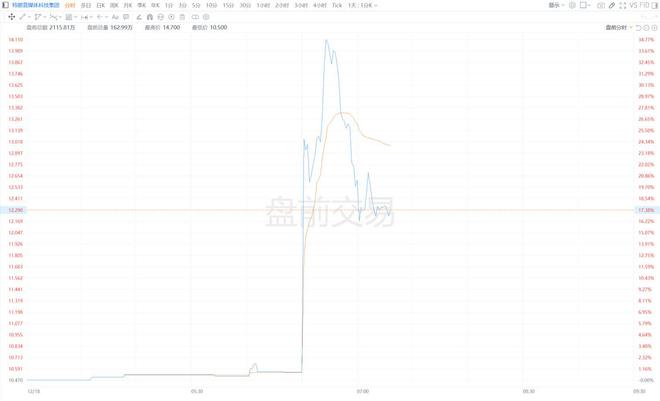
美股异动 | 特朗普媒体科技集团(DJT.US)盘前大涨26% 公司拟并购核聚变初创公司TAE
Zhi Tong Cai Jing· 2025-12-18 14:29
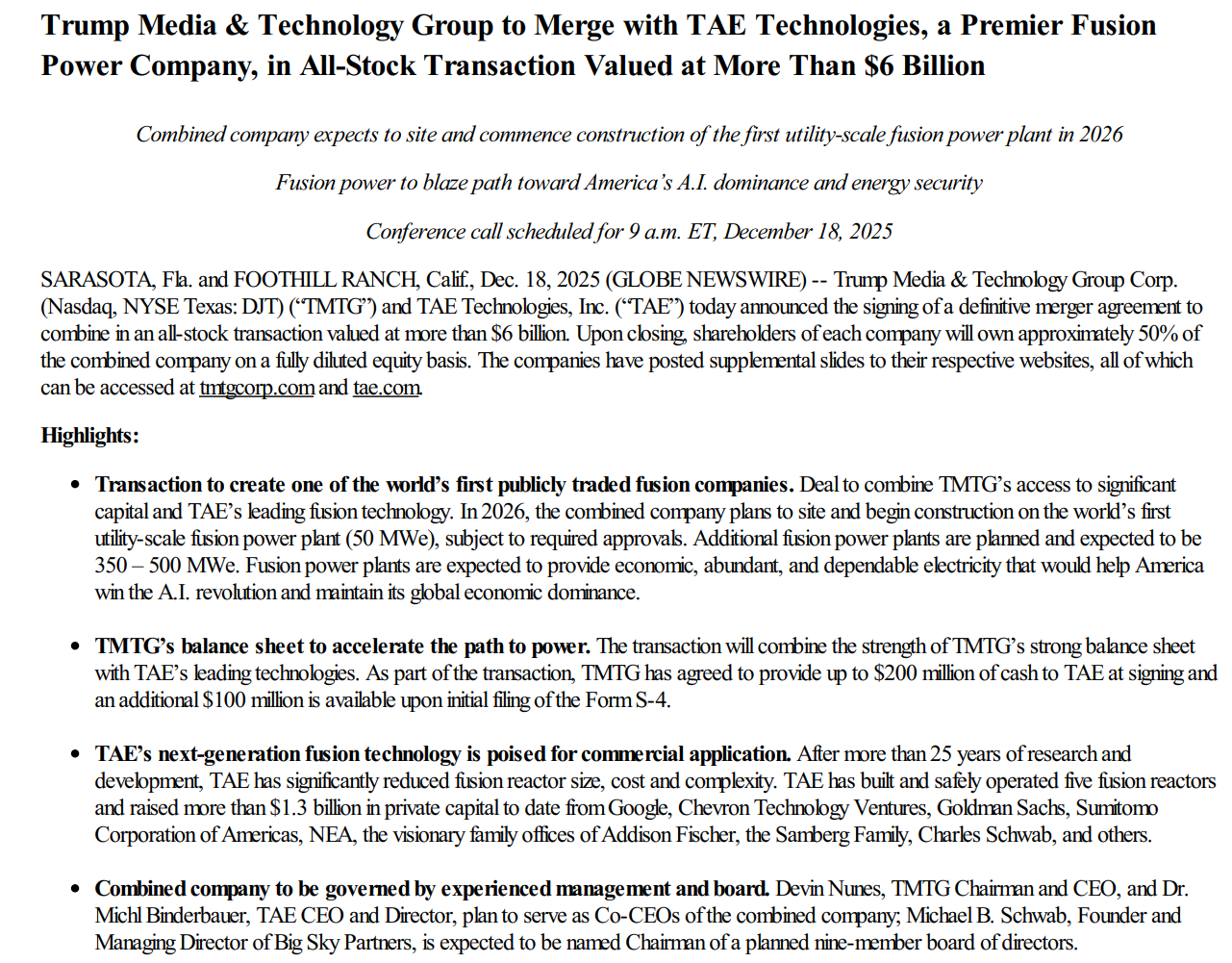
智通财经APP获悉,周四,特朗普媒体科技集团 (DJT.US)盘前大涨26%,报13.20美元。消息面上,特 朗普媒体科技集团 (Trump Media &; Technology Group Corp,简称TMTG)已与聚变能源初创公司TAE Technologies签署最终合并协议,这项全股票交易的估值超过60亿美元。根据协议条款,TMTG与TAE 将进行合并,双方现有股东将在完全稀释的基础上各持有新公司约50%的股份。为支持交易推进, TMTG将在签约时向TAE提供高达2亿美元的现金注资,并在提交S-4文件后提供额外的1亿美元资金。 (原标题:美股异动 | 特朗普媒体科技集团(DJT.US)盘前大涨26% 公司拟并购核聚变初创公司TAE) 此次合并旨在打造市场上首批公开上市的聚变能源公司之一。据报道,合并后的公司计划于2026年选址 并启动公用事业规模聚变发电厂的建设。管理层表示,这一战略布局旨在应对人工智能发展带来的巨大 能源需求,并致力于确立美国在能源安全领域的优势地位。 ...

Trump Media & Technology Group (NasdaqGM:DWAC) Earnings Call Presentation
2025-12-18 14:00
Transaction Overview - TMTG will merge with TAE in an all-stock transaction, aiming to create a pro forma company capitalized to fund a utility-scale fusion plant and grow media and technology franchises[5] - The transaction is expected to close in mid-2026, pending customary closing conditions and shareholder approval[5] - Post-merger, TMTG/TAE are expected to own approximately 50% each on a fully diluted basis[6] - TMTG has agreed to provide up to $200 million in cash to TAE, with an additional $100 million available upon initial filing of the Form S-4[6] Pro Forma Company Strategy - The pro forma company aims to deliver clean, affordable, and reliable fusion energy, targeting utility-scale power generation with plants scaled to 350-500 MWe[8, 9] - The company plans to advance TAE's proprietary technology, which is considered safe, deployable, and reliable for baseload power to meet AI-driven demand[7, 9] - The company intends to construct its first utility-scale 50 MWe fusion power plant, with site location and construction commencing in 2026, targeting initial power operations in 2031[21] Financials and Leadership - The pro forma company will have $3.1 billion of financial assets on its balance sheet as of Q3 2025[28] - TAE has raised $1.3 billion in private capital to date[7, 25] - The pro forma company will be governed by a nine-member board, with a majority being independent, including Devin Nunes, Michl Binderbauer, Donald J Trump Jr, and Michael B Schwab (Chairman)[6, 7] TAE Technology and Innovation - TAE has a 27-year history of fusion research, having built five fusion reactors to date[6, 7, 19] - TAE has over 400 employees, including 62 Ph Ds, and has been granted over 1,600 patents[7] - TAE is targeting fusion-generated electricity by 2031, with future commercial power plants expected to be sized at 350-500 MWe[11, 20]

美股异动|特朗普媒体科技集团盘前大涨40% 拟与核聚变公司TAE进行全股票交易合并
Ge Long Hui A P P· 2025-12-18 12:40
格隆汇12月18日|特朗普媒体科技集团(DJT.US)盘前直线拉升,一度大涨40.4%至14.7美元。消息面 上,特朗普媒体科技集团据悉将与TAE科技公司以全股票交易方式合并。特朗普媒体科技集团表示,交 易预计于2026年年中完成。合并后公司预计将于2026年选址并开始建设首座公用事业规模的核聚变发电 厂。聚变能源将为美国的人工智能主导地位和能源安全开辟道路。交易对每股TAE股票估值为53.89美 元。在签约时提供高达2亿美元的现金。交易结束后,公司将成为"真相社交"(Truth Social)、"真相 +"(Truth+)、"真相金融"(Truth.FI)、TAE、TAE Power Solutions以及TAE Life Sciences的控股公司。 ...
中国千亿资本下注“人造太阳”,美日被甩身后,重塑全球能源格局
Sou Hu Cai Jing· 2025-12-16 10:10
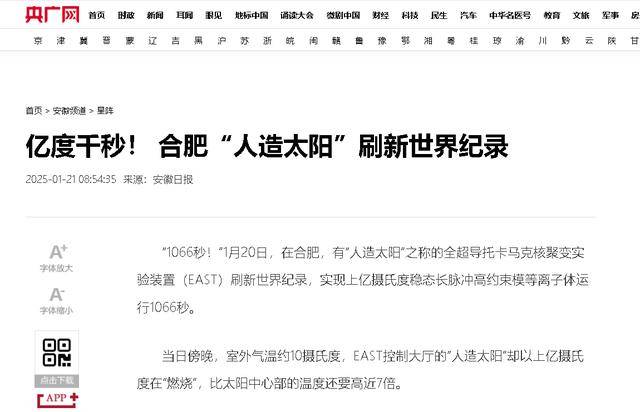
Core Viewpoint - China's advancements in nuclear fusion technology, particularly with the "artificial sun" project, have positioned the country as a global leader in energy innovation, significantly altering the global energy landscape [1][14]. Group 1: Technological Achievements - The EAST device in Hefei achieved plasma stability at 100 million degrees for 1066 seconds, while the "Chinese Circulation No. 3" in Chengdu reached an electron temperature of 160 million degrees [1]. - These milestones indicate China's significant progress in energy technology, surpassing Western nations [2]. Group 2: Advantages of Fusion Energy - Fusion energy offers a sustainable alternative to fossil fuels, utilizing hydrogen from seawater, which can produce energy equivalent to 300 liters of gasoline from just one liter of seawater [4]. - The safety profile of fusion energy is superior to fission, as it can cool down in case of an incident, reducing the risks associated with nuclear power [4]. Group 3: Historical Context and Development - China's journey in fusion technology began decades ago, initially observing international projects like ITER, but later decided to develop its own capabilities due to the limitations of international collaboration [6][8]. - By 2006, China secured a position in the ITER project, but eventually shifted focus to independent development, leading to significant contributions to ITER's key components [8][10]. Group 4: Future Prospects and Industry Impact - A dedicated fusion company has been established in China, with both state and private investments, indicating a strong commitment to commercializing fusion energy [12]. - The potential for localized power generation through fusion technology could revolutionize energy distribution, making electricity cheaper and more reliable for consumers [12][14]. Group 5: National Confidence and Global Positioning - China's advancements in fusion technology reflect a shift from dependency on foreign technology to becoming a leader in global energy transformation [14]. - The sustained support from the government and the dedication of scientists have fostered a new era of confidence, allowing China to assert its influence in the global energy sector [14].
地球上造小型核反应堆“愚蠢至极”,马斯克:太阳才是“免费终极核反应堆”
华尔街见闻· 2025-12-16 04:49
埃隆·马斯克公开斥责在地球上建造小型核聚变反应堆的努力是"愚蠢至极"的行为,并再次力挺太阳能,称太阳才是终极的"免费聚变反应堆"。 12月15日,马斯克在X平台的一篇帖子中,毫不掩饰他对地球核聚变项目的蔑视。他写道: "太阳是天空中一个巨大、免费的聚变反应堆。在地球上制造微型 聚变反应堆是愚蠢至极的。" 为了强调太阳无与伦比的能量优势,他用了一个极具冲击力的比喻: "就算你烧掉4个木星,太阳在太阳系所有能量产出中的占比四舍五入后仍然是100%!!" 马斯克甚至直接向参与清洁能源辩论的公司喊话,要求它们停止投资。他称: "别再为这些微不足道的小型反应堆浪费钱了,除非你主动承认它们只是你的宠 物科学项目。" 这番言论将地球上的核聚变研发直接定义为昂贵且不必要的"副业"。 人工智能被视为加速这一进程的关键变量。谷歌旗下的人工智能公司DeepMind已与联邦聚变系统公司宣布合作,旨在利用AI技术加速开发可并入电网的商业 化聚变能源解决方案。谷歌DeepMind的聚变团队在一篇博客文章中表示:"我们的AI专业知识与CFS的尖端硬件相结合,是推动聚变能源基础性发现的理想伙 伴关系。" 美国能源部长Chris Wright ...

建筑行业周报:核聚变招投标加速,继续重点推荐洁净室及核电模块标的-20251214
GF SECURITIES· 2025-12-14 10:09
Core Insights - The report emphasizes the acceleration of bidding for nuclear fusion projects and the operational launch of the Liebherr Nantong base, focusing on nuclear power and marine engineering modules [6][15][28] - The report highlights the structural recovery of infrastructure investment, particularly in Sichuan and Xinjiang, and recommends investments in low-valuation central state-owned enterprises [6][34] - The report tracks the development of cleanroom technology and the increasing capital expenditure of Taiwanese electronics companies in the U.S., indicating a trend of the Taiwanese supply chain moving to the U.S. [6][34] Group 1: Nuclear Fusion and Power Projects - The signing of a joint statement between China and France on December 4, 2025, promotes the development of nuclear power, recognizing nuclear fusion energy as a significant direction for future energy development [6][15] - The Liebherr Nantong base is expected to achieve an annual output value of CNY 560 million for nuclear modules and CNY 640 million for oil and gas energy modules, addressing the decline in traditional chemical business demand [6][28] - The report notes that the modular construction method in nuclear power can significantly shorten construction periods, with the Liebherr Nantong base now operational [6][28] Group 2: Cleanroom and Coal Chemical Industry - The report tracks the cleanroom sector, noting that TSMC plans to invest USD 165 billion in capital expenditures in the U.S., with Foxconn and Wistron also planning significant investments [6][34] - In the coal chemical sector, projects are progressing steadily, with Xinjiang remaining a primary investment area, including a 1.5 million tons/year coal-to-ethylene project [6][34] - The average price of medium and heavy plates in 13 regions decreased by 0.9%, while rebar prices fell by 1.0%, indicating a slight decline in steel prices [6][34] Group 3: Financial Tracking and Investment Recommendations - The report indicates that special bonds issued for refinancing have reached CNY 2.01 trillion, with a cumulative issuance of CNY 4.5 trillion in special bonds for the year, reflecting a 13.8% year-on-year increase [6][34] - The report recommends focusing on four main investment lines: infrastructure recovery, safety resources, technology in high-end manufacturing, and overseas business opportunities [6][34] - The funding availability rate for construction sites is reported at 59.74%, showing a slight increase from the previous week [6][34]




长三角议事厅·周报|打通AI商业化梗阻,长三角如何破题
Xin Lang Cai Jing· 2025-12-08 09:40
Core Insights - The global AI competition is intensifying, shifting from a focus on "parameters and performance" to "ecosystem and implementation," with an emphasis on sustainable revenue and real demand [1] - The Yangtze River Delta (YRD) region is well-positioned to leverage its complete industrial chain and digital economy foundation, but faces challenges in translating technology into measurable business value [1][4] - The YRD's AI development strategy is evolving towards a systematic ecosystem that integrates chips, models, platforms, and applications, moving away from isolated technological advancements [2] Group 1: AI Industry Development in the Yangtze River Delta - The YRD is transitioning from a focus on individual technological breakthroughs to building a comprehensive ecosystem that supports AI commercialization [2] - Shanghai aims to lead in smart terminal development, targeting a market scale of 300 billion yuan by 2027, integrating chips, algorithms, and consumer-grade AI products [2] - Zhejiang is focusing on healthcare AI applications, planning to establish a national AI medical application base by 2027 [3] - Jiangsu is leveraging its manufacturing advantages to establish over 70 industry standards by 2027, enhancing the usability of industrial AI [3] - Anhui is targeting a revenue of 100 billion yuan in AI by 2027, focusing on embodied intelligence and future forms of AI [3] Group 2: Barriers to AI Commercialization - The first barrier is high costs associated with model training and deployment, which limits the ability of small developers to iterate from prototypes to products [4][5] - The second barrier involves regulatory uncertainties, where changing compliance requirements can deter investment in AI projects [5] - The third barrier is the lack of compatibility between domestic computing power and mainstream models, leading to inefficiencies and increased costs [5][6] Group 3: Strategies for Overcoming Barriers - The YRD must shift from isolated technological advancements to a full-chain ecological approach to make AI a sustainable productivity tool for businesses [6][7] - Establishing mechanisms for regional collaboration is essential, allowing resources to be shared and utilized effectively across the region [7] - Infrastructure needs to be more accessible and productized, reducing the initial costs for businesses to adopt AI technologies [7][8] - Expanding high-quality scenario offerings and fostering long-term collaborations between AI companies and traditional industries will help transition from pilot projects to sustainable implementations [8]
中法联合声明
中国能源报· 2025-12-05 11:20
Group 1: Nuclear Energy Cooperation - The core viewpoint emphasizes the importance of nuclear energy as a clean, low-carbon, stable, and reliable energy source in addressing global challenges such as climate change and energy security [2][3] - Both countries reaffirm their commitment to ongoing cooperation in the peaceful use of nuclear energy, building on the existing agreements from 1997 and 1982 [2][3] - The collaboration will focus on areas such as the construction and management of third-generation pressurized water reactors, extending the lifespan of existing nuclear power plants, decommissioning, and radioactive waste management [3] Group 2: Technological Innovation and Safety - Both parties recognize that technological innovation is crucial for enhancing the safety and economic viability of nuclear energy, and they will continue to explore new projects in areas like small modular reactors and AI applications [3][4] - There is a mutual understanding of the importance of coordinated efforts in nuclear fuel supply, equipment manufacturing, and uranium resource security to ensure the stability of the nuclear energy supply chain [3] Group 3: Climate and Environmental Challenges - The two nations are committed to strengthening cooperation in addressing global climate and environmental challenges, reaffirming their dedication to various international agreements and frameworks [6][7] - They emphasize the importance of multilateralism and the role of scientific integrity in addressing climate issues, supporting the work of various international scientific bodies [7][8] - Both countries aim to enhance global renewable energy deployment and support the transition away from fossil fuels, with a shared goal of tripling global nuclear power capacity by 2050 [8][9] Group 4: Biodiversity and Sustainable Development - The countries recognize the interconnectedness of climate change, biodiversity loss, and pollution, committing to efforts to halt deforestation and land degradation by 2030 [9][10] - They express support for the establishment of a legally binding international instrument to end plastic pollution and encourage research into sustainable alternatives [10] Group 5: Financial Support and Capacity Building - Both nations are willing to support developing countries in achieving sustainable development and enhancing their access to climate and environmental funding [10] - They welcome initiatives like the Kunming Biodiversity Fund and reaffirm their commitment to financing goals outlined in the Kunming-Montreal Global Biodiversity Framework [10]

重磅!中法核能领域合作联合声明
Yang Shi Xin Wen Ke Hu Duan· 2025-12-05 09:45
Group 1 - Both China and France recognize the unique importance of nuclear energy as a clean, low-carbon, stable, and reliable baseload energy source in addressing global challenges such as climate change and energy security [1] - The two countries will continue to cooperate under the framework of the intergovernmental agreement on peaceful nuclear energy cooperation signed in 1997 and the protocol signed in 1982, focusing on industrial and technological collaboration [1] - Nuclear cooperation is considered a vital component of the comprehensive strategic partnership between China and France, with ongoing collaboration in areas such as third-generation pressurized water reactor construction, operation management, and radioactive waste management [1] Group 2 - Both parties acknowledge the importance of coordinated cooperation in nuclear fuel supply, nuclear equipment manufacturing, and uranium resource security to ensure the stability of the nuclear energy supply chain [2] - The two countries are committed to ensuring safe, reliable, and sustainable handling of spent fuel and radioactive waste, emphasizing the need for collaboration in nuclear energy safety development [2] - The recognition of nuclear fusion energy as a significant development direction for peaceful nuclear energy utilization, with a commitment to participate in the International Thermonuclear Experimental Reactor (ITER) project [2] Group 3 - Both countries reaffirm their commitment to the international nuclear non-proliferation regime, particularly the Treaty on the Non-Proliferation of Nuclear Weapons, and emphasize the role of the International Atomic Energy Agency in ensuring nuclear safety and security [3] - The two nations will provide necessary resources to achieve these goals, subject to funding availability and compliance with domestic legal requirements [3] Group 4 - Both parties commit to supporting international nuclear energy development while adhering to international obligations regarding nuclear safety, security, and non-proliferation [4] - The recognition of the ambition to develop global nuclear energy, with China supporting France's declaration to triple global nuclear energy from 2020 to 2050 as part of carbon neutrality commitments [4]