泡沫

Search documents
达利欧:AI热潮虽现泡沫迹象,但真正的拐点还未到来
Di Yi Cai Jing· 2025-11-20 23:47
达利欧表示,美国科技股估值偏高、AI 热潮具备泡沫特征,但市场仍未出现"刺破泡沫"的关键条件。 关于人工智能(AI)热潮是否已进入泡沫区间的讨论在华尔街不断发酵。桥水基金(Bridgewater Associates)创始人瑞·达利欧(Ray Dalio)近日在多家媒体采访中表达了不同观点。他认为,尽管估值 已处在偏高位置,但缺乏触发泡沫破裂的关键条件,"现在并不是从 AI 相关资产抽身的时候"。 黄金仍是关键配置 在加密资产方面,达利欧持相对谨慎的态度。他透露,比特币长期占其投资组合约1%,但对其能否成 为各国央行采用的储备资产信心不足。 他给出的理由主要有两点:第一,比特币的所有交易永久记录且可追踪,与主权货币体系的结构与隐私 要求存在根本差异;第二,量子计算未来可能带来的安全风险,使其长期稳定性仍存不确定性。 近期多家机构警示AI主题的高估值风险,但达利欧认为,市场是否进入泡沫并不是关键,更重要的是 泡沫何时会真正被刺破。他提到,从历史经验看,泡沫最终走向破裂通常与两类因素有关:其一是货币 政策突然收紧,其二是市场出现必须出售资产的压力。目前,这两种情形都不明显。 当地时间11月19日,英伟达最新财报显 ...

申万宏源陈达飞:刚性“泡沫”——申万宏源2026年海外经济宏观展望
Xin Lang Zheng Quan· 2025-11-19 03:03
Group 1 - The core viewpoint of the article emphasizes that the AI revolution is still in its early stages, and the potential for a "golden era" in AI capital may follow the current bubble phase [1][3] - The article discusses the divergence in asset prices since the emergence of ChatGPT, highlighting a conflict between strong expectations for the AI industry and weak economic realities [1] - It predicts that by 2025, the U.S. economy will experience a "soft landing," with a continued trend of interest rate cuts and a weakening dollar, while both risk and safe-haven assets will perform well [1][2] Group 2 - In 2025, AI capital expenditure is expected to become a new pillar of the U.S. economy, although there are concerns about cash flow pressures and debt financing needs for representative companies [3] - The article outlines that the monetary policy cycles in the U.S., Europe, and Japan will diverge, with the U.S. Federal Reserve expected to cut rates twice, while Japan may restart rate hikes depending on internal political stability [2] - It highlights the fiscal expansion expected in the U.S., Germany, and Japan, with respective increases in deficit rates of +1.0%, +0.84%, and +0.77%, and the impact on GDP growth from fiscal expansion is ranked as follows: Germany +0.63%, U.S. +0.6%, Japan +0.25%, and Eurozone +0.2% [2]

单年投入超720亿美元!Meta首席营销官回应AI投资质疑
Huan Qiu Wang Zi Xun· 2025-11-17 06:04
Group 1 - The explosive growth in investment in artificial intelligence infrastructure has raised concerns about whether the latest boom among large tech companies is heading towards a bubble [1] - Meta plans to invest up to $72 billion in artificial intelligence infrastructure this year, with expectations for even higher spending next year [2] - Meta's investments in AI have already generated billions in revenue, improving its advertising tools and content ranking algorithms [2] Group 2 - Meta's CEO, Mark Zuckerberg, expressed a willingness to risk missing out on hundreds of billions of dollars rather than fall behind in the development of superintelligence [2] - Despite the significant amounts of capital being invested, Meta's Chief Marketing Officer, Alex Schultz, stated that the current investment levels, while aggressive, do not reach the point of being irrational compared to historical bubbles [2] - Meta's projected revenue for this year is approximately $200 billion, with a market capitalization around $1.5 trillion [2]



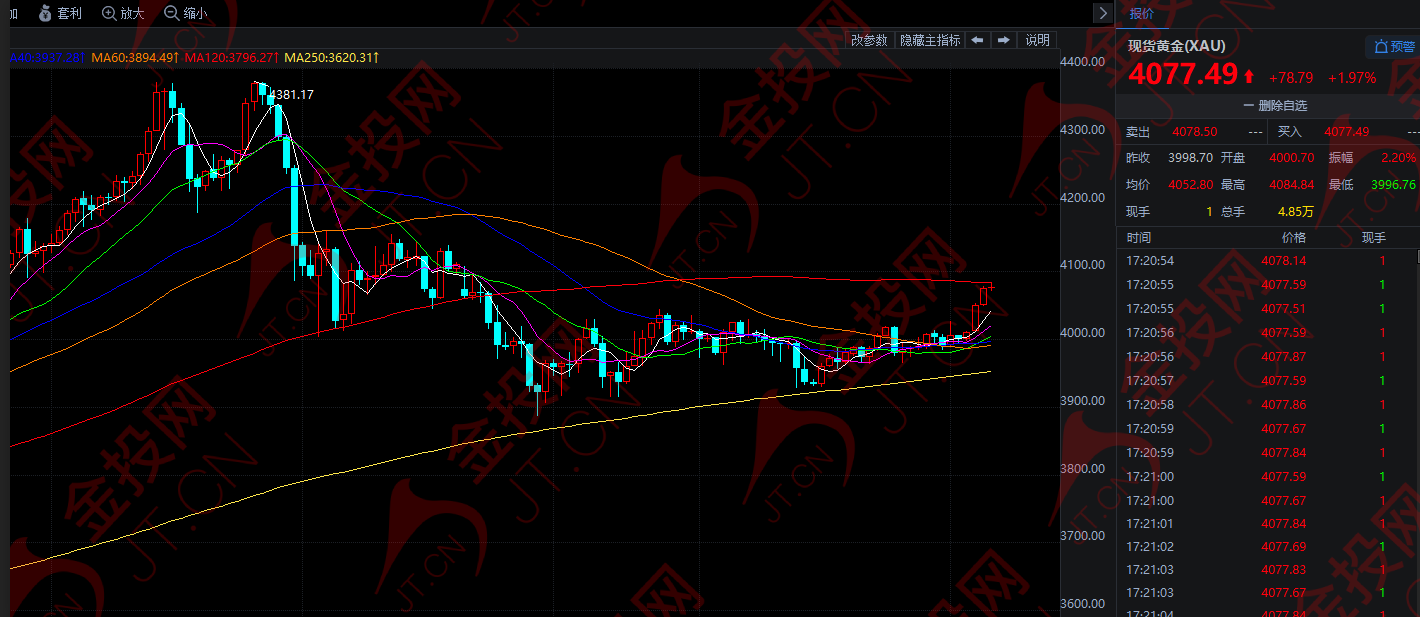
一则消息 黄金又爆了!
Jin Tou Wang· 2025-11-10 12:43
Group 1 - Gold prices experienced significant fluctuations, closing at $4000.91 after a drop of $1.57 or 0.04%, with a notable increase to around $4076 during European trading hours [1] - The U.S. stock market indices saw collective declines, with the Nasdaq down 3.04%, S&P 500 down 1.63%, and Dow Jones down 1.21% [2] - The U.S. government is expected to end its longest shutdown, with the Senate passing a temporary funding bill to provide government funding until January 30, 2026 [3][4] Group 2 - The potential economic impact of the government shutdown was highlighted, with warnings that continued shutdown could lead to negative economic growth in Q4 [5] - Recent announcements from the U.S. and China indicate a pause in certain trade measures, including the suspension of special port fees for U.S. vessels and the suspension of investigations into China's maritime and logistics sectors [6] - The upcoming release of the October CPI is anticipated to be a significant event, with analysts suggesting that a normal release could support interest rate cuts, while the absence of data may favor a more hawkish stance from the Federal Reserve [7] Group 3 - Concerns regarding high valuations in the U.S. stock market, particularly among AI stocks and the so-called "Tech Seven," have been raised by various financial institutions [8] - UBS noted that while there are warnings about potential market turbulence, the current market is still in the early stages of a bubble, lacking extreme valuation levels seen during the 2000 internet bubble [8] Group 4 - International developments include a large-scale attack by Russia on Ukraine's energy infrastructure, leading to power outages in multiple regions [10] - Russian defense forces reported intercepting 79 Ukrainian drones over ten regions [11] - Public support for President Putin remains high, with 74.5% of Russians approving of his work according to a recent poll [13]
美国知名对冲基金拆解400年“泡沫史”的最终判断:AI离“泡沫”还远
3 6 Ke· 2025-11-10 12:42
Core Insights - The report by Coatue concludes that AI is in the early "replacement/population" phase and has not yet reached a bubble peak, supported by healthy profit and cash flow from leading companies [1][2][10] - AI has generated $150 billion in revenue, demonstrating the rationality of capital expenditure through unprecedented technology adoption [2][4] - The current valuation levels in the AI sector are healthier compared to the internet bubble period, with the Nasdaq 100 index's forward P/E ratio projected at 28 times for 2025, significantly lower than the 89 times during the 1999 bubble [10][13] Group 1: AI Market Dynamics - AI technology is creating quantifiable investment returns across various industries, with significant revenue generation from programming assistants and efficiency improvements in knowledge work automation [4][5] - The market is transitioning from pilot projects to large-scale deployment of AI applications [5] - The investment landscape is characterized by a surge in private capital entering the AI sector, leading to the emergence of "super startups" [17][20] Group 2: Valuation Comparisons - The average P/E ratio of the top seven tech companies in 1999 was 67 times, while it is expected to be around 28 times in 2025, indicating a more stable financial environment for current tech giants [13][24] - The current valuation gap between tech and non-tech stocks remains within historical reasonable ranges, with tech companies generally exhibiting strong profitability and cash flow [17][24] Group 3: Future Projections - AI-driven industries are projected to generate $1.9 trillion in revenue annually by 2035, with a 20% return on invested capital (ROIC) [50] - AI technology is expected to account for 75% of the total market capitalization in the U.S. stock market, continuing a long-term trend of increasing market share for tech sectors [35][32] - The adoption rate of AI among enterprises has increased from 5% to 13%, indicating a transition phase before deeper integration and efficiency gains [38] Group 4: Economic Environment - The macroeconomic environment is stabilizing, with inflation expectations around 3% for 2025, fostering a favorable climate for technology investments [29][31] - The IPO market remains calm, with only 56 stock offerings projected for 2025, reflecting a more rational market sentiment compared to the 511 offerings during the 2000 bubble peak [51] Group 5: Risk Signals and Market Sentiment - There is a notable increase in retail investor leverage, approaching post-pandemic highs, which may indicate a degree of excessive optimism in the market [57] - Coatue identifies two potential futures for AI: a high-probability scenario of productivity gains and sustained low inflation, and a low-probability scenario of a bubble burst and economic downturn [61] Group 6: Historical Context - Historical phenomena once deemed "bubbles," such as the internet and cloud computing, evolved into long-term infrastructure, suggesting that AI is on a similar trajectory towards a productivity revolution [42][39] - The current AI wave is compared to previous technological supercycles, with significant growth potential still ahead as it is only in its early stages [64]
AI万亿赌局:表外“幽灵债务”正在堆积
Sou Hu Cai Jing· 2025-11-05 02:42
Core Viewpoint - Michael Burry, the inspiration behind "The Big Short," has indicated that the current market is filled with bubbles, particularly in the AI sector [1][3]. Group 1: Market Sentiment - Burry has established short positions in two popular AI stocks: Palantir (approximately $912 million) and NVIDIA (approximately $186.5 million) [3]. - The market is experiencing a significant rise, which may force Burry to cover his shorts despite his bearish outlook [3]. Group 2: Valuation Concerns - Palantir's market capitalization has reached $500 billion, with a staggering price-to-free cash flow ratio exceeding 245 times and a price-to-expected revenue ratio over 110 times for the current year [3]. - Even with projected revenue growth of 50% by 2026, the valuation remains alarming, with a price-to-earnings ratio of 75 times based on 2026 revenue estimates [4]. Group 3: Industry Risks - Investors are concerned that the current AI investment frenzy may lead to a collapse similar to the one depicted in "The Big Short," as tech giants' valuations have soared while initial investments in data center projects are not yielding profits [6].

刚刚,全线崩跌!投资大佬“杀疯”,泡沫破了?
Zheng Quan Shi Bao· 2025-11-05 00:02
Core Viewpoint - Michael Burry, a well-known investor, is heavily shorting AI stocks like Nvidia and Palantir, raising concerns about potential market corrections and the sustainability of current valuations in the tech sector [1][2][6]. Group 1: Market Performance - The U.S. stock market experienced significant declines, with the Nasdaq dropping over 2%, the S&P 500 falling more than 1%, and the Dow Jones decreasing by 0.53% [1]. - Major tech stocks faced severe sell-offs, including Tesla down over 5%, Nvidia down nearly 4%, and Palantir down almost 8% [1]. Group 2: Burry's Short Position - Michael Burry's Scion Asset Management has a short position in Nvidia and Palantir, with a total nominal value of over $1 billion in put options, representing 80% of the firm's portfolio [2][3]. - The put options for Palantir are valued at approximately $912 million, while those for Nvidia are around $186 million [2]. Group 3: Stock Price Movements - Despite the recent downturn, both Palantir and Nvidia saw price increases after September 30, with Palantir rising 4.6% and Nvidia increasing 6.5% [3]. - Palantir reported a 63% year-over-year revenue growth in Q3, reaching $1.181 billion, and raised its revenue guidance for Q4 and 2025 [4]. Group 4: Company Background - Palantir specializes in big data analytics, primarily serving U.S. defense and financial sectors, and has launched an AI platform integrating large language models [4]. - The company's stock has surged over 152% year-to-date, with a market capitalization of approximately $452.5 billion [4]. Group 5: Market Sentiment and Warnings - Several Wall Street executives, including Goldman Sachs' CEO, have expressed concerns about high valuation levels in the U.S. stock market, predicting potential corrections of 10% to 20% in the next 12 to 24 months [2]. - Burry's warnings about market bubbles and the potential for significant losses highlight the risks associated with current market conditions [6][7].
海外AI讨论
小熊跑的快· 2025-11-04 12:44
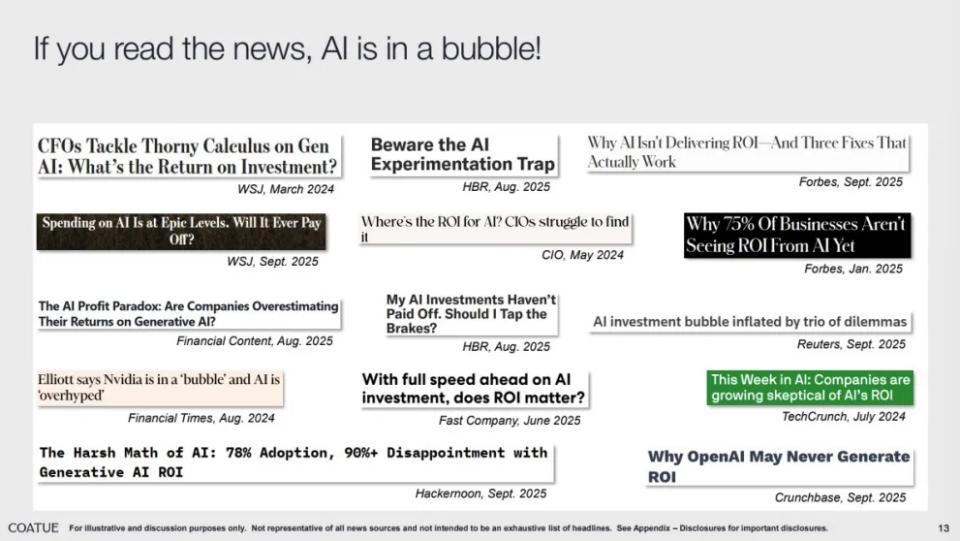
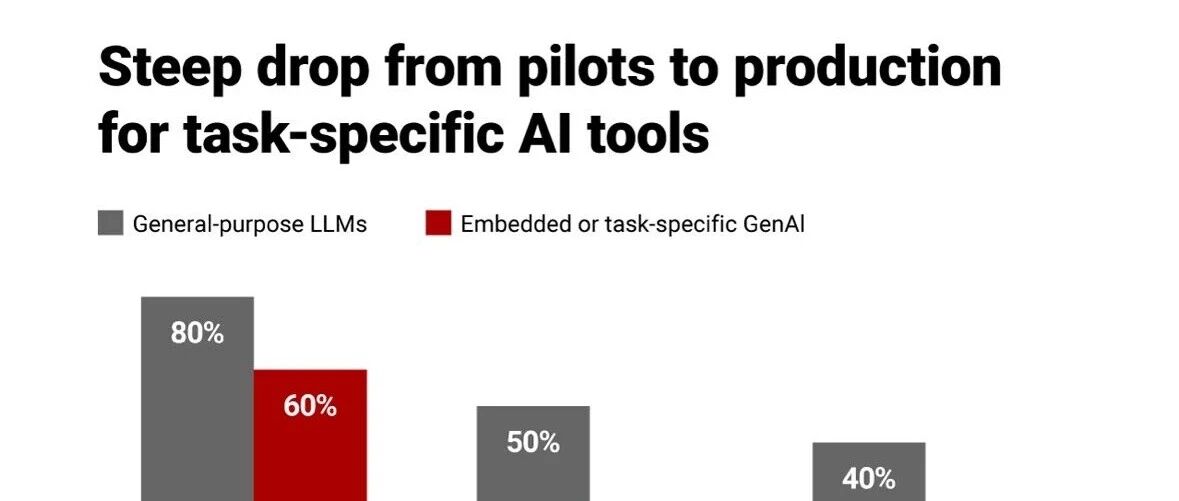
Group 1: Employment Issues - The rise of artificial intelligence is reducing job opportunities, particularly in entry-level positions, with job vacancies decreasing by approximately 30% since the launch of ChatGPT by OpenAI [2] - Amazon recently announced layoffs of 14,000 employees, primarily affecting middle management [2] Group 2: Profitability Concerns - The profitability issue surrounding AI was highlighted by Oracle's GPU cloud gross margin of 15%, which sparked discussions in overseas media [3] - Meta's significant stock drop has also reignited concerns regarding AI profitability [4] Group 3: AI Investment Returns - A recent survey by MIT revealed that despite companies investing between $30 billion to $40 billion in AI, a shocking 95% of them have not achieved any measurable returns [5] - Only 5% of AI systems successfully deployed in production environments, with the main barrier being the learning capability rather than infrastructure or talent [5] - Among companies that evaluated custom or vendor-sold AI systems, only 20% reached the pilot stage, and just 5% achieved production deployment that consistently creates business value [5] Group 4: Changing Perspectives on ROI - Technology leaders are beginning to shift their views on AI investment returns, suggesting that minor efficiency improvements are not a valid measure of ROI [6] - The emphasis is now on leveraging AI for significant innovation rather than merely enhancing productivity [6] Group 5: Depreciation and Profit Impact - A report calculated the return cycle for Microsoft's cloud H100, which has increased from 24 months to 36 months [11] - The impact of depreciation on profits is currently manageable, remaining below 30%, but is expected to exceed 40% starting in Q3 of next year [12] Group 6: Market Sentiment and Future Outlook - There is a growing awareness of potential leverage and early signs of a bubble, although risks have not yet materialized [14] - Profit margin pressures are anticipated to become more apparent by Q3 of next year, but the industry trend remains strong, particularly in AI [14]


美股2026年度策略 | 高处如何布局?
Sou Hu Cai Jing· 2025-11-04 05:27
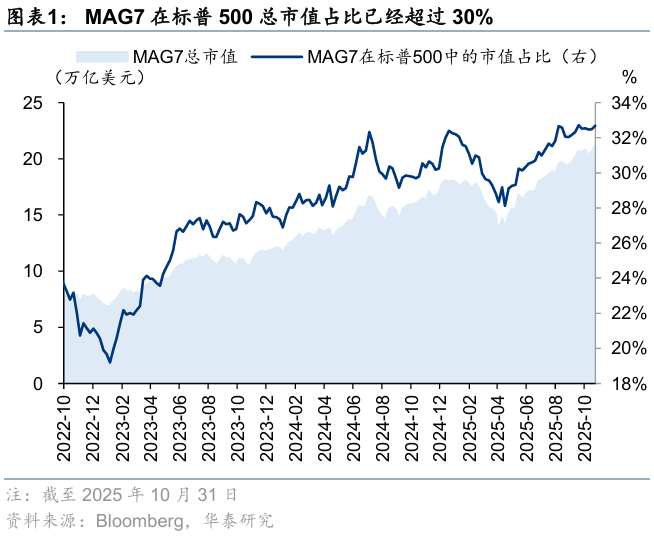
Group 1: Market Overview - The liquidity easing trend is expected to continue until the first half of 2026, with a focus on cyclical economic recovery in the second half of the year [1][5] - The U.S. stock market has experienced a K-shaped divergence, with the MAG7 companies contributing significantly to market capitalization growth [2][6] - As of October 31, 2025, the MAG7 companies accounted for over 30% of the S&P 500's total market capitalization, contributing nearly 50% of the market's expansion since 2023 [6][10] Group 2: Technology Sector Analysis - The current technology market is reminiscent of the late 1990s, with a concentration on high-quality large-cap stocks, raising concerns about potential market bubbles [3][22] - The EPS growth contribution from top tech stocks has been substantial, with MAG7's EPS growth reaching 24.7% [23][34] - Speculative trading has increased, with leverage in the stock market nearing levels seen during the 2020 QE period [34][35] Group 3: Economic Projections - The U.S. economy is expected to maintain a K-shaped divergence, but the driving factors may become more balanced compared to the past [4][57] - Bloomberg forecasts a 13.7% EPS growth for the S&P 500 in 2026, with a slowdown in capital expenditure growth for MAG7 [57][59] - Traditional economic recovery is anticipated to accelerate, supported by reduced trade policy uncertainty and monetary easing [57][63] Group 4: Investment Strategy Recommendations - Investors are advised to focus on profitable leading companies in the tech sector while gradually increasing exposure to cyclical sectors as the year progresses [5][64] - Historical data suggests that cyclical sectors tend to perform well after the end of a rate-cutting cycle, with significant positive returns expected [64][66] - Global diversification is recommended, with particular attention to developed markets like Germany and Switzerland, and emerging markets such as Saudi Arabia, South Korea, and India [65][67]
瑞银:当前AI热潮处潜在泡沫早期 关键见顶信号未现
Huan Qiu Wang Zi Xun· 2025-11-02 01:04
Core Viewpoint - UBS's global equity research team indicates that the current market is in the early stages of a potential bubble, but key signals that typically indicate a bubble peak—extreme valuations, long-term overheating catalysts, and short-term topping events—are currently absent [1] Group 1: Market Conditions - The U.S. stock market has met all seven prerequisites for bubble formation, including a 14 percentage point annualized return over bonds in the past decade, significant new technologies, a 25-year gap since the last bubble, overall profit pressure, market concentration, retail investor buying, and loose monetary conditions [3] - UBS emphasizes that simply comparing the current AI boom to historical bubbles is overly simplistic, as the logic behind its formation is more rational in two aspects [3] Group 2: AI and Productivity - Generative AI shows unique disruptive potential and adoption speed, with OpenAI attracting 800 million users in just three years, compared to Google's 13 years for the same user base [3] - If generative AI can temporarily boost productivity growth by 2% as expected, it could support a 20-25% upside in the stock market [3] Group 3: Macro Risk Structure - The macro risk structure has fundamentally changed; unlike the budget surplus during the 2000 internet bubble, the current U.S. government debt-to-GDP ratio is double that of the past, with high fiscal deficits [3] - In contrast, corporate balance sheets are relatively robust, with the tech giants' price-to-earnings ratio, excluding Tesla, at 35 times, significantly lower than the 45-73 times during the bubble period [3] Group 4: Semiconductor Market Potential - UBS estimates that if semiconductor industry spending reaches 1.3% of global GDP by 2030, the current valuation would be justified, with investment logic still based on earnings and cash flow [4] - Long-term structural factors that typically lead to bubble bursts are not currently evident, as over-investment signals have not appeared, and U.S. telecom technology investment as a percentage of GDP remains below the 2000 peak [4] Group 5: Debt Financing and Market Stability - Debt financing risks are low, as leading data center companies' capital expenditures to sales ratio is close to the 2000 telecom level, but tech giants primarily rely on cash flow rather than debt for investments [4] - UBS calculates that these companies would need a 40% increase in capital expenditures to start utilizing debt financing, contrasting sharply with the 3.5 times net debt/EBITDA ratio of telecom companies during the internet bubble [4] Group 6: Market Sentiment - The current market breadth is not as extreme as in 1999, and overall U.S. corporate profits remain stable [5] - Despite this, UBS finds that the market perceives a 20% probability of a bubble forming and advises investors to identify key signals that indicate a potential bubble burst as a core aspect of future investment decisions [5]