租金回报率

Search documents
现在,他们买房的标准是租金回报率
Jing Ji Guan Cha Bao· 2025-10-17 11:34
Core Insights - The article discusses the current real estate investment strategies of individuals like Zhang Qiang, who are focusing on rental income rather than capital appreciation due to market volatility [1][7] - It highlights the shift in investment logic from relying on property value increases to prioritizing stable rental yields, especially in core urban areas [7][8] Investment Strategy - Zhang Qiang is considering purchasing a small apartment in Beijing's inner ring, with a listing price of approximately 1.5 million yuan, potentially negotiating down to 1.2 to 1.3 million yuan due to the seller's urgency [1][3] - The focus is on properties with low total prices and high rental yields, with Zhang's ideal investment being a small one-bedroom unit that can generate around 4,000 yuan in monthly rent [5][6] Market Dynamics - The article notes a trend where small unit buyers are primarily young individuals or investors seeking stable rental returns, with over 60% of transactions in the area being for units under 70 square meters [5][6] - It also mentions that the current market has a limited supply of high-quality, low-priced properties, making it essential for investors to act quickly [6][8] Financial Considerations - Professional investors calculate returns more comprehensively, factoring in various costs such as property management fees, taxes, and potential vacancy losses, which can affect the overall investment return [8] - For Zhang's potential investment, the estimated annual return rate is around 3.9% when considering all associated costs, which is slightly lower than his personal calculations [8]
供需框架下楼市趋势探讨
2025-10-13 14:56
Summary of the Conference Call on Real Estate Market Trends Industry Overview - The conference call discusses the real estate market trends in China, particularly focusing on the current supply-demand dynamics and the factors influencing homebuyer sentiment and purchasing power [1][2][3]. Key Points and Arguments 1. **High Inventory Levels**: The core issue in the current real estate adjustment is the high inventory levels, particularly in 35 cities where unsold inventory has remained above 40 months, indicating persistent supply pressure [1][3]. 2. **Homebuyer Sentiment**: The willingness and ability of residents to purchase homes are critical for market stabilization. Factors such as income expectations, housing price yield, mortgage rates, and investment returns are currently leading to insufficient sentiment and declining purchasing power [1][4]. 3. **Comparison with U.S. Market**: Drawing from U.S. experiences, the stabilization of the housing market requires economic recovery to boost income, rental yields to exceed government bond yields, and a significant reduction in new housing inventory [1][4][5]. 4. **Hong Kong Market Recovery**: The stabilization of the Hong Kong real estate market is attributed to economic recovery, significant price declines reducing the burden of homeownership, and rental yields surpassing government bond yields, enhancing homebuying attractiveness [1][7][8]. 5. **Cost of Homeownership**: The cost of purchasing homes in mainland China has significantly decreased. For instance, for a second-hand home priced at 10 million yuan, adjustments in price, down payment, and interest rates have led to a reduction in total costs and monthly payments, although the attractiveness has not yet fully materialized [1][10]. 6. **Rental Yield Trends**: Nationwide, rental yields have surpassed the 10-year government bond yield, but remain below mortgage rates. Future attention should be paid to interest rate cuts and inventory policies to optimize supply-demand structures [1][11]. 7. **Sales Forecast**: It is anticipated that the total sales area in 2025 will see a year-on-year decline of approximately 6%, with transaction volumes nearing the bottom, indicating potential price adjustments [1][12]. Additional Important Insights - **Historical Context**: The analysis includes historical data from the U.S. and Hong Kong, highlighting how past market recoveries were characterized by significant price declines and improved economic conditions [4][5][6]. - **Investment Recommendations**: Investors are advised to focus on real estate companies with lighter historical burdens and optimized inventory structures, such as China Resources Land, Jianfa, and Binjiang, which have shown relatively good stock performance over the past year [2][12]. - **Policy Implications**: The importance of monitoring policy changes, particularly regarding interest rates and inventory management, is emphasized as these will be crucial in determining future market trends [2][11][12].
房价:如何稳住
Haitong Securities International· 2025-10-13 07:07
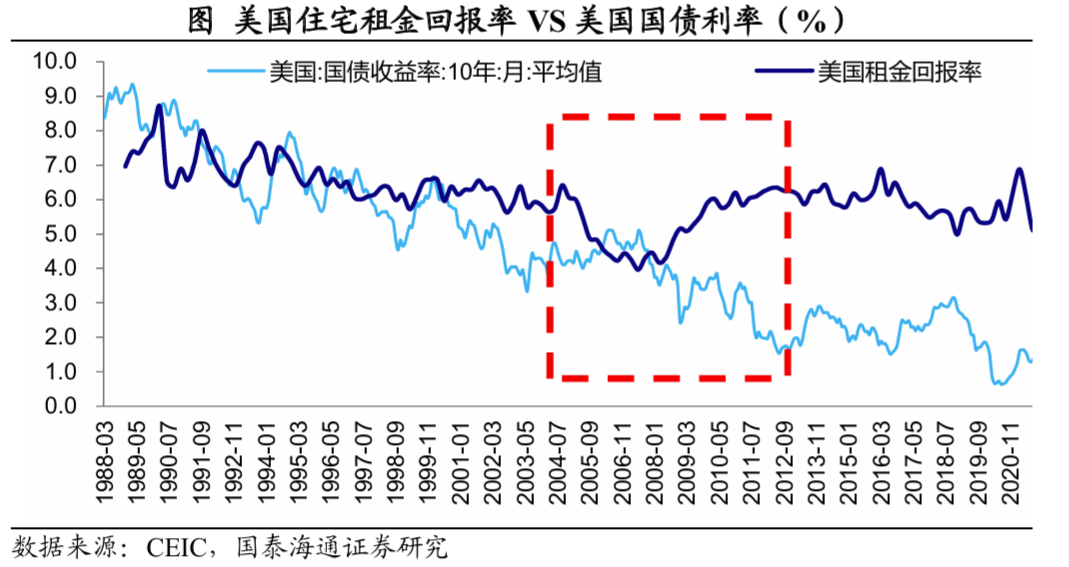
Group 1: Economic Overview - China's GDP growth rate for the first half of the year was significantly above 5.3%, exceeding market expectations[4] - Despite a strong supply side, demand remains weak, particularly in the real estate sector, which still holds a high proportion of household wealth[4] Group 2: Real Estate Insights - Rental yield is crucial; properties with rental yields above 3% are considered attractive if government bond yields are around 2%[8] - Historical data shows that even with high rental yields, such as 6% in the U.S. during 2012, housing prices did not stabilize until later[8] - The rental yield and price-to-rent ratio are essential indicators for assessing property value, similar to price-to-earnings ratios in the stock market[8] Group 3: Price Stability Factors - Housing prices are influenced by expectations of future price movements; when prices are expected to rise, rental yields become less significant[13] - A study of 13 economies revealed that during housing price adjustments, rental yields often revert to historical highs, indicating a compression of property valuations[16] - Stabilizing housing prices requires managing inflation expectations, as asset prices reflect the underlying economy[16] Group 4: Policy Implications - Recent macroeconomic policies in China have focused on boosting expectations and inflation, which are critical for stabilizing housing prices[17] - Continuous policy efforts are expected to play a key role in stabilizing housing prices and supporting domestic demand[17] Group 5: Risks - Global geopolitical risks, uncertainties in U.S. policies, and changes in regulatory policies pose significant risks to the housing market[20]
国泰海通宏观:房价如何稳住?
智通财经网· 2025-10-11 07:37
Group 1 - China's GDP growth in the first half of the year exceeded expectations at over 5.3%, indicating strong long-term growth potential despite short-term structural disparities in the economy [1] - The real estate sector remains a significant drag on domestic demand, as it holds a high share in residents' wealth allocation, impacting consumption sources [1] - The article emphasizes the need to stabilize housing prices and explores variables that could indicate when housing prices are stabilized [1] Group 2 - The concepts of rental yield and price-to-rent ratio are introduced, with rental yield measuring the annual rental income relative to the property's sale price [2] - A common belief is that if rental yields exceed government bond rates, properties become more attractive, but historical examples from the U.S. and Japan show this logic may not hold true [2][5] - The article argues that housing is akin to "credit bonds," where price fluctuations affect perceived value, unlike stable government bonds [5] Group 3 - The return on investment in real estate comes from both rental income and capital gains, with expectations of price increases diminishing the importance of rental yields [6] - When housing price expectations are low, rental yields must be significantly higher to compensate for potential price declines and associated costs [6] - The article draws parallels between real estate and stock market behaviors, noting that both markets react similarly to investor expectations [7] Group 4 - The analysis of 13 economies reveals that once housing prices enter a downward cycle, valuations tend to revert to historical lows, similar to stock market trends [7] - Stabilizing housing prices requires more than just increasing rental yields; it necessitates managing price expectations, which are influenced by macroeconomic inflation expectations [7][8] - Recent macroeconomic policies in China have focused on boosting expectations and inflation, which could positively impact housing price stability in the future [8]


断供潮之后是抛售潮?银行朋友透露:这3类房产白送都别要!
Sou Hu Cai Jing· 2025-09-30 08:40
Core Insights - The real estate market in China is experiencing a significant downturn, characterized by a surge in mortgage defaults and a corresponding increase in property listings, particularly in major cities [1][8] - The decline in property values is exacerbated by changing educational policies and demographic shifts, leading to a decrease in demand for certain types of properties [3][5] - Economic factors, including stagnant income growth and rising mortgage pressures, are contributing to a lack of buyer confidence, further complicating the market situation [8] Group 1: Mortgage Defaults and Property Listings - In September 2025, a bank in Hangzhou reported a 300% increase in mortgage defaults compared to the previous year, with 70% of the defaulted properties remaining unsold after three months [1] - The Beike Research Institute noted that in the first half of 2025, the number of second-hand homes listed for sale in 50 major cities exceeded 8.5 million, with 32% classified as "urgent sales" (price reductions over 15%), doubling from 2024 [1] Group 2: Property Types Facing Decline - "Old and dilapidated" properties are facing a dual threat, with prices for key school district homes dropping by 28% and non-school district "old and dilapidated" homes declining by 42% since their peak in 2021 [3] - Properties in suburban areas are experiencing a "death spiral," with a 12% population decline in areas like Tianjin Wuqing and a 35% increase in new housing supply, leading to a significant mismatch in demand and supply [5] Group 3: Economic and Policy Influences - The second quarter of 2025 saw a 4.7% year-on-year increase in China's GDP, but real disposable income growth slowed to 4.1%, indicating a growing gap between income growth and housing costs [8] - Despite policy measures to relax purchase restrictions and lower down payment ratios, the lack of buyer confidence remains a significant barrier to market recovery [8] Group 4: Market Dynamics and Risks - The average transaction cycle for second-hand homes extended to 120 days in the first half of 2025, doubling from 2024, indicating a market in stagnation [8] - The current market is characterized as a "buyer's market," where sellers may face significant price reductions if they rush to sell [9]
新房成交环比有所增长,国际大机构开始调仓布局中国商业地产
Huan Qiu Wang· 2025-09-30 02:17
Group 1 - The core viewpoint of the articles highlights the ongoing changes in China's real estate market, with a shift from "demand stimulation" to "supply quality improvement" in local policies, which is expected to benefit long-term industry structure optimization despite ongoing price pressures and a prevailing wait-and-see sentiment among residents [1][2] - As of September 29, the Beijing Municipal Commission of Housing and Urban-Rural Development has issued 25 pre-sale permits this month, covering 22 real estate projects across 10 districts, providing nearly 6,000 housing units [1] - New home transactions have seen a month-on-month increase due to low base effects and localized demand release, although year-on-year figures remain low, while the second-hand housing market shows resilience with a year-on-year recovery in core cities [1] Group 2 - The Financial Times article suggests that domestic investors in China are optimistic that a potential interest rate cut by the Federal Reserve could lead to a significant rebound in domestic housing prices, with bold predictions of a trillion-dollar capital inflow into China, potentially boosting the yuan and driving a noticeable increase in the housing market [1] - The article emphasizes that for real estate investors, rental yield is the true "anchor," and similar to stocks, short-term price movements in real estate are influenced by investor sentiment and capital flows, while the long-term value of real estate investment lies in stable rental returns [1] - Even if the Federal Reserve's rate cuts lead to foreign capital returning to domestic real estate, the capital's pursuit of profit will likely prioritize high-end commercial real estate or quality corporate bonds in core cities, with current commercial real estate yields in major cities like Beijing, Shanghai, Guangzhou, and Shenzhen reaching as high as 5%, surpassing U.S. Treasury yields [2]
上海楼市正在回归常识
Sou Hu Cai Jing· 2025-09-24 10:29
Core Viewpoint - The Shanghai real estate market showed initial signs of recovery in early 2025, but the momentum quickly faded, leading to a significant decline in transaction volumes and an increase in listings, indicating a challenging market environment [1][2][3]. Market Performance - In March 2025, Shanghai's second-hand housing transaction volume reached 21,300 units, surpassing the critical threshold of 20,000 units, but over 60% of these transactions involved sellers reducing prices by more than 15% or properties priced between 3 million to 5 million [1]. - By April 2025, transaction volumes dropped to 18,100 units, and further declined to 17,500 units in May, stabilizing around 16,000 units during the summer [2]. - As of early August 2025, the number of second-hand listings in Shanghai exceeded 200,000, a significant increase from less than 100,000 two years prior [3][4]. Price Trends - The average transaction period for second-hand homes extended from 180 days last year to 245 days this year, indicating a growing fear among sellers regarding the time it takes to sell properties [4]. - The average negotiation space for second-hand homes increased from 5.2% to 9.8%, yet buyers remain hesitant to make purchases [6]. - In the second quarter, housing prices outside the inner ring fell by 2.1%, while prices within the inner ring decreased by 0.6%, reflecting a downward trend in property values [6]. Luxury Market Dynamics - Despite the overall market decline, luxury properties priced above 30 million yuan saw a slight increase in transactions by 5% in the first half of 2025, indicating that high-end real estate remains a stable investment [4]. - Notable price reductions were observed in luxury properties, with some listings experiencing significant markdowns, such as a property that sold for 61 million yuan after being listed at 120 million yuan [4]. Rental Market Insights - The average rental price in Shanghai fell by 4.5% year-on-year in July 2025, with some long-term rental apartments offering incentives such as two months free rent for a one-year lease [7]. - The rental yield of 1.8% is not competitive compared to government bonds, raising questions about the viability of investing in rental properties [8].
楼市冷暖,租金先知
2025-09-17 00:50
Summary of Key Points from Conference Call Records Industry Overview - The records focus on the **Chinese real estate market**, particularly the rental yield trends in first and second-tier cities, and the impact of macroeconomic factors on housing investment opportunities. Core Insights and Arguments 1. **Rental Yield Trends**: - Rental yields in China's first-tier cities have increased from approximately **1.5% to 1.7%-1.9%**. However, due to low or negative CPI growth, the actual investment opportunities remain pessimistic [1][4]. - The rental yield plus CPI in first-tier cities has shown a declining trend, with historical lows reached in cities like Beijing, Shanghai, Guangzhou, and Shenzhen [1][8]. 2. **Impact of CPI and Housing Costs**: - The low housing holding costs in China are attributed to long-term monetary easing, lack of property taxes, and expectations of rising property prices, leading residents to prefer buying over renting [1][6]. - The need to increase actual rental yields necessitates either raising rents or lowering housing costs. The primary method to enhance yields is through reducing property prices, especially as global inflation slows and GDP growth in China declines [1][7]. 3. **Challenges for Rental Enterprises**: - Rental companies face challenges due to rising property prices and stagnant rent growth, leading to reduced profitability and cash flow pressures. The rental yield may fall below financing costs, causing operational difficulties [1][10]. - The capitalized rates for commercial real estate have decreased, indicating asset valuation issues, which further complicates expansion capabilities for rental enterprises [1][10]. 4. **Second-tier Cities Performance**: - In contrast to first-tier cities, second-tier cities like Changsha and Wuhan are showing signs of stabilization, with rental yields plus CPI expected to rise starting in 2024 [1][9]. 5. **Policy Incentives**: - Government policies, including low-cost land supply, tax incentives, and financial subsidies, are actively promoting the development of affordable housing, thereby reducing operational costs for companies and expanding market demand [2][12]. Additional Important Insights 1. **International Comparison of Rental Yields**: - Rental yield is a crucial metric for assessing property investment value, and when adjusted for inflation, China's first-tier cities' yields are comparable to international averages [3][4]. 2. **Institutional Rental Housing Growth**: - By the end of 2024, institutional rental housing projects in 16 hotspot cities are expected to see a **35% year-on-year increase** in room supply, indicating a growing trend despite a slowdown compared to previous years [13][14]. 3. **Differences in GDP Contribution**: - The real estate value added to GDP in the U.S. is significantly higher than in China, primarily due to differences in statistical methods used to account for residential housing [15]. 4. **Changes in Economic Accounting Standards**: - China has shifted its method of calculating the value of self-owned housing services from a cost-based approach to a market rent-based approach since 2016, improving the accuracy of GDP calculations [16][18]. This summary encapsulates the critical insights from the conference call records, highlighting the current state and future outlook of the Chinese real estate market, particularly in relation to rental yields and the impact of macroeconomic factors.
中信证券:房地产供给过大的局面已发生变化 市场具备止跌回稳基础
Zhi Tong Cai Jing· 2025-09-04 00:57
Group 1 - The overall real estate market faces challenges, but companies are responding with various measures to maintain a robust balance sheet [1] - The high housing prices and excessive real estate supply have fundamentally changed, providing a basis for market stabilization [1][4] - Commercial real estate, particularly shopping centers, is in an upward revaluation cycle, which is not synchronized with the residential development cycle [1] Group 2 - Developers are actively addressing current difficulties through four main strategies: rapid and effective inventory turnover, reducing non-performing assets, enhancing asset management capabilities, and cutting costs [2] - As of mid-2025, sample companies are expected to see a 14% decline in development business revenue compared to the peak in mid-2023, while operating revenue is projected to increase by 18% [2] - Companies are also expected to reduce sales expenses by 10.7% and management expenses by 33.7% by mid-2025, alongside a 10.1% reduction in employee numbers compared to the peak in 2021 [2] Group 3 - Developers continue to face pressures related to inventory, profitability, and cash flow, with housing prices in 70 major cities still in a downward trend [3] - The large volume of unsold properties poses risks of asset depreciation and slower turnover, leading to reduced operating cash flow [3] - The profitability of companies remains under pressure due to the overall decline in housing prices [3] Group 4 - The situation of excessively high housing prices and oversupply has fundamentally changed, with rental yields approaching 3% in some areas [4] - Leading companies have reduced new construction to below 30% of peak levels, and the area under construction has decreased to below 50% of peak levels [4] - The oversupply in the market is primarily characterized by an excess of existing homes, driven by market expectations [4] Group 5 - Three external factors may help reverse the downward trend in housing prices: potential policy optimization, wealth effects from the capital market, and continuous improvement in new productive forces and residents' income levels [5]

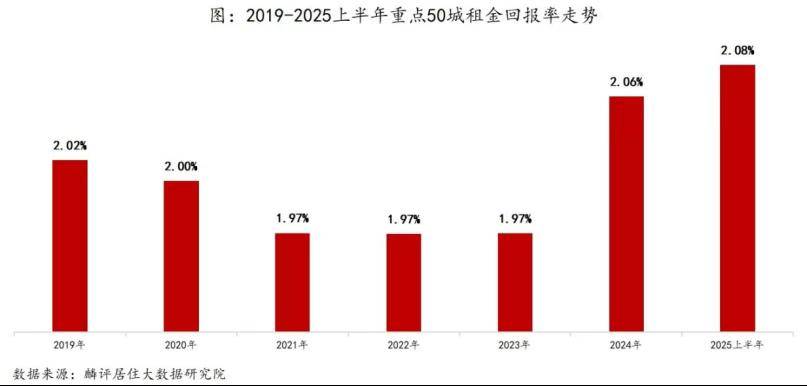
再创新高!2025年上半年全国重点50城租金回报率升至2.08%,跑赢常见理财收益率
Sou Hu Cai Jing· 2025-08-22 20:49
Core Insights - The domestic housing rental market in China is experiencing subtle changes, with the rental yield in 50 key cities rising to 2.08% in the first half of 2025, an increase of 0.02 percentage points from 2024, marking a new high [1] - Both housing prices and rents are in an adjustment phase, with expectations for housing prices to decline more than rents, leading to an increase in rental yield and improved rental income expectations [1][3] Rental Yield Analysis - Rental yield, defined as the ratio of annual rental income to property cost, is a crucial indicator for assessing property investment viability. Cities with rental yields above 5% are considered valuable for purchase and rental, while those below 3% indicate overpriced housing [3] - In August 2025, the average rental yield of 50 cities reached 2.08%, outperforming most low-risk financial products, with five-year fixed deposit rates at approximately 1.3% and ten-year government bond rates at 1.78% [3] City-Level Insights - The rental yield shows a pattern where three to four-tier cities outperform first and second-tier cities, with first-tier cities averaging 1.85%, second-tier at 2.06%, and three to four-tier cities at 2.58% in the first half of 2025 [6] - Specific cities like Urumqi, Guiyang, Guilin, Harbin, Zibo, and Changsha have rental yields in the internationally recognized reasonable range, with Urumqi leading at 3.86% [7] Investment Considerations - While rental yields have increased, the real estate market is still in a recovery phase, and investors should consider factors such as capital thresholds, holding periods, liquidity constraints, and market confidence [5][8] - Major cities like Shenzhen have the lowest rental yields, with Beijing and Shanghai following, indicating that despite the rise in rental yields, the market remains challenging for investors [8]