
红利

Search documents
市场情绪延续偏弱
Tebon Securities· 2025-12-03 13:13
Market Overview - The A-share market is experiencing a weak sentiment with major indices showing a general decline, particularly in the growth sectors which are adjusting more significantly than value sectors [3][6] - The Shanghai Composite Index closed at 3878.00 points, down 0.51%, while the Shenzhen Component Index fell 0.78% to 12955.25 points, and the ChiNext Index decreased by 1.12% to 3036.79 points [3] Stock Market Analysis - The market lacks a clear leading sector, with significant fluctuations observed in the commercial aerospace sector, influenced by recent rocket launch news [6][10] - Defensive sectors and some cyclical stocks are showing resilience against the overall market decline, suggesting a rotation in investment strategies [6][7] Bond Market Insights - The bond futures market is characterized by a clear differentiation in performance across maturities, with long-term bonds underperforming while mid to short-term bonds are stabilizing [10] - The 30-year bond contract saw a decline of 0.26%, while the 10-year bond contract increased by 0.06%, indicating a mixed sentiment in the bond market [10] Commodity Market Trends - Financial commodities are outperforming industrial commodities, with the Nanhua Commodity Index down 0.28% while industrial products are under pressure [10][11] - The industrial product index has decreased by 7.19% since the beginning of the year, reflecting weak demand and a contraction in manufacturing activity [10] Investment Strategy Recommendations - The report suggests maintaining a balanced allocation between technology and dividend stocks to hedge against sector rotation risks [7][12] - Focus on structural opportunities in undervalued defensive sectors and industries aligned with the "15th Five-Year Plan" trends [7][12] Recent Trading Hotspots - Key investment themes include dividend stocks for their attractive yields, AI applications driven by major tech advancements, and consumer sectors benefiting from currency appreciation [12] - The brokerage sector is highlighted due to active trading volumes and potential changes in trading regulations [12]
ETF 浪潮下的价值领航:南方基金以平台、团队、科技赋能指数投资新生态
经济观察报· 2025-12-01 11:08
Core Viewpoint - The article emphasizes that Southern Fund has become a leader in the ETF market due to its comprehensive product layout, top-tier research team, and intelligent technology empowerment, amidst increasing complexity in ETF choices for investors [1][2]. Comprehensive Product Layout - Southern Fund has developed a comprehensive product matrix since launching its first deep ETF in 2009, including flagship products like Southern CSI 500 ETF (510500) and Southern CSI 1000 ETF (512100), covering various market segments and asset classes [3][4]. - The total number of funds managed by Southern Fund has reached 126, with a total scale exceeding 402.2 billion yuan, maintaining a leading position in the industry [4]. - The Southern CSI 500 ETF (510500) is noted for being the largest and most liquid equity ETF in the market, with a scale of 136.9 billion yuan [4]. Focus on Technology and New Industries - Southern Fund is strategically focused on new industries and technologies, including artificial intelligence, semiconductors, and green finance, aligning with national strategies and providing investors with opportunities in economic transformation [5]. - The fund has launched various ETFs that reflect shareholder returns, such as the Dividend Low Volatility 50 ETF and Cash Flow ETF, responding to the growing demand for high-quality, stable assets [5]. Top-tier Research Team - The passive index funds managed by Southern Fund are characterized by high tracking precision, supported by a professional research team of 33 members with strong academic backgrounds and international experience [6]. - The core fund manager team has an average research experience of 10 years, covering a complete process from index product development to quantitative research and fund management [6]. Intelligent Technology Empowerment - Southern Fund has integrated AI and expert intelligence (EI) into its investment strategy, enhancing the precision of index investment management and providing a comprehensive risk monitoring system [8][9]. - The fund's intelligent investment management platform allows for automated risk intervention and improved investor service through diversified ETF solutions [8][9]. Service and Support System - Southern Fund has established a robust strategy service system that includes asset allocation, industry rotation, and tactical trading, along with various research reports and direct communication with fund managers [9]. - The company aims to enhance its core competitiveness in the ETF sector by continuously improving its product offerings, management expertise, and intelligent services, thereby supporting investors in seizing long-term opportunities in the capital market [9].


每日钉一下(股票市场下跌时,如何降低波动风险?)
银行螺丝钉· 2025-11-22 13:24
Group 1 - The article emphasizes that many investors start their investment journey with index funds and highlights the importance of understanding investment techniques to achieve good returns [2] - A free course is offered to teach investment strategies for index funds, including course notes and mind maps for efficient learning [2] Group 2 - During stock market downturns, investors can reduce volatility risk by choosing index funds, as they typically exhibit lower volatility compared to individual stocks [7] - Buying undervalued assets can also minimize downside volatility risk, with examples illustrating the limited downside potential when the market is at a 5.9 rating compared to a 1 rating [9] - For those seeking lower volatility, value-style investments are recommended, as they generally have less fluctuation than the market, while growth-style investments tend to be more volatile [10] - If value and dividend stocks still present significant volatility risk, managing stock asset allocation is advised [10]

A股大跌!火速解读
凤凰网财经· 2025-11-21 13:05
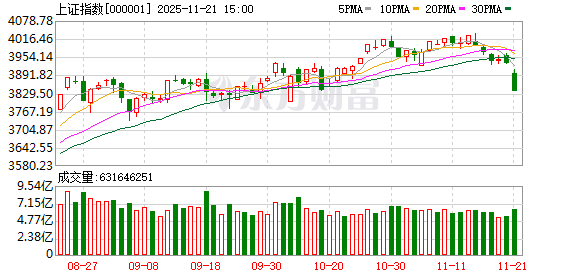
Core Viewpoint - The A-share market experienced a significant decline on November 21, with the Shanghai Composite Index dropping over 2%, attributed to multiple factors including external market pressures and internal structural contradictions [1][3][4]. Group 1: Factors Leading to A-share Adjustment - The decline in A-shares is influenced by both overseas risk transmission and internal structural issues, with concerns over the sustainability of AI profits and tightening liquidity impacting market sentiment [3][4]. - The market is currently in a policy and earnings vacuum, lacking new catalysts following the third-quarter report disclosures, leading to a shift in funds from high-growth sectors to lower-valued dividend assets [3][4]. - External market volatility, particularly from the U.S. stock market, has negatively impacted A-shares, with significant declines in major Asian indices following a drop in U.S. stocks [3][4]. Group 2: Long-term Market Outlook - Despite short-term fluctuations, the long-term outlook for A-shares remains optimistic, with expectations for new highs driven by stable domestic liquidity and confirmed earnings bottoms for listed companies [5][6]. - The fundamentals supporting a bull market have not changed, including improved confidence in handling U.S.-China risks and a shift in economic governance towards "anti-involution" strategies [6][7]. - The potential for a clearer path for U.S. interest rate cuts could alleviate external pressures on the market [5][6]. Group 3: Investment Strategy and Sector Focus - A balanced investment strategy is recommended, focusing on sectors benefiting from "anti-involution" policies, improving supply-demand dynamics, and high-quality tech growth stocks [7]. - The technology sector, particularly AI hardware, may require a period of consolidation due to high cumulative gains, while new economic drivers are expected to lead China into a profit recovery cycle [7][8]. - Investors are advised to maintain a rational approach to short-term volatility, emphasizing value investment in companies with long-term competitive advantages [6][7].

A股大跌 公募研判后市:“牛市的基础没有发生改变!”
Zhong Guo Ji Jin Bao· 2025-11-21 11:35
Core Viewpoint - A-shares experienced a significant decline on November 21, with the Shanghai Composite Index dropping over 2% and closing at a loss of 2.45% [2][3] Market Performance - The Shanghai Composite Index fell by 2.45%, the Shenzhen Component Index by 3.41%, and the ChiNext Index by 4.02% [2] - Sectors such as internet and media entertainment saw gains, while materials, chemicals, semiconductors, and electrical equipment faced declines [2] Causes of Decline - Multiple factors contributed to the adjustment in A-shares, including external risks and internal structural contradictions [3] - Concerns over an AI bubble and the impact of U.S. Federal Reserve interest rate expectations led to a decrease in global risk appetite [3][4] - The market is currently in a policy and earnings vacuum, lacking new catalysts following the third-quarter report disclosures [3] - The recent performance of the U.S. stock market, particularly the drop in major indices, negatively affected investor sentiment in the Asia-Pacific region, including A-shares [4] Future Outlook - Short-term market movements may continue to be volatile, but there is a long-term optimistic view on the potential for new highs in indices [5][6] - The domestic liquidity environment remains reasonably ample, and corporate earnings are gradually confirming a bottom [6] - The potential for a clearer path to interest rate cuts by the U.S. Federal Reserve could alleviate external pressures [6] Investment Strategy - A balanced investment strategy is recommended, focusing on sectors benefiting from "anti-involution," AI, and overseas expansion concepts [8] - Investors are advised to maintain a rational perspective on short-term fluctuations and adhere to value investment principles [7] - Emphasis on diversifying investments and setting stop-loss targets to manage risk exposure effectively [7]
A股大跌!火速解读
中国基金报· 2025-11-21 11:23
Core Viewpoint - The recent decline in A-shares is attributed to multiple factors, but the foundation for a bull market remains unchanged, with optimism for new highs in the long term [6][7]. Market Performance - On November 21, the Shanghai Composite Index fell by 2.45%, closing at 3834.89, while the Shenzhen Component and ChiNext Index dropped by 3.41% and 4.02%, respectively [2][4]. - The market saw significant declines across various sectors, with technology and AI-related stocks facing pressure due to external market conditions [4][5]. Factors Influencing A-share Adjustment - The decline is influenced by both external risks, such as concerns over AI bubbles and tightening liquidity expectations from the U.S. Federal Reserve, and internal structural contradictions within the market [4][5]. - The lack of new catalysts following the third-quarter earnings reports and the seasonal rebalancing of funds contributed to the market's cautious sentiment [4][5]. Future Market Outlook - Short-term market movements may continue to be volatile, but the medium to long-term outlook remains positive, supported by a reasonable liquidity environment and confirmed earnings bottoms for listed companies [7][8]. - The potential for a clearer path for U.S. interest rate cuts could alleviate external pressures on the market [7]. Investment Strategy - A balanced investment strategy is recommended, focusing on sectors benefiting from "anti-involution" policies, AI, and overseas expansion concepts [9][10]. - Investors are advised to maintain a rational perspective on short-term fluctuations and adhere to value investment principles, emphasizing quality companies with long-term competitive advantages [8][9].

A股开盘速递 | 指数集体上涨!银行股延续强势 中国银行(601988.SH)续创历史新高
智通财经网· 2025-11-20 02:01
Market Overview - The market indices collectively rose in early trading on November 20, with the Shanghai Composite Index up by 0.33%, Shenzhen Component Index up by 0.65%, and ChiNext Index up by 0.7% [1] Key Sectors Lithium Battery Sector - The lithium battery sector showed strong performance, with stocks like Beijiete hitting the daily limit, and companies such as Shengxin Lithium Energy, Jiuwu Gaoke, Fulin Precision, and Ganfeng Lithium also rising [1] - The price of lithium carbonate futures has surpassed 100,000, and there is a continuous price increase in lithium battery materials. Ganfeng Lithium's chairman indicated that by 2026, lithium carbonate prices could exceed 150,000 to 200,000 per ton [3] - Wanlian Securities suggests that the performance of midstream material companies in the lithium battery industry is expected to continue improving, presenting investment opportunities [3] Brokerage Sector - The brokerage sector experienced a collective rise, with stocks like Shouchuang Securities opening over 8% higher. Other notable gainers included Northeast Securities, China Galaxy, and CITIC Securities [1] - China International Capital Corporation (CICC) plans to merge with Dongxing Securities and Xinda Securities, which could reshape the competitive landscape among leading brokerages [5] Aquaculture Sector - The aquaculture sector saw a rise following reports that China has suspended imports of Japanese seafood. Analysts predict a significant recovery in China's aquaculture industry by 2025, with major seafood prices expected to rebound to historical highs [7] Institutional Insights - Galaxy Securities maintains a positive long-term outlook for the market, indicating that the current A-share market is in a consolidation phase with rapid sector rotation. There is a focus on lithium batteries and electrolyte themes, while consumer sectors benefit from policy support [9] - Shenwan Hongyuan notes that the market is currently in a high position of "Bull Market 1.0," suggesting a focus on high-level fluctuations. They predict that technology growth will have rebound opportunities before spring 2026, which may mark a peak [10][11] - Huatai Securities highlights that the market is currently experiencing a period of accumulation for a potential breakthrough, with a focus on low-occupancy sectors and the AI industry chain [12]


前10月广义基建增速微正,继续推荐“红利”组合 | 投研报告
Zhong Guo Neng Yuan Wang· 2025-11-19 08:30
Group 1 - The core viewpoint of the report indicates that while the broad infrastructure growth has shown slight positive growth in the first ten months, there was a significant decline in October, with narrow infrastructure investment down by 8.91% year-on-year and broad infrastructure down by 12.11% [2] - The report highlights that the cumulative narrow infrastructure investment (excluding electricity) reached 14.91 trillion yuan, a slight year-on-year decrease of 0.10%, while broad infrastructure reached 20.38 trillion yuan, showing a year-on-year increase of 1.51% [2] - Specific sectors such as transportation, storage, and postal services showed a minor year-on-year increase of 0.10%, but experienced a month-on-month decline of 10.09% in October [2] Group 2 - The market review indicates that the Shanghai Composite Index fell by 0.18%, the Shenzhen Component Index by 1.40%, and the ChiNext Index by 3.01%, while the Shenwan Construction Decoration Index rose by 0.35% [3] - Among individual stocks, 104 stocks in the construction sector rose, with the top five performers being Guosheng Technology (+60.98%), *ST Dongyi (+21.54%), Garden Shares (+17.23%), Rishang Group (+17.14%), and *ST Baoying (+16.90%) [3] - The report suggests that the "14th Five-Year Plan" provides opportunities for investment in major projects, with expectations for policy stimulus to stabilize and recover investment levels [2] Group 3 - The report recommends focusing on high-dividend, low-valuation stocks under the current liquidity and low-interest rate environment, highlighting companies like Sichuan Road and Bridge and Jianghe Group as key picks [4] - It also emphasizes the "Construction+" theme, encouraging mergers, restructuring, and transformation towards new industries such as renewable energy and digital construction, with companies like Shanghai Port and Hongrun Construction being highlighted for their clear transformation directions and growth potential [4]
AH股低开低走,AI应用逆势走强,恒指科指跌超1%,新能源车概念股走低
Hua Er Jie Jian Wen· 2025-11-18 06:16
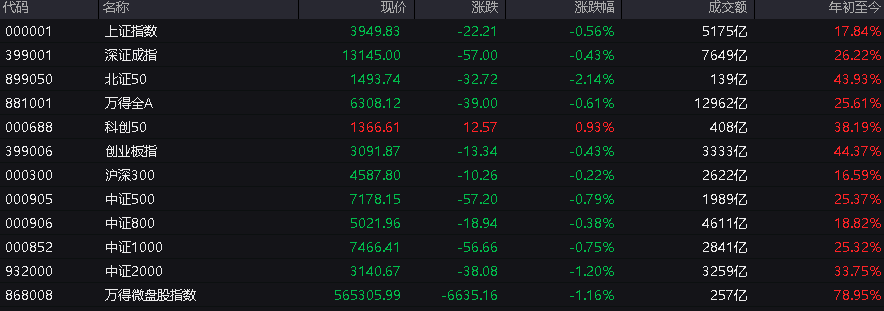
Market Overview - A-shares experienced a decline in the morning session, with the North Securities 50 Index dropping over 2% [1] - The Shanghai Composite Index closed at 3949.83 points, down 0.56% [1][8] - The Shenzhen Component Index closed at 13145.00 points, down 0.43% [2] - The ChiNext Index closed at 3091.87 points, down 0.43% [3] - The CSI 300 Index closed at 4587.80 points, down 0.22% [4] - The STAR 50 Index closed at 1366.61 points, up 0.93% [5] - The CSI 500 Index closed at 7178.15 points, down 0.79% [6] - The CSI 1000 Index closed at 7466.41 points, down 0.75% [7] Sector Performance - AI applications, semiconductor chips, CPO, and software development sectors led the gains, with stocks like Fushi Holdings and Inspur Software hitting the daily limit [1] - The battery sector faced significant declines, with stocks like Fengyuan Co. hitting the daily limit down [1][12] - Local stocks in Fujian, such as Sanmu Group, also saw substantial declines [1] Trading Volume - The total trading volume for the morning session reached 1.29 trillion yuan [1] AI Sector Developments - Positive news in the AI sector includes Alibaba's launch of the "Qianwen" project and the upcoming release of Google's Gemini 3.0 model [8] - China International Capital Corporation noted that the business model for AI applications is rapidly transitioning from concept validation to revenue generation, with demand expanding quickly [8] Market Sentiment - China Galaxy Securities anticipates that the year-end market will continue to exhibit a volatile structure, with a focus on themes like "anti-involution" and dividends [9] - The market is currently in a consolidation phase, with rapid rotation between sectors, particularly in technology and consumer sectors benefiting from policy support [9]

华泰证券:短期哑铃型配置强化,建议在成长、周期和红利中均衡配置
Mei Ri Jing Ji Xin Wen· 2025-11-18 00:30
Core Viewpoint - The overall industry prosperity index continued to decline in October, but the rate of decline has slowed down, with improvements noted in essential consumption, midstream manufacturing, and large financial sectors, while TMT (Technology, Media, and Telecommunications) shows continued differentiation [1] Group 1: Industry Insights - The essential consumption, midstream manufacturing, and large financial sectors are leading in terms of prosperity improvement [1] - The TMT sector continues to exhibit a mixed performance, indicating varying levels of recovery across different segments [1] Group 2: Investment Strategy - A short-term "barbell" strategy is recommended, suggesting a balanced allocation across growth, cyclical, and dividend stocks [1] - Focus on identifying sectors with improving prosperity that have a degree of sustainability, as well as those with relatively low valuations and chip positions [1] - Potential recovery opportunities are highlighted in sectors such as non-ferrous metals, chemicals, new energy, general automation, storage, military industry, and insurance [1] - Additionally, there is a suggestion to consider left-side positioning in certain consumer and service sectors, such as dairy products [1]
