美联储降息

Search documents
油价美元双破百,人民币何去何从?
Hua Tai Qi Huo· 2026-03-19 12:57
Report Industry Investment Rating - Not provided in the document Core View of the Report - The short - term high - level two - way fluctuation of the US dollar against the RMB will continue. It is expected that the US dollar against the RMB will fluctuate in the range of 6.85–6.95. If oil prices fall and the situation in the Strait of Hormuz eases, the RMB is expected to rise to around 6.85. The market's consensus expectation is that the RMB will maintain a relatively strong oscillation in 2026, with the exchange - rate expectation bottoming out in the 6.80 range, and the forecasts converging towards 6.80 in Q1 2027 [33][36][40] Summary by Relevant Catalogs 1. Quantity - Price and Policy Signals Quantity - Price Observation - The implied volatility curve of the 3 - month US dollar against the RMB options shows an appreciation trend of the US dollar, with the call - end volatility higher than the put - end [4] - The term structure of the 3 - month USDCNH options implied volatility and the implied volatility of the 3 - month US dollar against the RMB options with a delta of 5 are presented [6] - The premium and discount of the Singapore Exchange's US dollar against the RMB futures, bank forward premium and discount, and the US - China interest rate spread for different time periods (this week, last week, last month) are shown [9] Policy Observation - The counter - cyclical factor fluctuates around 0 [12] 2. Fundamentals and Views Event - Geopolitical risks are increasing, and the conflict may become long - term. The core issues include the policies after Mujtaba came to power, whether civilian facilities will continue to be damaged, and the passage situation of the Strait of Hormuz. The event affects various commodities, and there is still a gap in the oil supply even after the release of oil reserves [20][22] Macro - **US Economy** - Inflation is relatively smooth. The US CPI in February was flat, with service inflation falling and non - service inflation rising. Considering oil prices, the CPI may rise to 3.6% by May [23][24] - The Fed's expectation of interest - rate cuts has been postponed, and its policy stance has become marginally hawkish. The threshold for interest - rate cuts has been significantly raised, and the expectation of interest - rate cuts within the year has been compressed. The tail - risk has shifted from "no interest - rate cut" to "whether to raise interest rates again" [25][27] - The pace of interest - rate cuts in the US economy has slowed. Employment data is weak, inflation is rising due to oil prices, and economic expectations have been revised upwards, but the real - estate sector needs improvement [28] - **Chinese Economy** - The Chinese economy shows structural differentiation. In the context of the Spring Festival date shift, considering the data from January - February, infrastructure investment has continued to grow due to early - stage policy efforts; commodity retail sales have declined under a high - base effect, but catering revenue has rebounded; the real - estate sector is still under pressure, waiting for price stabilization; the loan situation shows that the household sector is weak while the corporate sector has improved; exports continue to support the economy [29][31] Overall View - Fundamentally, the economic expectation difference is favorable for the RMB, the Sino - US interest - rate difference is neutral, and the uncertainty of trade policies is neutral. The core view is that the US dollar against the RMB is expected to oscillate in the 6.85–6.95 range [36] Expectation - In 2026, the market's consensus expectation is that the RMB will maintain a relatively strong oscillation. The average exchange - rate expectation bottoms out in the 6.80 range, and the institutional game range is very wide (6.50–7.10). In Q1 2027, the forecasts converge towards 6.80 [40]
2026年3月美国FOMC会议:海外观察:美联储维持观望姿态,降息或更加谨慎
Donghai Securities· 2026-03-19 06:47
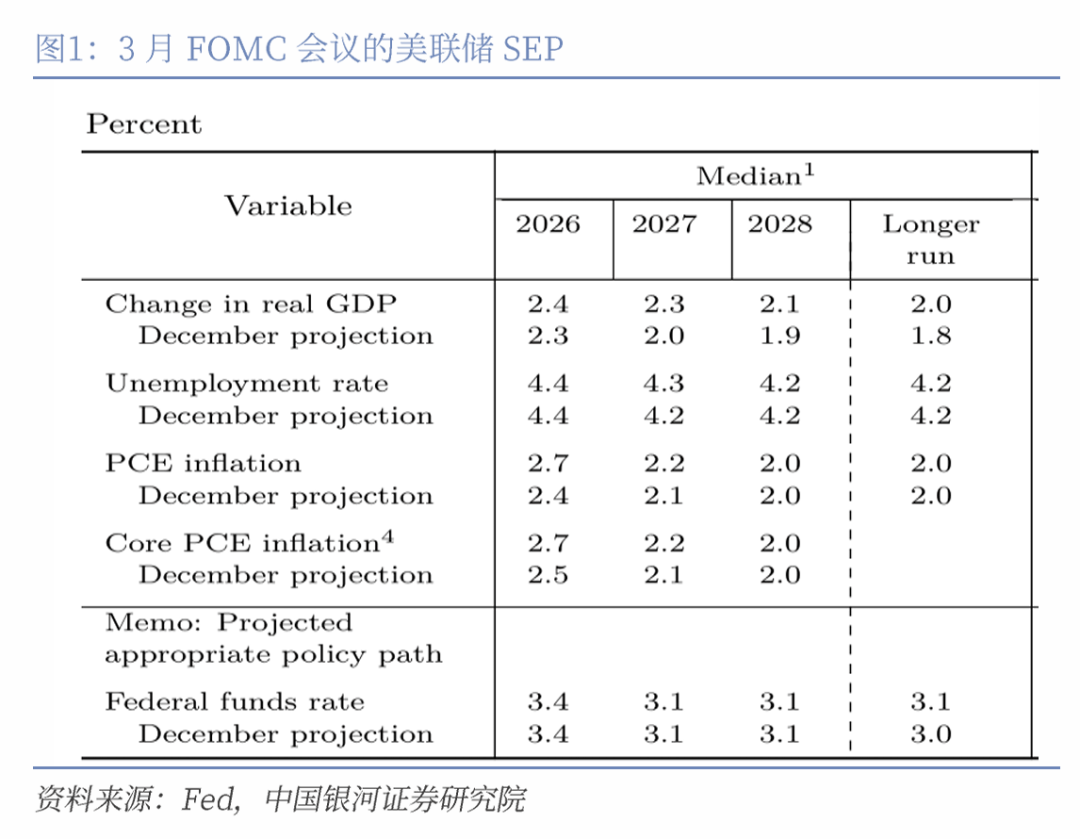
Monetary Policy - The Federal Reserve maintained the target interest rate at 3.50%-3.75% during the March 2026 FOMC meeting[2] - The statement changed from "unemployment rate stabilizing" to "little changed in recent months" and noted uncertainty from Middle East conflicts on the US economy[2] Economic Projections - The Fed raised economic growth forecasts for 2026 and 2027 by 0.1 percentage points to 2.4% and 0.3 percentage points to 2.3%, respectively[2] - Core PCE inflation forecasts for 2026 and 2027 were increased by 0.2 percentage points to 2.7% and 0.1 percentage points to 2.2%, respectively[2] Interest Rate Expectations - The dot plot indicates a median expectation of one rate cut in 2026, but with a more cautious distribution compared to December 2025[2] - Seven members favor no rate cuts in 2026, while seven support one cut (25 basis points), and five support more than one cut[2] Market Reactions - Following the FOMC meeting, US Treasury yields rose significantly, with the 2-year and 10-year yields increasing by 6 basis points and 5 basis points, respectively[2] - The stock market declined, gold prices fell slightly, and the US dollar index rose above 100[2] Risks - The report highlights risks from the Middle East conflict potentially impacting inflation more than expected and the adverse effects of AI on the US labor market[2]
3?FOMC 会议点评:不转松的美联储,降息越来越远?
Yin He Zheng Quan· 2026-03-19 05:04
Core Insights - The Federal Reserve has maintained its target range for the federal funds rate at 5.00%-5.25% for the second consecutive meeting, indicating a divergence in opinions regarding the necessity of rate cuts among committee members [1][2] - The economic outlook has been adjusted, with GDP growth and inflation expectations being raised, reflecting a stronger assessment of economic resilience [1][2] - The macroeconomic environment is shifting from "demand-driven inflation decline" to a combination of "stable growth but sticky inflation," which increases constraints on policy easing [1][2] Economic Forecasts - GDP growth forecasts for 2026, 2027, and 2028 have been revised upward to 2.4%, 2.1%, and 2.1% respectively, while the long-term forecast remains at 2.0% [10] - The unemployment rate is projected to remain stable at 4.4% for 2026, with slight improvements in subsequent years [10] - Core PCE inflation forecasts have been adjusted to 2.7% for 2026, indicating a slower pace of inflation decline than previously expected [10] Market Reactions - U.S. Treasury yields have risen across the board, with the 10-year yield increasing to 3.50%, reflecting a shift in rate cut expectations and inflation outlook [3][2] - The equity markets experienced declines, with major indices such as the Dow Jones, S&P 500, and Nasdaq falling by 1.5%, 1.2%, and 1.1% respectively [3][2] - The CME interest rate futures indicate that the market has largely priced out the possibility of rate cuts in 2026, with probabilities showing a strong preference for maintaining current rates [3][9] Asset Class Outlook - The outlook for U.S. Treasury yields suggests that short-term rates will remain sticky, while long-term rates are expected to rise, with the 10-year yield projected to range between 3.50%-3.75% [3][2] - Gold prices are under pressure from rising real interest rates, but if geopolitical conflicts persist, the macro environment may shift towards "high inflation + slowing growth," supporting gold prices in the range of $1,800-$2,000 per ounce [3][2] - Oil prices are expected to rise due to supply uncertainties from geopolitical tensions, with Brent crude projected to move to a range of $90-$100 per barrel if conflicts extend [3][2]
【中国银河宏观】能源通胀下的鹰派发布会——3月FOMC会议
Sou Hu Cai Jing· 2026-03-19 03:06
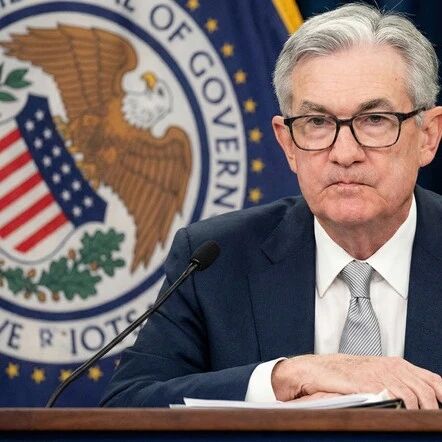
Core Viewpoint - The Federal Reserve remains cautious, maintaining interest rates in the 3.75%-3.50% range, with a slight upward adjustment in inflation expectations, while signaling a potential rate cut later in the year due to economic uncertainties stemming from geopolitical tensions and domestic labor market conditions [1][2][3]. Group 1: Federal Reserve's Actions and Statements - The FOMC statement showed limited changes, with the only dissenting vote against a rate cut coming from Miran, while Waller shifted to support maintaining rates [1][3]. - The SEP (Summary of Economic Projections) indicates a mild increase in inflation expectations for 2026, with PCE inflation rising from 2.4% to 2.7%, and GDP growth slightly adjusted from 2.3% to 2.4% [3][11]. - Powell's comments during the press conference conveyed a hawkish tone, emphasizing the need to balance inflation and employment goals, while downplaying immediate risks to the labor market [4][5]. Group 2: Economic Context and Risks - The economic backdrop presents challenges, with short-term stagflation risks and long-term recession concerns, as March CPI is expected to approach 3% amid rising energy prices [2][4]. - The geopolitical situation in the Middle East, particularly tensions involving Iran, adds uncertainty to energy prices and economic forecasts [2][6]. - The labor market shows signs of stagnation, with new job growth averaging near zero in March, raising concerns about future employment trends [2][4]. Group 3: Market Reactions and Projections - Following the FOMC meeting, risk assets experienced a decline due to heightened geopolitical tensions and hawkish signals from the Fed, with major U.S. stock indices falling significantly [9]. - The CME FedWatch Tool indicates that market participants are currently pricing in no rate cuts for 2026, reflecting a shift in expectations following the Fed's recent communications [9][31]. - The potential for high oil prices to impact economic growth and corporate profits is acknowledged, with a warning that sustained high inflation could lead to recession risks and necessitate rate cuts in the future [7][8].


格林大华期货早盘提示:贵金属-20260319
Ge Lin Qi Huo· 2026-03-19 01:07
1. Report's Industry Investment Rating - Not provided in the given content 2. Report's Core View - COMEX gold futures dropped 3.68% to $4,823.90 per ounce, COMEX silver futures dropped 5.63% to $75.42 per ounce; Shanghai gold night - trading session closed down 2.23% at 1088.90 yuan per gram, Shanghai silver closed down 4.44% at 19,170 yuan per kilogram. The market short - term uncertainty is high, and investors should control positions and prevent risks [1][2] 3. Summary by Relevant Catalogs 3.1. Market Quotes - COMEX gold futures fell 3.68% to $4,823.90 per ounce, COMEX silver futures fell 5.63% to $75.42 per ounce. Shanghai gold night - trading session closed down 2.23% at 1088.90 yuan per gram, Shanghai silver closed down 4.44% at 19,170 yuan per kilogram [1] - The U.S. dollar index rose 0.74% to 100.30, the 10 - year U.S. Treasury yield rose nearly 6.5 basis points to 4.265% [2] 3.2. Important Information - On March 18, the holdings of the world's largest gold ETF, SPDR Gold Trust, decreased by 2.571 tons to 1066.993 tons; the holdings of the world's largest silver ETF, iShares Silver Trust, decreased by 125.35 tons to 15,264.4 tons [1] - According to CME's "FedWatch", the probability of the Fed cutting interest rates by 25 basis points in April is 0%, and the probability of keeping interest rates unchanged is 100%. The probability of the Fed cutting interest rates by 25 basis points cumulatively by June is 11.2%, and the probability of keeping interest rates unchanged is 88.8%. The probability of keeping interest rates unchanged by July is 77.4% [1] - The U.S. February PPI rose 3.4% year - on - year (expected 3.0%, previous 2.8%), and rose 0.7% month - on - month (estimated 0.3%, previous 0.5%); the core PPI rose 3.9% year - on - year (expected 3.7%, previous 3.5%), and rose 0.5% month - on - month (expected 0.3%, previous 0.8%) [1] - At the Fed's March interest - rate meeting early today, the federal funds rate was kept unchanged, meeting market expectations. The Fed pointed out the uncertainty of the Middle - East impact, raised inflation expectations, and still expected one interest - rate cut this year. Powell said no rate cuts until inflation improves [1] - U.S. media reported that the U.S. wants to destroy Iran's military power and end the war as soon as possible, while Israel insists on hunting down Iranian leaders. Trump hopes Israel to suspend further attacks on Iranian energy facilities. Iranian energy facilities were attacked, and Iran vowed to strike back at the oil facilities of three Middle - East countries [1] 3.3. Market Logic - On Wednesday, the attack on Iran's South Pars petrochemical facilities caused a sharp rise in international crude oil prices. The U.S. February producer price index rose 3.4% year - on - year, higher than the market estimate. Traders further reduced their bets on Fed rate cuts in 2026. The Fed's March interest - rate meeting decided to keep the federal funds rate unchanged, meeting market expectations [1] - The expansion of the U.S. - Iran conflict to civilian oil facilities led to a sharp rise in international crude oil prices, suppressing COMEX gold and silver prices, which found support at around $4800 per ounce for gold and $75 per ounce for silver [2] 3.4. Trading Strategy - Due to high short - term market uncertainty, investors should control positions and prevent risks [2]
中信证券:预计美联储下半年基准情形降息1次25bps
Sou Hu Cai Jing· 2026-03-19 00:36
Core Viewpoint - The Federal Reserve's decision to maintain the policy interest rate at the March 2026 meeting aligns with market expectations, indicating stability in monetary policy [1] Group 1: Interest Rate and Economic Projections - The dot plot indicates a target interest rate midpoint of 3.4% for this year, consistent with the December 2025 forecast [1] - The Fed has raised its inflation forecast slightly and adjusted its economic growth outlook upwards while keeping the unemployment rate forecast unchanged [1] Group 2: Fed Chair's Remarks and Future Expectations - Jerome Powell did not provide judgments on the situation in Iran or oil prices, and his confidence regarding the decline in tariff-induced inflation has weakened compared to January [1] - It is anticipated that the Fed will not lower interest rates in April, with a baseline scenario of one rate cut of 25 basis points expected in the second half of the year under Chair Walsh's leadership [1]

中金:美联储还能再降息吗?
中金点睛· 2026-03-19 00:11
Core Viewpoint - The Federal Reserve maintained the benchmark interest rate at 3.5% to 3.75%, aligning with market expectations, while concerns shifted from potential rate cuts to the impact of geopolitical tensions, particularly regarding Iran, on monetary policy [1][2]. Summary by Sections Federal Reserve Meeting Outcomes - The FOMC meeting concluded without altering the interest rate, maintaining the forecast of one rate cut for the year, despite rising inflation expectations due to increased oil prices [2][3]. - Powell indicated that inflation is not decreasing as smoothly as previously anticipated, and the uncertainty surrounding the Iran situation complicates the economic outlook [2][9]. Economic Projections - The FOMC adjusted its economic forecasts, raising the PCE inflation estimate for 2026 from 2.4% to 2.7% and the GDP growth rate from 2.3% to 2.4%, while keeping the unemployment rate steady at 4.4% [3][9]. - The market's interpretation of the meeting was cautious, with the dollar and U.S. Treasury yields rising, while gold and U.S. equities fell [2]. Geopolitical Impact - The ongoing Iran situation is a significant factor influencing future monetary policy, with Powell expressing uncertainty about its potential impact on inflation and economic growth [9][10]. - The market's expectations for rate cuts have been pushed back, with CME futures indicating a delay until June 2027 for the next rate cut [2][15]. Investment Implications - The bond market appears to be pricing in a more pessimistic outlook compared to equities, with the S&P 500 reflecting a potential for 1.1 rate cuts in the next year, while the bond market anticipates only 0.1 [15][16]. - The current gap between actual and natural interest rates suggests the need for 2-3 rate cuts to align with economic conditions, particularly if inflation pressures persist due to high oil prices [9][11].
“新美联储通讯社”:从"何时降息"到"是否降息",关注三大信号窗口
美股IPO· 2026-03-18 00:41
Core Viewpoint - The escalation of the Middle East situation strengthens the consensus among Federal Reserve officials to maintain interest rates, with a focus on three key signals: policy statement wording, dot plot forecasts, and Powell's press conference, which will determine whether the current easing cycle is coming to an end [1][3]. Group 1: Key Signals - The first area of focus is the policy statement. In the January meeting, some officials pushed to remove language suggesting that the next action would be a rate cut, but this was unsuccessful. If this meeting results in such a modification, it would be the first clear acknowledgment that the current easing cycle may be nearing its end, carrying significant signal implications [4]. - The second observation window is the Summary of Economic Projections (SEP). This meeting coincides with the quarterly forecast update, where 19 participating officials will submit their predictions for inflation trends and future interest rate levels. The dot plot will visually present the collective judgment of officials regarding the timeline for rate cuts, serving as an important quantitative reference for assessing changes in policy inclination [4]. - The third window is the post-meeting press conference. The Federal Reserve Chair Powell can reinforce or weaken the signals from the first two areas through his statements. The market will closely analyze his wording to gauge whether the Fed's attitude towards policy shifts leans hawkish or dovish [5].
大越期货沪铜早报-20260317
Da Yue Qi Huo· 2026-03-17 02:12
1. Industry Investment Rating - No information provided 2. Core Viewpoints - The supply side of copper has disturbances, with smelting enterprises reducing production and the scrap copper policy being relaxed. In February, the Manufacturing Purchasing Managers' Index (PMI) was 49.0%, a 0.3 percentage - point decrease from the previous month, indicating a decline in the manufacturing prosperity level, which is bullish [2]. - The spot price is 99340, with a basis of 380, at a discount to the futures, which is neutral [2]. - On March 16, copper inventories decreased by 225 to 311,600 tons, while SHFE copper inventories increased by 8313 tons to 433,458 tons compared to the previous week, which is bearish [2]. - The closing price is below the 20 - day moving average, and the 20 - day moving average is moving downward, which is bearish [2]. - The main net position is long, and the long position is increasing, which is bullish [2]. - Geopolitical disturbances remain. The incident at Indonesia's Grasberg Block Cave mine has fermented, and copper prices have reached a new historical high. Currently, it is fluctuating at a high level and is expected to move sideways in the short term. Attention should be paid to Middle - East events [2]. 3. Summary by Related Catalogs Daily View - **Fundamentals**: Supply - side disturbances, smelting production cuts, relaxed scrap copper policy, and a decline in manufacturing PMI are bullish [2]. - **Basis**: Spot at a discount to futures, neutral [2]. - **Inventory**: LME inventory decrease and SHFE inventory increase are bearish [2]. - **盘面**: Closing price below 20 - day moving average and falling 20 - day moving average are bearish [2]. - **Main Position**: Main net long position increasing is bullish [2]. - **Expectation**: Geopolitical factors, high - price fluctuations, short - term sideways movement, and attention to Middle - East events [2]. Recent利多利空Analysis - **利多**: Global policy easing, mine - end tightness, geopolitical disturbances (Russia - Ukraine, Iran - US - Israel), Fed rate cuts, and slow mine - end production increase and mine - end production cuts [3][4]. - **利空**: US tariff fluctuations and weak global economy suppressing downstream consumption [4]. Inventory - **Exchange Inventory**: LME inventory decreased by 225 tons to 311,600 tons on March 16, and SHFE inventory increased by 8313 tons to 433,458 tons compared to the previous week [2]. - **Bonded Area Inventory**: Inventory at a low level is rising [13]. Processing Fee - Processing fee is falling [15]. Supply - Demand Balance - In 2024, there is a slight surplus, and in 2025, it will be in a tight balance [19]. - China's annual supply - demand balance shows different situations from 2018 - 2024, with a surplus of 110,000 tons in 2024 [21].
每日钉一下(为什么油价上涨,会引发市场波动呢?)
银行螺丝钉· 2026-03-16 14:10
Group 1 - Different regional stock markets do not move in unison, allowing investors to seize more opportunities by understanding multiple markets [2] - Global investment can significantly reduce volatility risk [2] - A free course is available that introduces methods for investing in global stock markets through index funds [2][3] Group 2 - The recent surge in oil prices has led to market volatility, particularly following regional conflicts [4][5] - Rising oil prices can lead to short-term inflation, which may hinder the Federal Reserve's ability to lower interest rates [6] - The pressure on small-cap stocks and emerging markets is expected if dollar interest rates do not continue to decline [6] Group 3 - The increase in oil prices has positively impacted certain value styles, particularly those with high energy sector exposure [6] - Recent weeks have seen a strong performance in dividend-focused indices, which are heavily weighted in energy and utility stocks [7] - Since the beginning of 2026, dividend indices in A-shares and Hong Kong stocks have become some of the highest-performing assets globally [7] Group 4 - Historical instances show that oil price increases due to regional conflicts are not uncommon, and oil is not a scarce resource [8] - High oil prices typically lead to increased production capacity, which can eventually result in price declines [8]