
金融周期

Search documents
A股开盘速递 | 三大指数涨跌不一 游戏、光伏设备、造纸等板块涨幅居前
智通财经网· 2025-06-20 01:41
Market Overview - A-shares opened mixed with the Shanghai Composite Index down 0.1%, Shenzhen Component Index down 0.13%, and the ChiNext Index flat [1] - Sectors such as gaming, photovoltaic equipment, and paper-making showed strong gains [1] Institutional Insights - Dongfang Securities highlighted that geopolitical conflicts remain a significant negative factor, but with policy support, the market is expected to undergo daily adjustments with potential for a rebound next week, particularly in the technology sector [1] - Everbright Securities noted that despite market adjustments, indices are still in a range-bound oscillation pattern, with a focus on humanoid robot concepts [2] - Guotai Haitong expressed that external uncertainties are not sufficient to trendily disrupt the Chinese stock market, emphasizing that new technologies are the main focus and the financial cycle could be a dark horse [3] Sector Recommendations - Financial and high-dividend sectors are recommended due to the benefits from the domestic risk-free interest rate decline, including banks, brokerages, operators, and highways [3] - Emerging technology growth is emphasized, with recommendations for sectors such as Hong Kong internet, media, innovative pharmaceuticals, military, and robotics [3] - The revival of cyclical consumption is viewed differently, with a positive outlook on tightly supplied cyclical goods and new consumption driven by supply, recommending sectors like non-ferrous rare earths, chemicals, retail, and cosmetics [3]
中金:破解人民币汇率的三个困惑
中金点睛· 2025-06-03 23:37
Core Viewpoint - The article discusses the recent fluctuations in exchange rates, particularly focusing on the strengthening of the RMB against the USD and the implications of these changes in the context of geopolitical and economic shifts [1][3]. Group 1: Three Confusions Regarding RMB Exchange Rate - The first confusion is that despite advancements in China's manufacturing technology and productivity, the actual RMB exchange rate has depreciated significantly since 2022, contradicting the Balassa-Samuelson Hypothesis (BSH) [3][7]. - The second confusion highlights the historical divergence between the nominal effective exchange rate and the actual effective exchange rate of the RMB, which has reached unprecedented levels since 2022 [8][18]. - The third confusion points out that the depreciation of the RMB against the USD has been less than that of other currencies from China's trading partners, indicating a complex interplay of factors affecting exchange rates [10][21]. Group 2: Analysis of the First Confusion - The limitations of the BSH are discussed, emphasizing that the hypothesis does not account for prolonged demand deficiencies, which can prevent price increases despite productivity gains [11][16]. - The article argues that the BSH primarily focuses on supply-side factors while neglecting the financial perspective, which can also influence the actual exchange rate [16][18]. Group 3: Analysis of the Second Confusion - The divergence between the nominal and actual effective exchange rates reflects a significant widening of the inflation gap between China and its trading partners, with China's inflation remaining low while that of major partners has increased [18][19]. - The article notes that China's inflation has been declining, with CPI growth averaging 0.2% from 2023 to 2024, contrasting sharply with the higher inflation rates in the US and other trading partners [19][20]. Group 4: Analysis of the Third Confusion - The RMB's depreciation against the USD has been less severe compared to the depreciation of currencies from other trading partners, suggesting that the current account has provided some support to the RMB [21][23]. - The article highlights that from January 2021 to April 2025, the RMB depreciated by 12% against the USD, while other currencies like the Japanese Yen and Australian Dollar experienced much larger depreciations [22][23]. Group 5: Future Outlook for RMB Exchange Rate - In the short term, there may be room for the RMB to appreciate against the USD, especially if the USD faces downward pressure due to fiscal and trade deficits [5][43]. - The article suggests that if the accumulated current account surplus is converted into RMB more rapidly, it could further support the RMB's appreciation [44][50]. - The analysis indicates that the RMB may have upward potential by the end of the year, driven by a weaker USD and supportive domestic factors [51][53].


中金:走出金融周期底部的政策与资产含义
中金点睛· 2025-05-13 23:39
Core Viewpoint - The current economic adjustment in China is characterized by a weak inflation cycle under a declining financial cycle, with productivity being a crucial dimension for analysis [1][8]. Financial Cycle - The financial cycle is defined as the long-term interaction between credit and housing prices, with a downward trend leading to credit contraction and insufficient domestic demand [9]. - During the financial cycle's expansion, productivity did not improve synchronously, indicating inefficient allocation of credit resources [12][19]. - The current financial cycle in China has seen a concentration of funds and labor in low-efficiency sectors, particularly real estate, leading to a decline in overall productivity growth [12][22]. Policy Implications - Historical experience suggests that during a declining financial cycle, both monetary and fiscal policies should be coordinated to stimulate the economy [2][33]. - The intensity of monetary and fiscal policies tends to increase as the negative impact of the cycle deepens, with a typical lag of 3 to 4 years before economic stabilization occurs [2][40]. - Current monetary policy efforts in China are relatively weaker compared to international averages, indicating room for further action [34][40]. Asset Implications - Accelerated policy efforts are expected to stabilize and potentially increase asset prices, with historical data showing that housing and stock prices tend to recover after initial declines [4][55]. - In the context of China's current economic environment, sectors such as finance, real estate, and technology are likely to perform better as policies are implemented [63]. - The ongoing global rebalancing of funds and a weak dollar environment may favor the revaluation of Chinese assets, particularly in light of domestic policy support [5][70]. Economic Development Trends - China's GDP growth from 2020 to 2025 is projected to significantly outperform international averages, attributed to factors such as manufacturing scale effects and pre-existing monetary and fiscal policy support [22][23]. - Price levels in China have shown similarities to international low-price differentiation scenarios, with a notable demand gap impacting inflation [23][24]. - The housing market in China has experienced a cumulative decline of 14% since the peak, which is more severe than the international average [24][26]. Conclusion - The analysis of the current economic cycle in China through the lenses of financial cycles, productivity, and price levels provides valuable insights into potential policy and asset performance [1][22].

中金:怎么理解房价与消费的关系?
中金点睛· 2025-05-08 23:33
Core Viewpoint - The article discusses the relationship between real estate prices and consumption in China, emphasizing that the primary driver of real estate value is land, which has monopolistic and financial attributes. This leads to a strong cyclical nature in real estate, where rising prices often correlate with increased private sector leverage, particularly among low-income households [1][2][3]. Group 1: Real Estate and Consumption Dynamics - The relationship between housing prices and consumption is not straightforward; both may be driven by credit expansion. In the early stages of a financial cycle, credit expansion raises housing prices, which in turn boosts credit, potentially accelerating macroeconomic consumption [2][3][12]. - During the financial cycle's downturn, housing price adjustments lead to a contraction in credit and consumption, indicating that macro policies should focus on fiscal measures to address demand shortages, such as supporting social welfare and housing for families [2][3][12]. Group 2: Wealth Effect and Consumption Factors - Key factors influencing consumption include current wealth, income, income expectations, and consumption propensity. The relationship between these factors and housing prices varies across different economic contexts and stages of real estate development [3][14]. - The wealth effect suggests that rising housing prices can increase the wealth of homeowners, potentially boosting consumption. However, this is often accompanied by rising debt levels, which may not sustain long-term consumption growth [3][14]. Group 3: Historical Context and Comparative Analysis - Historical experiences from the US and Japan show that consumption tends to perform well during housing price increases and weakens during declines. In China, consumption growth was not significantly boosted during the rapid housing price increases from 2016 to 2019, likely due to rising leverage suppressing consumption [4][15][16]. - The article highlights that in the US and Japan, during housing price increases, consumption growth is typically stronger in services compared to durable and non-durable goods. In contrast, during price declines, consumption shifts towards essential services and non-durables, with durable goods facing more pressure [5][44][47]. Group 4: Structural Changes in Consumption - The article notes that as housing prices rise, consumption patterns shift, with services like healthcare and entertainment seeing higher growth rates compared to basic necessities. This trend is observed in both the US and Japan, where the demand for convenience and upgraded services has increased [31][59][66]. - In China, the consumption growth rate has been declining alongside rising housing prices, indicating a potential disconnect between wealth accumulation through real estate and actual consumption behavior [26][28][30].

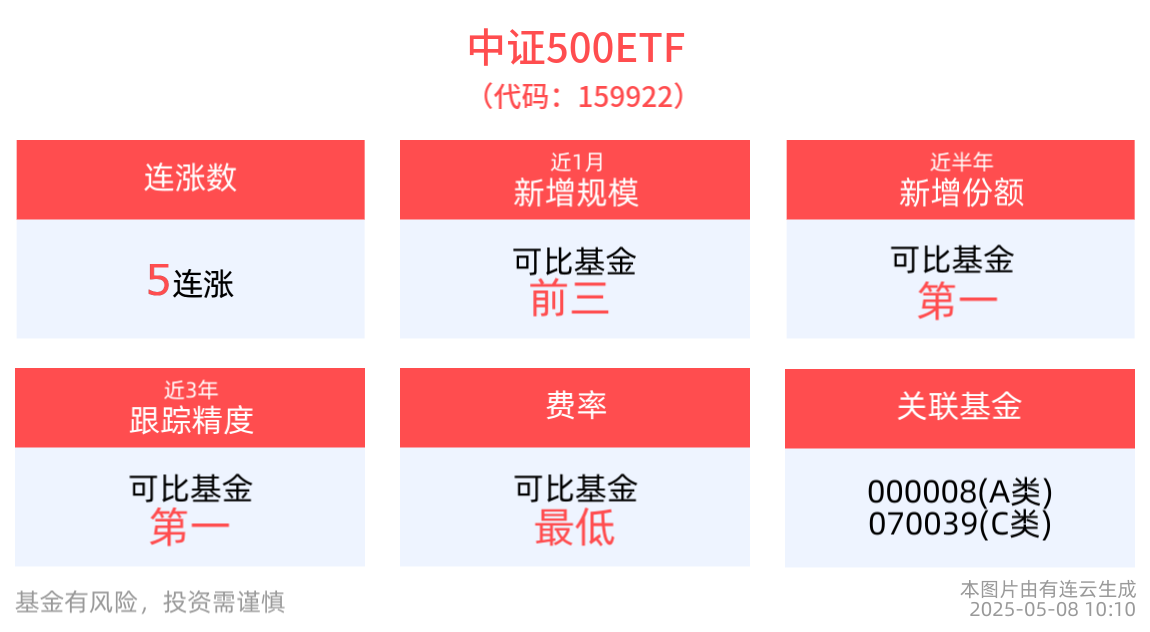
中证500ETF(159922)冲击5连涨,机构:市场有望走出震荡向上的结构性行情
Xin Lang Cai Jing· 2025-05-08 02:31
Group 1 - The core viewpoint indicates that the market is expected to shift from a defensive to a moderately aggressive stance as external interest rate cuts approach, with a focus on positive changes in both internal and external environments [3] - The China Securities 500 ETF has seen significant growth, with a recent increase in scale by 5.46 billion yuan and a half-year share growth of 20.44 billion shares [3] - Institutions believe that the discount rate for the stock market is entering a downward trend, supporting a positive outlook for the Chinese A/H stock markets [3] Group 2 - The top ten weighted stocks in the CSI Small Cap 500 Index include Jianghuai Automobile, Guangqi Technology, and Shenghong Technology, collectively accounting for 6.4% of the index [4] - Investors can access A-share small-cap investment opportunities through the CSI 500 ETF linked fund (070039) [4]
国泰海通:A股市场逐渐企稳回升 建议后续基金适度偏向成长配置
智通财经网· 2025-05-07 22:57
Group 1 - The A-share market is gradually stabilizing and recovering after the impact of "reciprocal tariffs," with a slight decline for the month. It is suggested that future fund allocations maintain a balanced style while moderately leaning towards growth, emphasizing the importance of fund managers' stock selection and risk control capabilities [1][2] - In April, the manufacturing PMI was 49.0%, a decrease of 1.5 percentage points from the previous month, influenced by the drastic changes in the external environment due to trade friction. The strategy team believes that after the shock, investors' understanding of the economic situation has improved, which is crucial for the stock market's recovery [2] - The focus of Sino-US competition extends beyond economic trade to technological and productivity advantages. In the medium to long term, emerging technology remains a key theme, and the financial cycle is expected to be a dark horse under the influence of declining risk-free interest rates and new capital inflows [2] Group 2 - Global central bank gold purchasing behavior is expected to be long-term and sustained, reflecting changes in the trust foundation of the global monetary system. The rise of trade protectionism and the restructuring of the global economy will increase economic differentiation, supporting residents' demand for gold [3] - The fundamental impact of the US dollar on gold pricing has weakened but still holds some influence. If the US economy weakens, the support for gold prices will strengthen. This gold bull market is characterized by different driving factors and pricing frameworks, suggesting a potentially long cycle [3] - From a long-term investment and risk-hedging perspective, it is recommended to allocate to gold ETFs [3]

国泰海通证券5月基金投资策略:A股4月收跌,相对偏向成长配置风格
国泰海通证券研究· 2025-05-07 15:01
Group 1 - The article discusses the stabilization and slight recovery of the A-share market following the impact of "reciprocal tariffs," suggesting a balanced investment strategy with a slight tilt towards growth stocks while emphasizing the importance of stock selection and risk control by fund managers [2] - In April, the manufacturing PMI was reported at 49.0%, a decrease of 1.5 percentage points from the previous month, indicating a shift in economic sentiment due to trade tensions [2] - The article highlights that the focus of Sino-US competition extends beyond trade to technology and productivity advantages, suggesting that emerging technologies will remain a key investment theme in the medium to long term [2] Group 2 - For bond funds, the report recommends focusing on government bonds with specific maturities (7-year or 20-year) and suggests a strategy of "bullet" operations to enhance yields [3] - The article notes that global central bank gold purchasing behavior reflects a long-term restructuring of the global monetary system, driven by rising trade protectionism and economic restructuring [3] - It emphasizes that the current gold bull market is distinct due to changes in driving factors and pricing frameworks, suggesting a prolonged cycle for gold investments [3]


中国宏观经济 - 中金公司2025年度春季投资策略会
中金· 2025-03-11 01:47
好,非常高兴在大家知道今天这一次的这个春季策略会是我们中介公司第一次非常高兴。为 什么说呢?我觉得这个时间点就特别好因为年度策略会我们是 11 月中旬到中期策略会大概 是一般是在六月份到中间隔了多长时间?七个月。所以这个季度的春季策略会起到个什么作 用呢?我觉得是承上启下。所以这个时间点开票加上最近是什么,你看市场情绪是很好的, 市场情绪什么这个比较兴奋我觉得这个情况是特别让人欣慰的。此时此刻,大家会问,我前 天我昨天录弇客户还在问,你不是年度观点讲什么? 你不是讲这个走向半通胀吗?那么走向半通胀现在到了什么情况呢?还是不是走向半通胀 了,到了什么程度呢?我们也看了一下,在我们网页上我们年度报告的主题是叫什么走向半 通胀。直到最近还是有人在我们有客户在不停的点击,再点击这个报告,说明大家还是关注 我们的观点的。所以我也是特别高感谢我们这个客户对我们的信任和支持。所以我今天的报 告的主题,我就是什么半通胀的第一步,也就是说我们这个年度报告的观点是走向半通胀。 那半通胀现在什么程度了呢? 是不是顺利呢?我的观点是到目前来看是比较顺畅的,尤其是半路上的第一步是比较顺畅的。 我记得我们在写这个年度报告的时候,市场情绪 ...
