预制菜风波

Search documents
西贝将关闭102家门店
财联社· 2026-01-15 07:12
2025年9月,西贝遭遇"预制菜风波",贾国龙称之为西贝成立以来最大的一次外部危机。同年12月,贾国龙在接受媒体采访时表示:"我认 错,我向顾客认错,我向员工认错,也向我自己认错。" 据悉,西贝去年持续发放大额消费券,累计金额超3亿元。在最近的一次专访中,贾国龙表示,2026年1月,门店生意同比下滑50%。 据中国新闻周刊, 近日, 网传西贝会议中称将一次性关闭全国102家门店,占门店总数的30%。1月15日,西贝餐饮创始人贾国龙确认了该消息属 实。 ...

2026年第一个“牛马顶流”,出现了
3 6 Ke· 2026-01-06 09:28
Core Insights - The rise of "Gai Ma Fan" (盖码饭) has marked a significant shift in the fast food landscape, overtaking traditional options like "Zhu Jiao Fan" (猪脚饭) to become a favorite among urban workers in major cities [2][10] - The Gai Ma Fan market is characterized by its appeal to young professionals, with 58.3% of consumers being office workers and 64% aged between 19-35 [2][4] - The efficiency of Gai Ma Fan, with preparation times of just 3-5 minutes, aligns with the fast-paced lifestyle of modern workers, making it a convenient meal option [3][4] Market Dynamics - Gai Ma Fan has seen rapid growth, with leading brand Ba Wan (霸碗) expanding to over 1,100 stores within seven years, competing closely with established brands like Lao Xiang Ji [2][8] - The average price range for Gai Ma Fan is between 16-30 yuan, making it accessible to a wide demographic, particularly among young workers [6][10] - The introduction of automated cooking machines has significantly reduced labor costs and improved service efficiency, allowing brands to scale rapidly [9][10] Consumer Behavior - The primary consumer demographic for Gai Ma Fan consists of young individuals facing job-related pressures, who appreciate the quick and affordable meal option [4][5] - Despite the convenience, there are concerns about the lack of customization in machine-cooked meals, leading to debates about the quality and personal touch of the food [11][15] - The popularity of Gai Ma Fan reflects a broader trend of consumer preference shifting towards quick, affordable meals amidst rising living costs [12][14] Competitive Landscape - The Gai Ma Fan segment is experiencing increased competition, with other brands and food types, such as Guangxi stir-fry, emerging as alternatives [14][15] - The market is witnessing a trend towards standardization, which may dilute brand differentiation and consumer loyalty over time [14][15] - The overall success of Gai Ma Fan will depend on its ability to maintain quality and consumer interest in a rapidly evolving food landscape [15][16]
预制菜风波的下半场,商场该“动手”了
3 6 Ke· 2025-12-18 02:46
Core Viewpoint - The ongoing controversy surrounding pre-prepared meals in China highlights a significant trust crisis between consumers and the food industry, driven by a lack of transparency and communication from businesses [25]. Group 1: Industry Dynamics - The pre-prepared meal sector has gained traction due to the efficiency demands of shopping centers, which favor standardized, easily replicable restaurant brands to attract foot traffic [6][10]. - Shopping centers have increasingly relied on pre-prepared meals to optimize kitchen space and reduce operational costs, leading to a cycle where consumer dissatisfaction grows as reliance on these meals increases [12][13]. - A significant portion of the pre-prepared meal market (60%-70%) is dominated by B-end markets, indicating that most chain restaurants in shopping centers utilize pre-prepared meals, which has led to a collective consumer backlash against the entire dining experience in these venues [13][20]. Group 2: Consumer Sentiment - Consumers are not inherently opposed to pre-prepared meals; rather, their resistance stems from a lack of transparency regarding the use of these products in restaurants, leading to feelings of deception [20][25]. - The cultural context in China places a high value on freshly prepared meals, making the industrialized production of pre-prepared meals seem devoid of authenticity and care [18][19]. - A survey indicated that 78.1% of consumers felt that restaurants did not adequately disclose the use of pre-prepared meals, exacerbating the trust deficit between consumers and food service providers [20]. Group 3: Recommendations for Improvement - Shopping centers should take proactive steps to enhance transparency regarding the use of pre-prepared meals, such as implementing clear labeling systems that inform consumers about the nature of the food being served [22][25]. - Engaging consumers through experiential marketing, such as cooking demonstrations and tasting events, can help demystify pre-prepared meals and improve consumer perceptions [24]. - Establishing a clear communication strategy that openly discusses the benefits and uses of pre-prepared meals can help rebuild trust and align consumer expectations with industry practices [25].
西贝“被人算计”?罗永浩“大战”华与华创始人!
Xin Lang Cai Jing· 2025-11-26 20:17
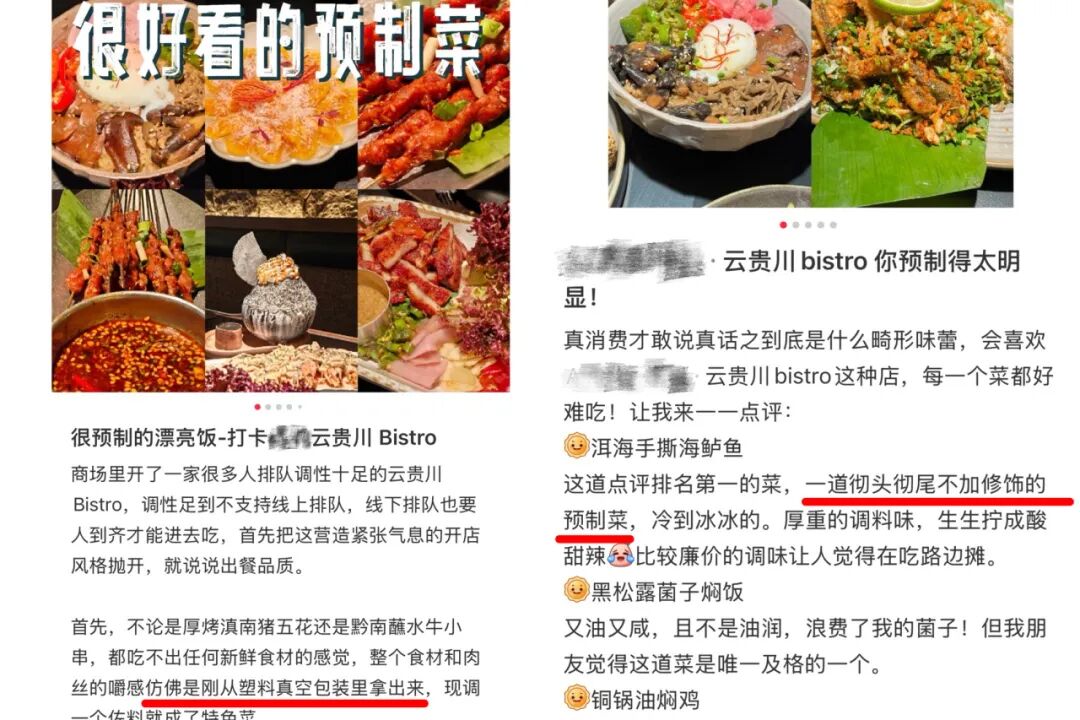
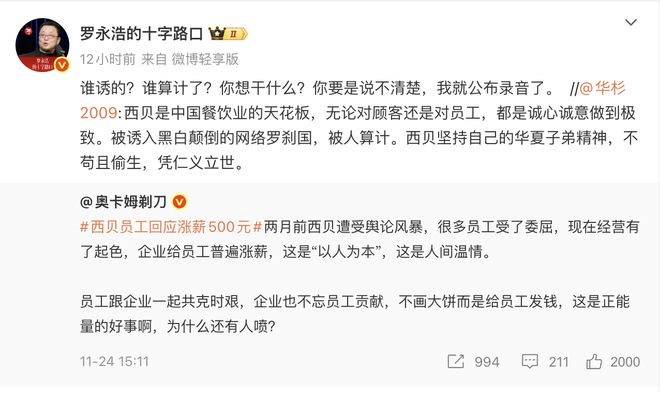
Core Points - The recent controversy involving Luo Yonghao and the restaurant brand Xibei has resurfaced, particularly regarding a salary increase for Xibei employees, which has drawn attention on social media [1][3] - Hua Shan, founder of marketing consultancy Hua Yu Hua, claimed that Xibei is being "schemed against," leading to further disputes with Luo Yonghao threatening to release recordings if no public apology is made by Hua Shan [1][4] Group 1: Company Background - Xibei has been collaborating with Hua Yu Hua since 2013, with Hua Yu Hua providing significant branding and marketing strategies, including the creation of the "I♥莜" symbol and the simplification of Xibei's menu from over 100 dishes to 44 [4][5] - Hua Yu Hua has charged Xibei over 60 million yuan in consulting fees over the past decade, averaging more than 6 million yuan annually [5] Group 2: Recent Developments - Luo Yonghao previously criticized Xibei for serving mostly pre-packaged dishes, which led to a public backlash against the brand [4] - Hua Shan has not yet responded to Luo Yonghao's accusations, and his social media account has been set to private, preventing further comments [5]

华与华创始人称西贝被算计,罗永浩要求下午六点前公开道歉
2 1 Shi Ji Jing Ji Bao Dao· 2025-11-26 07:01
Core Viewpoint - The recent controversy involving entrepreneur Luo Yonghao and the restaurant brand Xibei has reignited discussions about the pre-made food industry in China, highlighting issues of consumer rights and public relations within the sector [1][4]. Group 1: Controversy Background - Luo Yonghao criticized Xibei for serving pre-made dishes at high prices, which led to a significant public backlash against the restaurant [5]. - Xibei's founder, Jia Guolong, expressed feeling "hurt" by the criticism and announced intentions to sue Luo Yonghao [5]. - The controversy escalated with Luo emphasizing the importance of consumer rights and Xibei's subsequent decision to open its kitchens for public inspection [5][6]. Group 2: Financial Impact - Following the criticism, Xibei experienced a drastic decline in customer traffic, with daily revenues dropping by 1 million yuan on September 10 and 11, and an estimated decrease of 2 to 3 million yuan on September 12 [6]. - The financial repercussions of the controversy have been significant, affecting Xibei's overall business performance [6]. Group 3: Marketing and Consulting Relationships - Xibei has been working with the marketing consulting firm "Hua Yu Hua" since 2013, which has played a crucial role in its branding and marketing strategies [6]. - The collaboration has been financially substantial, with Hua Yu Hua reportedly receiving over 60 million yuan in consulting fees over ten years, averaging more than 6 million yuan annually [6].
华与华创始人称西贝被算计,罗永浩要求下午六点前公开道歉
21世纪经济报道· 2025-11-26 06:57
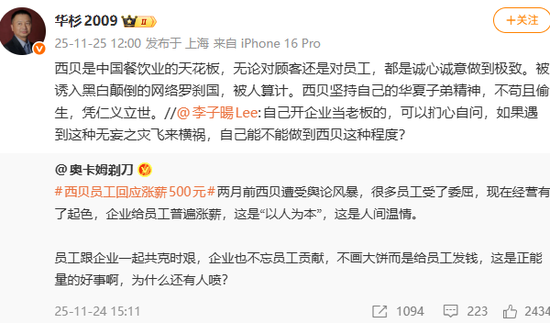
Core Viewpoint - The recent controversy involving entrepreneur Luo Yonghao and the restaurant brand Xibei has reignited discussions about the pre-made food industry and its implications for consumer rights and brand reputation [1][4]. Group 1: Controversy Overview - Luo Yonghao criticized Xibei for serving pre-made dishes at high prices, leading to a public backlash and a significant drop in customer traffic and revenue for Xibei [5]. - Xibei's founder, Jia Guolong, expressed feelings of being unfairly targeted and announced plans to sue Luo Yonghao for defamation [5]. - The marketing consulting firm Huayi Huayi, which has worked with Xibei for a decade, became involved in the dispute, with its founder Huashan defending Xibei and labeling Luo as a "network black mouth" [5][6]. Group 2: Financial Impact - Following the controversy, Xibei experienced a drastic decline in customer traffic, with daily revenue dropping by approximately 1 million yuan on September 10 and 11, and an estimated decrease of 2 to 3 million yuan on September 12 [5]. - The long-term partnership between Xibei and Huayi Huayi has been financially significant, with over 60 million yuan in consulting fees paid over ten years, averaging over 6 million yuan annually [6]. Group 3: Industry Context - The incident highlights the growing scrutiny of the pre-made food sector in China, as consumer awareness and demand for transparency increase [5]. - The controversy reflects broader challenges within the restaurant industry regarding quality perception and consumer rights, particularly in the context of rising operational costs and competitive pressures [5][6].

争议再起!华与华创始人称西贝被算计,罗永浩:下午六点前公开道歉
2 1 Shi Ji Jing Ji Bao Dao· 2025-11-26 05:39
Group 1 - The controversy involving entrepreneur Luo Yonghao and the restaurant brand Xibei has resurfaced, with comments from Hua Shan, founder of marketing consulting firm Hua Yu Hua, defending Xibei's employee salary increase and suggesting that the brand is facing malicious attacks [1][3] - Luo Yonghao responded to Hua Shan's comments with a series of questions and a threat to release recordings if no public apology was made by Hua Shan by a specified deadline [1][3] - The initial controversy began on September 10, when Luo Yonghao criticized Xibei for serving expensive pre-packaged meals, leading to a significant drop in customer traffic and sales for the restaurant [3][4] Group 2 - Following Luo Yonghao's comments, Xibei's daily revenue dropped by approximately 1 million yuan on September 10 and 11, with an expected decrease of 2 to 3 million yuan on September 12 [4] - Hua Yu Hua, founded in 2002, has been a long-term marketing partner for Xibei, having received over 60 million yuan in consulting fees over ten years, with an average annual fee exceeding 6 million yuan [4] - As of now, Hua Shan has not publicly responded to Luo Yonghao's accusations, and Xibei has also remained silent on the matter [4]
西贝全国门店多道招牌菜品降价
新华网财经· 2025-11-24 03:08
Core Insights - Xibei has implemented a nationwide price reduction for over 40 dishes, with an average decrease of nearly 20% since early October [2][3] - The company has also initiated various promotional activities to attract customers, including issuing cash vouchers and offering discounts [4] Price Adjustment - Xibei's price reduction affects 70%-80% of menu items at individual locations, with specific dishes seeing price drops of 16.81%, 11.24%, and 10.34% [3] - The price adjustments were a response to negative publicity following the "pre-made dish incident" in September [3] Employee Support - In light of the negative impact on frontline employees due to public backlash, Xibei has introduced a "compensation award" and is providing psychological counseling [3] - Since September, Xibei has increased salaries for frontline employees by an average of 500 yuan per month and is considering further salary enhancements [3] Customer Engagement - Xibei launched the "Xibei Treats You to Dinner" campaign, offering 100 yuan vouchers to customers, followed by a new promotion where customers receive vouchers based on their spending [4] - As a result of these initiatives, overall customer traffic increased by approximately 5% compared to the same period last year, with 70% of participants being repeat customers [4] Store Operations - Despite the promotional efforts, Xibei has closed nearly 10 stores since October, while planning to open 8 new locations by the end of December [4] - The company emphasizes that opening and closing stores is a normal part of restaurant operations and is based on business performance [4]

西贝全国门店多道招牌菜品降价,降幅约20%
Xin Lang Cai Jing· 2025-11-24 02:05
Core Insights - Xibei has implemented a nationwide price reduction on over 40 dishes, with an average decrease of nearly 20% since early October, following negative publicity from the "pre-made dish incident" [1][4] - The company has initiated various promotional activities, including distributing cash vouchers to attract customers back to its stores [2][4] - Despite the promotional efforts, Xibei has closed nearly 10 stores since October, although it plans to open 8 new locations by the end of December [4] Pricing Strategy - Xibei's price adjustments include specific dishes such as the grassland tender grilled lamb chop, which decreased from 119 yuan to 99 yuan (a reduction of 16.81%), and the scallion grilled fish, which dropped from 89 yuan to 79 yuan (an 11.24% decrease) [1] - The price reduction strategy is part of a broader effort to regain customer trust and increase foot traffic, which has reportedly risen by 5% compared to the same period last year [4] Employee Support Measures - In response to the negative impact on frontline employees due to the "Xibei Luo Yonghao incident," the company has introduced a compensation program and psychological counseling for affected staff [1] - Since September, Xibei has increased the average monthly salary of frontline employees by 500 yuan and is considering further salary enhancements [1] Customer Engagement Initiatives - The "Xibei Treats You to Dinner" campaign began on September 24, offering customers a 100 yuan voucher with any purchase, followed by a new promotion from October 9 to October 31, where customers could earn vouchers based on their spending [2] - Approximately 70% of customers participating in the promotional activities were returning customers, indicating a successful re-engagement strategy [4]
西贝回应多地门店关闭:正常经营行为,也陆续有新店开业
Xin Lang Cai Jing· 2025-11-11 02:09
Core Viewpoint - The company, Xibei, has issued a statement addressing the recent closure of multiple stores, emphasizing that opening and closing stores is a normal operational behavior in the restaurant industry, and adjustments are made based on business conditions [1]. Store Closures - Xibei has confirmed that the recent closures in cities such as Shenzhen, Shantou, and Yiwu are part of a normal adjustment process [3][4]. - The company has received reports from customers regarding store closures, citing reasons such as development planning adjustments or lease expirations [6]. Principles for Store Closures - Xibei adheres to three principles during store closures: 1. Customers are informed in advance through announcements and SMS notifications to members with stored value, offering them the option to either receive a full refund or transfer their balance to other locations [4][6]. 2. The company ensures that every customer dining at the closing store is treated with care and is informed about nearby Xibei locations [6]. 3. Employees are prioritized for reassignment to other Xibei stores to protect their interests [4][6]. New Store Openings - Despite the closures, Xibei is also opening new stores, including locations in Harbin and Jinan, with plans to open eight more by December 31, including stores in Shenzhen and Nanjing [5][6]. Service and Product Enhancements - Xibei is actively upgrading its services, adjusting menu items, optimizing pricing, and prioritizing food safety by advancing the "Sunshine Kitchen" initiative [7].