未来产业

Search documents
把AI当“研发搭子”,未来产业蕴含广阔前景
Xin Hua Wang· 2026-01-02 12:13
Core Insights - The article emphasizes the transformative role of artificial intelligence (AI) in scientific research, particularly in protein design and biomanufacturing, highlighting its potential to accelerate innovation and reduce costs [1][2]. Group 1: AI in Protein Design - Tianmu Technology has developed a protein design model that has processed over 10 billion protein data points and delivered more than 30 industrial projects, showcasing the efficiency of AI in generating optimal solutions for new projects [1]. - AI4S (AI for Science) is changing the traditional research paradigm by addressing the lengthy and costly processes associated with protein design, enabling the development of products that can withstand extreme industrial conditions [1][2]. - The ability of large models to extract features from vast datasets allows researchers to understand the structural characteristics of proteins that enable microorganisms to survive in extreme environments, thus enhancing biopharmaceutical and bio-agricultural research [2]. Group 2: Future Industry Trends - The Ministry of Industry and Information Technology plans to promote AI applications in biomanufacturing, with Tianmu Technology being one of the highlighted companies, indicating a broader trend towards upgrading the entire biomanufacturing industry chain [2]. - The "14th Five-Year Plan" suggests a forward-looking approach to future industries, exploring diverse technological routes and typical application scenarios, which includes fields like quantum technology, biomanufacturing, and brain-computer interfaces as new economic growth points [2]. - The emergence of intelligent research systems, such as the "Meta-Life" system led by the Lingang Laboratory, aims to revolutionize drug discovery by significantly shortening the target discovery cycle, demonstrating the potential of AI to transform the pharmaceutical industry [3]. Group 3: Systematic Development of Scientific Intelligence - The integration of AI into scientific research is not just about speeding up calculations but also about fundamentally transforming research paradigms and accelerating scientific discoveries [3]. - Industry experts believe that scientific intelligence is becoming a key engine for changing research paradigms, empowering industry development, and influencing economic structures globally [3]. - There is a call for deeper exploration in developing new theoretical frameworks and pathways to enhance the systematic advancement of scientific intelligence [3].
开启星际巡航,速览2025年最具潜力的产业新“星”
21世纪经济报道· 2026-01-01 13:16
Group 1 - The article emphasizes the transformative potential of emerging and future industries in reshaping China's economic growth trajectory towards 2025, as highlighted in the "14th Five-Year Plan" [1] - The low-altitude economy is experiencing explosive growth, indicating a significant opportunity for investment and development in this sector [1] Group 2 - The commercial aerospace sector is accelerating, contributing to the formation of a trillion-yuan ecosystem, which presents substantial investment opportunities [4] Group 3 - The installed capacity for renewable energy is rapidly increasing, showcasing the sector's growth and its importance in China's energy transition [7] Group 4 - The brain-computer interface market is continuously expanding, indicating a growing interest and investment in this innovative technology [9] Group 5 - China is leading globally in artificial intelligence patents, with accelerated computing power expansion, positioning the country as a key player in the AI industry [12] Group 6 - The embodied intelligence market in China accounts for nearly 30% of the global market, highlighting its significance and growth potential [14]

完成财政收入1340.7亿元!2025年青岛市财政局积极推动全市经济持续回升向好
Sou Hu Cai Jing· 2026-01-01 00:49
Group 1: Fiscal Performance and Economic Support - In 2025, Qingdao's local general public budget revenue reached 134.07 billion yuan, with tax revenue at 95.05 billion yuan [1] - The city implemented a proactive fiscal policy to support economic recovery, including securing 67.7 billion yuan in new special bonds for 307 key projects, with total project investments exceeding 510 billion yuan [1] - The government provided 4.765 billion yuan to support consumption upgrades in sectors like automobiles and home appliances, and issued 180 million yuan in consumer vouchers [1] Group 2: Employment and Social Welfare - A total of 1.56 billion yuan was allocated to stabilize and expand employment, resulting in 360,700 new urban jobs [2] - The city supported education by funding the construction and renovation of 20 schools and kindergartens, and provided nearly 100 million yuan for student assistance [2] - Social security measures included increasing the basic pension subsidy by 20 yuan and the medical insurance subsidy by 30 yuan, reaching 880 yuan and 800 yuan per person per year respectively [2] Group 3: Fiscal Management and Governance - The city emphasized strict control over general expenditures and "three public" expenses, aiming to enhance fiscal management through a comprehensive pilot program [3] - Efforts were made to ensure adequate funding for grassroots "three guarantees" expenditures and to strengthen financial supervision to ensure the safe and compliant use of fiscal funds [3] - The fiscal department plans to continue implementing effective fiscal policies to support high-quality development in the coming year [3]
布局未来:六大产业引领“十五五”新开局
Guo Ji Jin Rong Bao· 2026-01-01 00:31
Core Viewpoint - The "14th Five-Year Plan" lays the foundation for the "15th Five-Year Plan," which aims to cultivate emerging and future industries as a key part of building a modern industrial system, positioning China strategically for the next round of global technological and industrial transformation [1][3] Group 1: Strategic Overview - The "15th Five-Year Plan" emphasizes the construction of a modern industrial system and the consolidation of the real economy as primary strategic tasks, signaling the necessity for a solid technological and industrial foundation for China's modernization [3] - Future industries are characterized by their frontier, disruptive, and high-growth nature, stemming from significant breakthroughs in basic science, and are expected to dominate global economic landscapes in the coming decades [3] Group 2: Key Future Industries - Six future industries identified in the "15th Five-Year Plan" are crucial for driving the next wave of technological revolution, interlinked and collaboratively evolving to form a new matrix of productive forces [5] - Quantum technology is positioned as a cornerstone for information security and computational advancements, with China leading in quantum communication and achieving "quantum supremacy" with prototypes [5] - Biomanufacturing connects green transformation with industrial upgrading, with a market size nearing 1 trillion yuan, showcasing potential in achieving carbon neutrality through innovative technologies [5] - Hydrogen and nuclear fusion energy represent ultimate solutions for energy, with ongoing developments in compact fusion devices pushing towards engineering applications [5] Group 3: Market and Technological Development - Brain-computer interfaces and embodied intelligence are redefining human-machine relationships, with significant market growth expected in these areas by 2025 [6] - The sixth generation of mobile communication (6G) is set to integrate communication, perception, computation, and artificial intelligence, with China establishing a leading edge in 6G technology [6] Group 4: China's Unique Advantages - China's unique advantages lie in the combination of a new type of national system and a super-large market, allowing for concentrated resource investment in strategic areas like quantum and fusion technologies [8] - A tailored approach is essential for developing future industries, focusing on 1-2 key segments based on local resources and industrial foundations [8] - Establishing a virtuous cycle of technology, capital, and talent is crucial for fostering innovation and long-term investment in emerging technologies [8]
未来产业:如何前瞻布局
Xin Lang Cai Jing· 2025-12-31 21:05
Core Insights - The article discusses the importance of future industries as a core competitive arena for countries to seize technological leadership and cultivate new growth drivers, as outlined in China's 15th Five-Year Plan [10][11][12]. Group 1: Global Competition in Future Industries - Future industries such as quantum technology, bio-manufacturing, and brain-computer interfaces are seen as key areas for countries to gain competitive advantages and enhance national strength [10][11]. - The global R&D expenditure as a percentage of GDP has increased significantly from 2013 to 2022, indicating strong resilience in technology investment despite economic downturns [10]. Group 2: China's Progress in Future Industries - China is transitioning from technology catch-up to proactive layout in future industries, with strengths in quantum communication, 6G, brain-computer interfaces, hydrogen energy, and nuclear fusion [13][14]. - By 2024, China's total R&D investment is expected to exceed 3.6 trillion yuan, a 48% increase from 2020, with R&D intensity reaching 2.69%, surpassing the EU average [14]. Group 3: Funding Support for Future Industries - Future industries require substantial investment and long-term capital support, necessitating a multi-faceted funding structure that includes government, state-owned, and social capital [20][21]. - The establishment of a future industry fund in Shanghai, with a total scale of approximately 15 billion yuan, aims to support the growth of future industries through a structured investment approach [21]. Group 4: Application Scenario Innovation - Application scenarios are crucial for connecting technology with market needs, serving as testing grounds for new technologies and driving industrialization [24][25]. - The Ministry of Industry and Information Technology emphasizes the need for scenario-driven innovation to accelerate the commercialization of future industries [24].
人才蓝皮书:构建新质人才长周期供给体系
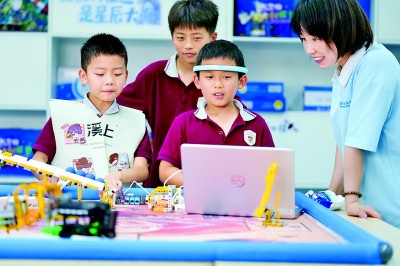
Xin Lang Cai Jing· 2025-12-31 16:58
Core Viewpoint - The development of future industries is a strategic choice to lead technological progress, drive industrial upgrades, and develop new productive forces, with a key focus on cultivating innovative talent [1] Group 1: Talent Development Strategies - The "Talent Blue Book: China Innovation Talent Development Report (2025)" emphasizes the need to shift from a single education reform approach to a proactive supply logic that includes "strategic guidance—pre-identification—type-based incubation—dynamic adaptation" to address the mismatch in supply and demand for new quality talent [1] - Experts suggest establishing high-end talent identification experimental zones in cutting-edge fields such as quantum information, brain-like intelligence, future computing power, and synthetic biology, utilizing a comprehensive identification model of "intelligent assessment + behavioral observation" to provide early foresight for national strategic talent resource absorption [1] - The proposal includes the "Future Technology Talent Seed Project," which aims to create experimental classes or top innovation colleges aligned with future industries, incorporating interdisciplinary education courses and challenging research projects to establish a continuous training pathway from secondary school to doctoral studies [1] Group 2: Talent Training Models - The blue book advocates for a bridge-type talent training model oriented towards strategic emerging industries, suggesting the transformation of key technology challenges into embedded training projects within real industrial scenarios to cultivate system integration and achievement conversion capabilities [2] - For future industries, an exploratory talent ecosystem should be constructed, relying on national laboratories to establish a "Future Scientist Preparatory Program" that provides a long-term, high-tolerance growth environment for young talents with non-mainstream thinking, cross-border potential, and disruptive problem awareness [2]
三度上榜!解锁南山让企业家“幸福扎根”的三重密码
Sou Hu Cai Jing· 2025-12-31 16:05
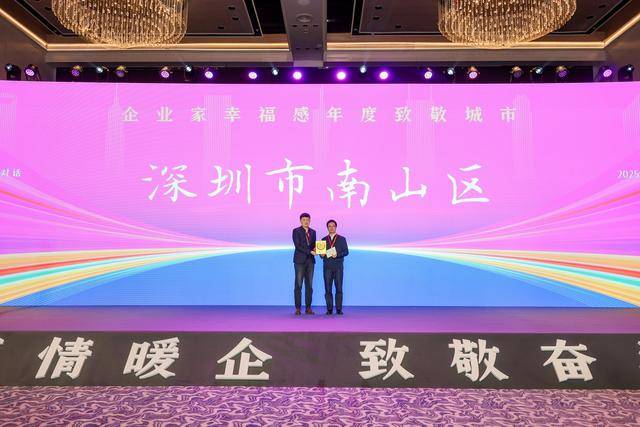
Core Viewpoint - The event held in Taicang, Jiangsu, recognized 20 cities, including Nanshan District of Shenzhen, for their contributions to enhancing entrepreneurs' happiness and business environment, marking Nanshan's third consecutive recognition [1][3]. Economic Performance - Nanshan District achieved a GDP of 742.81 billion yuan in the first three quarters of 2025, with a year-on-year growth of 5.8%, and is expected to surpass 1 trillion yuan for the year, becoming the first district in China to do so [4]. - The district hosts over 600,000 market entities and 218 listed companies, indicating a high density of businesses [3][4]. Entrepreneurial Services - Nanshan has developed a comprehensive service system for entrepreneurs, integrating online and offline services, with the "Ai Nanshan" platform offering over 2,000 services throughout the business lifecycle [4][5]. - The platform has recorded over 12.67 million visits and facilitated financing exceeding 3.68 billion yuan, with a 24-hour response time for business inquiries [5]. Community Engagement - Nanshan organizes various community events, such as the "Feather Enterprise" badminton tournament, to foster business networking and collaboration, resulting in direct solutions for 35 specific business needs and over 10 successful business matches [6][8]. Policy Support - The district's industrial policy has evolved to support businesses throughout their growth cycle, transitioning from attracting companies to nurturing their development through initiatives like the "Six Ones" action plan [9]. - The "X-Day" West Lake Roadshow has facilitated over 2,900 institutional connections, helping 17 companies secure over 530 million yuan in equity financing [10]. Investment Initiatives - The establishment of the "Guangdong-Hong Kong-Macao Greater Bay Area Venture Capital Guidance Fund" with a target size of 50.45 billion yuan aims to support hard technology sectors and align with Nanshan's innovation policies [12]. - This fund is expected to enhance the region's strategic competitiveness and provide stable capital support for early-stage technology companies [12]. Industrial Ecosystem - Nanshan's "robot valley" exemplifies a thriving industrial ecosystem, with significant collaboration among companies and research institutions, leading to remarkable achievements in the robotics sector [13][15]. - The district boasts over 1,400 AI companies, with a substantial share of the city's algorithm product registrations, highlighting its role as a hub for innovation [15]. Entrepreneurial Culture - Nanshan's commitment to fostering a supportive environment for entrepreneurs is reflected in its policies and community initiatives, creating a vibrant ecosystem that attracts and retains talent [16].
加码“长钱长投” 2025年险资在一级市场出资规模超千亿元
Zhong Guo Jing Ying Bao· 2025-12-31 15:45
Group 1 - The core viewpoint of the articles highlights the accelerated influx of insurance capital into the primary market, driven by regulatory guidance and a low-interest-rate environment, with insurance institutions contributing significantly to private equity funds [1][2] - In 2025, insurance institutions contributed a total of 1,097.56 billion yuan to private equity funds, marking a 55.85% increase compared to the same period in 2024 [1] - The top three insurance companies in terms of contributions to private equity funds in 2025 were China Pacific Life Insurance (205.99 billion yuan), Ping An Life Insurance (150 billion yuan), and Sunshine Life Insurance (114.88 billion yuan) [2] Group 2 - Insurance capital's participation in the primary market is facilitated through various investment methods, including fund-of-funds, direct investment funds, and proprietary capital [3] - In the first half of 2025, insurance asset management institutions registered equity investment plans totaling approximately 268 billion yuan, reflecting a year-on-year growth of 188% [3] - The significant performance of insurance capital in the primary market is attributed to three main factors: the need to address "asset scarcity," supportive regulatory policies, and the natural alignment of insurance capital characteristics with equity investments [3] Group 3 - Insurance capital is primarily directed towards future industries and new productive forces, promoting a shift towards more rational and patient value investing in the market [4] - Notable investments include a 50 billion yuan fund initiated by China Life Asset Management focused on hard technology, and a 100 billion yuan fund established by PICC aimed at modernizing industrial systems [4][5] - Insurance capital is characterized as "patient capital," favoring long-term investments in sectors aligned with national strategies, such as hard technology, AI, and healthcare [5] Group 4 - Despite the growing scale of insurance capital investments, not all general partners (GPs) are favored; insurance capital has stringent requirements for GP selection based on management scale, historical performance, and team capabilities [6] - Preferred GPs include those with insurance or state-owned backgrounds, as well as top-performing market-oriented GPs [6] - The collaboration between insurance capital and GPs is influenced by the need for alignment in long-term interests and risk management strategies [6][7]
2025,中国经济热词
Jing Ji Wang· 2025-12-31 08:35
Economic Development - In 2025, China's economy is advancing under pressure, focusing on new and improved quality [1] - The "15th Five-Year Plan" emphasizes the importance of the period for laying a solid foundation for achieving socialist modernization by 2035 [3] Future Industries - The "15th Five-Year Plan" suggests a forward-looking layout for future industries, promoting sectors like quantum technology, biomanufacturing, hydrogen energy, and nuclear fusion as new economic growth points [7][8] - Future industries are expected to significantly impact international competition and create new products, services, and consumption patterns over the next 5-10 years [8] Investment in Human Capital - The 2025 government work report calls for increased investment in human resources and services for people's livelihoods, focusing on education, health, and skills [10] - The implementation of a childcare subsidy system reflects a commitment to enhancing disposable income for families, thereby boosting consumption [15] Silver Economy - The "15th Five-Year Plan" aims to actively develop elderly human resources and the silver economy, indicating a direction for industrial innovation and market development [13] - In the first half of 2025, demand for products suitable for the elderly surged, with sales growth exceeding the national manufacturing average [13] Artificial Intelligence - The "Artificial Intelligence+" initiative is positioned as a strategic pivot for China to gain a competitive edge in global technology, integrating AI into various sectors [17] - The initiative aims to transform research paradigms and enhance the application of AI across industries, culture, and social governance [17] Urban Renewal - Policies for urban renewal are accelerating, with significant improvements in living conditions and quality of life for residents [19] - Over 240,000 old urban communities have been renovated, benefiting over 41 million households [19] Robotics Industry - The humanoid robotics sector is experiencing significant investment interest, comparable to the solar energy boom in 2018, though there are concerns about overvaluation [25] - The industry is still developing, with expectations for future advancements and applications [25] Cultural Products - The LABUBU toy has gained immense popularity both domestically and globally, resonating with young consumers and showcasing the potential of Chinese cultural products [27] - The success of LABUBU and similar products highlights the global appeal of culturally significant Chinese creations [27]

江门出资2亿参与粤港澳基金,支持企业开展颠覆性技术攻关
Nan Fang Du Shi Bao· 2025-12-31 02:55
Core Viewpoint - The establishment of the Guangdong-Hong Kong-Macao Greater Bay Area Venture Capital Guidance Fund aims to support strategic emerging industries and innovative technology enterprises, enhancing the region's technological self-reliance and innovation capabilities [2][3] Group 1: Fund Overview - The Guangdong-Hong Kong-Macao Fund has a total scale of 50.45 billion yuan and is part of the National Venture Capital Guidance Fund, which has a registered capital of 100 billion yuan [2] - The fund will focus on seed and early-stage technology companies in strategic emerging industries, supporting original and disruptive technological innovations [2] - The fund's management is undertaken by Shenzhen Capital Group, with a structure that includes a "fund company - regional fund - sub-fund" model [2] Group 2: Local Impact and Collaboration - The investment of 200 million yuan by Jiangmen City Investment Co., Ltd. is part of a broader strategy to link high-quality innovation resources in the Greater Bay Area and support local economic development [3] - Jiangmen aims to attract core elements such as capital, technology, and talent to key industries, accelerating the transformation of technological achievements into productive forces [3] - The city plans to deepen collaboration with fund management institutions and other cities to guide fund resources towards local quality SMEs, enhancing the industrial ecosystem [3]