
产品创新

Search documents
安克创新(300866):经营业绩表现稳健,核心品类持续推新
Xinda Securities· 2025-10-30 09:04
Investment Rating - The investment rating for Anker Innovation (300866) is not explicitly stated in the provided documents, but the overall performance and growth indicators suggest a positive outlook for the company. Core Insights - Anker Innovation reported a revenue of 21.019 billion yuan for the first three quarters of 2025, representing a year-on-year increase of 27.8%. The net profit attributable to shareholders was 1.933 billion yuan, up 31.3% year-on-year, while the net profit excluding non-recurring items was 1.483 billion yuan, reflecting a 13.8% increase [1][2]. - The company achieved a revenue of 8.152 billion yuan in Q3 2025, marking a 19.9% year-on-year growth, with a net profit of 766 million yuan, which is a 27.8% increase year-on-year [1][2]. - Anker's growth is supported by strong performance in both domestic and international markets, with domestic revenue growing by 21.6% and international revenue by 28.0% in the first three quarters of 2025 [2]. Summary by Sections Revenue Performance - For Q1-Q3 2025, Anker's revenue breakdown shows domestic revenue at 6.97 billion yuan (up 21.6% YoY) and international revenue at 20.322 billion yuan (up 28.0% YoY). Online sales contributed 14.396 billion yuan (up 25.2% YoY), while offline sales reached 6.623 billion yuan (up 33.8% YoY) [2]. Product Innovation - Anker continues to innovate across its core product categories. In the charging and storage segment, the new Anker Prime series was launched, featuring high-capacity power banks and collaborations with popular games. In the smart innovation category, new security systems and cleaning devices were introduced, showcasing advanced technology and design [3]. Profitability and Financial Metrics - The gross margin for Q1-Q3 2025 was 44.7%, a slight increase of 0.4 percentage points year-on-year. The company is increasing its R&D investment, with the R&D expense ratio rising to 9.3% [4][5]. The projected net profits for 2025-2027 are 2.64 billion, 3.34 billion, and 4.10 billion yuan, respectively, with corresponding P/E ratios of 23.0X, 18.2X, and 14.8X [5][7].
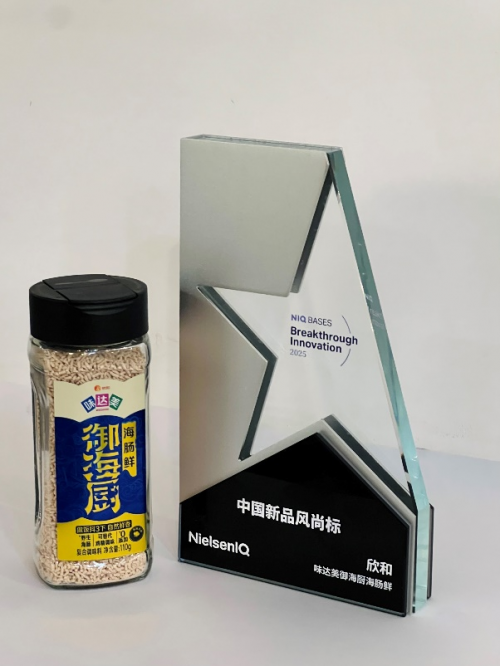
引领海味浪潮,味达美御海厨海肠鲜赢得2025年尼尔森创新大奖
Zhong Guo Shi Pin Wang· 2025-10-30 07:46
Core Insights - The article highlights that the product "Yuhai Chef Sea Intestine Fresh" from the company has won the 2025 Nielsen "New Product Trend Award," recognizing its innovation and leadership in the condiment industry [1][6] Group 1: Product Innovation - The product is based on deep consumer insights and innovative concepts, utilizing wild sea intestines from the Bohai Bay, which are known for their unique flavor and health benefits [1][3] - The sea intestines are processed through cleaning, crushing, and freeze-drying to retain their fresh taste, making them convenient for various cooking methods [3][5] Group 2: Market Performance - Since its launch, the product has gained significant consumer popularity due to its health-oriented and natural attributes, addressing the growing demand for quality condiments [5][6] - The unique selling point of "composite multi-layered sea flavor" and zero-additive positioning has helped the product meet consumer needs for high-quality seasoning [5] Group 3: Brand Commitment - The company, as a long-established brand in Shandong, has been recognized for its commitment to food quality and consumer experience, which is reflected in the award received [6] - The brand emphasizes a philosophy of "natural freshness, health, and safety," aiming to provide consumers with healthy and delicious options in response to the increasing demand for natural products [6]

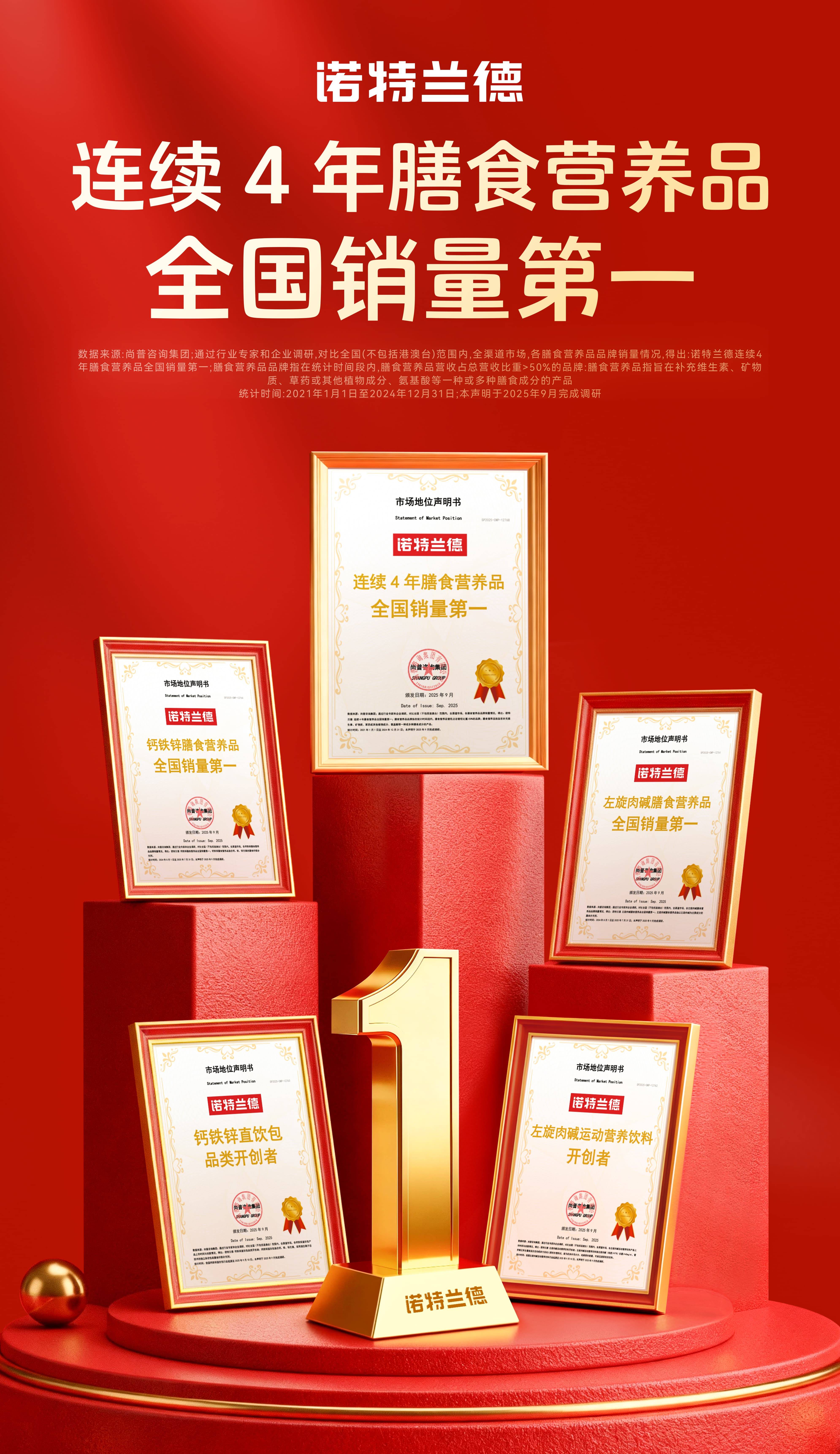
连续4年全国销量第一!诺特兰德斩获五大权威市场地位声明
Zhong Guo Shi Pin Wang· 2025-10-30 07:02
Core Insights - The dietary supplement market is experiencing intensified competition, leading consumers to seek innovative, targeted, and trustworthy products, shifting the industry towards high-quality development [1] Market Position and Performance - Noteland has received five significant market position statements, including "National Sales Leader in Dietary Supplements for Four Consecutive Years" and "First in National Sales for Calcium, Iron, and Zinc Dietary Supplements" [8][10] - The brand has been recognized by Frost & Sullivan as the "National Online Sales Leader in Dietary Supplements for Three Consecutive Years" from 2021 to 2023, further solidifying its market leadership [10] Innovation and Product Development - Noteland has demonstrated its leadership in product innovation by being recognized as the "Pioneer of Calcium, Iron, and Zinc Ready-to-Drink Packs" and "Pioneer of L-Carnitine Sports Nutrition Drinks" [11][28] - The introduction of the "Calcium, Iron, and Zinc Ready-to-Drink Pack" addresses consumer pain points related to traditional products, such as convenience and taste [21][22] Quality Control and Manufacturing - Noteland has established a comprehensive quality control system, including self-built factories and a full-chain quality control process, ensuring product quality from raw materials to finished products [29][30] - The company collaborates with over 200 renowned raw material suppliers globally and implements a rigorous 16-step self-inspection process throughout production [30] Brand Recognition and Future Outlook - The five market position statements serve as a strong affirmation of Noteland's commitment to quality and consumer trust, positioning the brand for continued growth and recognition in the industry [31]
甘源食品(002991):2025年三季度收入增速转正,盈利能力环比改善
Guoxin Securities· 2025-10-30 05:08
Investment Rating - The investment rating for the company is upgraded to "Outperform the Market" [6][11]. Core Views - The company reported a total revenue of 590 million yuan in Q3 2025, representing a year-on-year increase of 4.4%, while the net profit attributable to shareholders was 80 million yuan, down 26.3% year-on-year [1][9]. - Revenue growth in Q3 was primarily driven by the bulk snack and e-commerce channels, supported by new product launches and channel optimization [1][9]. - The company is experiencing a significant improvement in profitability, with a net profit margin recovering to 12.9%, an increase of 8.9 percentage points from Q2 [2][10]. - The company has optimized its product structure, leading to better sales performance of high-margin bean products, which has contributed to the recovery in profitability [2][10]. - Despite challenges in traditional channels and increased expenses due to domestic channel reforms and new product development, the company is expected to see a gradual improvement in its operational quality [3][11]. Financial Forecasts - The company has slightly adjusted its revenue forecasts for 2025-2027, expecting total revenues of 2.24 billion, 2.53 billion, and 2.88 billion yuan respectively, with year-on-year growth rates of -0.8%, +12.8%, and +14.2% [3][11]. - The net profit forecasts for the same period are adjusted to 250 million, 330 million, and 410 million yuan, with year-on-year changes of -33.9%, +31.0%, and +25.8% [3][11]. - The earnings per share (EPS) are projected to be 2.67, 3.50, and 4.40 yuan for 2025, 2026, and 2027 respectively [3][11]. Valuation - The company's stock price has decreased by nearly 40% since the beginning of the year, resulting in a price-to-earnings (PE) ratio of 20, 16, and 12 for 2025-2027, which is considered low compared to peers in the snack industry [3][11]. - The company has a well-established product matrix with numerous new products in the categories of beans, flavored nuts, and puffed snacks, which is expected to help it recover from the challenges faced in traditional channels [3][11].

品牌蓄力高质增长 星巴克中国发布四季度及全财年业绩报告
Zheng Quan Ri Bao Zhi Sheng· 2025-10-30 04:07
Core Insights - Starbucks reported strong performance in Q4 and full fiscal year 2025, with continuous revenue growth in the Chinese market for the fourth consecutive quarter and positive same-store sales growth for the second consecutive quarter [1] Revenue Performance - The company's revenue growth is attributed to innovative product offerings, expansion of the profitable delivery channel, and enhanced membership benefits in the Starbucks Rewards program [1] Same-Store Sales Growth - The increase in same-store sales is driven by multi-dimensional innovation, including the launch of the new tea latte series that has expanded non-coffee options and boosted afternoon sales, as well as new breakfast sandwich offerings tailored to Chinese consumer preferences [1] Delivery Channel Growth - The delivery business, leveraging new platform traffic growth and user subsidy policies, continues to show strong growth momentum [1] Membership Growth - As of the end of the fiscal year, the number of active members in the Starbucks Rewards program reached a record high of 25.5 million [1]

东方证券:维持小米集团-W买入评级 目标价71.65港元
Zhi Tong Cai Jing· 2025-10-30 02:50
Core Viewpoint - Oriental Securities predicts Xiaomi Group-W (01810) earnings per share for 2025, 2026, and 2027 to be 1.63, 2.06, and 2.60 CNY respectively, with a target price of 71.65 HKD based on a 32x PE valuation for comparable companies in 2026, maintaining a buy rating [1] Group 1: Automotive Business - Xiaomi's monthly car delivery exceeded 40,000 units in September 2025, showcasing strong production capacity expansion [3] - The company launched a tax subsidy scheme on October 24, 2025, allowing consumers to lock in orders by the end of November 2025, which is expected to support the annual car delivery target and future growth [3] Group 2: Product Innovation - Xiaomi's innovation and execution capabilities have significantly improved, enhancing its competitive edge in technology and product manufacturing, which is expected to drive growth across its automotive, home, and mobile businesses [2] - The Xiaomi 17 series smartphone, launched on September 25, 2025, features multiple innovative functions and has seen a 30% increase in sales compared to the previous generation, with the Pro version accounting for over 80% of sales [4] Group 3: Market Position - In Q3 2025, Xiaomi maintained a stable global smartphone market share of 14%, ranking third worldwide [4]


东方证券:维持小米集团-W(01810)买入评级 目标价71.65港元
智通财经网· 2025-10-30 02:48
Core Viewpoint - Oriental Securities predicts Xiaomi Group-W (01810) will have earnings per share of 1.63, 2.06, and 2.60 yuan for 2025, 2026, and 2027 respectively, with a target price of 71.65 HKD based on a 32x PE valuation for comparable companies in 2026, maintaining a buy rating [1] Group 1: Automotive Business - Xiaomi's automotive delivery volume exceeded 40,000 units in September 2025, showcasing strong production capacity [2] - The company has implemented a year-end tax subsidy plan to encourage sales, which is expected to support the achievement of annual delivery targets and future growth in the automotive sector [4] Group 2: Product Innovation and Market Position - Xiaomi's product innovation and execution capabilities have significantly improved, enhancing its competitive edge in technology and manufacturing [3] - In Q3 2025, Xiaomi maintained a global smartphone market share of 14%, ranking third worldwide, driven by the successful launch of the Xiaomi 17 series, which saw a 30% increase in sales compared to the previous generation [5]
星巴克发布四季度及全财年报:中国市场净营收、经营利润率稳健增长
Xin Lang Cai Jing· 2025-10-30 01:58
Core Insights - Starbucks reported a continuous revenue growth for four consecutive quarters, reaching $831.6 million in Q4 2025, a year-on-year increase of 6% [1] - The total revenue for the fiscal year 2025 was $3.105 billion, reflecting a 5% year-on-year growth [1] - Same-store sales experienced positive growth for the second consecutive quarter, increasing by 2%, with a 9% rise in transaction volume year-on-year [1] Revenue and Sales Performance - The growth in same-store sales was driven by multi-dimensional innovation, including ongoing product innovation that effectively expanded the customer base and the healthy profitability of the Star Delivery service [1] - The Starbucks Rewards program saw an increase in active members, reaching a record high of 25.5 million by the end of the fiscal year [1] Store Expansion and Profitability - Starbucks maintained a double-digit operating profit margin for its stores, with both operating profit and profit margin showing sequential improvement for four consecutive quarters [1] - In Q4, Starbucks opened 183 new stores and entered 47 new county-level markets, with a total of 415 net new stores added throughout fiscal year 2025 [1] - By the end of fiscal year 2025, Starbucks had established 8,011 stores across 1,091 county-level cities [1] Leadership Commentary - The CEO of Starbucks China, Liu Wenjuan, stated that the company is on a positive trajectory for growth, achieving robust key business metrics and setting multiple historical performance records in the fiscal year-end season [1] - The outstanding performance is attributed to continuous product innovation, exemplified by the tea latte series, and the rapid growth of the Star Delivery business [1]
会稽山:第三季度实现营收3.95亿元 同比增长21.09%
Zhong Zheng Wang· 2025-10-30 01:37
Core Insights - The company reported a revenue of 1.212 billion yuan for the first three quarters of 2025, representing a year-on-year growth of 14.12% [1] - The net profit attributable to shareholders, excluding non-recurring items, reached 108 million yuan, with a year-on-year increase of 8.28% [1] - In the third quarter alone, the company achieved a revenue of 395 million yuan, marking a year-on-year growth of 21.09% [1] Business Strategy and Market Activities - The company adheres to a dual-driven strategy of high-end and youth-oriented development, achieving steady progress across various areas [1] - It actively responded to the integration of culture, commerce, and tourism policies by sponsoring multiple summer events, attracting over 550,000 visitors [1][2] - The company is enhancing its brand image by integrating yellow wine experiences into night market economies and music festivals [1] Product Innovation and Technological Advancements - The company introduced the instant kill fresh-lock technology for the first time in the industry, launching the new product "Kuaijishan Original Fresh Yellow Wine" [1] - It held a quality technology exchange and product evaluation meeting, showcasing its leadership in industry technology [1] - The establishment of a postdoctoral workstation demonstrates the company's commitment to high-end talent and research capabilities [1] Cultural and International Engagement - The company is deeply involved in public welfare and international communication, sponsoring various sports events and supporting youth intellectual development [2] - It signed a contract for a yellow wine-themed station, creating an innovative experience node combining yellow wine and cultural tourism [2] - The company's products were showcased at the French National Day business dinner and the 2025 Shaoxing Overseas Cultural Week, enhancing the international influence of Chinese yellow wine [2]

会稽山第三季度营收增21.09% 渠道变革成效显著
Zheng Quan Shi Bao Wang· 2025-10-30 01:21
Core Insights - The company reported a revenue of 1.212 billion yuan for the first three quarters of 2025, representing a year-on-year growth of 14.12%, with a net profit attributable to shareholders of 116 million yuan, up 3.23% year-on-year [1] - In Q3 alone, the revenue reached 395 million yuan, marking a 21.09% increase, while the net profit was 22.39 million yuan, a growth of 2.47% year-on-year [1] Company Performance - The company is a leading player in the yellow wine industry, with well-known brands such as "Huaijishan," "Lanting," "Xitang," "Wuzhanmao," and "Tang Song" [1] - The company has focused on product and technology innovation, optimizing its product structure to create high-end yellow wine products and enhance the value of yellow wine [1] - Sales of mid-to-high-end yellow wine reached 751 million yuan, a year-on-year increase of 19.64%, while ordinary yellow wine sales dropped to 273 million yuan, down 16.01% [1] Market Dynamics - The majority of yellow wine consumption in China is concentrated in the Jiangsu, Zhejiang, and Shanghai regions, where the company has seen a net decrease of 49 distributors [2] - Despite the decrease in distributors in the main markets, sales revenue in these regions increased, with Zhejiang achieving 699 million yuan (up 17.89%) and Shanghai 219 million yuan (up 10.26%) [2] - The company expanded its distributor network in non-core markets, increasing by 91 to a total of 838 distributors [2] Sales Channels - Direct sales revenue for the company reached 245 million yuan, a significant increase of 58.87%, while wholesale and agency sales were 922 million yuan, up 6.93% [2] - International sales, however, decreased to 6.857 million yuan, down 15.95% year-on-year [2] Shareholder Insights - The top ten circulating shareholders list shows that Penghua Zhongzheng Wine ETF increased its holdings to 7.4086 million shares, an increase of 2.4553 million shares from the previous quarter [3] - Notable investor Ge Weidong maintained his holding at 4.9715 million shares, having entered the shareholder list in the semi-annual report [3]