
房地产发展新模式

Search documents
房地产构建新模式 关键是配置好“人房地钱”
Zheng Quan Ri Bao· 2025-10-31 16:20
Core Insights - The article emphasizes the need for a new development model in the real estate sector to promote high-quality growth, as outlined in the Central Committee's recommendations for the 15th Five-Year Plan [1] Supply Side - The supply side should focus on optimizing the provision of affordable housing, implementing city-specific policies to increase the supply of improved housing, and effectively utilizing inefficient and existing land [1][2] - Specific measures include enhancing the construction of affordable housing and adopting flexible supply methods, such as "purchase instead of construction" and "housing vouchers" [1] Development Side - The development side should prioritize urban connotation development, actively implement urban renewal, and build safe, comfortable, green, and smart housing [3] - The urban renewal market is projected to exceed 8.6 trillion yuan by 2025 and is expected to reach 10 trillion yuan by 2030, indicating a significant market opportunity [3] Financing Side - The financing side must rationally optimize the industry's balance sheets and innovate financing tools to meet reasonable financing needs of enterprises [3][4] - There is a call for innovative financing tools to reduce the scale of interest-bearing liabilities in the real estate sector while preventing systemic risks [4] Sales Side - The sales system should evolve to allow for both pre-sales and current housing sales, while clearing unreasonable restrictive measures on housing consumption [5][6] - Addressing hidden restrictive measures is crucial to facilitate resource flow and stimulate consumption across related industries [6]
黑龙江“十四五”安居图景:推窗见绿 人均住房面积42.2平方米
Zhong Guo Xin Wen Wang· 2025-10-31 13:33
Core Insights - The "14th Five-Year Plan" period in Heilongjiang Province has seen significant improvements in housing and urban infrastructure, with a focus on meeting diverse housing needs and enhancing living conditions for residents [1][3]. Housing Development - During the "14th Five-Year Plan," Heilongjiang Province has constructed approximately 43.37 million square meters of new residential space, increasing the per capita housing area from 35.49 square meters in 2020 to 42.2 square meters [1][3]. - A total of 1.8038 million households have undergone urban and rural housing renovations, benefiting nearly 5 million people [3]. Infrastructure Improvements - The province has completed over 22,000 kilometers of underground utility networks, achieving a public water quality compliance rate of over 95%, which is an increase of nearly 4 percentage points [4]. - The area covered by centralized heating has reached 1.126 billion square meters, with a coverage rate of 92%, and the urban gas supply rate has increased to 96%, up nearly 5 percentage points [4]. Environmental and Urban Development - The province has successfully treated all urban sewage to Grade A discharge standards and completed the remediation of 58 urban black and odorous water bodies [4]. - The average per capita park green space in cities has reached 15.54 square meters, promoting a lifestyle where residents can enjoy green spaces easily [4]. Construction Industry Growth - The construction industry in Heilongjiang has achieved a total output value of 572.27 billion yuan, reflecting a growth of 26.2% by the end of 2024 compared to 2020, with an average annual growth rate of 6% [5]. - The promotion of green buildings has reached 60 million square meters, and energy-saving renovations of existing buildings have totaled 50 million square meters [5].

倪虹撰文!阐释“推动房地产高质量发展”,全面落实六方面重点任务
券商中国· 2025-10-31 09:08
Core Viewpoint - The article emphasizes the importance of promoting high-quality development in the real estate sector as a necessity for meeting people's aspirations for a better life, advancing modernization, and facilitating the transformation of the real estate industry [1][2]. Summary by Sections Importance of High-Quality Development - High-quality development in real estate is essential for satisfying the public's desire for better living conditions, supporting the modernization of China, and aiding the transformation of the real estate industry [1]. Key Tasks for High-Quality Development - The article outlines several key tasks, including optimizing the supply of affordable housing, promoting sustainable market development, reforming real estate development and financing systems, enhancing housing quality, improving property service quality, and establishing a comprehensive safety management system for housing [2][3][4][5]. Optimizing Affordable Housing Supply - A multi-tiered housing security system will be established, focusing on public rental housing, affordable rental housing, and shared ownership housing. Local governments are encouraged to increase the supply of affordable housing based on actual needs, ensuring fairness and transparency in the application and allocation processes [2]. Promoting Sustainable Market Development - The establishment of a linkage mechanism among population, housing, land, and finance is crucial. Policies will be tailored to local conditions, allowing city governments to adjust real estate policies as needed. The rental market will be regulated to foster professional housing rental enterprises [3]. Reforming Development, Financing, and Sales Systems - The article advocates for a project company system in real estate development, where project companies operate independently. A lead bank system will be implemented for financing, ensuring that project companies can meet their financing needs while sharing risks with banks. The promotion of a "sell what you see" approach in property sales aims to mitigate delivery risks [3]. Enhancing Housing Quality - Initiatives will focus on constructing safe, comfortable, green, and smart homes, improving standards across the entire housing lifecycle, and addressing urban renewal challenges [4]. Improving Property Service Quality - The article calls for enhanced coordination among community organizations and property service companies, promoting self-regulation within the property service industry to improve service quality and address residents' daily concerns [4]. Establishing a Safety Management System - A comprehensive safety management system for housing will be developed, including safety inspections, funding for repairs, and quality insurance to ensure the safety and longevity of existing housing stock [5].
倪虹撰文阐释“推动房地产高质量发展”:全面落实六方面重点任务
Zheng Quan Shi Bao Wang· 2025-10-31 06:33
Core Viewpoint - The article emphasizes the importance of promoting high-quality development in the real estate sector as a necessity for meeting people's aspirations for a better life, advancing modernization, and facilitating the transformation of the real estate industry [1] Group 1: Key Tasks for High-Quality Development - Optimize the supply of affordable housing by establishing a multi-tiered housing security system, focusing on public rental housing and affordable rental housing to meet the basic housing needs of urban workers and disadvantaged families [2] - Promote the sustainable and healthy development of the real estate market by implementing housing development plans and establishing a mechanism that links population changes with housing demand, land supply, and financial resource allocation [3] - Reform and improve the systems for real estate development, financing, and sales, including establishing a main bank system for project financing and promoting the sale of existing homes to mitigate delivery risks [3][4] Group 2: Quality Improvement Initiatives - Implement housing quality enhancement projects to build safe, comfortable, green, and smart homes, while improving urban renewal efforts and addressing issues like elevator installation and parking [4] - Enhance property service quality by promoting community organization coordination and improving service standards, while expanding service coverage to meet diverse resident needs [4][5] Group 3: Safety Management Systems - Establish a comprehensive safety management system for the entire lifecycle of buildings, including safety inspections, management funds, and quality insurance to address safety risks in existing housing [5][6]
宝城期货资讯早班车-20251031
Bao Cheng Qi Huo· 2025-10-31 02:59
1. Report Industry Investment Rating - No information about the report industry investment rating is provided in the given content. 2. Core Viewpoints of the Report - The report presents a comprehensive overview of macro - economic data, commodity investment trends, financial news, and stock market information. It shows that the global economic situation is complex, with various factors influencing different markets. For example, the Sino - US economic and trade consultations have reached a series of consensus, which will have an impact on trade and related industries; the gold market is in a high - frequency volatile stage, and the demand and price trends are affected by multiple factors; the bond market has different trends at home and abroad, and the currency and exchange markets also show certain fluctuations [1][2][25] 3. Summary by Relevant Catalogs 3.1 Macro Data - In September 2025, GDP growth rate decreased to 4.8% from 5.2% in the previous quarter, but was higher than 4.6% in the same period last year. Manufacturing PMI rose to 49.8% from 49.4% in the previous month, and non - manufacturing PMI decreased to 50.0% from 50.3%. Social financing scale, M0, M1, M2, and other indicators also showed different trends. CPI was - 0.3% year - on - year, and PPI was - 2.3% year - on - year. Fixed - asset investment decreased by 0.5% year - on - year, while social consumer goods retail sales increased by 4.46% year - on - year. Exports and imports increased by 8.3% and 7.4% respectively year - on - year [1] 3.2 Commodity Investment 3.2.1 Comprehensive - The Sino - US economic and trade consultations in Kuala Lumpur reached a series of consensus, including the cancellation of 10% "fentanyl tariff" on Chinese goods by the US, the suspension of some export control and investigation measures, and the expansion of agricultural product trade. The Ministry of Commerce issued an implementation plan for expanding green trade, promoting the greening of foreign trade transportation and the use of clean energy. On October 30, 39 domestic commodity varieties had positive basis, and 28 had negative basis. The Hong Kong Monetary Authority lowered the benchmark interest rate by 25 basis points to 4.25% [2][3][4] 3.2.2 Metals - The Ministry of Commerce formulated the application conditions and procedures for tungsten, antimony, and silver export state - owned trading enterprises from 2026 - 2027. Gold entered a high - frequency volatile stage, and many banks adjusted the purchase rules of gold accumulation products. In the third quarter of 2025, global central banks increased their gold purchases, with a net purchase of 220 tons, an increase of 28% from the second quarter and 10% year - on - year. China's retail gold investment and consumption demand reached 152 tons in the third quarter, a 7% year - on - year decrease, but the amount reached 120.4 billion yuan, a 29% year - on - year increase. The target price range of gold at the end of 2026 was raised by Wells Fargo. The inventories of some metals such as tin, zinc, and aluminum decreased [6][7] 3.2.3 Coal, Coke, Steel, and Minerals - Henan Province issued an action plan for the quality improvement and upgrading of the steel and coal industries, aiming to promote enterprise restructuring and integration, and improve the level of clean development and intelligent construction [8] 3.2.4 Energy and Chemicals - The World Bank predicted that global commodity prices may decline for the fourth consecutive year in 2026. The US Treasury Secretary mentioned issues such as the integration of the shipbuilding industry, Japan's energy dependence, and potential investment. The US Energy Secretary said that the US could supply natural gas and oil to South Korea. Ukraine will resume importing natural gas through the Trans - Balkan route in November, and Nigeria approved a 15% import tariff on gasoline and diesel [9][10][12] 3.2.5 Agricultural Products - As of October 30, 113 A - share food and beverage listed companies' Q3 2025 reports showed that the total revenue was 630.845 billion yuan, a year - on - year increase of 1.99%, and the net profit was 137.676 billion yuan, a year - on - year decrease of 0.26%. India will impose a 30% import tariff on yellow peas from November 1. The EU Commission adjusted the forecast of ordinary wheat production and maintained the forecasts of other indicators [14][15] 3.3 Financial News 3.3.1 Open Market - On October 30, the central bank conducted 342.6 billion yuan of 7 - day reverse repurchase operations, with an operating interest rate of 1.40%, and the net investment was 130.1 billion yuan [16][17] 3.3.2 Important News - The leaders of China and the US held a meeting, and the economic and trade teams reached a consensus on resolving issues. The Sino - US economic and trade consultations in Kuala Lumpur achieved multiple consensus results. Five departments jointly issued a document to improve the duty - free shop policy from November 1. 500 billion yuan of new policy - based financial instruments have been fully invested, which is expected to drive the total project investment to exceed 7 trillion yuan. The central bank released the 2025 RMB internationalization report. The weighted average interest rate of newly issued commercial personal housing loans in Q3 2025 was 3.07%. The pilot area of pension wealth management products was expanded to the whole country. The Ministry of Housing and Urban - Rural Development proposed to build a new real estate development model. 21 troubled real estate enterprises completed debt restructuring, with a total debt resolution scale of about 1.2 trillion yuan. The Hong Kong Monetary Authority lowered the benchmark interest rate by 25 basis points. The US federal government shutdown may cause economic losses. The US Treasury Secretary mentioned the selection of the Fed Chairman. The central banks of Japan and Europe maintained their benchmark interest rates unchanged. Meta Platforms' corporate bond issuance received a large - scale subscription. Some companies had bond - related major events, and overseas credit ratings of some companies were adjusted [18][19][22] 3.3.3 Bond Market Summary - The sentiment in the inter - bank bond market was warm, with bond yields falling, and most Treasury bond futures rising. The money market interest rates mostly declined. The yields of some financial bonds of policy - based banks were determined. The yields of European and US bonds rose [25][28][29] 3.3.4 Foreign Exchange Market - The on - shore RMB against the US dollar closed at 7.1107, down 116 points from the previous trading day. The US dollar index rose, and most non - US currencies fell [30] 3.3.5 Research Report Highlights - CITIC Securities believed that the bond market had insufficient odds and winning rates in 2025, and a defensive strategy was more advantageous. It also expected the Fed to cut interest rates by 25 bps in December. Huatai Fixed Income thought that Hong Kong - style urban investment institutions had investment value [31][32][33] 3.4 Stock Market - A - shares declined with heavy trading volume, with technology - related stocks falling and the lithium - battery industry chain rising. The Shanghai Composite Index fell 0.73%, the Shenzhen Component Index fell 1.16%, and the ChiNext Index fell 1.84%. The total trading volume was 2.46 trillion yuan. Hong Kong stocks also declined, with the Hang Seng Index falling 0.24%. Southbound funds had a net purchase of 13.641 billion Hong Kong dollars. The margin trading balance of A - shares exceeded 2.5 trillion yuan, and the semiconductor industry received significant net purchases from margin funds [34][35]
首开股份前三季度实现业绩修复:毛利营收双提升,资金充沛,战略落子北京核心区
Jin Rong Jie· 2025-10-30 10:13
Core Viewpoint - The financial performance of Shoukai Co., Ltd. has shown significant improvement in the third quarter of 2025, with substantial growth in revenue and a notable recovery in profitability, indicating a strong foundation for high-quality development [1][2]. Financial Performance - In the first three quarters, the company achieved operating revenue of 23.186 billion yuan, representing a year-on-year increase of 60.31% [2]. - The net profit attributable to shareholders saw a significant reduction in losses, improving by over 1.1 billion yuan compared to the previous year [2]. - The gross profit margin increased by 4.12 percentage points to 11.03%, positioning the company at a leading level within the industry [2]. Cash Flow Improvement - The net cash flow from operating activities turned positive, reaching 5.049 billion yuan, marking a fundamental shift from significant outflows to positive inflows [3]. - This improvement in cash flow alleviates short-term liquidity pressures and provides a solid financial foundation for future project development and debt repayment [3]. Funding Support - The company benefits from strong support from its major shareholder, Shoukai Group, which plans to provide up to 3 billion yuan in perpetual bond financing [4]. - The company has also enhanced its financing capabilities, successfully issuing private bonds totaling 1.206 billion yuan at a low interest rate of 2.79% [4]. - The backing from state-owned enterprises and a solid operational foundation help the company withstand industry uncertainties [4]. Strategic Development - The company has made strategic land acquisitions, including a key plot in Beijing's Chaoyang District for 446 million yuan, which is expected to enhance its competitiveness in the high-end residential market [5]. - In the first three quarters, the company recorded a total of 847,000 square meters of project completion, with a balanced layout focusing on both Beijing and surrounding high-quality areas [6]. - The recent policy guidance from the 14th Five-Year Plan emphasizes high-quality development in the real estate sector, aligning with the company's strategic direction [6]. Future Outlook - With ongoing project advancements in core areas of Beijing and a favorable policy environment, the company is positioned to capitalize on market recovery and transition from stable recovery to high-quality growth [6].

十月土拍市场“点状升温”,顶层纲领指明供给侧方向
Di Yi Cai Jing· 2025-10-30 07:21
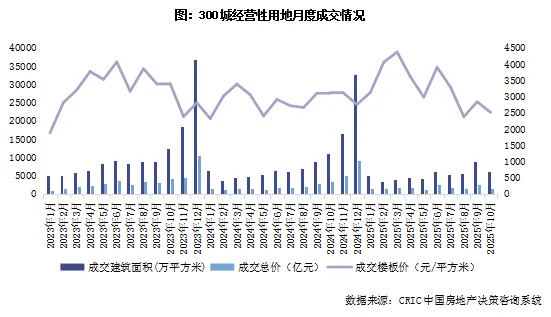
Core Insights - The land auction market in October showed a mixed performance, with a decline in overall transaction scale but instances of high premium land sales [1][2][4] Group 1: Market Performance - In October, the national operating land transaction area decreased by 13% month-on-month and 25% year-on-year, totaling 60.57 million square meters [1] - The transaction amount for the same period was 151.9 billion yuan, reflecting a month-on-month decline of 20% and a year-on-year decline of 35% [1] - The average premium rate for land auctions fell to 2.7%, marking a new low for the year, with a land abandonment rate of approximately 5% [1][2] Group 2: High Premium Transactions - Despite the overall market contraction, core cities maintained high transaction activity, with several key cities witnessing high total prices, premiums, or unit prices for residential land [2] - The highest total price for a land parcel in October was in Shanghai's Jing'an district, where a consortium won the bid for 7.737 billion yuan with a premium rate of 9.03% [2] - The highest unit price was recorded in Shanghai's Xuhui district at 148,500 yuan per square meter, with a total transaction price of 4.465 billion yuan and a premium rate of 10% [2][3] Group 3: Regional Highlights - Other cities also experienced high premium land sales, such as Changsha, Hangzhou, and Chengdu, with premium rates exceeding 18% in several cases [3] - In Qingdao, a land auction involved intense competition, resulting in a premium rate of 25.77% for a parcel won by Hisense [3] Group 4: Future Outlook - The recent release of the "15th Five-Year Plan" emphasizes the need for a new model in real estate development, focusing on optimizing housing supply and improving quality [6] - The market is expected to see further optimization in land supply, with a focus on quality improvement and meeting demand [6]

房地产未来五年定了!建“好房子”、保障房供给、城市更新成为重头戏
Sou Hu Cai Jing· 2025-10-30 05:15
10月28日,"十五五"规划建议全文公布,将"推动房地产高质量发展"放在了"加大保障和改善民生力度,扎实推进全体人 民共同富裕",强化了房地产的民生属性,以及在保障和改善民生中的地位。 出品 | 搜狐财经 作者 | 王泽红 对于推动房地产高质量发展,《建议》明确了五个方向: 一是加快构建房地产发展新模式,完善商品房开发、融资、销售等基础制度; 二是优化保障性住房供给,满足城镇工薪群体和各类困难家庭基本住房需求; 三是因城施策增加改善性住房供给; 四是建设安全舒适绿色智慧的"好房子",实施房屋品质提升工程和物业服务质量提升行动。 五是建立房屋全生命周期安全管理制度。 房地产新模式显"雏形",高质量发展不仅是建"好房子" 实现房地产高质量发展的主要抓手,就是房地产发展新模式,自2021年12月经济工作会议提出到2025年10月25日,差不 多过去四年时间,一直不断提出探索、推动、构建发展新模式。10月11日,住建部进一步明确新模式的内涵,并且提出 了新的说法。 "新模式的根基包含三大块:基础性制度、供应体系、人房地钱要素联动。" 广东省住房政策研究中心首席研究员李宇嘉 总结道,其中基础性制度主要是针对过去旧模式下 ...
重磅部署!未来五年这么干→
Jin Rong Shi Bao· 2025-10-30 03:54
Group 1: Economic Development Goals - The "15th Five-Year Plan" outlines key economic and social development goals, emphasizing high-quality growth, technological self-reliance, and the expansion of the middle-income group [2][3] - The plan aims for economic growth to remain within a reasonable range, with a focus on improving total factor productivity and synchronizing income growth with economic growth [2][4] Group 2: Modern Industrial System - The plan emphasizes the construction of a modern industrial system centered on advanced manufacturing, highlighting the importance of maintaining a reasonable proportion of manufacturing in the economy [4][5] - It aims to enhance the resilience and competitiveness of the industrial system in response to global technological and trade challenges [4][6] Group 3: Technological Innovation - The plan calls for accelerating high-level technological self-reliance, focusing on original innovation and key core technology breakthroughs [6][7] - It promotes the integration of technological and industrial innovation, advocating for a collaborative mechanism among government, industry, academia, and finance [6][7] Group 4: Domestic Market Expansion - The plan stresses the importance of building a strong domestic market and enhancing the interaction between supply and demand [8][9] - It aims to increase residents' disposable income and stimulate consumption while optimizing government investment structures [8][9] Group 5: Open Economy - The plan outlines a strategy for gradually expanding institutional openness and maintaining a multilateral trade system [9][10] - It emphasizes optimizing trade development pillars, including goods, services, and digital trade, to enhance competitiveness [9][10] Group 6: Employment and Housing - The plan focuses on promoting high-quality and sufficient employment, addressing structural employment issues while ensuring income stability [11][12] - It aims to establish a new model for real estate development, emphasizing high-quality housing supply and meeting diverse housing needs [12]
住房城乡建设部:大力发展智能建造、绿色建造等新型建造方式
智通财经网· 2025-10-30 01:02
Core Viewpoint - The meeting emphasized the importance of high-quality development in the housing and urban construction sector, focusing on new models for real estate development and enhancing the supply of affordable housing to meet the needs of urban workers and families in difficulty [1][3]. Group 1: High-Quality Development - The meeting highlighted the need to accelerate the construction of a new model for real estate development, improving the basic systems for commodity housing development, financing, and sales [1][3]. - It stressed the importance of optimizing the supply of affordable housing and increasing the supply of improved housing based on local conditions [3]. Group 2: Modernization and Innovation - The meeting called for the promotion of intelligent construction and green building methods, aiming for the industrialization, digitalization, and greening of the construction industry [1][3]. - It aims to consolidate and enhance the construction industry's position and competitiveness in the global industrial division of labor [1][3]. Group 3: Urban Development and Governance - The meeting underscored the need for urban development to focus on quality, advocating for urban renewal as a key approach to optimize urban structure and enhance quality [3]. - It emphasized the importance of modernizing governance in mega cities, improving community management, and enhancing the scientific, refined, and intelligent levels of urban governance [3][4]. Group 4: Implementation and Planning - The meeting identified the need to integrate the spirit of the 20th Central Committee's Fourth Plenary Session into the housing and urban construction work, ensuring that the decisions and deployments of the Central Committee are implemented [3][4]. - It called for high-quality preparation of the "14th Five-Year" plan for the housing and urban construction sector, aligning with national development goals and tasks [4].