绿色经济

Search documents
第22届东博会聚焦中国—东盟自贸区3.0版新机
Zhong Guo Xin Wen Wang· 2025-09-04 04:12
Core Viewpoint - The upcoming signing of the China-ASEAN Free Trade Area (CAFTA) 3.0 upgrade protocol is expected to create new opportunities for economic cooperation between China and ASEAN, particularly in digital and green economies [1][3]. Group 1: Economic Cooperation - The 22nd China-ASEAN Expo will release a blue paper promoting new opportunities within the CAFTA framework [1]. - The CAFTA 3.0 version includes nine new chapters focusing on digital economy, green economy, supply chain connectivity, and support for small and medium enterprises, which will enhance cooperation and benefit bilateral enterprises and citizens [3][4]. - The expo will host a dialogue on economic cooperation, emphasizing financial and digital economy collaboration, with high-level officials and scholars participating to discuss mutually beneficial strategies for the implementation of CAFTA 3.0 [3]. Group 2: Regional Integration - The completion of CAFTA 3.0 negotiations is significant for promoting regional economic integration and protecting free trade amidst global economic challenges, such as unilateral tariffs imposed by the U.S. [3]. - The expo has played an irreplaceable role in the evolution of the CAFTA from version 1.0 to 2.0, and now towards 3.0, establishing a unique "Nanning Channel" for cultural exchange and open economic development [4].


碳中和50ETF(159861)盘中涨超2%,行业政策优化或促进估值修复
Mei Ri Jing Ji Xin Wen· 2025-09-03 03:04
Group 1 - The Ministry of Industry and Information Technology held a symposium on the photovoltaic industry, emphasizing the need to curb low-price disorderly competition and promote the orderly exit of backward production capacity to optimize the industry environment through market-oriented and legal methods [1] - The supply of polysilicon has increased month-on-month, but the oversupply situation has not improved; wafer manufacturers are proactively reducing production to alleviate inventory pressure, and the inventory days of photovoltaic glass have returned to low levels [1] - Domestic new photovoltaic installations have significantly declined after the rush to install, with a year-on-year decrease of 47.55% in July; overseas component exports are weak, but imports from the Middle East, Americas, and Africa continue to increase [1] Group 2 - The prices in the photovoltaic industry chain are stagnant, with a slight rebound in polysilicon and wafer prices, while component prices remain stable; the short-term trend is expected to be stable [1] - The industry's second-quarter performance showed marginal improvement, and the gradual exit of backward production capacity is expected to optimize the competitive landscape; valuations are at historical lows, presenting a potential for recovery [1] - The Carbon Neutrality 50 ETF (159861) tracks the Environmental Protection 50 Index (930614), which selects the top 50 companies related to environmental protection from the Chinese A-share market, covering various fields such as clean energy, pollution control, and resource recycling [1]
中国—马来西亚高层商务对话在京成功举办
Zheng Quan Shi Bao Wang· 2025-09-02 13:00
Core Insights - The essence of China-Malaysia cooperation is mutual benefit and win-win outcomes, with both countries' development strategies highly aligned [1] - Malaysia is keen to deepen cooperation with China to jointly address threats from unilateralism and protectionism, aiming to maintain stability in global industrial, supply, and value chains [1] Group 1: Key Statements from Leaders - Malaysian Prime Minister Anwar welcomed Chinese enterprises to invest in Malaysia and engage in mutually beneficial cooperation [1] - The President of China Council for the Promotion of International Trade, Ren Hongbin, emphasized the deepening of the high-level strategic China-Malaysia community of shared destiny under the guidance of both countries' leaders [1] - Lu Chengquan, Chairman of the Malaysia-China Business Council, highlighted the potential for further collaboration in advanced manufacturing, artificial intelligence, digital economy, and green economy [1] Group 2: Areas of Cooperation - There is a strong emphasis on exploring trade growth potential and releasing investment cooperation momentum between the business sectors of both countries [1] - The integration of industrial and supply chains is a priority for enhancing the comprehensive strategic partnership between China and Malaysia [1]
透视豫股“中考成绩单”丨经探号
Sou Hu Cai Jing· 2025-09-02 05:40
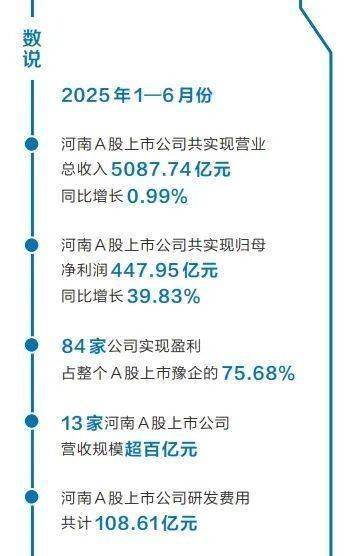
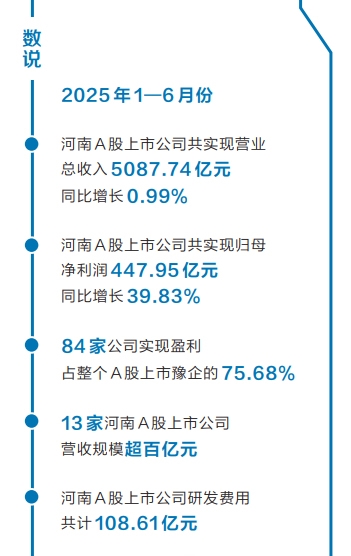
Core Insights - The performance of A-share listed companies in Henan for the first half of 2025 shows resilience and growth, with nearly 80% achieving profitability and overall revenue and net profit reaching new highs [1][8] - Traditional industries are enhancing quality and efficiency, exemplified by Muyuan Foods, which reported a revenue of 764.63 billion yuan, a 34.46% increase year-on-year, and a net profit of 105.30 billion yuan, up 1169.77% [2][3] - The green economy is gaining momentum, with significant growth in sales revenue for ecological protection and environmental governance industries, increasing by 16.1% and 21.9% respectively [8][9] Traditional Industries - Muyuan Foods has transformed the pig farming industry through technology, achieving record revenue and profit levels [2][3] - Yutong Bus has expanded its international presence, with a revenue of 161.29 billion yuan and a net profit of 19.36 billion yuan, marking a 15.64% increase [3][5] - Luoyang Molybdenum's net profit reached 86.71 billion yuan, a 60.07% increase, driven by the completion of major projects [5] Green Industries - Jin Dan Technology is focusing on the circular economy, reporting a revenue of 7.77 billion yuan, a 5.43% increase, and a net profit of 0.96 billion yuan, up 56.31% [7] - The sales revenue of the green industry in Henan has shown robust growth, with wind power and biomass energy sales increasing by 16.5% and 19.1% respectively [8][9] New Quality Industries - Zhongchuang Zhiling reported a revenue of 199.82 billion yuan, a 5.42% increase, and a net profit of 25.15 billion yuan, up 16.36% [10] - The company is investing in AI chip technology to enhance its industrial capabilities [10][12] - R&D expenditures among Henan A-share companies totaled 108.61 billion yuan, with Muyuan Foods leading at 9.21 billion yuan [12] Mergers and Acquisitions - The Henan government has introduced policies to support mergers and acquisitions, aiming to enhance the competitiveness of traditional industries and foster new sectors [13][16] - The Henan Securities Regulatory Bureau has been actively engaging with companies to address operational challenges and promote high-quality development [15][16]

上合组织前秘书长:多元合作为区域发展注入新动能|全球财经连线
2 1 Shi Ji Jing Ji Bao Dao· 2025-09-01 23:47
(原标题:上合组织前秘书长:多元合作为区域发展注入新动能|全球财经连线) 南方财经记者 施诗 天津报道 发表《天津宣言》,制定上合组织未来10年发展战略,做出成立上合组织开发银行的政治决定,设立六 个务实合作平台,发表关于促进能源可持续发展、绿色产业、数字经济、人工智能、科技创新合作5份 声明,发表关于支持多边贸易体制的声明,推动上合组织改革实现新的突破......海河之滨,2025年上海 合作组织(上合组织)天津峰会成果丰硕。 当前,百年变局加速演进,世界面临贸易摩擦、地缘政治、战略竞争多重挑战。在此背景下,作为世界 上幅员最广、人口最多的区域合作组织,上合组织的发展备受关注。 上海合作组织前秘书长弗拉基米尔·诺罗夫在接受南方财经记者独家专访时表示,《天津宣言》的发表 将对上合组织成员国产生直接且深远的影响。上合组织的未来前景十分光明,并已深度融入多极化世界 的架构之中。 他强调,随着各成员国进一步系统化推进可持续发展议程,上合组织将进一步巩固其作为欧亚地区负责 任增长中心的地位。 诺罗夫曾于2006年6月至2010年12月、2022年1月至2022年12月两次出任乌兹别克斯坦外交部长,并于 2019年至2 ...
透视豫股“中考成绩单”
He Nan Ri Bao· 2025-09-01 23:33
Group 1: Performance of Henan A-Share Listed Companies - In the first half of 2025, 111 Henan A-share listed companies reported that nearly 80% achieved profitability, with overall revenue and net profit reaching new highs [2] - The number of companies with revenue exceeding 10 billion yuan increased to 13, indicating strong growth in the region [2] - Among these, Muyuan Foods achieved a revenue of 76.463 billion yuan, a year-on-year increase of 34.46%, and a net profit of 10.53 billion yuan, up 1169.77% [4] Group 2: Innovations in Traditional Industries - Muyuan Foods has transformed traditional pig farming through technology, leading to significant improvements in efficiency and productivity [4] - The company has developed smart pig farming facilities that maintain optimal conditions for pig health, contributing to its market leadership [4] - Other companies in Henan are also focusing on enhancing traditional industries, gaining attention from capital markets [4] Group 3: Growth in Green Industries - The green industry in Henan has seen significant growth, with sales revenue in ecological protection and environmental governance increasing by 16.1% [11] - The sales revenue of the energy-saving and environmental protection industry grew by 21.9%, indicating a shift towards sustainable practices [11] - Jin Dan Technology is leveraging modern biotechnology to convert corn into high-value biodegradable materials, showcasing innovation in the green sector [8][10] Group 4: New Quality Industries - Companies like Zhongchuang Zhiling are advancing in new quality industries, with a revenue of 19.982 billion yuan, a year-on-year increase of 5.42% [12] - The company is investing in AI chip technology to enhance its capabilities in smart mining and digital factories [12] - The focus on R&D is evident, with Henan A-share companies collectively spending 10.861 billion yuan on research and development in the first half of 2025 [13] Group 5: Mergers and Acquisitions Policy - The Henan provincial government has introduced policies to support mergers and acquisitions among listed companies, aiming to optimize resource allocation and promote high-quality development [14] - This initiative is expected to facilitate the transformation and upgrading of traditional industries while fostering the growth of emerging sectors [14] - The emphasis on mergers and acquisitions aligns with the strategic goals of economic transformation in Henan [14]


首页透视豫股“中考成绩单”
He Nan Ri Bao· 2025-09-01 22:50
Core Viewpoint - The performance of A-share listed companies in Henan province for the first half of 2025 shows resilience and growth, with nearly 80% achieving profitability and record high revenue and net profit levels [8][9]. Group 1: Traditional Industries - Muyuan Foods has transformed traditional pig farming through technology, achieving a revenue of 76.463 billion yuan, a year-on-year increase of 34.46%, and a net profit of 10.53 billion yuan, up 1169.77% [10]. - The company’s growth is attributed to increased pig sales and reduced breeding costs, positioning it favorably in the market after the elimination of inefficient production capacity [10]. - Other leading companies in Henan, such as Shuanghui Development and Yuguang Gold Lead, also reported strong revenue figures, reinforcing the stability of the local economy [12]. Group 2: Green Industries - JinDan Technology is focusing on the circular economy by converting corn starch into biodegradable materials, achieving a revenue of 0.777 billion yuan, a 5.43% increase, and a net profit of 0.096 billion yuan, up 56.31% [13][14]. - The green industry in Henan is experiencing significant growth, with sales in ecological protection and environmental governance increasing by 16.1% and in energy-saving and environmental protection by 21.9% [15]. - Companies like Jinguang Electric and Chengfa Environment are also seeing revenue growth due to their focus on new energy products and innovative business models [15]. Group 3: New Quality Industries - Zhongchuang Zhiling reported a total revenue of 19.982 billion yuan, a 5.42% increase, and a net profit of 2.515 billion yuan, up 16.36% [16]. - The company is investing in AI and digital systems to enhance its operations, indicating a shift towards high-quality production and innovation [16][17]. - R&D investment among Henan A-share companies reached 10.861 billion yuan, with Muyuan Foods leading at 0.921 billion yuan [17]. Group 4: Mergers and Acquisitions - The Henan provincial government has introduced policies to support mergers and acquisitions, aiming to enhance the quality and innovation capabilities of listed companies [18]. - This strategy is expected to facilitate the transformation and sustainable development of enterprises, aligning with the province's economic goals [18]. Group 5: Overall Economic Outlook - The performance of Henan A-share companies reflects a transition from manufacturing to intelligent manufacturing and from homogeneous to differentiated products, indicating a proactive approach to innovation [19].
央地协同发力稳就业 增量举措加速出台落实
Shang Hai Zheng Quan Bao· 2025-09-01 19:06
Group 1 - The central government has implemented a series of fiscal, monetary, and industrial policies aimed at stabilizing employment, which has shown foundational and critical effects in promoting job stability [2][3] - In the first half of the year, 6.95 million new urban jobs were created, achieving 58% of the annual target, supported by measures such as increased unemployment insurance and social insurance subsidies [4][5] - The State Council has issued a notice with 19 policy measures to further enhance employment support, focusing on increasing unemployment insurance returns, deferring social insurance payments, and strengthening skills training [4][5] Group 2 - Local governments have accelerated the implementation of employment stabilization measures, with specific plans in cities like Beijing and Guizhou to create new job opportunities in emerging sectors [6] - Experts predict that the employment situation is likely to improve further due to ongoing economic recovery and the release of policy effectiveness, particularly in the service and manufacturing sectors [6] - There is a call for increased investment in education and training to address structural employment issues and support high-quality employment in the future [7]
研发突破产业链升级促发展 严牌股份上半年营收增长19.77%
Quan Jing Wang· 2025-08-27 09:08
Core Viewpoint - The company, Yanpai Co., Ltd., reported a revenue of 429 million yuan for the first half of 2025, marking a year-on-year growth of 19.77%, driven by strong market demand for its non-woven and woven product series [1] Group 1: Financial Performance - The company achieved a net profit attributable to shareholders of 21.52 million yuan and a net profit of 17.92 million yuan after deducting non-recurring gains and losses [1] - The revenue from non-woven and woven series reached 210 million yuan and 160 million yuan, with year-on-year growth rates of 12.88% and 15.44% respectively [1] - The gross profit margins for these segments were reported at 21.60% and 29.99% [1] Group 2: Industry Context - The global filtration materials industry is entering a new growth cycle, driven by tightening environmental regulations, industrial upgrades, and increasing public health awareness [2] - The global filtration materials market is expected to exceed 100 billion USD by 2025, with a compound annual growth rate (CAGR) of over 6% [2] - China currently accounts for over 40% of the global filtration materials production, but there is significant room for domestic products to replace imports [2] Group 3: Competitive Strategy - The company maintains a high level of R&D investment, with 15.79 million yuan allocated in the first half of 2025, representing over 4% of its revenue from 2022 to 2024 [3] - Yanpai Co., Ltd. has been recognized as a national high-tech enterprise and a "specialized and innovative" small giant, enabling it to meet diverse customer needs effectively [3] - The company employs a "production cost + reasonable profit" pricing model to enhance market competitiveness while maintaining cost advantages [4] Group 4: Global Expansion and M&A - The company has established a multi-regional overseas layout, with 155 million yuan in overseas revenue in the first half of 2025, reflecting a year-on-year growth of 14.45% [5] - Yanpai Co., Ltd. announced plans to acquire Technische Textilien Lörrach GmbH & Co. KG (TTL), enhancing its capabilities in the laundry textile sector and expanding its global market presence [6] - The acquisition will allow the company to leverage TTL's established customer relationships and regional expertise to enhance service delivery in Europe and North America [6] Group 5: Supply Chain and Production Capacity - The company is focused on extending its supply chain by establishing subsidiaries for raw material R&D and production, which will stabilize supply and reduce production costs [7] - Recent strategic investments include entering the synthetic leather sector and expanding into consumer-grade filtration and high-permeability materials [7] - The company raised 468 million yuan through convertible bonds to fund high-performance filtration material projects, expected to enhance production capacity and product diversity by the end of 2026 [8]
专访渣打新加坡及东盟CEO李福祐:中国对东盟投资聚焦创新产业
2 1 Shi Ji Jing Ji Bao Dao· 2025-08-26 23:44
Core Insights - The economic cooperation between China and ASEAN has become increasingly active, with China's imports and exports to ASEAN reaching 3.67 trillion yuan in the first half of the year, a year-on-year increase of 9.6%, surpassing the overall growth rate of China's goods trade [1] - The completion of the China-ASEAN Free Trade Area 3.0 negotiations is expected to lower the entry barriers for Chinese companies into the ASEAN market, enhance connectivity, and reduce operational costs, ultimately establishing a more resilient regional supply chain [1][2] Economic Cooperation - The China-ASEAN Free Trade Area 3.0 significantly expands the original framework by adding nine new chapters, including digital economy, green economy, and supply chain connectivity, which will facilitate deeper regional cooperation [2] - The completion of the negotiations sends a clear signal of deepening regional cooperation and strengthening connectivity amid rising global protectionism [2] Investment Trends - ASEAN has become a preferred destination for Chinese foreign direct investment (ODI), with a projected growth of 12.6% in 2024 [4] - The region's appeal lies in its proximity to China, lower operational costs, and a young population, providing a substantial consumer market [5] - Chinese investment in ASEAN is transitioning from infrastructure to innovation, with a focus on technology, consumer goods, clean energy, and digital services [5] Financial Needs and Challenges - Chinese companies expanding into ASEAN have evolving financial needs, including understanding local business environments, liquidity management, and risk hedging [8] - Different stages of development present unique challenges, from understanding legal and tax frameworks to maximizing capital efficiency during the investment phase [8] Digital Economy Development - ASEAN's digital economy is projected to reach $1 trillion by 2030, with potential to double if the ASEAN Digital Framework Agreement is successfully implemented [11] - Standard Chartered Bank aims to be a key partner in ASEAN's digital transformation, leveraging its global network and expertise [12] Currency Usage - The use of the renminbi in ASEAN has shown strong growth, with cross-border renminbi settlement volume expected to increase by 35% in 2024 [14] - The establishment of local currency settlement frameworks and the integration of local banks into the renminbi cross-border payment system are enhancing transaction efficiency [15]