
云计算

Search documents
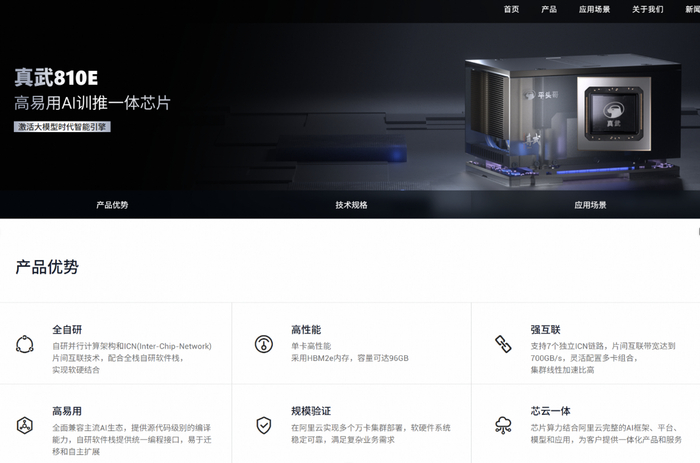
阿里平哥头自研AI芯片“真武”正式上线
Xin Lang Cai Jing· 2026-01-29 02:13
Core Viewpoint - Alibaba's chip design unit, Pingtouge, has launched a high-end AI chip named "Zhenwu 810E" following reports of its potential IPO, indicating significant progress in external market penetration and product development [1][2]. Group 1: Product Launch and Features - The "Zhenwu" PPU has been deployed in multiple clusters on Alibaba Cloud, serving over 400 clients including State Grid, Chinese Academy of Sciences, Xiaopeng Motors, and Sina Weibo [1]. - The PPU features a self-developed parallel computing architecture and inter-chip communication technology, with a memory of 96G HBM2e and an inter-chip bandwidth of 700 GB/s, suitable for AI training, inference, and autonomous driving [1]. - The overall performance of the "Zhenwu" PPU surpasses Nvidia's A800 and mainstream domestic GPUs, and is comparable to Nvidia's H20, with an upgraded version reportedly outperforming Nvidia's A100 [2]. Group 2: Strategic Integration and Market Position - Alibaba is integrating its AI, cloud computing, and chip technologies through a collaboration known as "Tongyun Ge," which includes Tongyi Lab, Alibaba Cloud, and Pingtouge, allowing for focused hardware development and optimized AI frameworks [2]. - The company aims to establish "Tongyun Ge" as an AI supercomputer, leveraging its self-developed chips, leading cloud services, and open-source models to achieve maximum efficiency in training and deploying large models [2]. - Alibaba and Google are currently the only two global tech companies with competitive capabilities across large models, cloud, and chip sectors [4].


东田微优化产品结构 2025年归母净利润预增超七成
Chang Jiang Shang Bao· 2026-01-29 01:50
Core Viewpoint - Dongtian Micro (301183.SZ) expects a significant increase in net profit for 2025, projecting between 96 million to 110 million yuan, representing a year-on-year growth of 71.98% to 97.06% compared to 55.82 million yuan in 2024 [1] Group 1: Company Performance - In the first three quarters of 2025, Dongtian Micro reported revenue of 637 million yuan, a year-on-year increase of 53.91%, and a net profit of 80.03 million yuan, up 99.2% [1] - The company attributes its performance growth to optimizing product structure, expanding market reach, and improving capacity utilization [2] Group 2: Growth Drivers - The growth in imaging optical business is driven by increased penetration of spin-coated optical filters in domestic smartphone brands, leading to a significant rise in product shipments [2] - The communication optical business is experiencing rapid growth due to rising demand for AI computing power, significantly boosting sales of high-speed optical components like WDM filters and optical isolators [2] - Other revenue streams include increased shipments of coating materials and molds for aspherical products, driven by higher customer demand [2] Group 3: Market Outlook - Dongtian Micro focuses on the research and manufacturing of precision optical components, with imaging optical components being the cornerstone of its business [2] - The rapid development of technologies such as artificial intelligence, big data, and cloud computing is driving the ongoing upgrade and expansion of data center infrastructure globally, creating long-term market demand for high-speed optical modules and their upstream core optical components [2]

未知机构:光连接专家交流CPONPOLPOAOC技术进展客户订单价值量及拆分供应商-20260129
未知机构· 2026-01-29 01:50
Summary of Conference Call on Optical Interconnect Technologies Industry Overview - The discussion focused on optical interconnect technologies, specifically AOC (Active Optical Cable), LPO (Linear Passive Optical), NPO (New Passive Optical), and CPO (Coherent Passive Optical) [1][2][17]. Key Points and Arguments AOC Technology - AOC is defined as a fixed optical fiber module suitable for short-distance multimode transmission, particularly within 50 meters, as used by Google [2][19]. - AOC's cost structure was analyzed, with 800G AOC priced over a thousand dollars and 400G AOC costing several hundred dollars [2][19]. - AOC is expected to support 1.6T transmission capabilities in the future, although current limitations exist [20]. LPO Technology - LPO modules differ from traditional optical modules by omitting DSP (Digital Signal Processor), utilizing linear drive technology, and achieving a transmission distance of up to 500 meters [4][19]. - LPO is projected to see shipments of three to four million units in 2023, potentially doubling by 2027 due to demand from major clients like Google, Microsoft, and Meta [5][19]. - The combination of AOC and LPO is anticipated for different application scenarios, with AOC for short-distance interconnects and LPO for longer distances [19]. NPO Technology - NPO optical engines are compact, low-power, and do not require an external shell, making them suitable for high-density applications like AI accelerators [7][10]. - NPO technology is expected to mature and be sold to cloud providers and equipment manufacturers, with significant market potential [9][23]. - The cost of NPO components, such as the optical engine, is estimated to be around $35 to $40 per unit [26]. Market Dynamics - The market for 800G optical modules is currently in mass production, while 1.6T modules are still in early development, expected to mature in two to three years [5][6][22]. - The supplier landscape is concentrated, with limited opportunities for new entrants, particularly in the TIA (Transimpedance Amplifier) and driver chip sectors dominated by companies like Marvell [6][22]. Technical Challenges - The discussion highlighted challenges in the 200G optical module market regarding transmission distance and industry maturity [3]. - The transition from NPO to CPO technology was noted as technically feasible but with potential challenges in product form factor [9][23]. Future Trends - The integration of optical communication technologies in data centers is expected to grow, with a focus on reducing costs and power consumption while improving system latency [10][14]. - The potential for NPO to replace existing GB300 systems was discussed, contingent on its maturity and performance improvements [25]. Additional Important Content - The role of silicon photonics in NPO technology was emphasized, with key suppliers identified as Group, Tog, and TSMC [15][28]. - The discussion also touched on the advantages of glass substrates in CPU applications, highlighting their cost-effectiveness compared to ceramic and PCB substrates [27]. - The collaboration between Google and various suppliers for LPO technology was noted, with initial production expected from companies like Xuchuang [28]. This summary encapsulates the critical insights and developments in the optical interconnect technology sector as discussed in the conference call.
A股早评:三大指数涨跌不一,有色金属板块再度大涨
Ge Long Hui· 2026-01-29 01:36
Group 1 - The A-share market opened with mixed performance among the three major indices, with the Shanghai Composite Index rising by 0.11% to 4155.92 points, while the Shenzhen Component Index and the ChiNext Index opened lower by 0.07% and 0.03% respectively [1] - Precious metals, including gold and silver, have reached new highs, leading to significant gains in the precious metals and other non-ferrous metal sectors, with companies like China Gold, Western Gold, and Silver Nonferrous hitting the daily limit [1] - The lithium mining and cloud computing concept stocks experienced adjustments during this trading session [1]
埃克斯云计算(南京)有限公司成立,注册资本200万人民币
Sou Hu Cai Jing· 2026-01-29 01:24
Group 1 - The establishment of Excloud Computing (Nanjing) Co., Ltd. has been registered with a legal representative named Ruan Jun and a registered capital of 2 million RMB [1] - The sole shareholder of Excloud Computing is Nanjing Aiying Digital Technology Co., Ltd., which holds 100% of the shares [2] - The business scope of Excloud Computing includes various services such as software development, artificial intelligence application software development, and cloud computing equipment sales [2] Group 2 - The company is classified under the national standard industry of scientific research and technical service industry, specifically in technology promotion and application service [2] - The registered address of Excloud Computing is located in the Jinzhong Community, Chengqiao Street, Liuhe District, Nanjing [2] - The company is structured as a limited liability company with a natural person investment or holding [2]
韩云霄:激活下沉市场增量蓝海
Jing Ji Ri Bao· 2026-01-29 00:54
前不久召开的全国商务工作会议将"激发下沉市场消费活力"列为"深入实施提振消费专项行动"核心 工作之一。涵盖三线及以下城市、县镇与农村地区的下沉市场,承载着我国70%的人口和60%的社会消 费品零售总额,正成为拉动国内消费增长的新动能。激发下沉市场消费活力,是大力提振消费、建设强 大国内市场的战略举措,对于加快构建新发展格局、推动高质量发展,具有重要战略意义。 深化业态融合,拓展消费空间。加强人工智能、物联网、云计算等技术在下沉市场的创新运用,加 速一二三产业融合。推动农业与旅游、教育、康养等产业深度融合,发展休闲垂钓、研学科普、民宿康 养等休闲农业新业态。深化先进制造业和现代服务业融合发展,加快发展服务型制造,壮大柔性生产、 云制造、共享制造、虚拟制造、工业电商等新业态。推进文化和旅游深度融合发展,持续丰富"非遗 +旅游""演出+旅游"等业态,深化"文旅+百业""百业+文旅",因地制宜发展旅居休闲、避暑避寒等业 态。 近年来,我国下沉市场活力持续迸发,呈现出人口基数大、边际潜力高、结构升级快的显著特征, 拥有超9亿消费者,消费规模稳步扩大,乡村市场增长持续快于城镇,消费结构正从"以基本消费为 主"转向"品质化 ...
微软财报亮眼却遭市场“用脚投票”:云业务增速微降 AI“狂烧钱”吓坏投资者
Jin Rong Jie· 2026-01-29 00:33
Core Viewpoint - Microsoft reported strong financial results for Q2 FY2026, exceeding Wall Street expectations, but concerns over slowing Azure growth and record capital expenditures led to a significant drop in stock price after hours [1][2]. Financial Performance - For the second quarter ending December 31, Microsoft achieved revenue of $81.27 billion, a year-over-year increase of approximately 17%, surpassing the market expectation of $80.3 billion [2]. - Net profit reached $38.46 billion, translating to earnings per share of $5.16, significantly above the expected $3.92 [2]. - Adjusted earnings per share were $4.14, also exceeding forecasts [2]. - A notable portion of the profit increase was attributed to changes in accounting treatment for the investment in OpenAI, contributing an additional $1.02 to earnings per share [2]. Cloud Business Performance - Microsoft's "Intelligent Cloud" segment, including Azure, generated revenue of $32.91 billion, a nearly 29% year-over-year increase, slightly above expectations [3]. - Azure and other cloud services revenue grew by 38% year-over-year at constant currency, matching analyst predictions, but the growth rate slowed by one percentage point compared to the previous quarter [3]. - Despite the overall cloud revenue surpassing $50 billion for the first time at $51.5 billion, the deceleration in Azure's growth raised concerns about the sustainability of AI-driven cloud growth [3]. Capital Expenditures and AI Investment - Capital expenditures surged to $37.5 billion, a 66% year-over-year increase, exceeding analyst expectations of $36.2 billion [4]. - Approximately two-thirds of this expenditure was allocated to computing chips for data centers to meet AI demand [4]. - CEO Satya Nadella noted an increase of nearly 1 gigawatt in computing capacity during the quarter, but the significant investment raised questions about the return on AI investments [4]. - The "remaining performance obligations" (RPO), indicating future revenue from signed contracts, reached a record $625 billion, more than doubling year-over-year, with 45% of this amount linked to agreements with OpenAI [4][5]. Competitive Landscape and Stock Performance - Microsoft is the first among major cloud service companies to report quarterly financial results, serving as a key indicator of the efficiency of AI investments among tech giants [7]. - In contrast to Microsoft's stock decline, Meta's stock rose significantly after announcing increased AI spending, highlighting differing market perceptions of AI strategies [7]. - The emergence of competitors like Google's Gemini model and Anthropic is intensifying pressure on Microsoft's AI and traditional software businesses [7]. - As of the close on Wednesday, Microsoft's stock was priced at $481.63, experiencing a drop of over 7% in after-hours trading, and a decline of approximately 11% over the past three months, underperforming the S&P 500 index, which rose by 1% during the same period [7].

新浪财经资讯AI速递:昨夜今晨财经热点一览 丨2026年1月29日
Xin Lang Cai Jing· 2026-01-28 23:31
Group 1: Federal Reserve and Currency Movements - The Federal Reserve maintained the federal funds rate target range at 3.5% to 3.75%, ending a three-rate cut cycle, with a focus on achieving full employment and a 2% inflation target [1][14] - The Chinese yuan's midpoint exchange rate broke the 7.0 mark against the US dollar for the first time in two and a half years, driven by a weak dollar and seasonal demand for currency settlement [1][15] Group 2: Company Developments and Financial Performance - Huadong Heavy Machinery expects a significant decline in net profit for 2025, projecting a decrease of 39.05% to 59.36% due to the divestment of its profitable CNC machine tool business and losses from its newly acquired chip subsidiary [1][18] - Agricultural University Technology listed on the Beijing Stock Exchange, becoming Shandong's first A-share company of the year, with its stock price surging by 111.56% on the first day despite concerns over its revenue and profit trends [1][20] - Seagate Technology's stock surged over 16% to a record high following a strong earnings report, with significant revenue and earnings per share exceeding market expectations [1][20] - SK Hynix reported a nearly 1.2 times increase in net profit for the previous year, driven by the AI storage market, and expects continued growth in storage demand [1][20] Group 3: Legal and Regulatory Issues - Shenzhen Water Bay Jewelry faced withdrawal difficulties, with thousands of investors unable to cash out, raising concerns about illegal gold betting practices [1][16] - Sunflower's major asset restructuring plan was terminated due to an investigation by the Securities Regulatory Commission, leading to significant losses for investors [1][21] - Dike Co., a leader in photovoltaic silver paste, initiated patent infringement lawsuits against two companies, seeking a total of 4 billion yuan in damages [1][21] Group 4: Market Trends and Consumer Behavior - The price of international spot gold reached a new high, exceeding $5,300 per ounce, prompting major jewelry brands to adapt their business strategies to focus on design and service rather than raw material value [1][23] - The price of Flying Moutai surged to 1,600 yuan per bottle, driven by seasonal demand and supply constraints, leading to a secondary market for reselling [1][24] - Industrial Fulian, an AI giant, projected a significant increase in net profit for 2025, driven by strong growth in cloud computing and AI server revenues [1][25]




美联储暂停降息,黄金冲上5400美元,特斯拉、Meta盘后大涨,马斯克最新表态
21世纪经济报道· 2026-01-28 23:18
Market Overview - The U.S. stock market showed mixed results with the S&P 500 index briefly surpassing 7000 points, while the Dow Jones Industrial Average rose slightly by 0.02% and the Nasdaq increased by 0.17% [1][2] - Storage concept stocks saw significant gains, with Seagate Technology rising over 19% and Intel and Western Digital both increasing by over 10% [3] Company Earnings Reports - Tesla reported an adjusted earnings per share of $0.50 for Q4, exceeding expectations, but its annual revenue declined by 3%, marking the first annual revenue drop in its history. Following the report, Tesla's stock price rose nearly 4% in after-hours trading [2][3] - Meta's Q4 revenue outlook surpassed expectations, leading to a stock price increase of 9.8% in after-hours trading [3] - Microsoft's Q2 revenue was $81.27 billion, slightly above expectations, with significant growth in its cloud computing business, although its stock fell by about 5% after the earnings report [3] Commodity Prices - Gold prices surged, with spot gold reaching $5,422.46 per ounce, reflecting a strong upward trend [5][6] - International oil prices rose collectively, with WTI crude oil increasing nearly 1.8% to $63.50 per barrel and ICE Brent crude oil rising over 1.6% to $67.68 per barrel, reaching the highest levels since September 2025 [5][6] Federal Reserve Decision - The Federal Reserve decided to maintain the federal funds rate target range at 3.5% to 3.75%, halting a series of previous rate cuts. This decision was in line with market expectations, with 10 out of 12 committee members supporting it [10][11]



四川省自贡运输机械集团股份有限公司 2025年度业绩预告
Zheng Quan Ri Bao· 2026-01-28 22:33
Group 1 - The company expects to turn a profit in 2025, with an estimated profit increase of approximately 102.92 million RMB due to an investment partnership [1][2] - The profit forecast data is preliminary and has not been audited, with final figures to be disclosed in the annual report [2] - The investment in Yangzhou Dinglong Qishun Equity Investment Partnership is classified as non-recurring gains [1] Group 2 - The company plans to issue A-shares to specific investors, with a total fundraising target of up to 787.68 million RMB [5] - The issuance is expected to dilute immediate returns, and the company has outlined measures to mitigate this risk [9][15] - The company has established a governance structure to ensure shareholder rights and protect minority investors [19][21] Group 3 - The fundraising will support projects aligned with national industrial policies, enhancing the company's competitive edge in the market [9] - The company has a strong talent pool and technical reserves, with a focus on innovation and development in the conveyor machinery sector [10][11] - The company has established a significant market presence both domestically and internationally, with products used in various industries [13][14] Group 4 - The company has committed to accelerating project construction to realize expected benefits quickly [15] - A robust management system for fundraising will be implemented to ensure efficient use of raised capital [16] - The company will adhere to a profit distribution policy to safeguard investor interests [19]