智能座舱

Search documents
特斯拉与火山引擎达成合作,全新Model Y L车型接入豆包大模型
Xin Lang Ke Ji· 2025-08-22 07:08
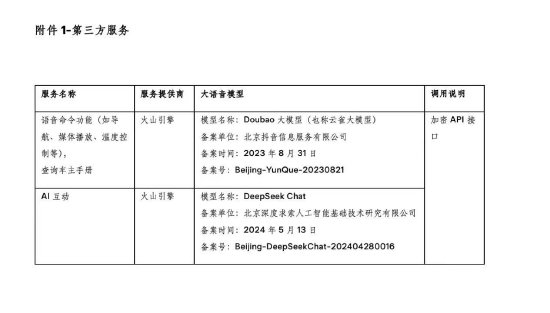
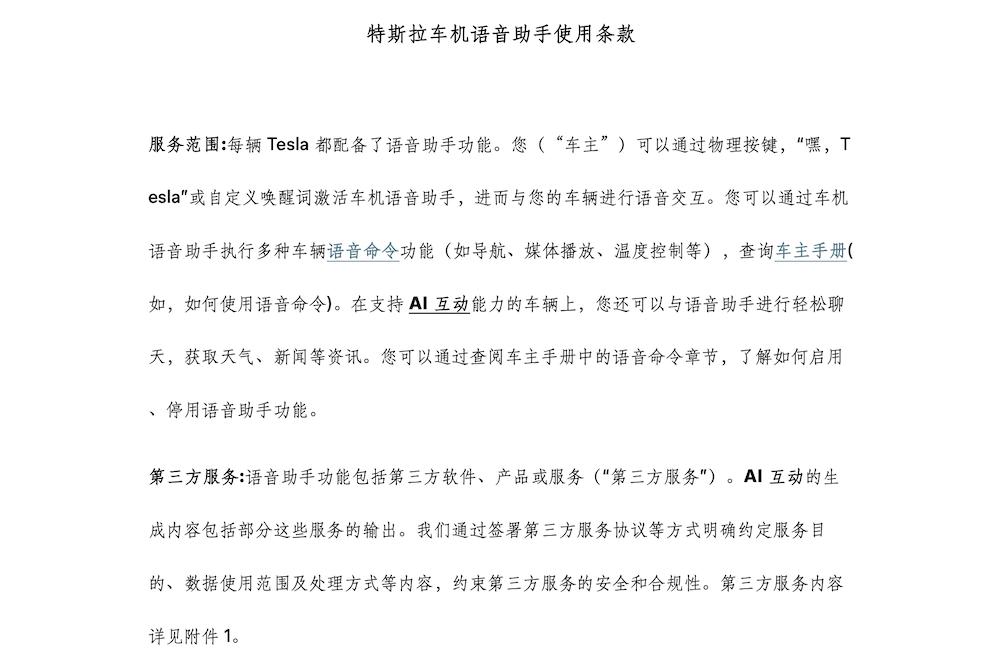
新浪科技讯 8月22日下午消息,特斯拉与火山引擎已于近日达成合作,在国内火山引擎将为特斯拉提供 大模型服务,助力特斯拉智能座舱交互体验升级。 根据特斯拉中国官网近期更新的《特斯拉车机语音助手使用条款》,全新上市的特斯拉Model Y L车型 将搭载豆包大模型与DeepSeek模型,两款模型均通过火山引擎接入。其中,豆包大模型将承担语音命 令功能,如导航设定、媒体播放操控、空调温度调节等,同时还具备车主手册查询功能;DeepSeek模 型则提供AI语音闲聊服务 。 此次,特斯拉通过火山引擎接入大模型服务,意味着未来在国内具备AI互动能力的特斯拉车辆上,用 户能够通过语音命令控制车辆功能以及进行人车互动,实现更好的智能座舱交互体验。(罗宁) | 服务名称 | 服务提供商 | 大语音模型 | 调用说明 | | --- | --- | --- | --- | | 语音命令功能(如导 | 大山引學 | 模型名称:Doubao 大模型(包称云盆大模型) | 加密 API 接 | | 新,媒体播放,温度控 | | 备案单位:北京抖音信息服务有限公司 | ロ | | 制等), | | 备案时间:2023年8月31日 | | ...


特斯拉终于用上了国产大模型,豆包和DeepSeek上车,但比中国车企晚了半年
3 6 Ke· 2025-08-22 06:56
Core Viewpoint - Tesla is integrating advanced AI models, Doubao and DeepSeek Chat, into its vehicle voice assistant system to enhance its smart cabin capabilities and address previous criticisms regarding its voice interaction performance [1][5][25]. Group 1: AI Integration - Tesla has announced the integration of Doubao (also known as Yunqiao) and DeepSeek Chat models into its voice assistant, although the specific launch date remains unclear [1][3]. - The voice assistant will allow Tesla owners to execute various commands such as navigation, media playback, and temperature control, as well as engage in AI interactions for information like weather and news [4][10]. Group 2: Previous Criticisms - Tesla's voice assistant has faced criticism for being "not intelligent," with users describing it as "artificially disabled" compared to competitors [5][10]. - The voice recognition accuracy for Tesla's 2025 Model Y is reported at 92%, but drops to 85% in noisy environments, highlighting its limitations in natural language understanding and continuous dialogue capabilities [11][12]. Group 3: Competitive Landscape - Compared to domestic competitors, Tesla's voice assistant lacks a rich application ecosystem and seamless integration with mobile devices, which has been a significant area of improvement for other brands [13][15]. - Competitors like Xiaopeng and Huawei have developed more advanced systems that support multi-turn conversations and extensive third-party application integration, putting pressure on Tesla to enhance its smart cabin features [12][15]. Group 4: Global AI Model Deployment - Tesla's AI model Grok has been deployed in the U.S. but is limited to certain models and does not allow for vehicle control commands [16][18]. - Recent reports indicate a significant privacy breach involving Grok, with over 370,000 user chat records exposed, raising concerns about data security [21][24]. Group 5: Strategic Implications - The introduction of DeepSeek Chat and Doubao models is seen as a strategic move by Tesla to better align with the Chinese market's demands and improve its competitive position in the smart cabin sector [25].

极米科技涨2.01%,成交额1.35亿元,主力资金净流入399.18万元
Xin Lang Cai Jing· 2025-08-22 04:39
Group 1 - The core viewpoint of the news is that XGIMI Technology has shown a positive stock performance with a 25.28% increase year-to-date and a recent rise in trading volume and market capitalization [1] - As of August 22, XGIMI's stock price reached 122.80 CNY per share, with a total market capitalization of 8.596 billion CNY [1] - The company has seen significant trading activity, with a net inflow of 3.9918 million CNY from main funds and a notable increase in large orders [1] Group 2 - For the period ending March 31, XGIMI reported a revenue of 810 million CNY, reflecting a year-on-year decrease of 1.89% [2] - The number of shareholders decreased by 5.91% to 5,895, while the average circulating shares per person increased by 6.28% to 11,874 shares [2] - XGIMI has distributed a total of 400 million CNY in dividends since its A-share listing, with 170 million CNY distributed over the past three years [2]

尚界H5放出白车身官图:九横五纵结构,高强钢及铝合金占比超88%
Feng Huang Wang· 2025-08-22 03:27
Core Viewpoint - The article highlights the introduction of the Shangjie H5, a new vehicle developed by Huawei in collaboration with SAIC, emphasizing its robust body structure and advanced safety features. Group 1: Vehicle Structure and Safety Features - The Shangjie H5 features a "steel fortress" body structure with a nine-horizontal and five-vertical design, utilizing over 88% high-strength steel and aluminum alloy [1] - The vehicle includes ultra-wide front and rear anti-collision beams, with coverage ratios of 74.8% and 73.6% respectively, enhancing protection against collisions [1] - The side protection is reinforced with a 4.5mm thick aluminum alloy threshold, further improving safety [1] Group 2: Product Launch and Specifications - Pre-orders for the Shangjie H5 will begin on August 25, with an official market launch scheduled for September [1] - The vehicle will be available in both pure electric and range-extended versions, targeting a price range of 150,000 to 250,000 yuan [1] - The Shangjie H5 is based on the SAIC Roewe ES39 model and will feature Huawei's intelligent cockpit and driving systems [1]

聚辰股份涨2.05%,成交额2.77亿元,主力资金净流入218.87万元
Xin Lang Cai Jing· 2025-08-22 03:11
Company Overview - Jucheng Semiconductor Co., Ltd. is located at 1761 Zhangdong Road, Pudong New District, Shanghai, established on November 13, 2009, and listed on December 23, 2019 [1] - The company specializes in the research, design, and sales of integrated circuit products [1] Stock Performance - As of August 22, Jucheng's stock price increased by 2.05%, reaching 81.95 CNY per share, with a trading volume of 277 million CNY and a turnover rate of 2.16%, resulting in a total market capitalization of 12.958 billion CNY [1] - Year-to-date, Jucheng's stock price has risen by 40.76%, with a 6.29% increase over the last five trading days, 8.57% over the last 20 days, and 12.71% over the last 60 days [1] Financial Performance - For the period from January to March 2025, Jucheng achieved a revenue of 261 million CNY, representing a year-on-year growth of 5.60% [2] - The company has distributed a total of 299 million CNY in dividends since its A-share listing, with 186 million CNY distributed over the past three years [2] Shareholder Information - As of March 31, 2025, Jucheng had 11,300 shareholders, a decrease of 14.15% from the previous period, with an average of 13,968 circulating shares per shareholder, an increase of 16.77% [2] - Among the top ten circulating shareholders, Hong Kong Central Clearing Limited is the fourth largest, holding 5.5366 million shares, an increase of 373,200 shares from the previous period [2] Industry Classification - Jucheng is classified under the Shenwan industry as Electronics - Semiconductors - Digital Chip Design, and is associated with concepts such as smart cockpits, electronic cigarettes, wireless earphones, storage concepts, and Xiaomi concepts [1]

翰博高新2025年中报:营收净利润双增长超50%,全球化产能布局加速落地
Sou Hu Wang· 2025-08-22 01:34
Core Insights - The company reported a significant increase in revenue and profit for the first half of 2025, with operating income reaching 1.554 billion yuan, a year-on-year growth of 50.84%, and net profit attributable to shareholders increasing by 59.91% [1] - The company specializes in providing one-stop solutions for semiconductor display panel backlight modules and key components, with products applicable in various fields including laptops, tablets, automotive displays, and VR [1] - The company's strong performance is attributed to years of solid technical accumulation and continuous innovation, focusing on balancing optical performance and cost-effectiveness [1] Business Performance - The company achieved a remarkable growth in cash flow from operating activities, which surged by 165.54% year-on-year [1] - The automotive backlight display module sector has become a key growth driver, with successful development of various high-end products and stable partnerships with major automotive manufacturers [2] - The company has entered the supply chains of notable firms such as BOE and CSOT, and has established collaborations with numerous automotive brands including NIO, Chery, and Ford [2] Technological Advancements - The company is actively engaged in the development of smart cockpit solutions, showcasing a dual-driven model of "full-chain technology independence + mass production experience feedback" [2] - It has made significant breakthroughs in the fields of automotive TLCM, Mini-LED, and large-size displays, securing project allocations from several major automotive manufacturers [3] - The company is expanding its manufacturing capabilities with bases in multiple cities and is accelerating the establishment of manufacturing bases in Southeast Asia to enhance global operational efficiency [3] Market Position - The company is reinforcing its leading position in the global backlight display module market through continuous technological innovation and capacity expansion [3] - Future growth potential in the semiconductor display sector is anticipated as the company embarks on a new growth cycle [3]
斑马原CFO公开吐槽老东家上市圈钱:离开是不看好业务;传阴阳师事业部负责人金韬已离职创业;极氪优化直营体系,转手部分门店
雷峰网· 2025-08-22 00:35
Key Points - The article discusses various developments in the tech and automotive industries, highlighting significant corporate actions, product launches, and market strategies. Group 1: Corporate Developments - Former CFO of Zhibo Network publicly criticized the company's upcoming IPO, stating that he left due to a lack of confidence in the business and accused certain executives of being opportunistic [4][6]. - Alibaba announced the spin-off of Zhibo Network for an independent listing on the Hong Kong Stock Exchange, with plans to retain over 30% ownership post-IPO [6]. - Alibaba's Lingxi Entertainment has shifted its reporting structure to report directly to CFO Xu Hong, indicating potential changes in business strategy [12][13]. Group 2: Product Launches and Innovations - NIO unveiled the new ES8 model, with a starting pre-sale price of 416,800 yuan, featuring significant upgrades in size and technology [19]. - Vivo introduced the Vision Exploration Edition, the lightest MR headset in the industry, weighing only 398g, designed for enhanced user experience [30]. - DeepSeek released version 3.1, which includes significant upgrades and price adjustments for its API services, reflecting a shift towards next-generation domestic chips [11]. Group 3: Market Strategies - Alibaba's local services division is launching a new group-buying feature called "Flash Group," aimed at price-sensitive consumers, to compete with Meituan's similar offerings [18]. - Multiple ride-hailing platforms, including Didi and T3, have announced reductions in commission rates to support driver income and expand platform capacity [24][25]. - Zero Run Auto reported a cumulative delivery of over 900,000 vehicles, achieving profitability in the first half of the year and adjusting its annual sales target upwards [26][27]. Group 4: Financial Performance - Kuaishou reported a revenue of 35.05 billion yuan for Q2 2025, with a net profit increase of 20.1%, and announced a special dividend for shareholders [39]. - Bilibili's Q2 revenue reached 7.34 billion yuan, with significant growth in advertising and gaming revenue, and a record high in user engagement metrics [40]. Group 5: Competitive Landscape - Samsung's HBM4 samples have passed initial testing with Nvidia and are set to enter pre-production, potentially challenging SK Hynix's dominance in the AI memory chip market [44][45]. - Intel is negotiating with large investors to replicate a previous financing deal with SoftBank, aiming to bolster its capital structure [46]. Group 6: Privacy and Regulatory Issues - Meta is facing allegations of circumventing Apple's privacy restrictions to enhance ad revenue, with claims of misleading advertisers about the performance of its Shop Ads [51][52]. - xAI's Grok platform experienced a significant privacy breach, exposing over 370,000 user chat records due to design flaws in its sharing functionality [46][47].





【机构调研记录】诺安基金调研正海磁材、生益电子等4只个股(附名单)
Zheng Quan Zhi Xing· 2025-08-22 00:12
Group 1: Zhenghai Magnetic Materials (正海磁材) - In the first half of 2025, Zhenghai Magnetic Materials achieved total revenue of 3.057 billion yuan, a year-on-year increase of 20.42%, but net profit decreased by 24.39% [1] - The company experienced improved operational efficiency in Q1, but faced profit pressure in Q2 due to changes in the international economic environment and intensified domestic market competition [1] - Product shipments increased by over 20% year-on-year, with shipments in the energy-saving and new energy vehicle markets growing by over 30% [1] Group 2: Shengyi Electronics (生益电子) - Shengyi Electronics reported a 91.00% increase in revenue and a 452.11% increase in net profit for the first half of 2025, driven by optimized product structure and a higher proportion of high-value-added products [2] - The company is focusing on the 800G high-speed switch market in telecommunications and enhancing its presence in the automotive electronics sector [2] - The Thai production base project is progressing steadily, having received investment incentives, and the smart computing center's first phase has begun trial production [2] Group 3: Desay SV (德赛西威) - Desay SV achieved revenue of 14.644 billion yuan in the first half of 2025, a year-on-year increase of 25.25%, with net profit rising by 45.82% [3] - The company has established overseas branches and commenced production in factories located in Indonesia and Mexico, with a smart factory in Spain expected to start mass production in 2026 [3] - The smart driving business generated revenue of 4.147 billion yuan, reflecting a year-on-year growth of 55.49%, while the smart cockpit business saw sales of 9.459 billion yuan, up 18.76% [3] Group 4: Livzon Pharmaceutical Group (丽珠集团) - Livzon Pharmaceutical Group anticipates single-digit revenue growth for the year, with profit growth expected to outpace revenue growth [4] - The company has submitted a listing application for P-CAB tablets and expects approval for injection products in the first half of 2029 [4] - The market potential for microsphere products is significant, with ongoing development in long-acting microsphere formulations and psychiatric products [4]


【私募调研记录】中睿合银调研德赛西威
Zheng Quan Zhi Xing· 2025-08-22 00:10
Group 1 - The core viewpoint of the news highlights the recent research conducted by Zhongrui Heyin on Desay SV, showcasing significant growth in revenue and profit for the first half of 2025 [1] - Desay SV achieved operating revenue of 14.644 billion yuan, representing a year-on-year increase of 25.25%, and a net profit of 1.223 billion yuan, with a year-on-year growth of 45.82% [1] - The company has secured new project orders with an annual sales volume exceeding 18 billion yuan, indicating strong demand for its products [1] Group 2 - Desay SV has established overseas branches in multiple countries, with factories in Indonesia and Mexico already in operation, and a smart factory in Spain set to commence mass production in 2026 [1] - The smart driving business generated revenue of 4.147 billion yuan, reflecting a year-on-year increase of 55.49%, and the company holds the top market share in domestic auxiliary driving domain controllers [1] - The smart cockpit business reported sales of 9.459 billion yuan, with an 18.76% year-on-year growth, and the fourth-generation smart cockpit has entered mass production while the fifth-generation platform has received new project orders [1] Group 3 - The company emphasizes research and development in technology, expanding its smart computing center, and has validated its integrated cockpit and driving solutions through real vehicle testing [1] - Desay SV is actively positioning itself in emerging fields, indicating a forward-looking strategy in technology and product development [1]
阿里巴巴分拆斑马智行赴港上市,上汽为重要股东,一季度亏损扩大
Sou Hu Cai Jing· 2025-08-21 22:17
Core Viewpoint - Alibaba Group plans to spin off its smart car business, Zhaoma Network Technology Co., Ltd. (Zhaoma Zhixing), and list it independently on the Hong Kong Stock Exchange, marking a significant step towards capital market engagement [1] Company Overview - Zhaoma Zhixing, previously a subsidiary of Alibaba, will no longer be included in Alibaba's consolidated financial statements starting from the end of 2024. Alibaba currently holds approximately 44.72% of Zhaoma Zhixing's shares and will maintain over 30% ownership post-spin-off [1] - The company focuses on the development of smart cockpit solutions, providing system-level OS solutions, AI end-to-end solutions, and in-car platform services. Established in 2015, it has garnered significant attention from the capital market [1] Financial Performance - Zhaoma Zhixing has shown steady revenue growth but has also faced high losses and comprehensive expenses. Revenue figures for 2022, 2023, and 2024 were 805 million, 872 million, and 824 million RMB respectively, while losses and comprehensive expenses were 878 million, 876 million, and 847 million RMB for the same years [5][8] - In Q1 of this year, the company reported revenue of 136 million RMB but incurred losses and comprehensive expenses amounting to 1.582 billion RMB [5][8] Market Position - According to data from Zhaoma Zhixing's prospectus, it is the largest software-centric smart cockpit solution provider in China based on projected 2024 revenue, and it leads in solution deployment volume [2] - The market for smart cockpit solutions in China is expected to reach 327.4 billion RMB by 2030, with software-based cockpit solutions projected to account for 114.9 billion RMB [2] Growth Metrics - Despite facing losses, Zhaoma Zhixing's market share and deployment volume have been on the rise. The deployment volume of its smart cockpit solutions increased from 835,000 units in 2022 to 2,334,000 units in 2024, reflecting a compound annual growth rate of 67.2% [7] - Revenue from the AI end-to-end solutions segment also grew rapidly, from 16 million RMB in 2022 to 55 million RMB in 2024 [7] IPO Plans - The funds raised from the IPO will primarily be used to enhance R&D investment, increase market share in China, expand globally, support business acquisitions and expansion plans, and supplement working capital [8]