
全国统一大市场建设

Search documents
华创证券张瑜解读政治局会议:等待进一步信息
Xin Lang Cai Jing· 2025-12-08 15:31
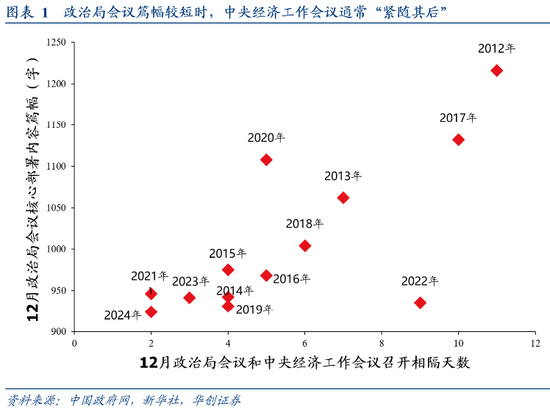
来源:一瑜中的 一、篇幅"短"——篇幅非常短,往往意味着经济工作会议大概率几天内召开 核心内容篇幅极短:本次政治局会议通稿与经济相关的核心内容仅934字,接近历史最低水平(2024年 为924字)。 会议召开的时间预判:根据以往经验,政治局会议先开定调,经济工作会议后开部署。通稿篇幅越短, 通常意味着经济工作会议有可能将在2-4天内召开。 政策细节披露时间:预计更多政策细节将在几天后的经济工作会议通稿中公布(篇幅通常为4000-5000 字)。 信息解读建议:政治局通稿信息颗粒度较粗,属于定调性质,不宜过度解读。 二、"优化供给"——反内卷进入"弱化提法,强化做法"的务实阶段 (一)政策提法变化:本次通稿强调"持续扩大内需、优化供给,做优增量、盘活存量,因地制宜发展 新质生产力,纵深推进全国统一大市场建设"。 (四)政策解读:反内卷未在高层文件中出现,并不代表降温或停止,而是进入具体执行抓手阶段。 三、再提"跨周期"——超常规政策不能常态化存在 (一)"跨周期"提法回归:通稿提出"明年经济工作要坚持稳中求进、提质增效,继续实施更加积极的 财政政策和适度宽松的货币政策,发挥存量政策和增量政策集成效应,加大逆周期 ...

张瑜:等待进一步信息——政治局会议极简学习
一瑜中的· 2025-12-08 15:14
文 : 华创证券研究所副所长 、首席宏观分析师 张瑜(执业证号:S0360518090001) 报告正文 一、 篇幅"短"——篇幅非常短,往往意味着经济工作会议大概率几天内召开 核心内容篇幅极短: 本次政治局会议通稿与经济相关的核心内容仅 934 字,接近历史最低水平( 2024 年为 924 字)。 会议召开的时间预判 :根据以往经验,政治局会议先开定调,经济工作会议后开部署。通稿篇幅越短,通常意味着经 济工作会议有可能将在 2-4 天内召开。 政策细节披露时间 :预计更多政策细节将在几天后的经济工作会议通稿中公布(篇幅通常为 4000-5000 字)。 信息解读建议: 政治局通稿信息颗粒度较粗,属于定调性质,不宜过度解读。 二、 "优化供给"——反内卷进入"弱化提法,强化做法"的务实阶段 (一)政策提法变化: 本次通稿强调"持续扩大内需、优化供给,做优增量、盘活存量,因地制宜发展新质生产力, 纵深推进全国统一大市场建设"。 (二)反内卷进入务实阶段: "优化供给"是大方向,核心之一是"反内卷"。 当前"反内卷"已从强化提法转向强化做法,进入务实阶段。 (三)具体举措: 1 、 统一大市场建设 。 2 、 ...

中央政治局会议释放六大信号
2 1 Shi Ji Jing Ji Bao Dao· 2025-12-08 15:03
Core Viewpoint - The meeting of the Central Political Bureau on December 8 emphasized the need for a stable yet progressive economic strategy for 2026, focusing on enhancing quality and efficiency while implementing proactive fiscal and moderately loose monetary policies [2][5]. Group 1: Economic Policy Direction - The meeting highlighted the importance of maintaining a stable yet progressive work guideline, better coordinating domestic economic work with international trade, and enhancing the forward-looking, targeted, and coordinated nature of macroeconomic policies [5][6]. - The proactive fiscal policy and moderately loose monetary policy will continue, aiming to ensure effective transmission of fiscal expansion to the real economy while maintaining a stable financing environment [8][9]. Group 2: Economic Growth and Demand - The meeting called for continuous expansion of domestic demand and optimization of supply, emphasizing the need for a consumption-driven economic model to address current demand weaknesses [14][15]. - It was noted that the real estate sector is still facing challenges, with significant declines in investment and sales, indicating a need for targeted measures to stabilize this sector [5][12]. Group 3: Innovation and New Growth Drivers - The meeting stressed the importance of innovation-driven development and the cultivation of new growth drivers, with a focus on technology and manufacturing upgrades [17]. - There will be an emphasis on increasing fiscal spending in technology sectors and supporting the integration of technological innovation with industrial development [17]. Group 4: Risk Management - The meeting reiterated the commitment to maintaining stability in employment, enterprises, markets, and expectations, while actively managing risks in key areas such as real estate and local government debt [19][20]. - It was acknowledged that the current debt pressures faced by residents, enterprises, and local governments require careful management to prevent the accumulation of new ineffective debts [20].

税务部门严打违规招商引资 查处1818名“双高”人员
Zheng Quan Shi Bao Wang· 2025-12-08 12:14
Core Viewpoint - The National Taxation Administration has intensified tax regulation efforts to maintain a unified national market and fair tax order, focusing on combating tax evasion and illegal practices in investment attraction [1][2]. Group 1: Tax Regulation Measures - The tax authority has established four "prohibitions" regarding illegal investment attraction, including not providing advice, not cooperating, not reporting knowledge of violations, and not allowing lax management [2]. - A monitoring system has been implemented to regularly check for abnormal tax revenue and invoice issuance related to illegal investment attraction [2]. - The introduction of the "Internet Platform Enterprises Tax Information Reporting Regulations" has led to over 7,000 platforms reporting tax-related information, effectively reducing issues like fake orders and fraudulent invoicing [4][5]. Group 2: Impact on Tax Compliance - The number of cross-regional tax services has increased nearly fourfold compared to the previous year, indicating a growing compliance among taxpayers [2]. - The tax revenue from online merchants has seen a year-on-year increase of 12.7%, with the tax burden of online merchants becoming more comparable to that of offline merchants [4]. - Small-scale taxpayers have reported a 22% increase in the amount of invoices obtained, reflecting a shift towards compliant business practices [5]. Group 3: Enforcement Actions - From January to November, the tax authority has investigated 3,904 high-risk gas stations, recovering 4.163 billion yuan in taxes, and has also targeted 1,818 high-profile individuals, recovering 1.523 billion yuan [7]. - A total of 69,600 enterprises suspected of fraudulent invoicing have been inspected, recovering 8.606 billion yuan in export tax refunds [7]. - The tax authority has also cracked down on 484 illegal tax intermediaries, highlighting a comprehensive approach to tackling tax-related crimes [7].
12月中央政治局会议学习理解:实现“十五五”良好开局
Shenwan Hongyuan Securities· 2025-12-08 10:15
宏 观 研 究 中央政治局会议学习理解 国 内 经 济 相关研究 证券分析师 赵伟 A0230524070010 zhaowei@swsresearch.com 贾东旭 A0230522100003 jiadx@swsresearch.com 侯倩楠 A0230524080006 houqn@swsresearch.com 联系人 贾东旭 A0230522100003 jiadx@swsresearch.com 本研究报告仅通过邮件提供给 博时基金 博时基金管理有限公司(researchreport@bosera.com) 使用。1 2025 年 12 月 08 日 实现"十五五"良好开局 —— 12 月中央政治局会议学习理解 事件:12 月 8 日,中共中央政治局召开会议,分析研究 2026 年经济工作,审议《中国共产党 领导全面依法治国工作条例》。 政治局会议在基调上有何亮点?统筹经济工作和经贸斗争、重视政策效果和经济增长 会议重提 2025 年 4 月政治局会议首提的"更好统筹国内经济工作和国际经贸斗争",凸显对 外部环境不确定性的关注与内部发展稳定性的重视。这一表述在 2024 年 12 月会议"更好 ...
一组组税收数据勾勒中国经济高质量发展“画卷” 多领域“亮点”不断涌现
Yang Shi Wang· 2025-12-08 09:54
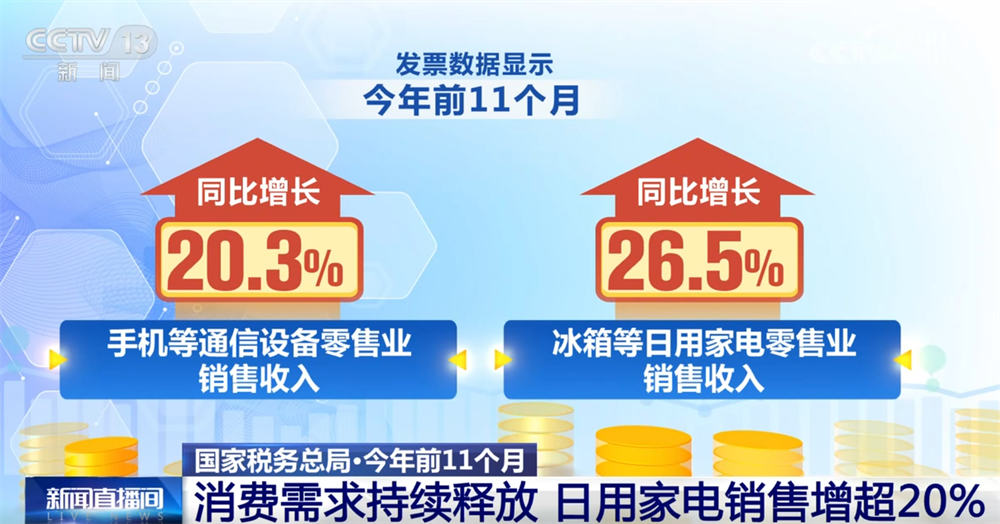
Group 1: Consumer Demand and Sales Growth - Consumer demand has been continuously released this year, driven by policies such as the trade-in program for consumer goods [1] - Sales of home appliances and new energy vehicles have maintained rapid growth, with retail sales of communication devices and daily household appliances increasing by 20.3% and 26.5% year-on-year, respectively [1] - The sales revenue of new energy passenger vehicles has also shown a positive trend, with a year-on-year increase of 19.1% [1] Group 2: Cultural and Tourism Sector Growth - The cultural and tourism market has seen the emergence of new business formats and scenarios, enhancing consumer vitality [3] - Sales revenue from artistic creation and performance, as well as film screenings, increased by 15.6% and 19.1% year-on-year, respectively [5] - The integration of tourism with cultural activities has led to a surge in immersive and scenario-based tourism consumption [5] Group 3: Sports and Health Sector Performance - The sports and health sectors have exhibited high consumer enthusiasm, with sports exhibition services and retail sales of sports goods increasing by 29.7% and 6.6% year-on-year, respectively [5] - Health-related consumption has become a new hotspot, with retail sales of health auxiliary treatment equipment and health consulting services maintaining double-digit growth [5] Group 4: Elderly Care Services Demand - The consumption demand from the elderly population has increased, driving diversified growth in essential elderly care services [7] - Sales in elderly care, social assistance, and nursing home services have increased by 33.6%, 9.6%, and 14.6% year-on-year, respectively [7] Group 5: Tax Refunds and Cross-Border Trade - The sales volume and tax refunds for tax refund goods have increased by 98.8% year-on-year, reflecting the optimization of the tax refund policy and services [8] - The number of tax refund stores has reached 12,252 nationwide, with over 7,000 stores offering "buy and refund" services [8][10] - The variety of goods eligible for tax refunds has expanded significantly, with 329 categories available, an increase of 84 categories year-on-year [10] Group 6: Water Resource Tax Reform - The implementation of the water resource tax reform has shown significant results, with a 26.9% increase in the number of tax filers and an 18.5% increase in tax revenue [11] - The tax reform has led to a notable decrease in groundwater and special water usage, with a 13% and 49.7% reduction, respectively [13] Group 7: Inter-Provincial Trade Growth - The proportion of inter-provincial trade sales in the national sales revenue has increased to 41.1%, up 0.8 percentage points year-on-year [16] - The number of provinces experiencing growth in inter-provincial trade has risen from 19 to 27, indicating deepening trade connections [16] - The average processing time for cross-regional tax-related business has been reduced by 5 to 10 days, enhancing efficiency [18]
数据破壁垒 办证不停运!海上运输跑出“加速度”
Yang Shi Xin Wen Ke Hu Duan· 2025-12-08 09:21
Core Insights - The article discusses the advancements in the maritime logistics sector in Xiamen, particularly the implementation of a "single window" system that streamlines the process for ships entering and leaving the port, significantly reducing the time and effort required for documentation [2][4]. Group 1: Policy and Infrastructure Development - The "14th Five-Year Plan" emphasizes breaking down barriers to establish a unified national market and improving logistics rules and standards [1]. - The Xiamen Maritime Bureau has developed 33 modules with over 80 functions to enhance service efficiency for enterprises [3]. Group 2: Technological Innovations - The introduction of the "single window" system allows for one-time data submission, enabling quick processing of ship entry documentation, which previously required multiple submissions [2][3]. - The system provides real-time tracking of ship schedules and offers additional services such as fuel and supply information [2]. Group 3: Economic Impact - In the first three quarters of the year, the export value of ships from Fujian reached 15.17 billion, a year-on-year increase of 45.4%, marking a historical high for the same period [3]. - The "non-stop certification" service has saved enterprises over 100 million in operational losses by reducing the time required for documentation from 28 days to as little as one day [8]. Group 4: Collaborative Efforts - The Xiamen Maritime Bureau has collaborated with various departments to create a comprehensive service platform that allows for simultaneous processing of necessary certifications, thus optimizing the workflow [7][8]. - Feedback from 68 enterprise needs has been collected to further enhance the services provided by the "single window" system [3].
国家税务总局:加力纠治违规招商引资涉税问题
Xin Hua Cai Jing· 2025-12-08 08:29
新华财经北京12月8日电(记者董道勇)8日,在国家税务总局举行的例行新闻发布会上,国家税务总局 副局长蔡自力介绍说,税务部门深入贯彻党中央、国务院关于纵深推进全国统一大市场建设"五统一、 一开放"的基本要求,切实发挥税收职能作用,积极作为、多点发力,持续做全国统一大市场的有力维 护者和推进者。 "下一步,税务部门将继续深入贯彻落实党中央、国务院决策部署,加力推动部门协同共治,更好发挥 税务部门在整治'内卷式'竞争中的职能作用,更好服务全国统一大市场建设。"蔡自力说。 一是加力纠治违规招商引资涉税问题。蔡自力表示,违规招商引资是影响全国统一大市场建设的症结之 一。自去年初起,税务总局就在全系统组织开展违规招商引资涉税问题专项治理,将其作为建强政治机 关的重要抓手,明确要求各地税务机关对地方违规招商引资涉税问题不得出谋划策、不得参与配合、不 得知情不报、不得放任失管,并严肃查处和通报违反规定的典型案例。同时,对各地违规招商引资带来 的税收收入异常、发票开具异常等情形,专门设置相关指标,进行常态化按月监测和核实处置,重大问 题推送相关部门协同纠治。 (文章来源:新华财经) 三是加力提升跨区域税费业务办理效能。蔡自力 ...
税务总局:报送涉税信息后,各类“小哥”收入和税负均未受到影响
Xin Jing Bao· 2025-12-08 07:25
Group 1 - The core viewpoint of the news is that the tax revenue in China has shown a positive trend, with tax authorities collecting over 29 trillion yuan in tax and fee income from January to November, indicating a stable economic situation [1] - The tax revenue (excluding export tax rebates) exceeded 16 trillion yuan, reflecting the ongoing improvement in the economic landscape [1] Group 2 - The tax authorities have seen a nearly fourfold increase in handling cross-regional tax-related business for taxpayers this year, with inter-provincial trade sales accounting for 41.1% of national sales revenue, up 0.8 percentage points year-on-year [2] - The number of provinces experiencing growth in inter-provincial trade has increased from 19 to 27, indicating a deepening of trade connections between provinces [2] Group 3 - The tax authorities have implemented strict measures against local governments engaging in illegal investment attraction practices, which disrupt the national unified market [2][3] - A set of four prohibitions has been established for local tax authorities to prevent them from participating in or facilitating illegal tax incentives [2][3] Group 4 - Over 7,000 platform companies have reported tax-related information since the implementation of the new regulations, leading to a 12.7% year-on-year increase in tax payments by platform operators [4] - The regulations have resulted in a reduction of "brushing" activities that artificially inflate traffic, and the number of "shell platforms" has also decreased [4][5] Group 5 - The implementation of the regulations has encouraged small-scale taxpayers to request invoices from suppliers, resulting in a 22% year-on-year increase in invoice amounts obtained by these taxpayers [5] - Previously hidden issues, such as tax evasion through income concealment and income splitting, have become easier to detect, providing a solid foundation for compliance [5] Group 6 - The regulations do not impose additional burdens on delivery and service personnel, ensuring their daily work and income remain unaffected [6] - The tax authorities have prohibited platforms from over-deducting fees during tax withholding, protecting the rights of service workers [6] Group 7 - The tax authorities have cracked down on tax evasion cases involving high-risk gas stations and celebrities, recovering over 15 billion yuan in tax payments from 1,818 individuals [7] - A total of 39,04 high-risk gas stations have been investigated, resulting in a recovery of 41.63 billion yuan in tax payments [7] - The authorities have maintained a high-pressure stance against fraudulent tax practices, inspecting nearly 69,600 enterprises suspected of tax fraud this year [7]
1818名包括明星网红在内的“双高”人员被查处
Shang Hai Zheng Quan Bao· 2025-12-08 06:33
Core Viewpoint - The National Taxation Administration emphasizes the implementation of policies to enhance the business environment, promote fair competition, and regulate the platform economy, leading to improved tax compliance and reduced disorderly competition [1][2][3]. Group 1: Regulatory Measures - The tax authorities are intensifying efforts to address tax issues related to illegal investment attraction, which is seen as a key obstacle to building a unified national market [1][2]. - Specific indicators have been established to monitor and verify tax revenue anomalies and invoice issuance related to illegal investment attraction, with a focus on preventing "policy gaps" and "invoice economy" practices [2]. Group 2: Policy Environment Optimization - The tax authorities are working to ensure fair tax policies as an inherent requirement for the construction of a unified market, establishing a regular inter-ministerial consultation mechanism with the Ministry of Finance [3]. - There is a commitment to fully implement tax and fee preferential policies to support high-quality development, utilizing big data to match policies with eligible businesses [3]. Group 3: Cross-Regional Tax Services - The tax authorities are enhancing the efficiency of cross-regional tax services, implementing a one-stop service for tax-related business nationwide, which has resulted in a nearly fourfold increase in cross-regional tax business handled this year [4]. - Data shows that from January to November, inter-provincial trade sales accounted for 41.1% of national sales revenue, reflecting deepening trade connections between provinces [4]. Group 4: Enforcement Actions - The tax authorities have focused on high-risk sectors, identifying and addressing tax evasion cases, including 3,904 high-risk gas stations and 1,818 individuals, recovering significant amounts in unpaid taxes [5][6]. - A total of 69,600 enterprises suspected of fraudulent tax practices were inspected, recovering 8.606 billion yuan in export tax refunds [6]. Group 5: Compliance and Transparency - The tax authorities have increased the exposure of typical tax violation cases, with over 490 cases disclosed this year, aiming to deter violations and promote compliance [7]. - There has been a notable increase in the number of major tax violators who have taken corrective actions, with a 40% rise in those successfully restoring their credit status [7].