
社会融资规模

Search documents
新华财经早报:8月14日
Xin Hua Cai Jing· 2025-08-13 23:55
Group 1: Regulatory Developments - The Chinese government is seeking public opinion on a draft notice aimed at strengthening supervision of autonomous driving and preventing misleading advertising related to smart connected vehicles [1] - The draft emphasizes that companies must provide accurate and comprehensive information regarding the automation levels and capabilities of their vehicles, prohibiting exaggerated claims [1] - The notice also states that companies must not conduct OTA upgrades without prior filing and must not push untested software versions to users [1] Group 2: Financial Data and Economic Indicators - The People's Bank of China reported that the total social financing increased by 23.99 trillion yuan in the first seven months of 2025, which is 5.12 trillion yuan more than the same period last year [1] - As of the end of July, the broad money supply (M2) stood at 329.94 trillion yuan, reflecting an 8.8% year-on-year growth [1] - The net cash injection in the first seven months was 465.1 billion yuan, with RMB loans increasing by 12.87 trillion yuan and deposits rising by 18.44 trillion yuan [1] Group 3: Corporate Performance - Ningde Times reported a 35.62% year-on-year increase in net profit for the first half of 2025, reaching 271.97 billion yuan, with a 42.21% increase in the second quarter [1] - Tencent's revenue for the first half of 2025 was 364.5 billion yuan, a 14% increase year-on-year, with a net profit of 124.4 billion yuan, up 16% [1] - The company plans to distribute a mid-year dividend of 10.07 yuan per 10 shares [1] Group 4: Market Movements - The Shanghai Composite Index rose by 0.48% to 3683.46, while the Shenzhen Component Index increased by 1.76% to 11551.36 [5] - The Hang Seng Index saw a significant rise of 2.58%, closing at 25613.67 [5] - The WTI crude oil price decreased by 1.65% to $62.04, while Brent crude oil fell by 0.56% to $65.74 [5]


前7月社融增量保持同比多增 信贷结构优化
Sou Hu Cai Jing· 2025-08-13 23:09
Core Viewpoint - The financial growth rate remains high, with significant increases in social financing and money supply, indicating effective monetary policy and support for the real economy [1][2]. Group 1: Financial Growth Metrics - As of the end of July, the social financing scale stock increased by 9% year-on-year, while the broad money supply (M2) grew by 8.8% [1]. - The incremental social financing for the first seven months reached 23.99 trillion yuan, which is 5.12 trillion yuan more than the same period last year [2]. - The M1 money supply also rose by 1 percentage point to 5.6% compared to the previous month, indicating improved liquidity and market confidence [1]. Group 2: Loan and Credit Structure - The balance of inclusive small and micro loans reached 35.05 trillion yuan, growing by 11.8% year-on-year, while medium to long-term loans in the manufacturing sector amounted to 14.79 trillion yuan, up by 8.5% [1]. - The growth rate of RMB loans as of the end of July was 6.9%, slightly down from 7.1% the previous month, influenced by seasonal factors and external pressures [2][3]. - The new corporate loan interest rate was approximately 3.2%, and the new personal housing loan rate was about 3.1%, reflecting a year-on-year decrease of around 45 and 30 basis points, respectively [3][4]. Group 3: Government Bond Financing - Government bond net financing for the first seven months increased by 4.32 trillion yuan year-on-year, serving as a major support factor for the social financing scale increment [2]. - The direct financing market, particularly through government and corporate bonds, has been growing faster than credit financing, aligning better with economic transformation [2].
前7月社融增量保持同比多增 信贷结构优化 7月M2同比增长8.8%,“剪刀差”收窄资金活化程度提升
Zheng Quan Shi Bao· 2025-08-13 22:17
Group 1: Financial Growth and Monetary Policy - The growth rate of total financial volume remains high, with social financing scale stock increasing by 9% year-on-year as of the end of July [1] - The broad money supply (M2) increased by 8.8% year-on-year, indicating a moderately loose monetary policy [1] - The structure of credit has improved, with inclusive small and micro loans reaching 35.05 trillion yuan, up 11.8% year-on-year, and medium to long-term loans in manufacturing at 14.79 trillion yuan, up 8.5% year-on-year [1] Group 2: Government Bonds and Direct Financing - The cumulative net financing of government bonds in the first seven months increased by 4.32 trillion yuan year-on-year, serving as a major support for social financing scale growth [2] - Direct financing, primarily through government and corporate bonds, is growing faster than credit financing, reflecting the development of the direct financing market [2] - The Central Political Bureau's meeting on July 30 emphasized accelerating government bond issuance, which is expected to further boost social financing growth in the third quarter [2] Group 3: Loan Dynamics and Seasonal Trends - July typically sees a seasonal decline in loan issuance, influenced by financial institutions adjusting credit issuance and the need for businesses to settle accounts [3] - The ongoing policy of replacing hidden debts is impacting loan growth, with estimates suggesting that this factor reduces loan growth by over 1 percentage point [3] - Recent efforts to eliminate "involution" competition may lead to a decrease in credit demand from small and medium-sized enterprises [3] Group 4: Interest Rates and Financing Costs - Interest rates remain low, with new corporate loan rates around 3.2% and new personal housing loan rates at approximately 3.1%, reflecting a year-on-year decline of about 45 and 30 basis points respectively [3][4] - The low interest rates indicate a relatively abundant supply of credit, making it easier and cheaper for borrowers to obtain bank loans [4] - Initiatives to promote transparency in the comprehensive financing costs for enterprises are underway, which may lead to clearer financing costs in the future [4]
7月末社会融资规模、广义货币增速均保持较高水平 信贷供给总体充裕 有效满足实体经济融资需求
Zhong Guo Zheng Quan Bao· 2025-08-13 22:17
Core Viewpoint - The People's Bank of China (PBOC) has maintained a moderately loose monetary policy, supporting the real economy through high levels of social financing and broad money (M2) growth as of the end of July [1] Group 1: Credit Growth - In the first seven months, RMB loans increased by 12.87 trillion yuan, with a loan balance of 268.51 trillion yuan at the end of July, reflecting a year-on-year growth of 6.9% [2] - The fluctuations in credit data during June and July are attributed to financial institutions' half-year reporting and the settlement period for enterprises, as well as the significant impact of local government debt swaps on loan data [2][3] - The impact of debt resolution and risk mitigation factors on current loan growth exceeds 1 percentage point, with local government debt swaps affecting loans by approximately 2.6 trillion yuan since last November [3] Group 2: Loan Interest Rates - Loan interest rates have remained low, with new corporate loan rates around 3.2% and new personal housing loan rates at approximately 3.1%, both down by about 45 and 30 basis points year-on-year, respectively [4] - The decline in financing costs reflects adequate monetary and credit conditions, indicating that the real economy's financing needs are being met [4] Group 3: Monetary Aggregates - As of the end of July, M2 stood at 329.94 trillion yuan, growing by 8.8% year-on-year, while M1 was 111.06 trillion yuan, with a year-on-year increase of 5.6% [7] - The narrowing gap between M1 and M2 indicates improved liquidity and efficiency in fund circulation, aligning with the recovery of economic activities [7] Group 4: Economic Outlook - The cumulative social financing scale for the first seven months reached 23.99 trillion yuan, exceeding the previous year's figure by 5.12 trillion yuan, with a total stock of 431.26 trillion yuan at the end of July, reflecting a year-on-year growth of 9% [7] - The macroeconomic indicators have performed better than expected in the first half of the year, supporting the reasonable growth of monetary credit and meeting the effective financing needs of the real economy [7]
前7月人民币贷款增加12.87万亿元
Sou Hu Cai Jing· 2025-08-13 22:17
在货币供应量方面,截至7月末,我国广义货币余额329.94万亿元,同比增长8.8%;狭义货币余额 111.06万亿元,同比增长5.6%;流通中货币余额13.28万亿元,同比增长11.8%。前7个月净投放现金 4651亿元。 "社会融资规模、广义货币增速均保持在较高水平,体现了适度宽松的货币政策取向,为实体经济提供 了适宜的货币金融环境。"招联首席研究员、上海金融与发展实验室副主任董希淼表示,上半年,人民 贷款利率继续保持低位,实体经济融资需求满足度高。7月利率低位运行,新发放企业贷款利率约 3.2%,新发放个人住房贷款利率约3.1%,分别较去年同期下降约45个和30个基点。 "利率是资金供求关系的价格信号,利率低位下行反映信贷供给相对充裕,资金需求方获得银行信贷支 持更加容易、成本更加优惠。"中国邮政储蓄银行研究员娄飞鹏表示,贷款利率已经在低位运行了很长 时间,说明信贷资源供给总体是充裕的,实体经济的融资需求满足度比较高,加上禁止违规手工补息、 建立存款招投标利率报备机制、优化非银同业存款利率自律管理等一系列政策的实施,让利率运行机制 更加顺畅,既稳住了银行负债成本,也为银行向企业让利提供了更多空间。目前很多 ...
前7月人民币贷款增加12.87万亿元 实体经济融资需求满足度高
Ren Min Ri Bao· 2025-08-13 21:55
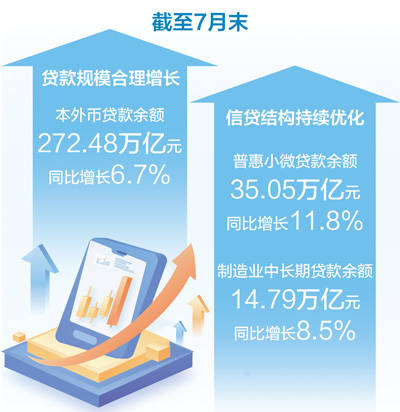
据初步统计,前7个月,我国社会融资规模增量累计为23.99万亿元,比上年同期多5.12万亿元,其中, 对实体经济发放的人民币贷款增加12.31万亿元。截至7月末,我国社会融资规模存量为431.26万亿元, 同比增长9%,其中,对实体经济发放的人民币贷款余额为264.79万亿元,同比增长6.8%。 在货币供应量方面,截至7月末,我国广义货币余额329.94万亿元,同比增长8.8%;狭义货币余额 111.06万亿元,同比增长5.6%;流通中货币余额13.28万亿元,同比增长11.8%。前7个月净投放现金 4651亿元。 本报北京8月13日电 (记者吴秋余)中国人民银行发布的最新数据显示:今年前7个月,我国人民币贷 款增加12.87万亿元,截至7月末,我国本外币贷款余额272.48万亿元,同比增长6.7%,人民币贷款余额 268.51万亿元,同比增长6.9%,金融支持实体经济有力有效。 在贷款规模保持合理增长的同时,信贷结构持续优化,出现不少亮点。截至7月末,我国普惠小微贷款 余额为35.05万亿元,同比增长11.8%,制造业中长期贷款余额为14.79万亿元,同比增长8.5%,以上贷 款增速均高于同期各项贷款增速。 ...
前7月人民币贷款增加12.87万亿元
Ren Min Ri Bao· 2025-08-13 21:50
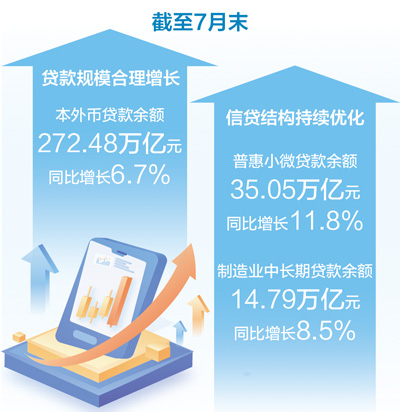
Group 1 - The core viewpoint of the articles highlights the robust growth of loans and the effective financial support for the real economy in China, with a total increase of 12.87 trillion yuan in loans in the first seven months of the year [2] - As of the end of July, the balance of RMB loans reached 268.51 trillion yuan, reflecting a year-on-year growth of 6.9%, while the total balance of loans in both RMB and foreign currencies was 272.48 trillion yuan, growing by 6.7% [2] - The structure of credit is continuously optimizing, with notable increases in inclusive small and micro loans, which reached a balance of 35.05 trillion yuan, growing by 11.8% year-on-year, and medium to long-term loans for the manufacturing sector, which totaled 14.79 trillion yuan, up by 8.5% [2] Group 2 - Loan interest rates remain low, with new corporate loan rates around 3.2% and new personal housing loan rates at approximately 3.1%, both showing declines of about 45 and 30 basis points compared to the same period last year [2][3] - The total social financing scale increased by 23.99 trillion yuan in the first seven months, which is 5.12 trillion yuan more than the same period last year, with RMB loans to the real economy increasing by 12.31 trillion yuan [3] - The broad money supply (M2) reached 329.94 trillion yuan by the end of July, growing by 8.8% year-on-year, while the narrow money supply (M1) was 111.06 trillion yuan, up by 5.6% [4] Group 3 - In terms of deposits, RMB deposits increased by 18.44 trillion yuan in the first seven months, with household deposits rising by 9.66 trillion yuan and non-financial enterprise deposits increasing by 3.109 trillion yuan [5] - The total balance of deposits in both RMB and foreign currencies reached 327.83 trillion yuan, reflecting a year-on-year growth of 9%, while the balance of RMB deposits was 320.67 trillion yuan, growing by 8.7% [5] - The implementation of a series of monetary policies has effectively supported the recovery of the real economy, with macroeconomic indicators showing overall positive performance [5]
信贷供给总体充裕 有效满足实体经济融资需求
Zhong Guo Zheng Quan Bao· 2025-08-13 21:10
Core Viewpoint - The People's Bank of China has maintained a suitable monetary environment for the real economy, reflecting a moderately loose monetary policy orientation, with significant support for economic recovery in the first half of the year [1][4]. Credit Growth - In the first seven months, RMB loans increased by 12.87 trillion yuan, with a loan balance of 268.51 trillion yuan at the end of July, showing a year-on-year growth of 6.9% [1][2]. - The fluctuations in credit data in June and July were influenced by financial institutions' half-year report disclosures and the settlement period for real enterprises, as well as the impact of local government debt replacement [1][2]. Loan Rate Trends - The new corporate loan rate was approximately 3.2% and the new personal housing loan rate was about 3.1% at the end of July, both showing declines of about 45 and 30 basis points year-on-year, respectively [2][3]. - The overall decline in financing costs reflects a favorable monetary and credit condition, indicating that the effective financing demand of the real economy is being met [2][3]. Credit Structure and Quality - The economic structure's transformation has led to adjustments in credit structure, emphasizing the need for high-quality credit allocation [3]. - The People's Bank of China has been guiding financial institutions to increase credit support for key areas and weak links, enhancing the effectiveness of structural monetary policy tools [3]. Money Supply and Efficiency - By the end of July, M2 balance was 329.94 trillion yuan, with a year-on-year growth of 8.8%, while M1 balance was 111.06 trillion yuan, growing by 5.6% year-on-year [3]. - The narrowing gap between M1 and M2 indicates improved liquidity and efficiency in fund circulation, aligning with the recovery of economic activities [3]. Economic Outlook - The overall economic performance has been stable and improving, supporting reasonable growth in financial totals, which is crucial for meeting the effective financing needs of the real economy [4][5]. - The macroeconomic policies are expected to remain consistent and stable in the second half of the year, ensuring a smoother domestic economic cycle and reasonable growth in effective credit demand [5].
7月社融数据超预期增长9%,"一石多鸟"政策效应加快显现
Shang Hai Zheng Quan Bao· 2025-08-13 20:26
Core Viewpoint - The central bank's data indicates that as of the end of July, social financing scale, broad money (M2), and RMB loans grew by 9%, 8.8%, and 6.9% year-on-year, respectively, continuing to outpace economic growth [1][4]. Group 1: Credit Growth Analysis - In July, credit growth slowed due to multiple factors including seasonal effects, local government debt swaps, and financial institutions reducing excessive competition, leading to a decrease in the loan growth rate to 6.9%, down from 8.7% the previous year [2][3]. - July is traditionally a low month for credit, as June often sees higher lending due to banks' performance assessments and businesses' cash flow needs [2][3]. - The impact of local government debt swaps on loan data remains significant, with estimates suggesting that these swaps have influenced loan growth by approximately 2.6 trillion yuan [3]. Group 2: Monetary Policy and Financing Environment - The high growth rates of social financing scale and M2 reflect a moderately loose monetary policy, providing a suitable financial environment for the real economy [4][5]. - As of the end of July, the social financing scale stood at 431.26 trillion yuan, with a year-on-year growth of 9%, indicating a robust increase in financing activities [4]. - Government bond issuance has been a major driver of social financing growth, with a more proactive fiscal policy supporting economic demand [4][5]. Group 3: Loan Structure and Interest Rates - The structure of loans is optimizing to meet the demands of economic transformation, with inclusive small and micro loans and medium to long-term loans for manufacturing showing growth rates of 11.8% and 8.5%, respectively [7]. - Loan interest rates remain low, with new corporate loans averaging around 3.2% and personal housing loans at approximately 3.1%, reflecting a favorable credit supply environment [7]. - The reduction in financing costs has positively impacted effective demand, with some businesses reporting interest rates halved compared to previous levels [7]. Group 4: Future Outlook - Experts anticipate that macroeconomic policies will maintain continuity and stability in the second half of the year, supporting employment, businesses, and market expectations, which will facilitate smoother domestic economic circulation [8].
前7个月人民币贷款增加12.87万亿元 对实体经济保持较大的支持力度
Qi Huo Ri Bao Wang· 2025-08-13 18:10
Core Viewpoint - The People's Bank of China reported that in the first seven months of the year, RMB loans increased by 12.87 trillion yuan, and the total social financing scale increased by 23.99 trillion yuan, which is 5.12 trillion yuan more than the same period last year, indicating strong financial support for the real economy [1] Group 1: Loan and Financing Data - In July, the new social financing maintained a year-on-year increase, supported by government bond financing, despite fluctuations in new credit data due to credit overdraft and hidden debt replacement [1][2] - The increase in loans is subject to seasonal characteristics, with July typically being a "small credit month," and historical data shows that manufacturing and construction PMI averages are lower in July compared to June [2] - The growth of social financing in July was primarily driven by government special bonds and corporate bond financing, with new government bonds amounting to 1.24 trillion yuan, an increase of 555.9 billion yuan year-on-year [2] Group 2: Monetary Supply and Economic Outlook - The difference in growth rates between narrow money supply (M1) and broad money supply (M2) narrowed to 3.2%, indicating improved liquidity and efficiency in the financial system [3] - It is expected that after short-term disturbances subside, new credit in August will return to positive values, and social financing will remain at a high level, with M2 continuing to grow rapidly and M1's growth rate accelerating [3] - The monetary policy is anticipated to maintain a supportive stance in the second half of the year, focusing on reducing financing costs and increasing credit availability to stimulate domestic demand [3]