中美关税战

Search documents
宝城期货股指期货早报-20250625
Bao Cheng Qi Huo· 2025-06-25 02:23
Report Summary 1) Report Industry Investment Rating No specific industry investment rating is provided in the report. 2) Core Viewpoints of the Report - The overall view is that the stock index will mainly show a range - bound oscillation in the short - term, with a mid - term upward trend. Yesterday, all stock indices rose unilaterally, and the market turnover increased. The market's risk preference has recovered due to the easing of geopolitical risks, but short - term policy signals are lacking, and external risks may cause some disturbances [4]. 3) Summary by Related Catalogs Variety Viewpoint Reference - Financial Futures Stock Index Sector - For IH2509, the short - term view is oscillation, the mid - term view is upward, and the intraday view is oscillation with a slight upward bias. The reference view is range - bound oscillation, and the core logic is that the positive policy expectations provide strong support [1]. Main Variety Price Market Driving Logic - Financial Futures Stock Index Sector - **Market Performance**: Yesterday, all stock indices rose unilaterally, and the total market turnover of the stock market was 1447.9 billion yuan, an increase of 301.1 billion yuan compared with the previous day [4]. - **Positive Factors**: Iran's acceptance of the cease - fire plan has eased geopolitical risks, and the market's risk preference has recovered. The main support for the market comes from the expected positive policies in the future due to weak credit and inflation data [4]. - **Negative Factors**: There is no incremental policy signal in the short - term, and it is necessary to wait for the policy guidance from the Politburo meeting in July. The implementation of the cease - fire agreement between Iran and Israel is still uncertain, and external risks may affect the market's risk preference [4].
需求预期良好,菜粕偏强震荡(菜粕周报6.16-6.20)-20250623
Da Yue Qi Huo· 2025-06-23 03:21
Report Summary 1. Report Industry Investment Rating - Not provided in the given content 2. Core Viewpoints - The rapeseed meal is expected to be in a short - term range - bound and slightly bullish trend, influenced by factors such as low inventory of imported rapeseed, the tariff on Canadian oil residue cakes, and the trend of soybean meal. The future trend depends on policies and the movement of soybean meal [8][42][44]. 3. Summary by Directory 1. Weekly Prompt - Not provided in the given content 2. Recent News - Domestic aquaculture is recovering from the off - season, with tight supply and rising demand in the spot market. The annual rapeseed production in Canada has slightly decreased, and China has imposed additional tariffs on Canadian oil residue cakes. The global rapeseed production has slightly decreased due to lower output in the EU and Canada. The ongoing Russia - Ukraine conflict may support commodity prices [10]. 3. Bullish and Bearish Factors - Bullish factors: China's additional tariffs on Canadian rapeseed oil and oil residue cakes; low inventory pressure on rapeseed meal at oil mills. Bearish factors: The upcoming listing of domestic rapeseed in June; uncertainties in the anti - dumping investigation on Canadian rapeseed imports, and the seasonal off - season for rapeseed meal demand [11]. 4. Fundamental Data - **Rapeseed Arrival**: The arrival volume of imported rapeseed in June was lower than expected, and the import cost was in a slightly bullish and volatile trend [18]. - **Oil Mill Operation and Inventory**: The rapeseed inventory at oil mills continued to decline, and the rapeseed meal inventory slightly decreased to a low level. The rapeseed crushing volume at oil mills slightly decreased [21][23]. - **Rapeseed Meal Transaction**: Not provided in the given content - **Aquaculture**: The prices of aquatic fish fluctuated slightly, and the prices of shrimps and shellfish remained stable. China's aquatic product and fish production, shellfish and shrimp - crab production, and OECD's forecast of China's fish production and imports are presented, but no specific analysis is given [25][27][29]. - **Supply - Demand Balance Sheet**: The supply - demand balance sheets of domestic rapeseed and rapeseed meal from 2014 - 2023 are provided, including data on harvest area, inventory, production, consumption, etc. [15][17]. 5. Position Data - The main long positions in rapeseed meal decreased, but capital inflows were observed [8]. 6. Rapeseed Meal Viewpoints and Strategies - **Fundamentals**: Rapeseed meal is in a short - term range - bound and slightly bullish trend. The low inventory of rapeseed meal and the tariff on Canadian oil residue cakes support the price, but the absence of additional tariffs on rapeseed imports limits the upside potential [8]. - **Basis**: The spot price is 2620, and the basis is - 59, indicating a discount to the futures price, which is bearish [8]. - **Inventory**: The rapeseed meal inventory is 1.55 tons, a 18.42% week - on - week decrease from last week's 1.9 tons and a 40.38% year - on - year decrease from last year's 2.6 tons, which is bullish [8]. - **Technical Analysis**: The price is above the 20 - day moving average and moving upward. The KDJ indicator is oscillating and falling from a high level, and the MACD is oscillating upward with a narrowing red energy bar. In general, the short - term trend is slightly bullish, but the future trend depends on policies and the movement of soybean meal [42]. - **Trading Strategies**: In the short - term, the futures are expected to be slightly bullish. For the RM2509 contract, it is recommended to trade within the range above 2600 or wait and see. For options, sell slightly out - of - the - money put options on the 09 contract [12]. 7. Next Week's Focus Points - The most important factors are the planting weather in US soybean - producing areas, Canadian rapeseed exports and domestic crushing demand, and the arrival and operation of imported soybeans and rapeseed in China. Secondary factors include domestic soybean meal and aquaculture demand, and the inventory of rapeseed meal at domestic oil mills and downstream procurement. Other factors include macro - economy and the Israel - Palestine conflict [45][46].
6月LPR“按兵不动”,增量政策或将延至四季度
Bei Jing Shang Bao· 2025-06-20 11:03
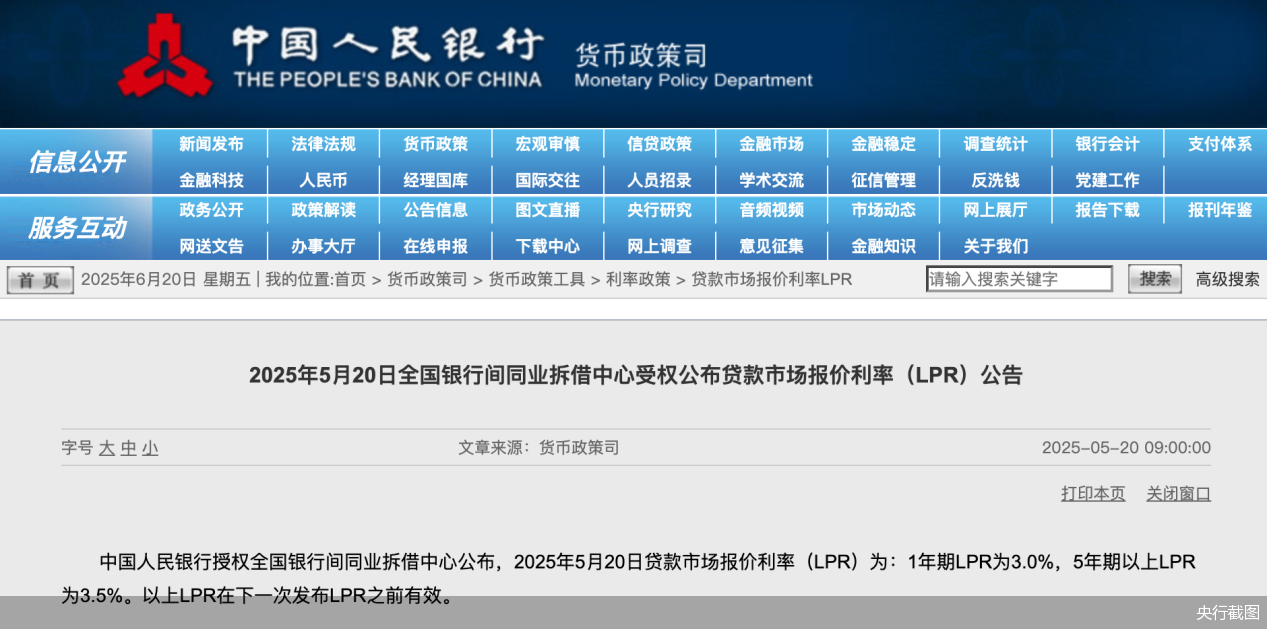
Core Viewpoint - The Loan Prime Rate (LPR) remains unchanged for June 2025, with the 1-year LPR at 3% and the 5-year LPR at 3.5%, reflecting market expectations and the stability of policy rates [1][4]. Group 1: LPR and Monetary Policy - The LPR was last adjusted in May 2025, where both the 1-year and 5-year LPRs were reduced by 10 basis points [4]. - Factors influencing the stability of the LPR include the expectation of steady policy rates and ongoing pressure on bank interest margins [4][5]. - The People's Bank of China (PBOC) emphasizes the importance of a smooth monetary policy transmission mechanism and aims to lower the overall financing costs in the economy [5][6]. Group 2: Banking Sector Performance - As of the end of Q1 2025, the net interest margin of commercial banks has decreased to a historical low of 1.43%, down 9 basis points from the previous quarter [4]. - The decline in net interest margins across various types of banks indicates a challenging environment for profitability and growth [5]. - The pressure on banks' interest margins is expected to limit the potential for further LPR reductions in the near term [5][6]. Group 3: Future Outlook - The potential for further LPR adjustments in the second half of 2025 remains, with expectations of additional monetary easing depending on domestic and international economic conditions [5][6]. - The focus of future monetary policy may shift towards reducing non-interest costs and enhancing the overall financing environment for businesses and households [6].

宝城期货股指期货早报-20250618
Bao Cheng Qi Huo· 2025-06-18 02:18
Group 1 - Report Industry Investment Rating - Not provided in the given content Group 2 - Core Viewpoints of the Report - The short - term view of the stock index is interval oscillation, the medium - term view is going up, and the intraday view is oscillating strongly. The policy - side positive expectations form strong support, but there are uncertainties from external factors such as the evolution after the end of the Sino - US tariff war suspension period and the Middle East geopolitical crisis [1][5] Group 3 - Summary by Relevant Catalogs Variety Viewpoint Reference - Financial Futures Stock Index Sector - For IH2506, the short - term trend is oscillation, the medium - term trend is upward, the intraday trend is oscillating strongly, and the reference view is interval oscillation. The core logic is that the positive policy expectations provide strong support [1] Main Variety Price Market Driving Logic - Financial Futures Stock Index Sector - The varieties include IF, IH, IC, IM. The intraday view is oscillating strongly, the medium - term view is upward, and the reference view is interval oscillation. The core logic is that the latest May credit data shows weak real - economy financing demand, so policy - side support is expected. The positive policy expectations strengthen the bottom support of the stock index. Also, there are high uncertainties from external factors, and the stock market risk preference is defensive. In the short term, the stock index will mainly oscillate in an interval, waiting for new driving forces [5]
大越期货国债期货早报-20250604
Da Yue Qi Huo· 2025-06-04 02:57
Group 1: Report Industry Investment Rating - No relevant information provided Group 2: Core Viewpoints - On June 3, the bond market showed narrow fluctuations, with most yields of major interest - rate bonds in the inter - bank market rising slightly, and most treasury bond futures closing down. The inter - bank market funds were balanced and loose, and the weighted average interest rates of major repurchase transactions declined. The Sino - US tariff war is a long - term process, and short - term changes are unlikely to significantly affect bond market expectations. Domestic factors such as this month's liquidity, certificate of deposit rates, and government bond supply need to be monitored [3]. - The 5 - month manufacturing PMI rebounded slightly but remained in the contraction range, and the Caixin China Manufacturing PMI fell below the boom - bust line for the first time in eight months. In April, government bond issuance helped the growth rate of social financing scale continue to accelerate, and the central bank cut interest rates and reserve requirements. After the shock of the suspension of the tariff war was quickly released and the reserve requirement and interest rate cuts were implemented, the funds remained loose. With the central bank's continued use of quantitative tools, the bond market's continuous adjustment momentum remains [5]. Group 3: Summary by Related Catalogs 1. Market Review - The T2509 contract had a closing price of 108.685, a decline of 0.03%, a trading volume of 96,000, an open interest of 285,750, and a daily decrease of 1,142 positions. The TF2509 contract had a closing price of 105.960, a decline of 0.04%, a trading volume of 79,600, an open interest of 219,680, and a daily increase of 5,684 positions. The TS2509 contract had a closing price of 102.352, a decline of 0.04%, a trading volume of 54,900, an open interest of 171,028, and a daily increase of 5,667 positions. The TL2509 contract had a closing price of 119.45, an increase of 0.03%, a trading volume of 96,300, an open interest of 148,128, and a daily decrease of 780 positions [8]. 2. Fundamental Analysis - On June 3, the People's Bank of China conducted 454.5 billion yuan of 7 - day reverse repurchase operations at a fixed - rate and quantity - tender method with an operating rate of 1.40%. With 830 billion yuan of reverse repurchases maturing on the same day, the net withdrawal was 375.5 billion yuan [3]. 3. Basis Analysis - The basis of the TS main contract was - 0.0741, indicating that the spot was at a discount to the futures, which was bearish. The basis of the TF main contract was - 0.0175, also indicating a discount of the spot to the futures, which was bearish. The basis of the T main contract was 0.0230, indicating that the spot was at a premium to the futures, which was bullish. The basis of the TL main contract was 0.41130, indicating a premium of the spot to the futures, which was bullish [3]. 4. Inventory Analysis - The balances of deliverable bonds for the TS, TF, and T main contracts were 1.3594 trillion yuan, 1.4935 trillion yuan, and 2.3599 trillion yuan respectively, which was neutral [4]. 5. Market Analysis - The TS, TF, and T main contracts were all trading above their 20 - day moving averages, and the 20 - day moving averages were all upward, which was bullish [4]. 6. Position Analysis - The TS main contract had a net long position with an increase in long positions. The TF main contract had a net long position with an increase in long positions. The T main contract had a net long position with a decrease in long positions [5].
百亚股份20250603
2025-06-04 01:50
Summary of Baia Co., Ltd. Conference Call Company Overview - **Company**: Baia Co., Ltd. - **Industry**: Sanitary products, specifically focusing on women's hygiene products Key Points and Arguments Recovery from Pandemic Impact - Baia Co., Ltd. has restored platform data to pre-pandemic levels through increased expenditure and adjusted marketing strategies, with Douyin leading, followed by Tmall and Pinduoduo [2][3] - The company plans to leverage the 618 shopping festival to eliminate the impact of two rounds of the pandemic and normalize e-commerce operations [3][27] Offline Business Performance - The offline business has been less affected by the pandemic, maintaining stable operations and expanding nationally as planned [5][7] - Seasonal sales fluctuations were noted, with strong performance during the Women's Day and Double Eleven events, while the second and third quarters are expected to be relatively flat [5][6] Inventory Management - The overlap of Women's Day and the 315 public opinion incident affected distributor inventory levels, but overall inventory has gradually returned to normal [5][6] - The company maintains low inventory in new regions to control risks, while the Sichuan-Chongqing region has higher inventory due to faster sales [6][7] Market Competition - The sanitary napkin market is highly competitive, with some brands exiting and new entrants emerging, leading to a revised expectation for overall e-commerce growth [10][11] - Consumer loyalty is strong, making it difficult for new brands to gain traction quickly [10] Product Differentiation - Baia Co., Ltd. emphasizes product differentiation through technical specifications and added value, such as probiotic products and organic cotton lines [11][12] - The company plans to continue iterating existing products and launching new ones annually to meet consumer demand [12][13] Channel Strategy - The company is focusing on offline channel expansion, particularly in new regions, while maintaining a strong online presence [4][8] - The profitability of various channels varies, with Douyin currently being the only loss-making channel, while offline channels are expected to achieve a net profit margin of around 20% [15][22] Regional Performance - The Sichuan-Chongqing region saw a 30% year-on-year growth in Q1, with expectations for high single-digit growth for the year [18] - The company anticipates that the Guangdong region will achieve breakeven in the second half of the year, with continued high growth [17] Future Outlook - The company aims for a 30% annual growth rate, with a revenue target exceeding 4 billion yuan for the year [27] - The 618 shopping festival is seen as a critical period for recovery, with plans to reassess annual targets post-event [27] Challenges and Risks - The ongoing U.S.-China tariff situation may impact raw material costs, but the company has made preparations to mitigate these effects [20] - The competitive landscape is expected to remain challenging, particularly with the entry of new brands and the need for effective marketing strategies [10][25] Conclusion - Baia Co., Ltd. is strategically positioned to recover from pandemic impacts and capitalize on market opportunities through a combination of online and offline strategies, product innovation, and careful inventory management. The company remains optimistic about achieving its growth targets despite competitive pressures and market challenges.

长江期货棉花月报:反弹结束,震荡回落-20250603
Chang Jiang Qi Huo· 2025-06-03 09:52
长江期货棉花月报 长江期货股份有限公司交易咨询业务资格:鄂证监期货字{2014}1号 2025-06-03 【长期研究|棉纺团队】 研究员: 洪润霞 执业编号:F0260331 投资咨询编号:Z0017099 黄尚海 执业编号:F0270997 投资咨询编号:Z0002826 联系人: 钟 舟 执业编号:F3059360 顾振翔 执业编号:F3033495 反弹结束,震荡回落 01 走势回顾:5月郑棉反弹后震荡运行 02 供应端分析:新季全球供应仍显宽松 03 需求端分析:下游需求总体尚稳 04 逻辑与展望:震荡回落 目 录 05 02 01 走势回顾:5月郑棉反弹后震荡运行 01 5月郑棉反弹后震荡运行 数据来源:博易大师、中国棉花信息网、TTEB、IFIND、长江期货 Ø 5月郑棉大幅反弹后震荡运行,宏观层面,月初中美开始接触直至联合声明发布,中美关税战趋向缓和,市场 情绪有所缓解,期价从低位一路上行,达到月内最大涨幅,5 月 28 日,美国联邦贸易法院裁决阻止了特朗普 对等关税,后续对等关税发展如何需暂时观望,不确定性较大。基本面来看,市场前期部分积压订单逐步发运, 有少量订单回流,但棉类产业链传导不明 ...
美国等了两周,中国还不松口,特朗普随即变脸,暂停对华履行协议
Sou Hu Cai Jing· 2025-05-30 00:27
Group 1 - The U.S. Department of Commerce has been busy adjusting its tariff policies and has recently halted the export of key technologies to China, particularly in the aviation sector [1][3] - The Trump administration's decision to suspend licenses for the sale of products and technologies to China's COMAC is seen as a strategic move to counter China's rapid advancements in the aviation industry [3][6] - The U.S. aims to maximize its benefits from the trade war, seeking not only negotiations but also leveraging tariffs to protect its domestic industries [6] Group 2 - The U.S. is concerned about the rise of China's aviation industry and has been pressuring to hinder China's progress in developing its own large aircraft [8][11] - The CJ-1000A engine, designed specifically for China's C919 aircraft, boasts significant advantages in terms of size, fuel efficiency, and performance compared to the current LEAP-1C engine [10][11] - The U.S. government is attempting to protect Boeing, which has been struggling since the 737 MAX crisis, by using export restrictions as a means to support the company [11][13] Group 3 - The U.S. is using the suspension of aviation engine technology exports as leverage in negotiations regarding rare earth materials, which are crucial for its military and high-tech industries [15][18] - China holds a dominant position in the rare earth market, supplying approximately 70% of the U.S.'s needs, which is critical for advanced military equipment [18][20] - The recent U.S. actions may inadvertently accelerate China's innovation in aviation technology, particularly with the impending production of the CJ-1000A engine [20]

一通电话标志着美大败,万斯通告全球,一个时代结束,中美分胜负
Sou Hu Cai Jing· 2025-05-29 07:07
自特朗普上台以来,他就迫不及待地采取了关税手段,针对我国发起经济攻势。自2月份起,美国接连三个月加大对我国的 关税力度,尤其是到了4月,关税的压力变得更加沉重。显然,特朗普急于阻止我国日益增长的经济势头,深怕美方被甩得 越来越远。于是,他采取了极端手段,歇斯底里地将矛头指向我国,妄图制止我国的发展。然而面对美国的咄咄逼人,我国 始终表现得沉着冷静。 每当美方加大税率的同时,我国都能以同样的方式做出回应,而其他国家往往无法做到这一点。美国在加税后很快就感受到 压力,最终不得不开始妥协。最近的一次中美对话再次证明,美方在这场博弈中输了,甚至美国官员万斯公开表示,美国霸 权时代已经宣告终结。 回顾过去,曾经中美关系在某些时期还是友好相处的,那时候我国的发展速度较慢,美方还曾主动伸出援手,助力我国走向 更好的未来。无疑,那段日子是双方关系中最为和谐的一段,但这一美好时光如今已不复存在。 特朗普在首次担任总统时,将矛头直指我国,专注于经济领域的对抗。这一行为迫使我国不得不做出反击,并正式拉开了中 美对抗的序幕。从2018年至今,美国始终在各个领域与我国针锋相对,中美之间的对抗越来越加剧,显然这种局面是美国自 己的所作所 ...
美国屈服,欧洲承认中国很强,28国纷纷学中国掀桌,齐齐对美将军
Sou Hu Cai Jing· 2025-05-29 06:09
在全球经济与政治的大舞台上,局势常常风云变幻,波澜壮阔。而其中一场极为引人注目的戏剧,莫过 于中美之间的关税战。这并非一场普通的贸易摩擦,而是如同一场紧张激烈的战争,波及的范围广泛、 影响深远,世界各国无不对此高度关注。特别是在这场关税战的背后,不仅能看到全球贸易格局的变 化,还能感受到各国纷纷重新审视自己与美国关系的复杂局面。尤其是欧洲国家的态度变化,更是耐人 寻味。 中美关税战:一场精彩的反击战 中国在关税战中的亮眼表现无疑为其他国家提供了有益的借鉴,尤其是欧洲国家纷纷效仿中国的强硬策 略,敢于与美国展开对抗。看到中国的成功,欧洲国家开始一一表态,显然不再对美国的关税威胁低 头。欧盟作为一个经济大国,在对美国的关税谈判中采取了坚决的态度,明确表示,如果美国不降税, 欧盟将进行报复。 欧盟的态度背后有着强大的底气。在钢铁、铝和汽车等领域,美国对欧盟征收了25%的进口关税,几乎 对其他所有商品征收10%的"基准关税",并且准备进一步加征20%的"对等关税",这让欧盟遭受了重大 损失。面对美国的不断施压,欧盟决定勇敢反击。 然而,关税战并没有持续太久。美国消费者发现,原本物美价廉的中国商品变得昂贵,生活成本随之 ...