
主动管理

Search documents
独家专访!美国资管巨头最新发声:一直高配中国!
Zhong Guo Ji Jin Bao· 2025-11-10 14:53
Core Insights - The chairman and CEO of Neuberger Berman, George H. Walker, emphasizes that the firm has been overweighting China in its investment strategy compared to benchmarks, indicating a long-term commitment to the Chinese market [1][10] - Walker notes that while the valuation of U.S. tech stocks is becoming expensive, the critical question for investors is not whether to invest, but how to invest effectively [1][11] - The global asset management industry is witnessing a significant rise in actively managed ETFs, with Neuberger Berman's active ETF business growing to approximately $2.5 billion [4][6] Company Overview - Neuberger Berman, founded in 1939, manages assets totaling $558 billion, equivalent to approximately 3.97 trillion RMB, and operates in 26 countries and 39 cities [2] - The firm has a strong presence in both public and private markets, with $358 billion in public market assets and $150 billion in private market assets [2] Investment Strategy - The firm has been focusing on diversifying investments and maintaining a robust risk management framework, especially in light of past financial crises [3] - Walker highlights the importance of transparency and tax efficiency in investment products, noting that actively managed ETFs are gaining traction due to these factors [5][6] Market Trends - The growth of actively managed ETFs is outpacing that of passive ETFs, indicating a shift in investor preferences towards more actively managed strategies [6] - The firm anticipates that the global AUM (Assets Under Management) for active ETFs will grow from $1.4 trillion in June 2025 to $4.2 trillion by 2030 [6] Client Focus - Neuberger Berman aims to align its compensation structure with client interests, ensuring that deferred compensation is tied to client performance rather than the firm's stock price [7] - The firm recognizes the increasing interest from Chinese insurance companies in global asset allocation strategies, particularly in a low-interest-rate environment [8] Geopolitical Considerations - Walker suggests that foreign investors will require time to increase their allocation to Chinese assets, despite recent positive developments in U.S.-China trade relations [10]
财通资管荣获“2025证券业金牛奖”4项大奖
Zhong Zheng Wang· 2025-11-10 12:58
Group 1 - The core theme of the event was "Introducing New Quality, Linking Global, Promoting Industry" and the "2025 Securities Industry Golden Bull Award" was announced [1] - Caitong Asset Management won four awards, including the "Five-Year Golden Bull Securities Firm Collective Asset Manager" and three individual awards for fixed-income asset management plans, highlighting its long-term commitment and strength in fixed-income investment [1] - As of the end of Q3 2025, Caitong Asset Management's total management scale exceeded 300 billion yuan, with over 100 billion yuan in public fund management and more than 20.8 million investors served [1] Group 2 - In the fixed-income sector, Caitong Asset Management adheres to a "low volatility, stable return" philosophy and emphasizes risk control before seeking returns [2] - The company has established a multi-strategy fixed-income system and has a management scale exceeding 176 billion yuan in fixed-income products, with over 41.5 billion yuan distributed to investors [2] - Caitong Asset Management aims to enhance its active management capabilities and diversify its product offerings to improve investor experience and create long-term value [2]
年度之约,质启新程,财联社首届公募业高质量发展论坛成功举办
财联社· 2025-11-10 06:14
Core Viewpoint - The public fund industry is approaching a significant transformation phase, emphasizing high-quality development and the need for effective service to the real economy, particularly in technology innovation and advanced manufacturing sectors [6][8]. Group 1: Forum Highlights - The forum gathered over 100 executives from regulatory bodies, public funds, and securities asset management firms to discuss key issues such as reform paths, support for the real economy, and investment research upgrades [3][4]. - Five major highlights were presented, including the gathering of top-level wisdom, in-depth discussions on industry pain points, and a focus on actionable insights for building a governance framework that aligns with new regulations [3][4]. - The establishment of the "Public Fund Evergreen Think Tank" aims to provide strategic support for the industry, reflecting a commitment to long-term, investor-centered development [4][33]. Group 2: Regulatory Insights - Regulatory representatives emphasized that the healthy development of the public fund industry relies on proactive actions from the entire ecosystem, especially in the context of the rapid growth of index investment products [5]. - As of September, the ETF market size exceeded 5.62 trillion yuan, ranking first in Asia, indicating a significant shift towards index-based investment strategies [5]. Group 3: Industry Challenges and Solutions - The industry faces challenges such as the disparity between fund profitability and investor returns, necessitating a shift towards a buyer advisory model to enhance investor experience [20][22]. - Key industry leaders discussed the importance of balancing active and passive investment strategies, with a focus on meeting client needs and enhancing competitive advantages [26][31]. Group 4: ETF Market Trends - The global ETF market has surpassed 18 trillion USD, with a notable increase in active ETFs, which are expected to account for 85% of new ETF launches in the U.S. by 2024 [12][14]. - China's ETF market has grown approximately sevenfold since 2019, yet it still represents only 5% of the total stock market capitalization, indicating substantial growth potential [12][14]. Group 5: Future Directions - The establishment of the "Public Fund Evergreen Think Tank" aims to strengthen research capabilities and promote long-term investment and value investment principles within the public fund industry [33][35]. - The industry is encouraged to collaborate and explore high-quality development paths, contributing to the stability and growth of China's capital market [35].



公募基金业绩基准新规来了,买基金会变得更容易吗?
Sou Hu Cai Jing· 2025-11-04 11:14
Core Viewpoint - The public fund performance comparison benchmark is set to undergo a systematic overhaul, potentially ending its historical ineffectiveness and enhancing transparency for investors [3][4][5]. Investor Perspective - The new regulations will make fund products easier to understand and fund quarterly reports more readable, with detailed disclosure requirements aimed at improving transparency [5]. - Historical issues with benchmarks include misalignment with fund styles, arbitrary performance embellishment, and a lack of effective monitoring mechanisms [4][10]. - The new rules will require comprehensive comparisons of returns and risks, including volatility metrics, allowing investors to better assess risk-adjusted returns [7]. - Funds will need to disclose asset allocation and industry distribution, enabling investors to identify deviations from benchmarks more clearly [8]. - Fund managers must provide explanations for performance differences, incorporating both qualitative and quantitative analyses, which will enhance the quality of quarterly reports [9][10]. Institutional Perspective - The new regulations impose comprehensive internal control requirements on fund managers, affecting product design and investment operations [11]. - A "benchmark element library" will be established to standardize benchmark selection, ensuring that funds are aligned with appropriate indices [12]. - The regulations emphasize the need for a stable benchmark, preventing frequent changes that could obscure investment mistakes [12]. - Fund companies must create independent monitoring teams to ensure compliance with benchmarks, enhancing risk management practices [13][14]. - The transition period for existing products to adapt to the new benchmarks is set at one year, allowing institutions time to adjust [14]. Industry Perspective - The new regulations are expected to reshape the industry, promoting standardization and transparency while presenting execution challenges [16]. - Balancing active management with benchmark constraints poses a challenge, as excessive adherence to benchmarks may stifle fund managers' ability to generate excess returns [17]. - The existing benchmark system may not adequately support innovative investment strategies, necessitating the development of more flexible indices [18]. - There is a gap between the granularity of industry information disclosed and investor needs, highlighting the importance of detailed data for better investment decisions [19][20]. - The new regulations signify a move towards a more mature public fund industry, emphasizing the need for enhanced internal controls and adherence to strategy [21].

监管划红线,资产管理信托全面禁止资金池、通道类业务
Hua Xia Shi Bao· 2025-11-04 10:01
Core Viewpoint - The National Financial Regulatory Administration has released a draft regulation aimed at standardizing the development of asset management trust businesses, emphasizing "returning to the essence and strictly controlling risks" [2] Summary by Sections Regulation Overview - The draft regulation consists of five chapters and eighty-five articles, highlighting clear prohibitions on channel and fund pool businesses, marking the end of the "no-risk arbitrage" model in the trust industry [2] - The regulation establishes a comprehensive framework for product establishment, sales, operations, risk management, information disclosure, and supervision, creating a "four-dimensional risk prevention" system [2] Definition and Investor Requirements - The regulation defines asset management trusts as private asset management products based on trust law, aimed at qualified investors who can identify and bear risks [4] - It sets stringent requirements for qualified investors, including a minimum net financial asset threshold of 3 million RMB for individuals and 10 million RMB for institutions [6] Prohibition of Channel and Fund Pool Businesses - The regulation explicitly prohibits channel and fund pool operations, requiring trust companies to fulfill active management responsibilities and not delegate these duties to other entities [7] - It mandates that trust companies must accurately reflect the net value of trust units and adhere to the actual income and risk factors of underlying assets [7] Investment Management and Control - The regulation limits the investment amount in a single asset to no more than 25% of the trust product's actual trust capital, with an overall cap of 30 billion RMB for all trust products managed by a company [8] - It encourages the development of standardized trust products while reducing the proportion of non-standard products, pushing trust companies to transition from "financing intermediaries" to "investment management institutions" [6][8] Transitional Arrangements and Compliance - Trust companies are required to review existing asset management trust businesses and develop rectification plans in accordance with the new regulation, with progress monitored by the regulatory authority [10]

中信建投:养老理财新规促进综合养老生态构建 向”主动管理,差异化服务”转型
智通财经网· 2025-11-04 03:24
Group 1 - The core viewpoint of the article is that the new pension financial regulations and trust management rules aim to transform the asset management industry by promoting long-term investments and reducing reliance on non-standard assets [1][2][4] - The pension financial regulations introduced by the National Financial Regulatory Administration focus on expanding nationwide trials, linking fundraising scale to net capital, and enhancing account services to activate pension funds in the market [1][2] - The trust management regulations aim to reduce the scale of traditional non-standard business and promote investment in standardized assets, requiring trust companies to rebuild their personal customer service networks and enhance their portfolio investment capabilities [3][4] Group 2 - The new regulations compel financial management companies to shift from product sales to constructing a comprehensive pension ecosystem, enhancing their service capabilities to remain competitive [2][4] - Both regulations encourage asset management institutions to transition from "channel business and homogeneous competition" to "active management and differentiated services," with a focus on long-term asset allocation and full-cycle advisory services [4] - Institutions that possess active management capabilities, effective risk management, and a comprehensive service ecosystem are expected to become market leaders [4]

固收江湖,谁主沉浮?信达澳亚缘何十年跑赢95%同行?
Cai Fu Zai Xian· 2025-10-30 07:27
Core Insights - The Chinese financial market has undergone significant changes over the past decade, with a downward trend in risk-free interest rates and a shift in investor risk preferences towards rationality [1] - Xinda Australia Fund Management Co., Ltd. has emerged as a representative player in the fixed income sector, showcasing strong performance and a clear strategic layout [1] Group 1: Performance Metrics - As of September 30, 2025, Xinda Australia Fund's average return on fixed income assets over the past ten years reached 77.57%, ranking third among 71 comparable fund companies [1] - The company has consistently ranked in the top ten for both the past seven and five years, demonstrating its ability to generate sustained profits across market cycles [1] Group 2: Product Strategy - Xinda Australia has developed a clear and precise product line in fixed income, catering to diverse client risk preferences [1] - The company offers a short-term bond series focused on high liquidity and low volatility, as well as medium to long-term products like fixed-open bond funds and pure bond funds [1] - The "fixed income plus" product line aims to enhance portfolio yield while controlling volatility through a strategy of "bond foundation and equity enhancement" [1] Group 3: Investment Approach - The fixed income investment strategy emphasizes macroeconomic foresight, dynamic duration adjustment, and a rigorous credit evaluation system [2] - The investment team, led by experienced fund managers, integrates macro, credit, trading, and quantitative strategies to capture excess returns [2] - Xinda Australia aims to maintain a robust performance in a volatile market through a systematic and platform-based operation, supported by a comprehensive risk control mechanism [2] Group 4: Future Outlook - The macroeconomic environment is expected to impose higher demands on fixed income investments, with a continued downward trend in medium to long-term interest rates [2] - The company plans to deepen its focus on active management and diversify its product offerings to navigate market changes effectively [2]
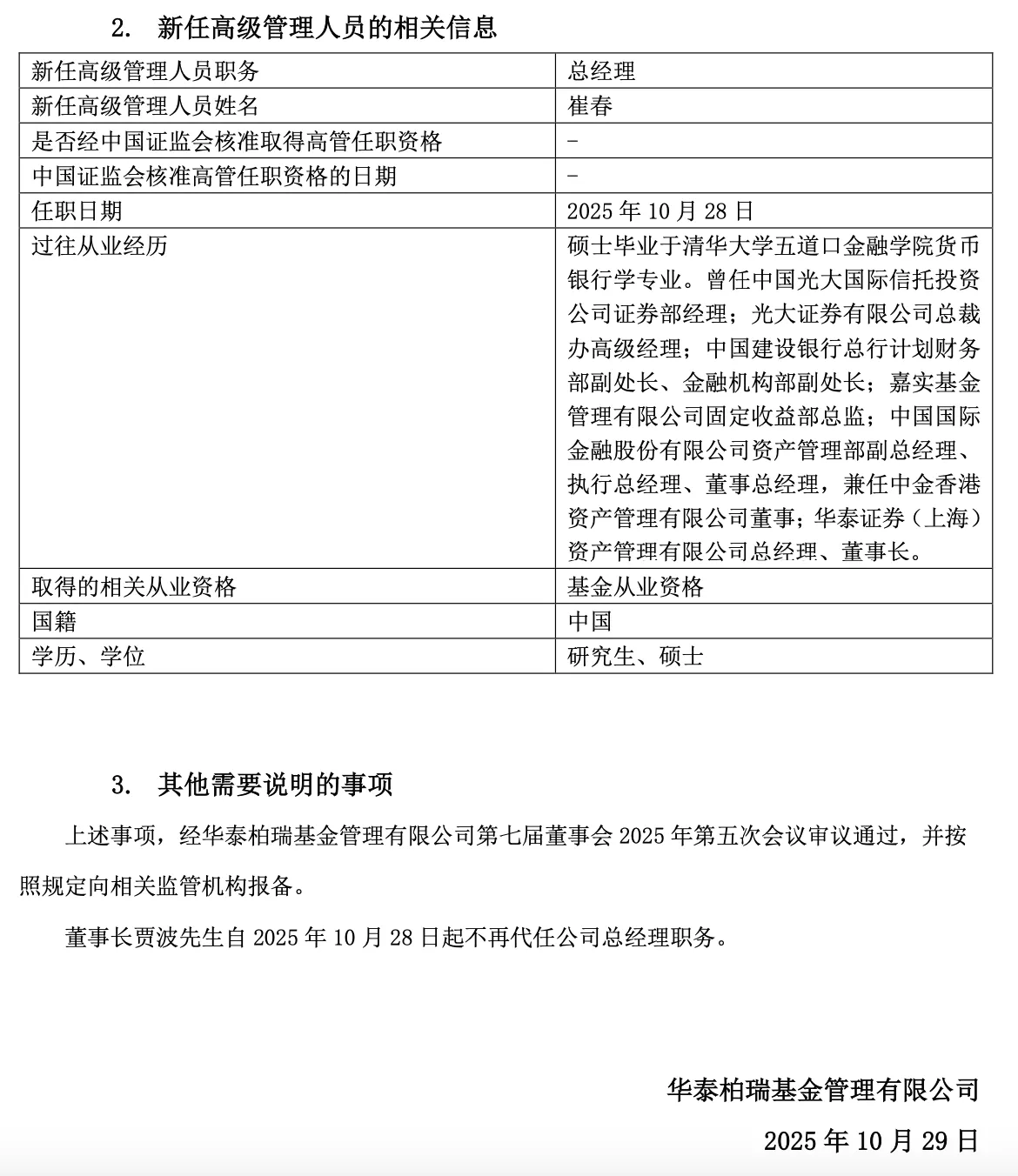
新核心、新力量:崔春出任华泰柏瑞总经理引关注
Cai Jing Wang· 2025-10-28 07:43
Core Viewpoint - Huatai-PB Fund announced the appointment of Cui Chun as the new General Manager, effective October 28, 2023, while the previous chairman, Jia Bo, will no longer act in this capacity [1] Group 1: New Management Appointment - Cui Chun has been appointed as the General Manager of Huatai-PB Fund, with a term ending on October 28, 2025 [2] - Cui Chun holds a master's degree from Tsinghua University and has over 20 years of experience in the financial industry, having worked at various prestigious institutions [5] - Prior to joining Huatai Securities Asset Management in 2015, Cui held significant positions in companies such as Everbright Securities and China Construction Bank [5] Group 2: Company Performance and Strategy - As of mid-2025, Huatai Securities Asset Management's assets under management reached 627 billion yuan, with public fund business exceeding 160 billion yuan [5] - The company reported revenue of over 1.2 billion yuan and a net profit of 713 million yuan for the first half of 2025, making it one of the few asset management firms with such high figures [6] - Huatai-PB Fund has a strong position in the ETF market, with its ETF management scale exceeding 597.8 billion yuan, reflecting a year-on-year increase of over 118.6 billion yuan [7] Group 3: Future Outlook - The industry anticipates that Cui Chun's experience in diversified asset management and financial technology will create strong synergies with the existing leadership [6] - Huatai-PB Fund is recognized for its long-term commitment to index investment, maintaining a leading position in the passive investment sector [6] - The company is also expanding its active management capabilities, particularly in quantitative and fixed-income strategies, which is expected to support future growth [7]
债券基金遭遇“冷冬” 主动管理面临更大考验
Shang Hai Zheng Quan Bao· 2025-10-27 00:12
Core Insights - The bond market, which has experienced a strong performance for several years, has entered a phase of wide fluctuations in 2023, particularly since the third quarter [1] - Overall market risk appetite has increased, leading to a reassessment of the value of major asset classes, with bond assets appearing weaker [1] - The introduction of new regulations on public fund fees has also impacted institutional participation in the bond market [1] - As a result, the popularity of actively managed bond funds has significantly decreased, while bond ETFs have emerged as a new source of capital in the bond market [1] - This divergence in market dynamics indicates a changing investment ecosystem for bonds, with active management facing greater challenges and passive allocation gaining momentum [1]
债券基金遭遇“冷冬”
Shang Hai Zheng Quan Bao· 2025-10-26 17:26
Core Viewpoint - The bond market is experiencing a significant slowdown, transitioning into a phase of wide fluctuations, with active bond funds losing market heat while bond ETFs are gaining traction as a new source of capital [1][4]. Group 1: Bond Fund Market Dynamics - Active bond funds are facing challenges due to three main reasons: lack of attractive yields, net value volatility, and limited contribution to channel income [2][3]. - There has been a notable increase in large redemptions from bond funds, with at least 26 funds announcing adjustments to net value precision due to significant withdrawals in just two weeks [2]. - The issuance of new bond funds has also cooled, with only three new funds established in October, totaling 261 million yuan, which represents just 1.12% of all new fund issuance during the same period [2]. Group 2: Bond ETF Performance - Despite the struggles of bond funds, bond ETFs have attracted substantial capital, with 24 new science and technology bond ETFs launched since July, accumulating a total scale of 244.94 billion yuan, an increase of 17.52 billion yuan from their initial scale [4][5]. - Institutional investors are the primary subscribers of these bond ETFs, with major banks and securities firms holding significant proportions of the funds [4][5]. - The expansion of bond ETFs is expected to have a growing impact on the bond market, particularly in the context of a low-interest-rate environment where active management faces increased competition from lower-fee ETFs [6]. Group 3: Future Outlook for Bond Market - Analysts remain cautiously optimistic about the bond market's future, citing a more favorable supply-demand structure compared to previous years, with limited supply pressure anticipated in the fourth quarter [7]. - The bond market is expected to experience a phase of stabilization, with potential trading opportunities arising from fluctuations within a defined range [7]. - There is ongoing attention to the new public fund fee regulations, with many investors believing that the bond market has not fully priced in the impact of these changes [7].