存储涨价

Search documents
存储涨价风暴席卷消费市场,下游厂商迎来“最难定价季”
Di Yi Cai Jing· 2025-11-26 13:28
Core Insights - The consumer electronics market is facing significant challenges due to a storage price surge that began in the second half of 2025, affecting all segments from upstream to downstream [1][2][3] - The price of storage components, such as DDR5 chips, has seen dramatic increases, with some prices doubling within a month, leading to inventory shortages for major smartphone manufacturers [2][6] - Companies are responding to rising costs by increasing product prices, with mid-range smartphones seeing price hikes of 200 to 300 yuan [3][7] Price Surge in Storage Components - The price of 1TB mechanical hard drives has risen from over 380 yuan to nearly 500 yuan, while 1TB solid-state drives have increased from over 500 yuan to 700 yuan [1] - The price of DDR5 16Gb chips surged from $7.68 to $15.5 within a month, marking a 102% increase [2] - Major manufacturers like Samsung and SK Hynix have paused quotes due to extreme price volatility [2] Impact on Smartphone Manufacturers - Major smartphone brands are experiencing inventory levels below two months, with some DRAM stocks lasting less than three weeks [2] - Companies are adjusting their pricing strategies to cope with increased storage costs, with OPPO and Honor raising prices for their new models [3][7] - Smaller smartphone brands may face significant challenges and potential market exit due to low margins and rising costs [6] Effects on PC and Home Storage Markets - The price of AI home storage products has increased by 20-30% compared to the previous year's Double Eleven shopping festival [4][5] - NAS products have also seen price increases, with some models rising from 2499 yuan to 3149 yuan [5] - The overall trend in the NAS market is expected to be upward due to rising component costs and increased demand for higher performance [5][8] Future Market Outlook - The storage price surge is anticipated to continue into 2026, with analysts warning of potential further adjustments to global smartphone shipment forecasts [7][9] - Despite current challenges, the NAS market is projected to grow significantly, with a compound annual growth rate exceeding 25% over the next five years [9] - The demand for storage is driven by the explosion of AI applications, which has led to a notable supply shortage [9]
20cm速递|科创芯片ETF国泰(589100)涨超2.5%,行业需求复苏与存储涨价引关注
Mei Ri Jing Ji Xin Wen· 2025-11-26 06:56
Core Insights - The electronic industry is experiencing a sustained recovery in demand, effective supply clearance, and rising prices for storage chips, with domestic production efforts exceeding expectations [1] - Nvidia reported a 62% year-on-year revenue growth and a 22% quarter-on-quarter increase, surpassing market expectations, with data center revenue growing by 66% driven by the promotion of GB300 [1] - Google launched Gemini 3, trained on Google TPU, showcasing advanced inference capabilities and outperforming previous benchmarks [1] - Current structural opportunities in the industry include AI computing power, AIOT, semiconductor equipment, key components, and rising storage prices [1] Industry and Company Summary - The Guotai ETF (589100) tracks the semiconductor index (000685), with a daily fluctuation of 20%, reflecting the overall performance of listed companies in the semiconductor sector on the Sci-Tech Innovation Board [1] - The index focuses on domestic substitution and high R&D investment companies, with a core emphasis on chip design and manufacturing, exhibiting high growth potential and market volatility characteristics [1]
信创ETF(159537)盘中上涨1.3%,电子行业复苏与存储涨价引关注
Mei Ri Jing Ji Xin Wen· 2025-11-26 06:55
Group 1 - The electronic industry is experiencing a sustained recovery in demand, effective supply clearance, and rising prices for storage chips, with domestic production efforts exceeding expectations [1] - Nvidia's Q3 financial report shows a 66% year-on-year increase in data center revenue, primarily driven by the promotion of GB300, with Q4 revenue expected to reach $65 billion, significantly exceeding market expectations [1] - Google's release of Gemini 3, trained using self-developed TPU, demonstrates advanced reasoning capabilities and multimodal understanding, outperforming the previous generation in various benchmark tests [1] Group 2 - Current structural opportunities in the industry are concentrated in areas such as AI computing power, AIOT, semiconductor equipment, key components, and rising storage prices [1] - Capital expenditure from North American cloud providers continues to grow, and Qualcomm's entry into the AI chip market further confirms the industry's high prosperity [1] - The Xinchuang ETF (159537) tracks the Guozheng Xinchuang Index (CN5075), which selects listed companies in the semiconductor, software development, and computer equipment sectors to reflect the overall performance of information technology innovation-related securities [1]
集成电路ETF(159546)涨超2.3%,电子行业需求持续复苏
Mei Ri Jing Ji Xin Wen· 2025-11-26 06:08
Core Insights - The electronic industry is experiencing a sustained recovery in demand, effective supply clearance, and rising prices for storage chips, with domestic production efforts exceeding expectations [1] - Nvidia's Q3 financial report shows a 62% year-over-year revenue growth, with data center business revenue increasing by 66%, primarily driven by the accelerated promotion of the GB300, and the Q4 revenue guidance reaching $65 billion, significantly surpassing market expectations [1] - Google has released the Gemini 3 model, which is entirely trained on self-developed TPUs, demonstrating significant advancements in reasoning and multimodal capabilities across various AI benchmark tests, reflecting a comprehensive "full-stack" AI technology ecosystem from chips to software [1] - Current structural opportunities in the industry are concentrated in AI computing power, semiconductor equipment, key components, and rising storage prices [1] Industry Overview - The Integrated Circuit ETF (159546) tracks the Integrated Circuit Index (932087), which selects listed companies involved in semiconductor design, manufacturing, packaging, testing, and related materials and equipment to reflect the overall performance of the integrated circuit industry [1] - This index focuses on technology innovation and growth-oriented companies, serving as an important indicator of the development of China's high-tech industry [1]
东海证券晨会纪要-20251125
Donghai Securities· 2025-11-25 05:53
Group 1: Non-Bank Financial Sector - The non-bank financial index fell by 4.4%, underperforming the CSI 300 by 0.6 percentage points, with brokerage and insurance indices also declining by 4.9% and 3.0% respectively, indicating a significant drop in the securities index [5][6] - China International Capital Corporation (CICC), Dongxing Securities, and Xinda Securities announced a major asset restructuring plan, which involves a share swap merger, expected to enhance market competitiveness and resource allocation [6] - The merger is projected to result in total assets exceeding 1 trillion yuan, ranking the combined entity fourth in the industry, with a net profit of 9.5 billion yuan, elevating it to sixth place [6] Group 2: Insurance Sector - The China Actuarial Society released guidelines for the allocation of costs in life insurance products, aimed at promoting reasonable pricing and refined management [7] - The guidelines categorize costs into variable costs directly related to sales and fixed costs that need to be allocated, ensuring transparency and preventing manipulation between new and renewal business [7] Group 3: Electronic Industry - Nvidia reported a Q3 revenue of $57 billion, a 62% year-over-year increase, driven by a 66% growth in data center revenue, with Q4 revenue expected to reach $65 billion, significantly exceeding market expectations [11][12] - Google launched Gemini 3, a multimodal understanding model that outperforms its predecessor in various AI benchmarks, showcasing advanced reasoning capabilities [13][14] - The electronic sector underperformed the market, with the electronic index declining by 5.89% compared to the CSI 300's 3.77% drop, indicating a challenging market environment [14] Group 4: Investment Recommendations - For brokerages, the focus should be on mergers and acquisitions, wealth management transformation, and innovative licensing, with a recommendation to invest in large, financially robust brokerages [8] - In the insurance sector, attention should be given to large comprehensive insurance companies that possess competitive advantages, especially under the new regulatory framework [8] - In the electronic industry, investors are advised to consider companies benefiting from strong domestic and international demand in AIOT, as well as those involved in semiconductor equipment and materials [15]


小米集团(1810.HK):3Q25汽车业务扭亏为盈 手机毛利率或受存储涨价影响
Ge Long Hui· 2025-11-21 03:44
Core Viewpoint - Xiaomi achieved its first profit in the automotive business in Q3 2025, while the smartphone business faced pressure from rising storage prices [1][2] Group 1: Financial Performance - Xiaomi's Q3 2025 revenue and adjusted net profit were 113.1 billion and 11.3 billion yuan respectively, with revenue meeting market expectations and adjusted net profit exceeding them [1] - Automotive and AI revenue reached 29 billion yuan, a year-on-year increase of 199%, with an average selling price (ASP) of 260,000 yuan, up 9% year-on-year [1] - The automotive gross margin was 25.5%, showing a slight decline due to reduced sales of the SU7 Ultra model, with operational profit from the automotive sector at 700 million yuan, marking its first profitable quarter [1] Group 2: Smartphone and AIoT Business - Smartphone revenue decreased by 3% year-on-year, primarily due to a decline in ASP in overseas markets, although this was partially offset by an increase in the proportion of high-end models in mainland China [1] - The smartphone gross margin was under pressure, declining by 0.4 percentage points to 11.1% due to rising storage prices [1][2] - AIoT revenue grew by 6% year-on-year, with a gross margin maintained at a high level of 23.9%, although growth rate slowed due to the reduction of national subsidies [1] Group 3: Future Outlook and Adjustments - The company anticipates competition in the automotive sector, leading to a downward revision of the 2026 sales target to 569,000 units from a previous estimate of 700,000 units [2] - The 2026 smartphone gross margin forecast has been lowered to 9.4% from 12.1%, while the overall gross margin for smartphone and AIoT combined is projected at 21.2% [2] - The target price for Xiaomi has been adjusted to 50 HKD, reflecting the impact of storage price increases on the smartphone business and competition in the automotive sector [3]

北京君正(300223.SZ):存储涨价会推动公司存储产品销售收入的增长
Ge Long Hui· 2025-11-20 04:01
Group 1 - The core viewpoint of the article is that the increase in storage prices will positively impact the sales revenue of the company's storage products [1] Group 2 - The company, Beijing Junzheng (300223.SZ), communicated this information through its investor interaction platform [1] - The rise in storage prices is expected to drive growth in the company's sales revenue [1]

小米汽车,真撑得起门面?
虎嗅APP· 2025-11-20 00:24
Core Viewpoint - The article emphasizes that Xiaomi's growth is under pressure due to the tightening of subsidies and increased competition in its traditional business, particularly in smartphones and IoT, while the automotive business shows potential but faces challenges ahead [11][12][24]. Overall Performance - Xiaomi Group reported total revenue of 113.1 billion RMB for Q3 2025, a year-on-year increase of 22.3%, primarily driven by the automotive business [6][27]. - Traditional business (smartphones and AIoT) revenue grew only 1.6% year-on-year, indicating weak performance in hardware sales [27][30]. - Gross margin improved to 22.9%, supported by the automotive business, while smartphone margins declined due to intensified competition [30][31]. Automotive Business - The automotive segment generated 29 billion RMB in revenue, with a shipment of 109,000 units and an average selling price of 260,000 RMB [6][35]. - The automotive business achieved a gross margin of 25.5%, although it slightly decreased from the previous quarter due to a reduction in the share of high-margin models [38][39]. - The core operating profit for the automotive business was 680 million RMB, marking its first profitable quarter [7][67]. Smartphone Business - Xiaomi's smartphone revenue was 46 billion RMB, down 3.1% year-on-year, reflecting the impact of subsidy reductions and increased competition [42][44]. - Smartphone shipments increased by 0.5% year-on-year, but the average selling price fell by 3.6% due to a higher proportion of low-cost models sold [44][46]. - The smartphone gross margin dropped to approximately 11.1%, influenced by rising component costs and market competition [48][23]. IoT Business - The IoT segment reported revenue of 27.6 billion RMB, a year-on-year increase of 5.6%, significantly lower than previous quarters due to subsidy reductions affecting large appliances [51][18]. - The gross margin for IoT products was 22.9%, benefiting from a higher proportion of sales in more profitable categories [52][53]. Internet Services - Internet services revenue reached 9.4 billion RMB, growing 10.8% year-on-year, primarily driven by advertising services [56][60]. - Advertising revenue was 7.2 billion RMB, up 16.1%, while value-added services saw a slight decline [56][66]. Overseas Market - Overseas revenue was 40.1 billion RMB, a slight decrease of 0.2%, with internet services growing by 19.1% to 3.3 billion RMB [60][62]. - Hardware sales in overseas markets continued to show weakness, reflecting a challenging demand environment [60]. Profitability - The core operating profit for the quarter was 6.7 billion RMB, with a core operating profit margin of 5.9%, impacted by declining smartphone margins and increased expenses [67][66]. - Traditional business core operating profit was approximately 6.03 billion RMB, while the automotive segment contributed 680 million RMB [67][66].


逆势买入!资金加仓信号
Zhong Guo Zheng Quan Bao· 2025-11-18 12:44
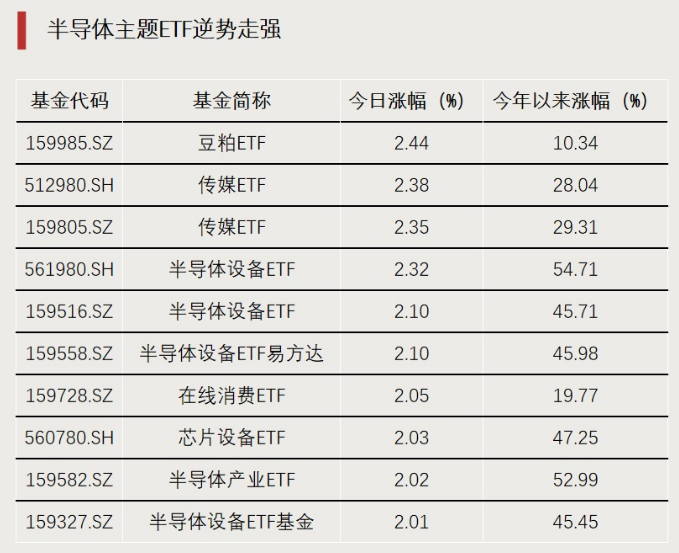
Market Overview - On November 18, over 1,300 ETFs in the market saw more than 200 increase in value, with 52 ETFs rising over 1% [1] - The overall market experienced a pullback, but semiconductor-themed ETFs performed strongly, with several products rising over 2% [2] Fund Flows - On November 17, the ETF market saw a net inflow exceeding 17 billion yuan, with consistent inflows over 100 billion yuan on both November 14 and 17 [3] - The leading ETFs in terms of net inflow included the CSI 300 ETF and the SSE 50 ETF, which attracted 1.658 billion yuan and 1.16 billion yuan respectively on November 17 [9][10] Semiconductor ETFs Performance - On November 18, all semiconductor-related ETFs, except for the China-Korea Semiconductor ETF, saw increases, with six ETFs making it to the top ten gainers [4] - The Semiconductor Equipment ETF (561980) led the category with a 2.32% increase, while the top three weighted stocks were Zhongwei Company, Beifang Huachuang, and Cambrian, each with over 10% weight [4] Commodity ETFs Performance - The Soybean Meal ETF (159985) topped the market with a 2.44% increase, with a trading volume of 789 million yuan, which was over 3.7 times the previous day's volume [4] - Media-related ETFs also performed well, with two ETFs rising over 2.3% [4] Battery ETFs Performance - On November 18, battery sector ETFs experienced significant declines, with many falling over 4% [6] - The top declining ETFs included those linked to the CSI Battery Theme Index and the National New Energy Vehicle Battery Index, with the largest component stocks being Yangguang Electric and CATL [7][8] New ETF Launches - As of November 18, the number of newly established ETFs this year reached 324, with a total issuance scale exceeding 250 billion yuan, marking a historical high [13] Semiconductor Industry Outlook - The semiconductor industry is currently experiencing multiple favorable factors, particularly driven by the surge in AI computing demand and technological breakthroughs [12] - Key drivers include rising storage price expectations, increased capital expenditures, and growing demand for advanced process equipment [12]
闪存龙头宣布涨价50% 10股年内股价翻倍
2 1 Shi Ji Jing Ji Bao Dao· 2025-11-09 14:11
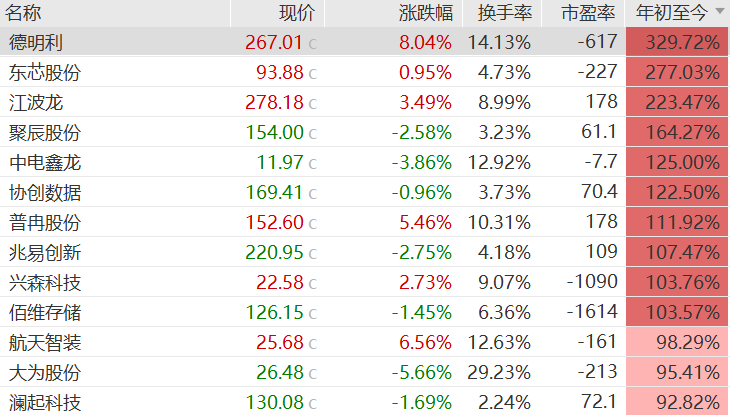
Core Viewpoint - The storage industry is experiencing significant price increases, with SanDisk raising NAND flash contract prices by 50%, marking at least the third price hike this year [1] Group 1: Price Increases and Market Trends - Since September, there has been a strong expectation for price increases across mainstream storage products, including HBM, DRAM, NAND flash, SSDs, and mechanical hard drives, all facing shortages [1] - DDR5 spot prices surged by 25% within a week as multiple storage manufacturers suspended DDR5 pricing [1] - The A-share storage chip sector has seen strong performance, with 10 stocks doubling in price year-to-date, including Demingli, which rose nearly 330% [1][2] Group 2: Company Performance - Jiangbolong reported a 54.6% year-on-year increase in revenue for Q3, reaching 6.539 billion yuan, and a staggering 1994.42% increase in net profit [3] - Bawei Storage achieved a 68.06% year-on-year revenue growth in Q3, totaling 2.663 billion yuan, with net profit soaring by 563.77% [3] - Lanke Technology's Q3 revenue grew by 57.22% year-on-year, reaching 1.424 billion yuan, maintaining stable growth [3] Group 3: Industry Dynamics - The transition from DDR4 to DDR5 is influencing revenue growth among companies, with some experiencing slight declines due to supply shortages and price surges [4] - The overall market for chip design firms is undergoing structural changes driven by the recovery in storage and the rise of edge AI applications [4] - The storage price fluctuations are impacting the shipment rhythm of terminal products, necessitating a balance between technological iteration and cost control [4] Group 4: Future Outlook - ICBC Credit Suisse believes the current storage price increase is primarily driven by unexpected demand from AI servers, with expectations for high prices to persist at least until mid-2026 [5] - The ongoing investment in AI infrastructure by domestic and international manufacturers is expected to further support the upward price trend in the storage market [5]