数字主权

Search documents
欧美数字服务管理分歧进一步加剧
Ren Min Ri Bao· 2025-12-12 19:48
Core Viewpoint - The European Commission has fined the social media platform X €120 million for violating the transparency obligations of the Digital Services Act, marking the first significant enforcement action under this regulation [1][2]. Group 1: Violations and Penalties - X platform was found to have three main violations: misleading "blue check" certification, insufficient transparency in the advertising database, and restrictions on researchers' access to public data. The fines for these violations totaled €120 million, with specific penalties of €45 million, €35 million, and €40 million for each violation respectively [2]. - The European Commission has set two deadlines for X: 60 days to submit a solution to end the "blue check" violations and 90 days to provide a plan to improve transparency in the advertising database and access for researchers [2]. Group 2: Legal and Political Implications - This fine establishes a legal precedent, reinforcing the EU's regulatory authority and potentially leading to a fragmentation of global digital rules. It may also increase compliance costs for X, impacting its business model, and exacerbate the trust crisis between the US and EU [2][3]. - The ongoing enforcement actions against US tech companies by the EU are seen as a means to maintain digital sovereignty, promote fair competition, and protect user rights, particularly in data security and content regulation [3][4]. Group 3: US-EU Relations and Strategic Disagreements - The US has criticized the EU's regulatory framework as unfair to American tech companies, suggesting that it could lead to more frequent enforcement actions against them in Europe. The US views this as a form of digital protectionism [4]. - There are long-standing strategic disagreements between the US and EU regarding data governance, technology regulation, and digital taxation, with the EU emphasizing strict data protection and the US advocating for data free flow [4]. Group 4: Global Digital Governance Challenges - The global digital governance landscape is characterized by fragmentation, with various regional rules like the EU's General Data Protection Regulation and the new US-Mexico-Canada Agreement coexisting, leading to inconsistencies in standards for data flow and AI ethics [5]. - The enforcement actions by the EU may influence global digital governance by promoting the adoption of EU standards among multinational companies, potentially establishing a global regulatory benchmark, but could also intensify the competition for digital sovereignty between the US and EU [6].
微软祭出在亚洲最大投资,175亿美元豪赌印度AI
Tai Mei Ti A P P· 2025-12-10 03:26
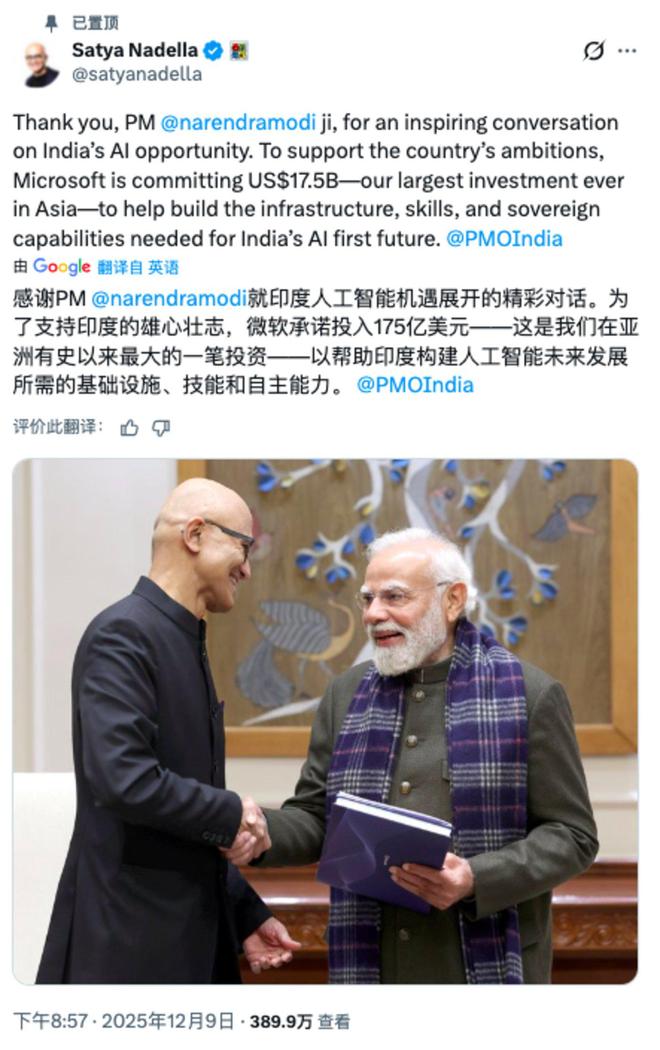
Group 1 - Microsoft CEO Satya Nadella announced a commitment to invest $17.5 billion in India to build AI infrastructure, skills training, and self-sufficiency [1][3] - This investment is the largest ever by Microsoft in Asia and will be implemented gradually from 2026 to 2029, focusing on AI infrastructure centered around large-scale data centers [1][3] - The investment aims to provide AI skills to 20 million Indians by 2030 and create job opportunities while supporting the development of digital governance platforms in India [3][4] Group 2 - Microsoft has been active in India for over 30 years, employing more than 22,000 people, and is leveraging India's policy advantages, labor cost benefits, and IT infrastructure [4][5] - The recent investment comes amid a strategic reevaluation by Microsoft, with Nadella hiring Rolf Harms as an AI economics advisor to rethink the company's business model in the AI era [5][6] - Microsoft’s Copilot AI platform has a high usage rate of 76%, indicating its strategic significance in the AI software service market [6] Group 3 - Other tech giants like Google and Nvidia are also interested in the Indian AI market, with Google planning to invest $15 billion in India over the next five years [7][9] - The Indian government is actively seeking foreign investment in AI and digital infrastructure, viewing AI as a critical area for future development [10] - Predictions indicate that India's data center market could triple in size within five years, with the AI market expected to reach $17 billion by 2027 [10]


国际观察丨跨大西洋关系裂痕加深
Xin Hua She· 2025-12-09 01:32
Core Points - The European Union (EU) imposed a €120 million fine on the US social media platform X, leading to strong reactions from the US government, including threats of tariffs on EU goods if such actions continue [1][3][4] - The fine is part of a broader conflict over digital sovereignty, with the EU asserting its right to regulate US tech companies while the US accuses the EU of unfair practices [4][10] - A recent US national security strategy report indicates a diminishing importance of Europe in US strategic interests, highlighting a growing ideological divide between the US and Europe [6][8][9] Digital Sovereignty Dispute - The EU's fine against X was based on violations of transparency under the Digital Services Act, marking the first non-compliance decision under this legislation [3][4] - US officials characterized the fine as an attack on American tech platforms, questioning Europe's commitment as a partner while seeking military protection from the US [3][4] - The ongoing disputes reflect a deeper struggle for digital sovereignty, with the EU aiming to enhance its regulatory power against the backdrop of US dominance in the digital sector [4][10] Ideological Divide - The US national security strategy report has been criticized for its limited focus on Europe, suggesting a shift in US priorities away from traditional allies [8][9] - Analysts interpret the report as indicative of a fundamental change in the transatlantic relationship, with the US no longer viewing Europe as a core interest [8][9] - The report's language has been described as dismissive and even hostile towards Europe, suggesting a widening ideological gap that could impact future cooperation [8][9] Accelerating European Strategic Autonomy - The EU's regulatory actions against US tech companies are seen as a direct response to perceived US interference in its digital governance [10][13] - European nations are increasing defense spending and military cooperation to reduce reliance on US military support, reflecting a desire for greater strategic autonomy [10][13] - Analysts emphasize the need for the EU to develop a cohesive response to US policy changes, focusing on enhancing defense capabilities and economic security [10][13]

【环球财经】跨大西洋关系裂痕加深
Xin Hua She· 2025-12-08 12:22
新华财经布鲁塞尔12月8日电(记者陈斌杰张兆卿丁英华)欧盟5日对美国社交媒体平台X开出1.2亿欧元 的巨额罚单,引发美方强烈反应。美总统特朗普称,如果欧盟继续惩罚美国科技企业,美国将对欧加征 关税。 巨额罚单背后,是美欧围绕数字主权的矛盾争端。美国近日发布新版国家安全战略报告,数字监管正是 这份报告提到的涉欧内容之一。 分析人士指出,美欧近年来围绕数字监管纷争不断,背后是双方的数字主权之争。欧盟一直承受着美国 数字巨头扩张引发的多重冲击,强调有必要以自决和开放的方式增强欧盟数字主权。而美国为维护全球 数字产业霸主地位,多次指责欧盟数字监管对美科技企业不公平。 美国全国公共广播电台网站的文章说,美欧围绕数字主权问题的矛盾日益加剧。美欧之间从跨大西洋盟 友关系演变为竞争对手。欧洲努力树立数字监管的形象,特朗普政府则试图打破欧方对美国数字公司追 求更高利润设立的壁垒和限制。 欧盟前内部市场委员蒂埃里·布雷顿表示,欧盟面临来自美国的压力,要求其放弃来之不易的网络安全 法规,"我们绝不能屈服"。 价值观"鸿沟"? 在欧盟对X平台开出巨额罚单前不久,美国白宫发布国家安全战略报告,称欧洲在数字监管、市场开放 等领域挑战"美 ...
欧盟开出“数字服务法案”首张罚单:马斯克的X因违反内容法被罚1.2亿欧元
Hua Er Jie Jian Wen· 2025-12-05 13:48
Core Viewpoint - The European Commission has imposed a €120 million (approximately $140 million) fine on Elon Musk's social network X, marking the first penalty since the Digital Services Act (DSA) came into effect, highlighting the growing divide between Europe and the U.S. on tech regulation and freedom of speech [1] Group 1: Fine Details - The fine was based on the principle of transparency rather than the revenue scale of X, which surprised the market as it was previously suggested that the fine could be based on Musk's entire business empire's revenue [2] - X's advertising revenue is projected to be around $2.3 billion this year, while Musk's largest private business, SpaceX, is expected to generate $15.5 billion in revenue by 2025 [2] - The DSA allows the EU to impose fines of up to 6% of a platform's global annual revenue for failing to combat illegal content and misinformation or violating transparency rules [2] Group 2: Compliance and Future Investigations - X has 60 days to propose solutions to rectify the identified issues and must implement reforms within 90 days to avoid additional fines [2] - The fine will be directed to Musk and his AI lab xAI, which competes with OpenAI and acquired the X platform earlier this year [2] - The EU is still investigating other potential DSA violations related to X, which could lead to further fines in the future [3] Group 3: Broader Regulatory Context - The EU is intensifying its regulatory scrutiny of U.S. tech giants under the DSA and the Digital Markets Act (DMA), with recent fines imposed on Apple and Meta [4] - The EU has previously issued significant penalties to other companies, including over $8 billion in fines to Google and a €13 billion tax payment demand from Apple to Ireland [4] - These enforcement actions have consistently drawn criticism from the U.S. government, with past administrations expressing dissatisfaction over the EU's high fines and regulatory measures against American tech companies [5]
重启MH370搜寻:深海数据的贝叶斯博弈与七千万美元的期权对赌
Sou Hu Cai Jing· 2025-12-03 08:25
Core Viewpoint - The search for MH370, marking its 11th anniversary, is not just a governmental response but a calculated commercial experiment involving Ocean Infinity's advanced underwater technology and a $70 million "no find, no fee" clause [2][3]. Group 1: Search Methodology - The search has evolved from traditional grid methods to Bayesian search theory, which updates prior probabilities based on fragmented data, narrowing down the search area to a precise 15,000 square kilometers [3]. - Ocean Infinity's deployment of autonomous underwater vehicles (AUVs) not only aims to find the aircraft but also to create high-resolution seabed maps, which hold significant value in the context of submarine warfare and deep-sea resource exploration [3]. Group 2: Potential Outcomes and Implications - Finding the wreckage may not resolve the controversy but could initiate new legal and geopolitical challenges, especially if mechanical failure or crew manipulation is implicated [4][5]. - The search's intermittent nature reflects a balance of interests among stakeholders, as certainty could lead to significant financial and diplomatic repercussions for involved parties [5]. Group 3: Strategic Insights - The incident emphasizes the need for China to develop independent aviation safety protocols and capabilities, reducing reliance on Western companies for search operations [6]. - The tragedy of MH370 serves as a reminder that possessing core technologies and data sovereignty is crucial for ensuring safety in uncertain environments [6].

【环球财经】美欧数字监管冲突升级 欧战略自主空间遭挤压
Xin Hua She· 2025-12-03 03:58
Core Viewpoint - Recent tensions have arisen between the US and EU regarding digital regulation, with the US accusing the EU of unfair practices against American tech companies and using tariffs as leverage to demand concessions from the EU [1][2]. Group 1: US-EU Trade Relations - The US imposed a 50% tariff on over 400 steel and aluminum products from the EU in August, while criticizing the EU's increasing digital regulations on American tech firms [2]. - The EU has taken enforcement actions against American tech companies, including a €2.95 billion antitrust fine against Google and ongoing investigations into Amazon and Microsoft regarding their cloud services [2][4]. - US Secretary of Commerce has linked digital regulation to steel and aluminum tariffs, suggesting that the EU must adjust its tech regulations for the US to consider lowering tariffs [3][4]. Group 2: Digital Sovereignty vs. Economic Interests - The US aims to maintain its dominance in the global digital industry by pressuring the EU to relax its digital regulations, which the EU views as a matter of sovereignty [4][5]. - The EU insists on its right to legislate digital regulations independently, with officials stating that these regulations are non-negotiable and part of their sovereign rights [4][5]. - The EU's strategic autonomy is being challenged as the US uses tariffs as leverage, creating a dilemma for the EU between maintaining digital sovereignty and protecting its economic interests [5][6]. Group 3: Future Implications - The linkage of tariffs and digital regulation may complicate future trade negotiations, as the US adopts a "cross-issue" negotiation strategy that could embed digital regulation conditions in any trade discussions [5][6]. - The EU's need for tariff reductions may lead to political backlash if concessions are made on digital regulations, while a firm stance could result in greater trade impacts and deepen transatlantic rifts [6].
国际观察|美欧数字监管冲突升级 欧战略自主空间遭挤压
Xin Hua Wang· 2025-12-03 02:21
Core Viewpoint - The conflict between the US and EU over digital regulation is escalating, with the US accusing the EU of unfair practices against American tech companies and using tariffs as leverage to demand regulatory concessions from the EU [1][4]. Group 1: US-EU Trade Relations - Following a trade agreement in July, economic tensions between the US and EU have not subsided, with the US imposing a 50% tariff on over 400 steel and aluminum products from the EU in August [2]. - The EU has enacted a series of enforcement actions against American tech companies under the Digital Services Act and Digital Markets Act, including a €2.95 billion antitrust fine against Google in September [2]. - The US has linked digital regulation to steel and aluminum tariffs, with US Commerce Secretary suggesting that the EU must adjust its tech regulations to receive tariff reductions [3]. Group 2: Digital Sovereignty vs. Digital Hegemony - Observers note that the US is using tariff threats to curb the EU's digital regulatory expansion, aiming to maintain its dominance in the global digital industry [4]. - The EU asserts that its digital regulations are a matter of sovereignty and should not be subject to trade negotiations, emphasizing its right to legislate independently [4][6]. - The EU's strategic autonomy is under pressure, as the US's tariff strategy targets the EU's traditional industries, which are already facing challenges from rising energy costs and green transitions [6]. Group 3: Future Implications - The linkage of tariffs and digital regulation creates a dilemma for the EU, as concessions on digital regulation could provoke political backlash, while a firm stance may lead to greater trade impacts [6]. - Analysts suggest that the US's approach increases its negotiating leverage, as the EU's need for tariff relief is more urgent than the US's need for regulatory relaxation [6]. - The EU's pursuit of strategic autonomy is complicated by its reliance on the US for security and economic cooperation, indicating limited strategic space for the EU [7].
微软CEO称加大欧洲AI投资,强调数字主权新内涵
Xin Lang Ke Ji· 2025-12-02 10:52
Group 1 - Microsoft is increasingly viewing Europe as a core region for its artificial intelligence strategy, with significant investments planned in Germany and the EU [1] - The investments will focus on establishing local facilities in Europe rather than setting up AI factories or cloud centers in the US [1] - Digital sovereignty is emphasized as a critical consideration for countries, with nations seeking to ensure supply continuity and risk resilience [1] Group 2 - True digital sovereignty extends beyond infrastructure to include the development of proprietary AI bases and foundational models by local industries, such as German automotive manufacturers [1] - The US maintains a leading position in AI due to its innovative tech industry and trusted technological framework [1] - Countries that can effectively promote AI applications across various sectors, including economic development, healthcare, manufacturing, and education, are likely to emerge as winners in the AI competition [2]
微软CEO承诺加码欧盟AI投资 强调数字主权不止基建
Xin Lang Cai Jing· 2025-12-02 09:31
Core Insights - Microsoft is increasingly viewing Europe as a core region for its artificial intelligence strategy, with significant investments planned in Germany and the EU [2][5] - The investments will focus on establishing local facilities in Europe rather than in the US, emphasizing the importance of digital sovereignty for countries [2][5] - Digital sovereignty is not just about infrastructure but also about creating AI bases and models tailored to local industries, such as automotive and manufacturing in Germany [2][5] Investment Strategy - Microsoft is committing capital to high-risk investments in Europe, specifically targeting Germany and the broader EU [2][5] - The focus is on building physical entities within European countries, rather than relying on US-based AI factories or cloud centers [2][5] Digital Sovereignty - Digital sovereignty is highlighted as a critical consideration for nations, with a need for countries to ensure supply continuity and risk resilience [2][5] - The true essence of digital sovereignty involves local industries developing their own AI capabilities and models [2][5] Competitive Landscape - The US currently leads in AI systems and models due to its innovative tech industry and trusted technological framework [2][5] - For Europe to become a major player in the global AI landscape, it must promote the practical application of AI across various sectors, including healthcare, manufacturing, and education [3][6] Future Outlook - Countries that can effectively scale AI applications and integrate them into economic growth will emerge as winners in the AI competition [3][6] - Germany and Europe have the potential to excel in AI if they actively adopt relevant technologies and reskill their workforce [3][6]