
注册制

Search documents
“十四五”资本市场制度重塑 锚定下一个五年改革突破口 | “十四五”规划收官
Di Yi Cai Jing· 2025-08-21 14:56
Core Viewpoint - The A-share market has returned to 3700 points, with a total market value exceeding 100 trillion yuan, marking a new high in nearly a decade, as the "14th Five-Year Plan" approaches its conclusion [1] Group 1: Systematic Restructuring of Capital Market - The capital market has undergone a comprehensive transformation during the "14th Five-Year Plan," with the implementation of a registration system and the establishment of a multi-tiered capital market framework [2][10] - The establishment of the Beijing Stock Exchange in 2021 and the full implementation of the registration system in 2023 have significantly lowered the barriers for companies to go public, supporting more innovative and growth-oriented enterprises [2][3] - A total of over 5.64 trillion yuan in equity financing was raised in the A-share market during the "14th Five-Year Plan," with IPOs exceeding 1400 and raising 1.62 trillion yuan, a 30% increase compared to the previous five-year period [2][3] Group 2: Investor Structure and Protection Mechanisms - The proportion of domestic institutional investors in the A-share market has increased, reaching 18.46% by the first quarter of 2025, up from 16.59% in early 2021 [3] - The total cash dividends paid by A-share listed companies exceeded 8 trillion yuan during the "14th Five-Year Plan," an increase of nearly 80% compared to the previous period [5] - Regulatory measures against financial fraud and insider trading have intensified, with the China Securities Regulatory Commission handling 2668 cases of securities and futures violations from 2021 to 2024 [5] Group 3: Challenges and Future Directions - Despite progress, challenges remain, including structural financing issues and insufficient services for innovation, particularly for small and medium-sized enterprises [6][7] - The capital market's service to emerging industries needs improvement, with a focus on providing comprehensive financial support throughout the lifecycle of innovative companies [8][11] - Future reforms will emphasize optimizing the registration system, enhancing the quality of listed companies, and improving investor protection mechanisms [11][12]
“十四五”资本市场制度重塑,锚定下一个五年改革突破口| “十四五”规划收官
Di Yi Cai Jing· 2025-08-21 13:07
Group 1: Core Insights - The "14th Five-Year Plan" is approaching its conclusion, with the A-share market returning to 3700 points and total market capitalization exceeding 100 trillion yuan, marking a nearly ten-year high [2] - The capital market has undergone a systematic transformation over the past five years, with the implementation of a registration system and the establishment of a multi-tiered capital market framework [2][3] - The transition towards high-quality development has revealed shortcomings, including structural imbalances in financing, insufficient service innovation, and the need for improved company quality and investor structure [2][3] Group 2: Market Developments - Significant reforms have occurred during the "14th Five-Year Plan," including the establishment of the Beijing Stock Exchange and the full implementation of the registration system, which replaced the approval system [3] - A total of over 5.64 trillion yuan in equity financing was raised in the A-share market during this period, with IPOs exceeding 1400 and raising 1.62 trillion yuan, a 30% increase compared to the previous five-year period [3][4] - The fundraising scale of the Sci-Tech Innovation Board and the Growth Enterprise Market has significantly increased, with the former raising over 800 billion yuan and the latter over 1 trillion yuan [4] Group 3: Investor Structure and Protection - The proportion of domestic institutional investors in the A-share market has increased, reaching 18.46% by the first quarter of 2025, up from 16.59% in early 2021 [4] - The total cash dividends paid by A-share listed companies exceeded 8 trillion yuan during the "14th Five-Year Plan," an increase of nearly 80% compared to the previous period [6] - Regulatory measures have been strengthened to combat financial fraud and insider trading, with the China Securities Regulatory Commission handling 2668 cases of securities and futures violations from 2021 to 2024 [6] Group 4: Challenges and Future Directions - Despite progress, challenges remain in financing for small and medium-sized enterprises (SMEs) and the need for improved services for innovative companies [8][9] - The capital market's service to the real economy and technological innovation faces issues such as inadequate financial service systems and a lack of support for the entire lifecycle of technology companies [8] - Recommendations include enhancing the construction of the Growth Enterprise Market and Sci-Tech Innovation Board, simplifying listing processes for SMEs, and improving the regulatory framework to monitor fund flows effectively [9][12]
年内券商IPO承销收入超105亿元
Xin Hua Wang· 2025-08-12 06:26
Core Viewpoint - The A-share IPO fundraising scale has increased significantly this year, leading to a rise in underwriting and sponsorship income for securities firms, which has exceeded 10.5 billion yuan. However, issues have arisen within the industry, necessitating enhanced internal controls and improved professional quality in investment banking operations [1][2]. Group 1: IPO Market Performance - A total of 140 companies have completed A-share IPOs this year, raising 220.205 billion yuan, representing a year-on-year increase of 36% [2]. - Since May, there has been a significant decline in IPO fundraising, with only 20.637 billion yuan raised, a month-on-month decrease of 69% [2]. - The underwriting and sponsorship income for 44 securities firms has reached 10.524 billion yuan, showing a slight year-on-year increase [2]. - The highest income from underwriting and sponsorship comes from the Sci-Tech Innovation Board and the Growth Enterprise Market, totaling 4.656 billion yuan and 4.438 billion yuan, respectively, accounting for 86.41% of total income [2]. Group 2: Underwriting Approval Rates - This year, 22 securities firms achieved a 100% approval rate for their underwriting projects, including both leading and smaller firms [3]. - Conversely, five firms reported a zero approval rate, with some projects being rejected or withdrawn [3]. - The overall approval rate for IPO applications stands at 87.27%, with 192 out of 220 companies approved [2][3]. Group 3: Regulatory Environment and Internal Controls - The China Securities Regulatory Commission (CSRC) has issued guidelines to strengthen internal controls within investment banking, highlighting five scenarios that require inspection [3][5]. - The number of licensed sponsors has increased significantly from 3,810 in December 2019 to 7,499 currently, following regulatory changes [4]. - Despite the increase in licensed sponsors, issues have emerged, with 228 sponsors facing penalties for various violations [4]. Group 4: Enhancements in Due Diligence Standards - The CSRC has revised the "Due Diligence Guidelines for Sponsors" and the "Guidelines for Work Papers in Securities Issuance and Listing Sponsorship" to improve the quality of due diligence and standardize practices [5]. - The revisions emphasize the role of sponsors in investment value assessment and introduce new requirements for work papers [5].
创业板综指:逐浪新经济,科技与成长的代名词
申万宏源证券上海北京西路营业部· 2025-08-08 02:38
Core Viewpoint - The article emphasizes the investment value of the ChiNext board, highlighting its role in supporting innovative and growth-oriented enterprises in China, particularly in the context of favorable macroeconomic conditions and government policies aimed at fostering technological innovation [3][5][6]. Group 1: National Policy Support - The ChiNext board has been positioned as a key platform for supporting innovative and growth-oriented enterprises since its establishment in 2009, focusing on "three innovations and four new" (innovation, creation, creativity, new technologies, new industries, new business formats, new models) [5]. - The recent Central Political Bureau meeting in December 2024 underscored the importance of promoting the integration of technological innovation and industrial innovation, indicating strong macro policy support for core assets on the ChiNext board [5]. - Continuous improvements in the registration system and related regulations are attracting more strategic emerging enterprises to list on the ChiNext board, aligning with the national innovation-driven development strategy [5]. Group 2: Macroeconomic Environment - The current macroeconomic environment shows clear signs of recovery, providing strong support for the capital market, with a moderately loose monetary policy and increased fiscal spending [7]. - The global trend of major economies entering a rate-cutting cycle, particularly the strengthening expectations of rate cuts by the Federal Reserve, is enhancing the willingness of global funds to allocate to emerging markets, benefiting the A-share market [7]. - The ChiNext board, representing growth sectors, has significant potential for valuation recovery and strong allocation value due to the improving internal and external environment [7]. Group 3: Key Industry Trends - Key industries within the ChiNext board are expected to emerge from cyclical lows, with signs of recovery in the lithium battery sector driven by improved supply-demand dynamics and price stabilization [8]. - The photovoltaic sector is also showing signs of recovery as supply-side pressures ease, potentially leading to an end to the low-price competition and a return to profitability [8]. - The biopharmaceutical industry is witnessing a turning point due to the easing of policy headwinds and a recovering investment environment, with expectations of entering a new upward cycle [8]. - The electronics and computer sectors are benefiting from the global AI wave, with high demand for computing infrastructure and AI applications driving growth [9]. Group 4: ChiNext Composite Index Characteristics - The ChiNext Composite Index (399102) serves as a core indicator reflecting the overall performance of the ChiNext market, covering over 1,300 stocks and providing comprehensive representation [11][12]. - The index is characterized by a high concentration of emerging industries, with significant representation from sectors such as power equipment, electronics, biopharmaceuticals, and computers [12]. - As of June 30, 2025, the ChiNext Composite Index's price-to-book ratio is 3.59, indicating relatively low valuation levels, with expected net profit growth of 60.21% in 2025 [15][16]. Group 5: Investment Strategy - The ChiNext Composite Enhanced ETF combines passive index investment with active management advantages, aiming to achieve returns that exceed the index through quantitative management techniques [17]. - The investment strategy focuses on selecting stocks based on a quantitative Alpha selection model that considers various fundamental and technical factors, aiming for a balanced and effective portfolio [18].

侃股:高股息股票是长期热点
Bei Jing Shang Bao· 2025-08-06 11:08
Core Viewpoint - High dividend stocks are emerging as a stable investment choice amidst the rapid rotation of market themes, providing a safe haven for funds when other hotspots are absent [1][2][3] Group 1: Market Characteristics - The A-share market is currently exhibiting a dual-style characteristic, with thematic investments leading to rapid intra-day sector rotations while high dividend sectors like banks and utilities attract long-term capital [1][2] - High dividend stocks have shown their substitute value during market volatility, as funds quickly flow into blue-chip stocks with dividend yields exceeding 5% when thematic investments face collective pullbacks [1][2] Group 2: Economic and Regulatory Context - In the context of macroeconomic transformation, high dividend companies often operate in monopolistic industries or possess stable consumer attributes, leading to strong cash flow predictability [2] - The implementation of the registration system is shifting the A-share market from growth premium to value discovery, aligning high dividend strategies with ESG investment principles, which are favored by international capital [2] Group 3: Future Trends - The development of high dividend stocks is expected to follow three major trends: expansion from traditional sectors to stable cash flow industries like consumer goods and pharmaceuticals; the integration of dividend yield with other evaluation metrics such as price-to-earnings ratio and cash flow quality; and the growth of financial derivatives that enhance the efficiency of capital utilization through high dividend hedging strategies [2]
媒体视点 | 开市六周年——科创板成长为资本市场改革“示范田”
Jing Ji Ri Bao· 2025-08-01 08:45
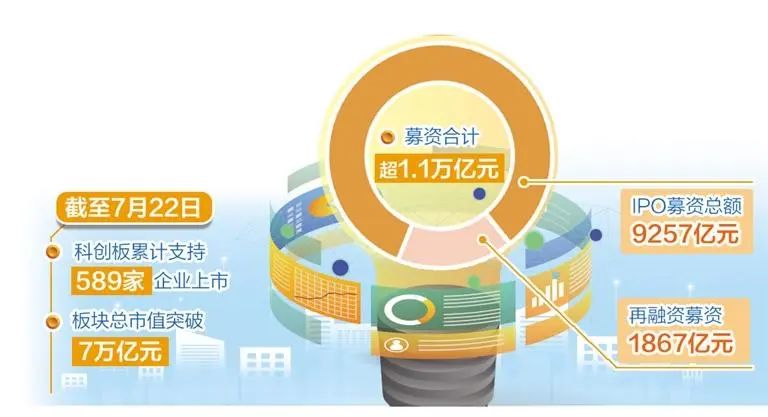
Core Viewpoint - The Sci-Tech Innovation Board (STAR Market) has evolved into a significant platform for supporting "hard technology" enterprises in China, contributing to the development of strategic emerging industries and enhancing the country's technological self-reliance since its inception six years ago [2][3][4]. Group 1: Support for "Hard Technology" Enterprises - As of July 22, the STAR Market has supported 589 companies to go public, raising a total of 925.7 billion yuan through IPOs and 186.7 billion yuan through refinancing, exceeding 1.1 trillion yuan in total [3]. - The total market capitalization of the STAR Market has surpassed 7 trillion yuan, with ten leading companies, including Haiguang Information and SMIC, accounting for nearly 1.47 trillion yuan, representing over 20% of the total market cap [3]. - The STAR Market has facilitated the transformation of technology companies from "catching up" to "leading," significantly contributing to breakthroughs in key technologies and supporting the development of a modern industrial system [3][4]. Group 2: Reform and Innovation - The STAR Market has effectively served as a "testing ground" for reforms, implementing a registration-based IPO system and establishing a flexible and inclusive listing framework [5][6]. - It has supported 54 unprofitable companies and 8 with special share structures, with 22 of these unprofitable companies achieving profitability post-listing [6]. - The recent "1+6" policy reform aims to expand the listing standards to include fields like artificial intelligence and commercial aerospace, enhancing financing channels for cutting-edge technology firms [6][7]. Group 3: R&D Investment and Market Dynamics - In 2024, the STAR Market's R&D investment is projected to reach 168.1 billion yuan, more than three times the net profit attributable to shareholders, with a median R&D investment-to-revenue ratio of 12.6% [8]. - Approximately 90% of STAR Market companies received venture capital investment before going public, indicating a strong trend towards early-stage investment in hard technology [8]. - The STAR Market has established a comprehensive index system with 30 indices, and the total scale of products tracking these indices has reached nearly 260 billion yuan, with the STAR 50 index becoming a flagship for hard technology investments [8]. Group 4: Investor Returns and Future Outlook - 509 companies have disclosed plans for quality improvement and return actions for 2025, covering 87% of the total, with over 60% of companies proposing cash dividend plans for 2024, totaling 38.8 billion yuan [9]. - The STAR Market aims to enhance its ecosystem by optimizing listing standards, improving transparency, and providing differentiated support for technology companies at various development stages [9]. - Future initiatives include expanding financing channels and promoting cross-border technology cooperation to strengthen the global competitiveness of Chinese technology firms [9].
晶阳机电IPO折戟:合规瑕疵与行业寒冬双重夹击下的资本困局
Xin Lang Zheng Quan· 2025-07-31 08:20
Core Viewpoint - The termination of the IPO review for Zhejiang Jingyang Electromechanical Co., Ltd. highlights the survival challenges faced by small enterprises in the photovoltaic equipment sector amid industry cycle adjustments and internal governance issues [1] Compliance Issues - The IPO process was marred by compliance flaws, including undisclosed shareholding arrangements and delayed disclosure of a significant sales contract worth 119 million yuan, which constituted 23.55% of the company's audited total assets for 2022 [2] - Initial inquiries from the Beijing Stock Exchange raised concerns about the authenticity of the shareholding arrangements and potential disputes, which were not satisfactorily addressed by the company [2] Performance Decline - The company's financial performance showed a dramatic decline, with revenues of 308 million yuan in 2024, down 9.24% year-on-year, and a net profit of 46.44 million yuan, down 13.08% [3] - In Q1 2025, revenues plummeted to 42.84 million yuan, a decrease of 55.67%, and net profit fell to 6.25 million yuan, down 67.28%, despite a slight increase in gross margin [3] - The decline is attributed to overcapacity in the photovoltaic supply chain and rapid technological advancements, with the market share of the company's main product being only 2.01% as of March 2023 [3] Industry Insights - The case of Jingyang Electromechanical serves as a warning for companies seeking to go public, emphasizing the importance of demonstrating resilience against industry fluctuations and maintaining credible financial data and governance practices [4] - The company's planned fundraising of 166 million yuan for expansion has been halted, raising questions about its ability to survive in a challenging market characterized by overcapacity and accelerated technological changes [4]
上市5年,股价经过5次腰斩,从308元跌到18,公司终于卖给散户了!
Sou Hu Cai Jing· 2025-07-30 09:49
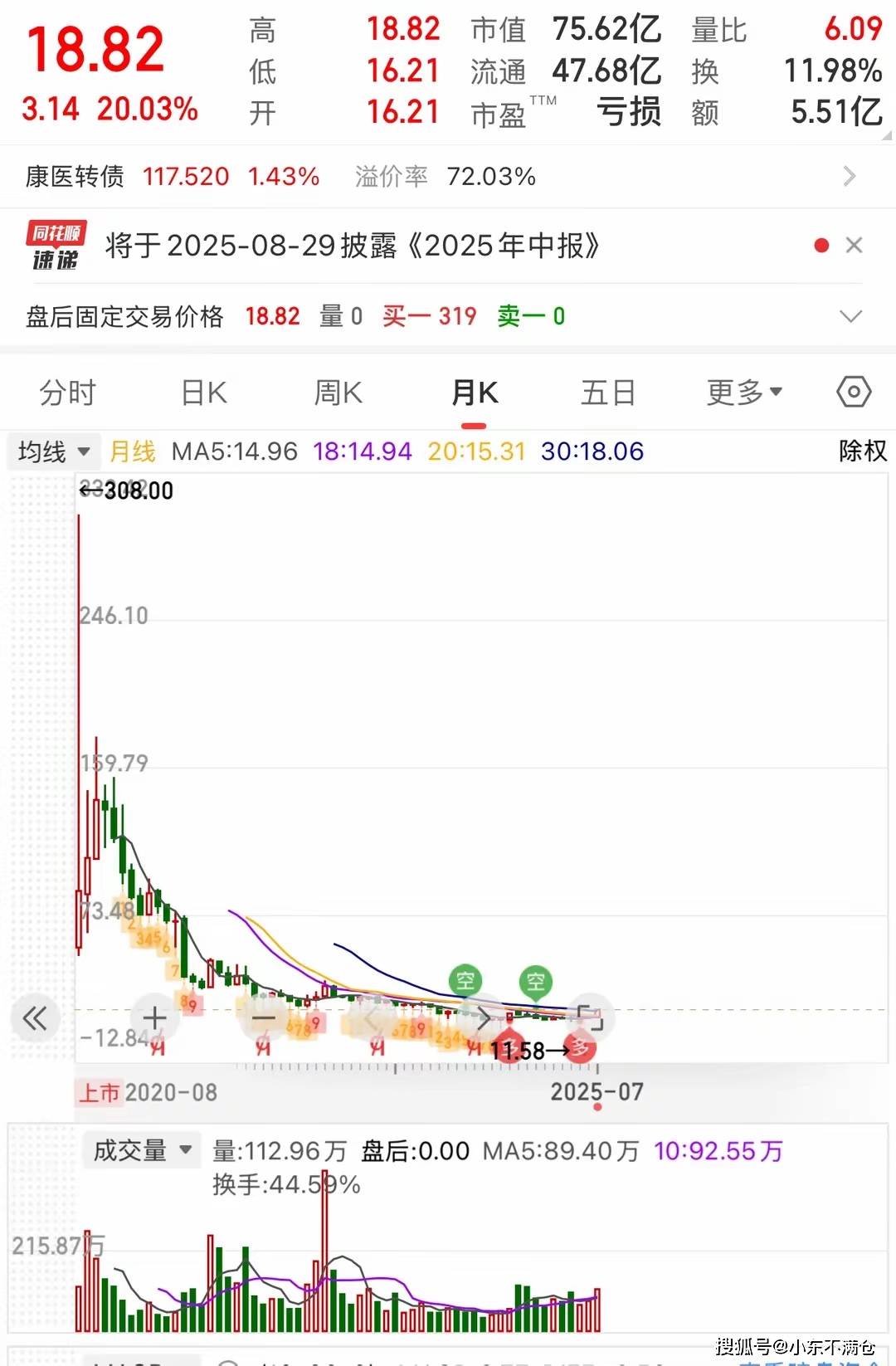
Core Viewpoint - The stock of Kangtai Medical has experienced a dramatic decline from its peak price of 308 yuan to around 18 yuan, leading to significant losses for retail investors, while the company's owner has been cashing out during this downturn [1][3][8]. Company Overview - Kangtai Medical, listed on the ChiNext board on August 24, 2020, specializes in the research, production, and sales of medical diagnostic and monitoring equipment, with a product range that includes blood oxygen monitors, ECG devices, ultrasound equipment, and digital health services [5][8]. Stock Performance - The stock price surged to 308 yuan on its first trading day, representing a more than 30-fold increase from its initial offering price of 10.16 yuan, but has since plummeted, with the lowest recorded price around 11 yuan [8][10]. - The company's market capitalization has decreased to approximately 7.562 billion yuan, with a current stock price of 18.82 yuan [6][9]. Financial Performance - Kangtai Medical reported a net profit of 3.524 billion yuan in 2021, a decline of 42.56% year-on-year, and further decreased to 1.962 billion yuan in 2022, down 44.32% year-on-year. By 2024, the company reported a net loss of 77.9 million yuan, a decline of 147% year-on-year [8][12]. Management Actions - The owner, Hu Kun, holds 188 million shares and announced plans to sell 12 million shares at the lowest stock price, cashing out over 160 million yuan, which has angered investors [3][10]. - Despite the company's losses, Hu Kun's family received nearly 50 million yuan in dividends from a 100 million yuan distribution, raising concerns among shareholders [12][14]. Investor Sentiment - Retail investors express frustration over the company's management and stock performance, feeling that they have been misled and financially harmed, with many feeling trapped in their investments [16].
帮主郑重:ST沐邦突遭立案!中长线投资如何避雷?
Sou Hu Cai Jing· 2025-07-28 03:43
Group 1 - ST Muban has been officially investigated by the China Securities Regulatory Commission (CSRC) for financial fraud, marking a significant regulatory action as four listed companies were simultaneously targeted [1][3] - The CSRC's investigation highlights multiple infractions by ST Muban, including false financial disclosures, accounting errors, and the misappropriation of over 400 million yuan in fundraising [3][4] - The company is facing severe financial distress, with a projected loss of 1.16 billion yuan in 2024 and a significant drop in stock price to 4.94 yuan, resulting in a market capitalization of just over 2 billion yuan [3][4] Group 2 - The recent regulatory actions signal a stricter approach to eliminating "zombie companies" from the market, emphasizing the need for stability and rigorous oversight [4][5] - The CSRC's chairman has stated that the policies will not protect underperforming stocks, indicating a clear stance on the necessity of delisting companies that fail to meet standards [4][5] - Investors are advised to be cautious of companies with deteriorating fundamentals and poor governance, as these are often the first to face regulatory scrutiny [6][7] Group 3 - A legal window for affected investors has opened, allowing for potential claims against ST Muban for those who held shares during specific periods [8][9] - Investors are encouraged to preserve transaction records and account proofs to prepare for collective litigation following the regulatory outcomes [9][10] - The regulatory actions are viewed as a necessary step for market purification, aiming to eliminate fraudulent practices and allocate resources to genuinely strong companies [10]


券商板块“异动”频频 注册制下证券行业马太效应或将加剧
Zheng Quan Ri Bao Wang· 2025-07-28 03:01
Group 1 - The recent merger news among brokerages has led to significant movements in the brokerage sector, attracting attention from institutions and investors [1] - The current macroeconomic environment remains unstable due to ongoing foreign pandemic issues and complex international relations, which has resulted in high market volatility affecting the brokerage sector [1] - The regulatory authorities are focusing on financial supply-side reforms, which will benefit the brokerage sector as a key participant in the capital market [1] Group 2 - The brokerage sector's valuation stands at 2.02 times, which is at the historical median level, indicating potential investment opportunities given the clarity of regulatory policies and liquidity [2] - The trend towards creating large-scale brokerages continues, with leading brokerages expected to benefit from their strong capital and risk management capabilities [2] - The implementation of the registration system for IPOs is anticipated to enhance the growth potential for brokerage investment banking businesses, with larger brokerages likely to gain a competitive advantage [1][2]