流动性紧缩

Search documents
阿根廷流动性紧缩,总统米莱与顶级银行发生冲突
Sou Hu Cai Jing· 2025-08-20 18:07
Core Viewpoint - The newly implemented liquidity measures aimed at curbing the peso sell-off have intensified tensions between President Milei and the banking sector, threatening the profitability of banks [1] Group 1: Regulatory Changes - New regulations require financial institutions to meet reserve requirements on a daily basis instead of monthly, which is seen as inefficient and costly by bankers [1] Group 2: Industry Response - Major financial institutions are preparing a document with operational reform proposals to be submitted to the central bank [1]
阿根廷新流动性措施致米莱与大型银行关系紧张
Xin Hua Cai Jing· 2025-08-20 14:18
Group 1 - Argentina has implemented new liquidity measures to curb the sell-off of the peso, leading to tensions between President Milei and the banking sector [1] - The new regulations require banks to meet reserve requirements daily instead of monthly, which is seen as inefficient and costly by bankers [1] - The tensions began at the end of July when the government decided to issue local currency debt to withdraw pesos from the market, aiming to suppress the demand for dollars [1] Group 2 - The peso depreciated over 12% in July, marking its worst performance since President Milei took office in December 2023 [1] - This move has resulted in liquidity tightening, pushing real interest rates into double digits [1] - Subsequently, the central bank ordered banks to meet reserve targets daily and raised some reserve ratios, forcing banks to compete for pesos in a tight liquidity environment, which has increased financing costs [1]
两大“抽水机”将同时开启!2019年式的市场风暴恐正酝酿
Jin Shi Shu Ju· 2025-08-12 00:34
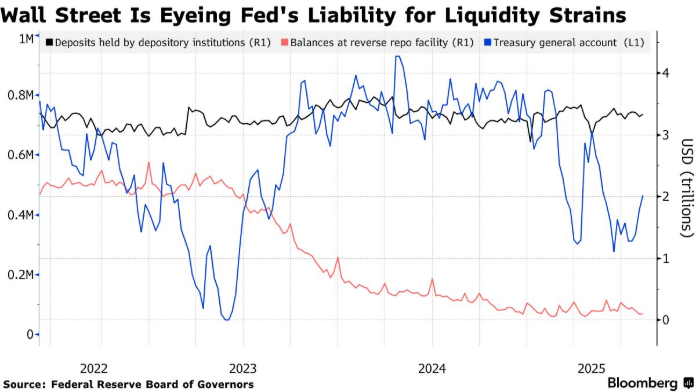
Group 1 - The U.S. Treasury is increasing the supply of short-term government securities to rebuild its cash reserves, raising concerns about potential liquidity tightening in the financing market [1] - Approximately $328 billion of short-term government securities have been issued since the debt ceiling was raised, which is drawing funds from the financial system [1] - The Treasury General Account (TGA) is expected to increase from about $490 billion to $860 billion by mid-September, potentially causing bank reserves to drop below $3 trillion for the first time since the pandemic [1] Group 2 - Federal Reserve Governor Waller indicated that the Fed could reduce bank reserves to around $2.7 trillion without disrupting the overnight financing market [4] - The usage of the Fed's overnight reverse repurchase (RRP) tool, a key measure of excess liquidity, has been declining, making bank reserves increasingly critical for financing market functionality [4] - Following a spike at the end of July, the balance of the RRP tool has been on a downward trend, with estimates suggesting it could approach zero by the end of August [4] Group 3 - As the RRP tool nears depletion, the increase in Treasury cash balances will directly consume bank reserves, raising the likelihood of a liquidity crunch similar to the one experienced in 2019 [5]

流动性紧缩冲击来袭?分析师预警:美债发行“抽走”资金,9月恐成市场压力临界点
Zhi Tong Cai Jing· 2025-08-11 23:59
Group 1 - The U.S. Treasury has issued approximately $328 billion in short-term government bonds to replenish cash reserves since the debt ceiling was raised, leading to concerns about potential liquidity constraints in the financing market [1] - Bank reserves remain ample at around $3.33 trillion, providing necessary buffers for the financing market, but this situation may change in late September as the Treasury's total account is expected to increase from about $490 billion to $860 billion [1] - The decrease in available reserves is projected to bring the bank reserve balance below $3 trillion for the first time since the pandemic, which may require increased attention to daily changes in overnight market conditions [1] Group 2 - Federal Reserve Governor Waller is reportedly a candidate for the next Fed Chair, suggesting that the Fed could reduce bank reserves to about $2.7 trillion, which is significant for assessing the impact on overnight funding markets [2] - The usage of the Fed's overnight reverse repurchase agreement (RRP) tool has been declining, indicating a reduction in excess liquidity, with estimates suggesting that RRP usage could drop to zero by the end of August [2] - The increase in Treasury cash balances is expected to lead to a decrease in bank reserves, raising the likelihood of funding stress in the market [2]
A 股风格转换的历史复盘与回测分析
Yin He Zheng Quan· 2025-07-16 11:54
Historical Review of Size and Style Rotation - From 2008 to 2010, small-cap stocks outperformed due to significant economic stimulus and abundant liquidity, with small-cap stocks being more sensitive to funding[6] - Between 2011 and 2013, large-cap stocks gained favor as economic growth pressures increased, highlighting their defensive attributes[8] - The period from 2013 to 2015 saw a resurgence of small-cap stocks driven by the rise of new industries and increased M&A activity, with leverage funds entering the market[9] - From 2016 to 2021, large-cap stocks dominated as supply-side reforms improved profitability for leading companies, while M&A activity cooled[10] - In the 2021 to 2023 period, small-cap stocks regained strength due to changes in funding structure and the rise of new industries like AI[12] Growth vs. Value Style Rotation - From 2011 to 2014, value stocks outperformed as the economy shifted from stimulus-driven growth to self-sustained growth, with GDP growth declining[15] - In 2015, growth stocks saw a rebound due to the rise of the internet and new industries, despite ongoing economic pressures[19] - The period from July 2016 to October 2018 favored value stocks as traditional industries improved amid tightening liquidity[21] - From November 2018 to July 2021, growth stocks outperformed due to the rise of new industries and favorable liquidity conditions[23] - From August 2021 to August 2024, value stocks are expected to dominate due to tightening global liquidity and geopolitical uncertainties[25] Key Indicators and Future Outlook - The historical analysis indicates that size and style rotations are influenced by fundamental factors, liquidity, valuation, and policy[27] - The correct prediction rate for small-cap outperformance since 2005 is 69%, while for growth vs. value since 2011 is 77%[2] - In the first half of 2025, small-cap stocks outperformed with a 7.54% increase in the CSI 1000 index compared to a 1.37% increase in the CSI 300 index[2] - The outlook for the second half of 2025 suggests a potential shift towards large-cap stocks due to institutional investor preferences and external uncertainties[2]
日本成贸易谈判首选,美国会开出哪些条件?
Hua Er Jie Jian Wen· 2025-04-14 10:06
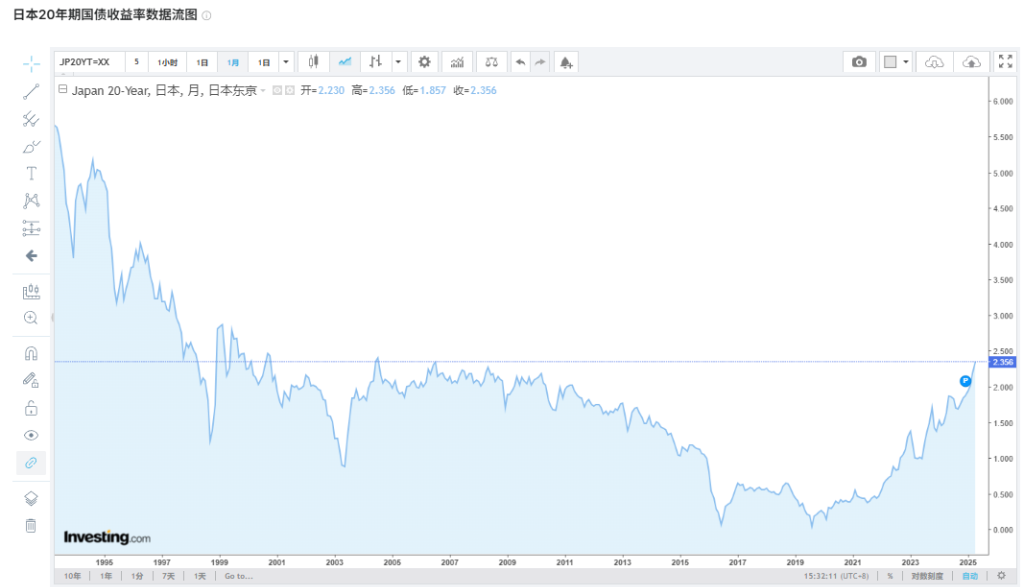
Core Viewpoint - The United States has initiated substantive trade negotiations with Japan, aiming to establish Japan as a model case for agreements with other countries following the recent tariff delay announcement [1][2]. Group 1: U.S.-Japan Trade Negotiations - Japan is the first country to engage in substantial trade negotiations with the U.S. after the tariff delay, indicating a strategic choice by the U.S. [1][2]. - The U.S. intends to use Japan as a template for future agreements with other nations, highlighting the importance of this negotiation [2]. Group 2: Potential U.S. Demands on Japan - The U.S. may push Japan to set explicit trade surplus targets, which could force Japan to reduce exports and increase imports, impacting its trade balance [3]. - Other potential demands include pushing for yen appreciation, which could harm Japanese export-oriented companies and hinder economic recovery [3]. - The U.S. might also request Japan to extend the maturity of its U.S. Treasury holdings, limiting Japan's foreign exchange reserve flexibility [3]. Group 3: Japanese Government's Stance - Japanese Prime Minister Kishida emphasized the importance of not compromising too quickly for a deal, advocating for a careful approach to negotiations [4]. - The potential U.S. demands could significantly impact Japan's financial markets, with warnings of a rapid depreciation of the dollar and a substantial appreciation of the yen [4]. Group 4: Impact on Japanese Economy and Bond Market - A stronger yen could reduce the competitiveness of Japanese exports, adversely affecting manufacturing firms that rely heavily on exports [5]. - Increased fiscal spending, as suggested by the U.S., would require Japan to issue more government bonds, exacerbating supply pressures in the bond market [5]. - The Japanese long-term bond market is already showing signs of instability, with recent spikes in yields indicating market volatility [5]. Group 5: Global Market Implications - Nomura warns of a global bond market imbalance and tightening liquidity risks, which could lead to broader credit contractions [7]. - The recent fluctuations in global stock markets and the widening of high-yield bond spreads indicate ongoing credit tightening [7].
集体飙涨!18万人爆仓
21世纪经济报道· 2025-03-03 02:22
Market Overview - On March 3, cryptocurrencies experienced a sudden surge, with Bitcoin rising over 7.7% and Ethereum increasing by more than 11% [1][2] - Notable price movements included ADA soaring by 63.6% and XRP jumping by 28.1% [1][2] Liquidation Events - Over the past 24 hours, more than 180,000 traders were liquidated, with a total liquidation amount of approximately $828 million [2] - The liquidation breakdown showed significant losses across various time frames, with $830 million liquidated in 24 hours, including $280 million from long positions and $550 million from short positions [3] Regulatory Developments - President Trump announced that XRP, Solana (SOL), and Cardano (ADA) will be included in the U.S. cryptocurrency reserves [5][8] - A new working group was established to assess the feasibility of creating a national digital asset reserve and to develop a regulatory framework for the cryptocurrency industry [6][7] Market Sentiment and Reactions - The recent surge in cryptocurrency prices is seen as a response to the Biden administration's regulatory stance on the crypto industry [7] - Trump's upcoming cryptocurrency summit on March 7 aims to further solidify his support for the crypto sector [10] Historical Context - The cryptocurrency market faced a significant downturn prior to the recent surge, with Bitcoin dropping over 5% on February 26, reaching below $84,000, a nearly 20% decline from its January peak [13][16] - The market's volatility was exacerbated by a major hacking incident at Bybit, which resulted in the loss of over $1.5 billion in assets, triggering panic among investors [16][19]