
经济不确定性

Search documents
美国上周首次申请失业金人数降至22万
Sou Hu Cai Jing· 2025-11-20 14:02
Core Insights - The number of initial unemployment claims in the U.S. dropped to 220,000, indicating that employers are generally retaining their current workforce despite economic uncertainties [1] - This report marks the first nationwide initial unemployment claims data release after a 43-day government shutdown [1] - The October employment report will not be published, and the November employment data will be released on December 16, after the last Federal Reserve meeting of the year [1] - Policymakers are divided on whether a third interest rate cut should occur this year [1]
国际金价小幅下跌,分析师认为黄金价格可能很快见底
Huan Qiu Wang· 2025-11-19 02:06
Group 1 - The core viewpoint of the articles indicates a decline in international precious metal futures, with COMEX gold futures down 0.17% to $4067.40 per ounce and COMEX silver futures down 0.34% to $50.54 per ounce, attributed to reduced expectations for a rate cut by the Federal Reserve in December [1][4] - Analysts highlight that the Federal Reserve's Vice Chairman Jefferson emphasized a cautious approach as interest rates approach neutral levels, reflecting a divergence in monetary policy perspectives among Fed officials [1] - The expectation for a 25 basis point rate cut in December has decreased to 52.6%, down from 93.7% last month, contributing to the downward pressure on gold prices [1] Group 2 - Despite recent declines, analysts believe that gold prices may soon reach a bottom, as future rate cuts by the Federal Reserve are still anticipated, and central bank diversification in investments remains strong [1] - Investors typically view gold as a hedge against inflation and economic uncertainty, with gold prices having risen over 50% this year, positioning it for its best annual performance since 1979 [4] - India's Ministry of Commerce reported that gold imports in October reached a record high of $14.72 billion, nearly tripling year-on-year, with cumulative gold imports for the fiscal year so far at $41.23 billion, a year-on-year increase of 21.44% [4]

Gold prices plunge for fourth straight day of declines as hopes for interest-rate cut fade
New York Post· 2025-11-18 17:48
Core Viewpoint - Gold prices have declined to their lowest levels in over a week due to reduced expectations for an interest rate cut by the Federal Reserve in December [1][4]. Group 1: Gold Price Movement - Gold futures fell 0.3% to $4,062.20 per ounce, marking the fourth consecutive day of declines and the lowest price since November 10 [1]. - The probability of a quarter-point interest rate cut next month has decreased to 52.6%, down from 93.7% a month ago [1]. Group 2: Market Sentiment and Fed Commentary - Market participants are adjusting their expectations for US interest rate cuts following hawkish remarks from Federal Reserve officials [2]. - Fed Vice Chair Philip Jefferson emphasized the need for a cautious approach to further rate cuts, which has unsettled investors seeking lower interest rates [4][6]. Group 3: Economic Indicators and Future Outlook - The Federal Reserve officials lacked access to critical government data during the recent shutdown, which is essential for their interest rate decision-making [3]. - Upcoming releases of Fed minutes and the delayed September jobs report are anticipated to provide significant insights into the US economy's health [3]. Group 4: Gold's Performance and Influencing Factors - Despite recent declines, gold has gained over 50% this year, positioning it for its best performance since 1979, driven by factors such as inflation concerns and central bank buying [6][7]. - The US economy is showing signs of cooling, which is expected to lead to falling interest rates and a weaker US dollar, creating a favorable long-term outlook for gold [10].

美国消费健康状况风向标本周揭晓:家得宝(HD.US)、劳氏(LOW.US)财报将释放重要信号
Zhi Tong Cai Jing· 2025-11-18 07:01
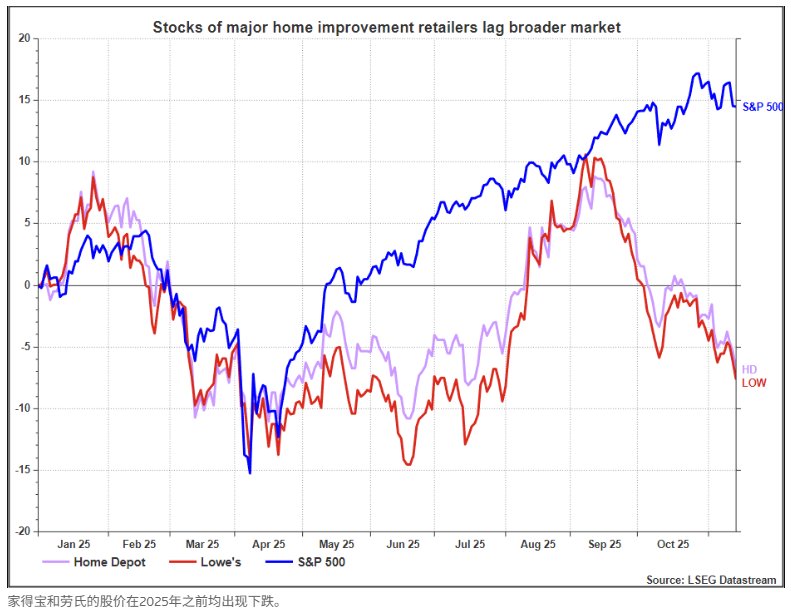
Group 1 - Home Depot and Lowe's are expected to report slight sales growth in their upcoming quarterly earnings, providing insight into market conditions and consumer spending on home improvement and DIY projects [1] - The companies face higher raw material costs due to tariffs imposed by the Trump administration, but a temporary pause on tariffs for Chinese goods may offer short-term relief [1] - The actual tariff rate borne by American consumers has surged to 17.9%, the highest level since 1934, adding pressure to household budgets [1] Group 2 - Analysts predict Home Depot's same-store sales will grow by 1.5% in the third quarter, compared to a decline of 1.3% in the same period last year [3] - Lowe's is expected to see a 1% increase in same-store sales, up from a 1.1% decline in the previous year [4] - The stock prices of Lowe's and Home Depot have dropped approximately 16% and over 11% respectively in the past 12 months, while the S&P 500 index has risen by 15% [3] Group 3 - Demand for home improvement is anticipated to be led by professional customers, while DIY customers are expected to engage in smaller projects [6] - Home Depot and Lowe's are increasing their focus on professional contractors and builders to offset weak DIY demand during a sluggish real estate market [6] - Lowe's has made significant acquisitions, including a $1.33 billion purchase of Artisan Design and an almost $8.8 billion acquisition of Foundation Building Materials, while Home Depot announced a $4.3 billion acquisition of GMS [6]


香港第一金:黄金短期偏震荡,等待数据指引方向
Sou Hu Cai Jing· 2025-11-14 07:29
Economic Uncertainty - The end of the U.S. government shutdown has led to concerns about the potential delay or non-release of key economic data, such as the October CPI and employment report [2] Federal Reserve Policy Expectations - The probability of a rate cut in December has decreased to approximately 50%, down from over 95%, as recent statements from Federal Reserve officials lean towards a hawkish stance, putting pressure on gold prices [3] Dollar and Safe-Haven Sentiment - A weakening dollar, nearing a two-week low, combined with a soft stock market, has created a demand for safe-haven assets, providing support for gold prices [4] - The uncertainty surrounding the release of key economic data from the U.S. government, particularly the October CPI and employment report, is crucial as it will directly impact the Federal Reserve's interest rate decisions [4] Technical Levels - Resistance level is at $4245, which is the previous day's high and a key resistance point [5] - Support levels are identified between $4145 and $4160, which correspond to the previous day's low and the current Asian session low [6] - A strong support/resistance level is noted at $4100 (psychological level) and $4300 (round number) [6]

Where Do Gold Prices Go From Here? Here's What Experts Say
Investopedia· 2025-11-13 23:30
Core Insights - The price of gold has experienced significant fluctuations, reaching a high of $4,360 per troy ounce on October 20, before dropping to $3,970 and then rebounding to around $4,260 recently, indicating ongoing volatility in the market [2][3][7] - Analysts suggest that despite the end of the federal government shutdown, the demand for gold remains strong due to economic uncertainty and potential political risks, with UBS projecting a possible price increase to $4,700 if risks escalate [3][4][7] Investment Demand - There has been a notable increase in investment demand for gold, particularly from North American exchange-traded funds (ETFs), which have significantly boosted trading volumes [3][8] - U.S. gold trading volume reached a record high of $208 billion per day in October, with a 59% increase in September and a further 51% rise in October, driven primarily by ETF demand [8] Market Environment - The current market environment remains uncertain, with potential for further government shutdowns and legal challenges to tariff policies, which could sustain support for gold prices [9][10] - UBS anticipates that global gold demand could reach its highest level since 2011 due to factors such as potential interest rate cuts, a weakening U.S. dollar, and high levels of global government debt [11] Retail Demand - Retail demand for gold has shown improvement, particularly for gold bars in the U.S., with reports of strong sales from retailers like Costco, driven by consumer trust and stable pricing in a rising market [12]

Historic Government Shutdown Is Coming to an End—But Another Budget Fight Looms
Investopedia· 2025-11-13 04:30
Core Points - The longest government shutdown in U.S. history, lasting 43 days, is set to end after the House voted to pass a funding bill [1][2][6] - The funding bill will keep the government operational until January 30, allowing federal workers to return to their jobs and receive back pay [1][6] - The shutdown has caused significant economic disruptions, including delayed paychecks for federal workers and a halt in crucial economic data reporting [4] Economic Impact - The end of the shutdown may alleviate some economic uncertainty that has affected the economy in recent months [3] - Despite the anticipated economic rebound once federal workers receive back pay, there may be lasting damage due to the shutdown's effects [4] - The conflict that led to the shutdown remains unresolved, particularly regarding the expiration of health insurance subsidies under the Affordable Care Act, which could increase premiums by an average of $1,000 per month for affected individuals [4][7]
日本央行利率决议解读,2025财年GDP上调,日元汇率走势分析
Sou Hu Cai Jing· 2025-11-07 04:11
Group 1 - The Bank of Japan decided to maintain the benchmark interest rate at 0.5%, marking the sixth consecutive meeting without change, reflecting a cautious approach to economic uncertainty [2][4] - Two members of the policy committee voted in favor of raising the rate to 0.75%, indicating growing internal divisions regarding inflation pressures and the normalization of interest rates [2][4] - The central bank emphasized the need to monitor economic data closely, suggesting that if inflation continues to improve, a gradual rate hike may be considered to prevent overheating [2][4] Group 2 - The latest economic forecast from the Bank of Japan raised the GDP growth rate for the fiscal year 2025 to 0.7%, driven by increased corporate investment and consumer recovery [4] - Core CPI is expected to remain around the 2% target over the next three years, supported by falling energy prices and wage growth, although risks of inflation decline due to weak demand or cost fluctuations were noted [4][5] - The improvement in economic data provides room for potential rate hikes, but the central bank must ensure the sustainability of inflation [4][5] Group 3 - Following the announcement, the yen experienced a brief rebound, with the USD/JPY rate dropping to 153.08, but later retraced some gains due to ongoing pressure from interest rate differentials with other major economies [5][7] - Market reactions indicate that the necessity for a rate hike is increasing, with concerns that inaction could lead to further yen depreciation and heightened import inflation [5][7] - The future trajectory of the yen will depend on the timing of the Bank of Japan's rate hikes and the global economic environment, necessitating close monitoring of subsequent data releases [5][7] Group 4 - Looking ahead, the Bank of Japan faces increasing domestic and international pressures, with rising wages and consumer recovery potentially driving sustained inflation [7][8] - Calls for interest rate normalization from the business sector are growing, while the high interest rate environment maintained by other central banks exacerbates yen weakness and capital outflow risks [7][8] - Analysts suggest that the Bank of Japan may initiate rate hikes in early next year, but the approach will be gradual to avoid disrupting the fragile economic recovery [7][8]

Ultima Markets:美联储内部分歧加剧,鲍威尔共识领导力遇考
Sou Hu Cai Jing· 2025-11-06 06:18
Core Viewpoint - The article discusses the increasing internal divisions within the Federal Reserve regarding monetary policy, highlighting the challenges faced by Chairman Powell in achieving consensus amid economic uncertainty and differing opinions on interest rate decisions [3][6]. Group 1: Internal Divisions - The Federal Reserve's monetary policy committee, consisting of 19 members, is experiencing deepening divisions, with a notable split in votes during the recent interest rate decision [3][4]. - The recent decision to lower the benchmark interest rate by 25 basis points was met with a 10-2 vote, marking the third occurrence of dual dissent among voting members since 1990 [3]. - Dissenting votes came from Governor Milan, who favored a 50 basis point cut, and Kansas City Fed President George, who preferred to maintain the current rate [3]. Group 2: Powell's Leadership Challenges - Chairman Powell's ability to build consensus is under significant scrutiny, especially as he faces strong disagreements among officials on future actions [3][6]. - The upcoming December meeting may not guarantee another rate cut, as the committee could opt to either lower rates by 25 basis points or keep them unchanged [3][6]. - Powell's leadership has been effective in the past, but the current environment presents a more challenging landscape for achieving agreement among committee members [7]. Group 3: Economic Context and Market Implications - Investors are navigating a complex economic backdrop characterized by government shutdowns leading to data shortages, a weakening labor market, and persistent inflation [3][4]. - The political landscape is also affecting the Fed's independence, with the Trump administration criticizing the Fed and preparing to nominate a successor for Powell [3]. - Economists predict that the Fed may continue to lower rates, but the process could become "chaotic and disorderly," leading to a more unpredictable investment environment [8].

美国纸箱出货量跌至十年低位 加剧旺季零售销售疲弱忧虑
Zhi Tong Cai Jing· 2025-11-03 22:25
Core Insights - The sales of corrugated boxes in the U.S. continue to weaken, raising concerns about a disappointing holiday shopping season this year [1] - The third quarter saw the lowest shipment volume of corrugated boxes since 2015, continuing a trend of weakness from the second quarter [1][4] - Major companies in the packaging sector have warned that economic uncertainty is impacting retail and consumer spending [1] Industry Overview - Corrugated boxes are crucial packaging materials for food, daily necessities, and e-commerce shipping, often seen as a leading indicator of retail demand [4] - Typically, October sees a surge in box orders for retailers to stock up for the holiday season, but this year is notably sluggish [4] - A media survey indicated that most box factories reported October orders as "flat or below normal levels" [4] Consumer Confidence and Economic Indicators - The U.S. consumer confidence index has dropped to a five-month low, and manufacturing activity has contracted for eight consecutive months [4] - Thomas Hassfurther, President of Packaging Corporation of America, noted a lack of economic momentum and highlighted ongoing trade uncertainties affecting business [4] Company Performance - Smurfit Westrock reported an 8.7% year-over-year decline in box volume in North America for the third quarter, leading to a stock price drop of over 12%, marking the lowest closing price since its listing in July 2024 [4] - International Paper lowered its net sales forecast for this year and 2027, with a nearly 13% drop in stock price following the announcement [5] - CEO Andy Silvernail of International Paper projected a 1% to 1.5% decline in corrugated box shipments for 2024, attributing this to trade uncertainties, weak consumer confidence, and a sluggish real estate market [5] Market Outlook - Industry experts believe that the weak demand for corrugated boxes reflects a lack of manufacturing and retail restocking activity, suggesting that this year's holiday shopping season may fall short of previous years [5] - E-commerce, department stores, and durable goods sectors are facing heightened operational uncertainties [5]


