
结构性降息

Search documents
国债期货日报:结构性降息落地,国债期货大多收跌-20260120
Hua Tai Qi Huo· 2026-01-20 03:06
1. Report Industry Investment Rating - No relevant information provided 2. Core View of the Report - The bond market oscillates between stable growth and easing expectations, and short - term attention should be paid to policy signals at the end of the month. Influenced by the stock market, the Political Bureau meeting released a signal of loose money, the LPR remained unchanged, and the Fed's interest - rate cut expectation continued. Meanwhile, the increase in global trade uncertainty added uncertainty to foreign capital inflows [3]. 3. Summary by Directory I. Interest Rate Pricing Tracking Indicators - **Price Indicators**: China's monthly CPI had a 0.20% month - on - month increase and a 0.80% year - on - year increase; China's monthly PPI had a 0.20% month - on - month increase and a - 1.90% year - on - year decrease [8]. - **Monthly Economic Indicators**: The social financing scale was 442.12 trillion yuan, with a month - on - month increase of 2.05 trillion yuan and a growth rate of 0.47%; M2 year - on - year growth was 8.50%, with a month - on - month increase of 0.50% and a growth rate of 6.25%; the manufacturing PMI was 50.10%, with a month - on - month increase of 0.90% and a growth rate of 1.83% [9]. - **Daily Economic Indicators**: The US dollar index was 99.04, with a month - on - month decrease of 0.34 and a decline rate of 0.34%; the US dollar against the offshore RMB was 6.9549, with a month - on - month decrease of 0.002 and a decline rate of 0.03%; SHIBOR 7 - day was 1.47, with a month - on - month increase of 0.00 and a decline rate of 0.20%; DR007 was 1.48, with a month - on - month increase of 0.03 and a growth rate of 2.37%; R007 was 1.68, with a month - on - month increase of 0.17 and a growth rate of 11.44%; the 3 - month inter - bank certificate of deposit (AAA) was 1.59, with a month - on - month increase of 0.00 and a decline rate of 0.06%; the AA - AAA credit spread (1Y) was 0.09, with a month - on - month increase of 0.00 and a decline rate of 0.06% [10]. II. Overview of the Treasury Bond and Treasury Bond Futures Market - Relevant figures include the closing price trend of the main continuous contract of treasury bond futures, the price change rate of each treasury bond futures variety, the precipitation fund trend of each treasury bond futures variety, the position ratio of each treasury bond futures variety, the net position ratio of the top 20 in each treasury bond futures variety, and the long - short position ratio of the top 20 in each treasury bond futures variety [12][13][18]. III. Overview of the Money Market Fundamentals - Relevant figures include the Shibor interest rate trend, the maturity yield trend of inter - bank certificates of deposit (AAA), the statistics of inter - bank pledged repurchase transactions, the local bond issuance situation, the spread between China Development Bank bonds and treasury bonds, and the treasury bond issuance situation [23][24][25]. IV. Spread Overview - Relevant figures show the inter - period spread trend of each treasury bond futures variety and the term spread of spot bonds and the cross - variety spread of futures, such as (4*TS - T), (2*TS - TF), (2*TF - T), (3*T - TL), and (2*TS - 3*TF + T) [32][34][39]. V. Two - Year Treasury Bond Futures - Relevant figures include the implied interest rate of the main contract of two - year treasury bond futures and the maturity yield of treasury bonds, the IRR of the TS main contract and the capital interest rate, the three - year basis trend of the TS main contract, and the three - year net basis trend of the TS main contract [42][44]. VI. Five - Year Treasury Bond Futures - Relevant figures include the implied interest rate of the main contract of five - year treasury bond futures and the maturity yield of treasury bonds, the IRR of the TF main contract and the capital interest rate, the three - year basis trend of the TF main contract, and the three - year net basis trend of the TF main contract [46][54]. VII. Ten - Year Treasury Bond Futures - Relevant figures include the implied yield of the main contract of ten - year treasury bond futures and the maturity yield of treasury bonds, the IRR of the T main contract and the capital interest rate, the three - year basis trend of the T main contract, and the three - year net basis trend of the T main contract [53]. VIII. Thirty - Year Treasury Bond Futures - Relevant figures include the implied yield of the main contract of thirty - year treasury bond futures and the maturity yield of treasury bonds, the IRR of the TL main contract and the capital interest rate, the three - year basis trend of the TL main contract, and the three - year net basis trend of the TL main contract [58][63]. Strategy - **Unilateral**: Repurchase interest rates have declined, and treasury bond futures prices are oscillating. - **Arbitrage**: Pay attention to the decline of the 2603 basis. - **Hedging**: There is medium - term adjustment pressure, and short - sellers can use far - month contracts for appropriate hedging [4].
建信期货国债日报-20260120
Jian Xin Qi Huo· 2026-01-20 02:33
Report Information - Report Name: Treasury Bond Daily Report [1] - Date: January 20, 2026 [2] - Researchers: He Zhuoqiao, Huang Wenxin, Nie Jiayi [3] Report Highlights - **Report Industry Investment Rating**: Not provided - **Core View**: In January, the bond market is entering a phase where negative factors are gradually materializing. Although the short - term possibility of a second interest rate cut is low and the policy expectations are not high, the central bank still has room for reserve requirement ratio cuts and interest rate cuts this year, with a loose orientation unchanged. The supply - demand mismatch in the first quarter may present allocation opportunities, and the market may remain volatile in the short term [11][12] Summary by Section 1. Market Review and Operation Suggestions - **Market Performance**: GDP data released in the morning met expectations. Despite the marginal weakening of economic activities in December, the short - term possibility of a second interest rate cut is low, and policy expectations are not high. Coupled with the increased disturbance of the tax period to the capital market this week, treasury bond futures fluctuated weakly and closed slightly lower across the board [8] - **Interest Rate Bonds**: The yields of major inter - bank interest rate bonds with various maturities changed within a narrow range. The decline of long - term active bonds was within 1bp. By 16:30 pm, the yield of the 10 - year treasury bond active bond 250016 reported 1.8405%, down 0.25bp [9] - **Capital Market**: The inter - bank capital market was stable. The net reverse repurchase investment in the open market today was 7.22 billion yuan. The inter - bank capital sentiment index changed little. The overnight DR in the inter - bank deposit market fluctuated within a narrow range around 1.32%. The 7 - day capital interest rate rose 3.42bp to 1.48%. The medium - and long - term capital was stable, and the 1 - year AAA certificate of deposit interest rate fluctuated within a narrow range around 1.63% - 1.64% [10] - **Conclusion**: In January, the bond market's negative factors are gradually being realized. However, the central bank still has room for reserve requirement ratio cuts and interest rate cuts this year. The supply - demand mismatch in the first quarter may bring allocation opportunities. In the short term, after the release of economic data this week, there will be a 1.5 - month data window period. The implementation of the structural interest rate cut last week may mean entering a policy observation period, and the easing expectations may not significantly increase before the Two Sessions in March, and the market may maintain a volatile trend [11][12] 2. Industry News - **GDP Data**: In 2025, China's GDP was 14,018.79 billion yuan, a 5% increase over the previous year at constant prices. The added value of large - scale industries increased by 5.9%, the added value of the service industry increased by 5.4%, the total retail sales of consumer goods increased by 3.7%, and the fixed - asset investment decreased by 3.8% [13] - **Housing Price Data**: In December 2025, the prices of commercial residential buildings in 70 large and medium - sized cities generally declined month - on - month, and the year - on - year decline widened. The prices of new homes in first - tier cities decreased by 0.3% month - on - month, and the decline of second - hand housing prices decreased by 0.9% [13] 3. Data Overview - **Treasury Bond Futures Market**: The report provides data on the trading of treasury bond futures on January 19, including contract information such as pre - settlement price, opening price, closing price, settlement price, change, change rate, trading volume, open interest, and open interest change [6] - **Money Market**: The report includes information on the SHIBOR term structure change, SHIBOR trend, inter - bank pledged repurchase weighted interest rate change, and inter - bank deposit pledged repurchase interest rate change [28][32] - **Derivatives Market**: The report shows the Shibor3M interest rate swap fixing curve (mean) and FR007 interest rate swap fixing curve (mean) [34]
开门红-之后
2026-01-20 01:50
Summary of Key Points from Conference Call Industry or Company Involved - The discussion primarily revolves around the investment landscape in China, focusing on monetary policy, market trends, and the impact of AI technology across various sectors. Core Insights and Arguments - **Investment Window**: The first half of the year is identified as an investment window, with a focus on growth sectors, overseas opportunities, and cyclical turning points. Short-term recommendations include optical communication, lithium batteries, and humanoid robots, while emphasizing the need to monitor profit expectations and valuation digestion [2][3] - **Monetary Policy**: The central bank's structural interest rate cuts aim to stabilize the economy and ensure a strong market opening. The total policy for 2026 is expected to be stable, which is crucial for maintaining market confidence [4][6] - **Market Dynamics**: Current market conditions show a divergence between the stock market and the real economy, with capital flowing into the stock market rather than the real economy. This trend is expected to continue, leading to a prolonged disconnection between stock performance and economic fundamentals [10] - **AI Penetration**: AI technology is rapidly penetrating various sectors, particularly in legal and financial services. The growth in AI search capabilities is expected to drive significant traffic increases, although there are concerns regarding public sentiment and misinformation related to AI [12][13][14] - **US-China AI Landscape**: There are notable differences in the AI industry landscape between the US and China, particularly in infrastructure, model development, and talent availability. The US has a lead in data center infrastructure, while China has advantages in power generation and a growing talent pool [21][22] Other Important but Potentially Overlooked Content - **Economic Indicators**: High-frequency data indicates that the first quarter's performance is likely to be lower than the previous year, with challenges in achieving a strong market opening. The overall economic policy for the year is expected to mirror last year's intensity, with potential for additional policies in the second half [9][10] - **Investment Strategy**: The investment strategy should focus on sectors benefiting from credit expansion, while avoiding areas with credit contraction, such as traditional real estate and consumer sectors, until clear improvements are observed [29][31] - **Market Performance**: The A-share market has shown strong performance compared to the Hong Kong market, which has lagged since October 2025. This disparity is attributed to structural differences and varying credit cycles [25][28] - **Future Investment Opportunities**: Key investment opportunities in the AI sector include hardware and chip-related companies, with a focus on high-profit expectations amid government support. The application layer presents diverse opportunities across different markets [26][30] This summary encapsulates the essential insights and arguments presented during the conference call, highlighting the current investment landscape, monetary policy implications, and the evolving role of AI in various industries.
刚刚,LPR公布!连续8个月保持不变,符合市场预期
Xin Lang Cai Jing· 2026-01-20 01:36
Core Viewpoint - The Loan Prime Rate (LPR) has remained unchanged for eight consecutive months, aligning with market expectations, with the one-year LPR at 3.0% and the five-year LPR at 3.5% as of January 20, 2026 [1][9]. Summary by Relevant Sections LPR Announcement - The latest LPR was announced by the People's Bank of China (PBOC) on January 20, 2026, with the one-year LPR set at 3.0% and the five-year LPR at 3.5% [1][6]. - This marks the eighth month in a row that the LPR has remained stable since June of the previous year [9]. Mechanism of LPR Calculation - The LPR is determined by 20 banks submitting quotes based on the open market operation rates, with the final rate calculated by removing the highest and lowest quotes and averaging the rest [4][8]. - The LPR serves as a reference for bank loan pricing and is published on the 20th of each month [4]. Recent Monetary Policy Changes - On January 15, 2026, the PBOC announced a reduction in the re-lending and rediscount rates by 0.25 percentage points, with new rates for various terms set at 0.95%, 1.15%, and 1.25% for 3-month, 6-month, and 1-year re-lending respectively [4][10]. - This structural "rate cut" differs from a comprehensive rate cut, as it does not directly lower the LPR but aims to reduce financing costs for banks, which can then offer lower rates to small and micro enterprises [10]. Future Monetary Policy Outlook - The PBOC's vice governor indicated that there is still room for further reductions in reserve requirements and interest rates this year [5]. - Analysts suggest that the recent structural rate cut may reduce the immediate necessity for further rate cuts, and the likelihood of additional cuts may be decreasing to prevent overheating in asset prices [5][11]. - Future monetary policy is expected to remain moderate, with potential adjustments in policy rates anticipated to be limited to 10 basis points and possibly occurring once or twice [11].

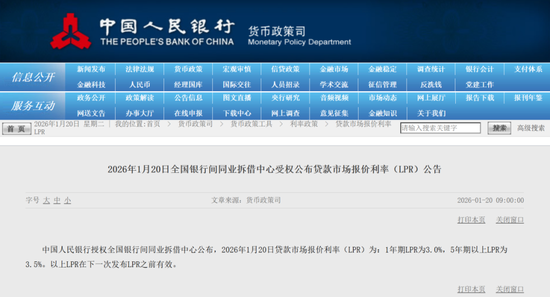
今年第一期LPR公布
Xin Lang Cai Jing· 2026-01-20 01:36
Core Viewpoint - The Loan Prime Rate (LPR) remains unchanged for the eighth consecutive month, with the 1-year LPR at 3.0% and the 5-year LPR at 3.5%, aligning with expectations due to stable reference rates [1][6]. Group 1: LPR and Interest Rates - The LPR's stability is attributed to the unchanged 7-day reverse repurchase rate, making a decrease in LPR unlikely [3][8]. - As of December 2025, the weighted average interest rates for new corporate loans and personal housing loans are approximately 3.1%, reflecting a decline of 2.5 and 2.6 percentage points since the second half of 2018 [3][8]. Group 2: Monetary Policy and Future Expectations - The Deputy Governor of the People's Bank of China, Zou Lan, indicated that there is still room for reserve requirement ratio (RRR) cuts and interest rate reductions this year, supported by stable exchange rates and a steady net interest margin for banks [4][9]. - Experts suggest that the recent structural interest rate cuts may delay the timing for a comprehensive interest rate reduction, as the urgency for total rate cuts is not high due to the current economic conditions [4][9]. - Analysts from various institutions expect that any future RRR cuts or interest rate reductions will be implemented flexibly based on real economic conditions [5][10].
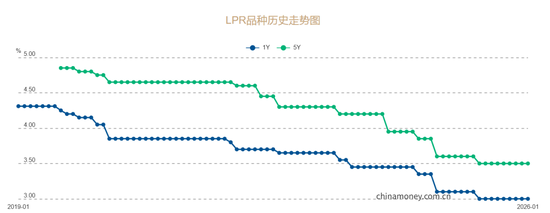
刚刚,LPR公布!
中国基金报· 2026-01-20 01:33
【导读】LPR连续8个月保持不变,符合市场预期 中国基金报记者 晨曦 这是LPR自去年6月份以来连续8个月保持不变,符合市场预期。 贷款市场报价利率由各报价行按公开市场操作利率加点形成的方式报价,由全国银行间同业 拆借中心计算得出,为银行贷款提供定价参考。目前,LPR包括1年期和5年期以上两个品 种。 刚刚,最新LPR公布! 1月20日9时,中国人民银行授权全国银行间同业拆借中心公布,2026年1月20日贷款市场报 价利率(LPR)为:1年期LPR为3.0%,5年期以上LPR为3.5%。以上LPR在下一次发布LPR 之前有效。 据介绍,这种结构性"降息"与全面降息有很大区别,不是通过下调政策利率带动LPR下行。 再贷款是央行对银行的贷款,不是央行直接向企业发放贷款。下调再贷款、再贴现利率后, 拿到更低成本资金的银行,或以更低利率向小微企业、科技创新、绿色转型等重点领域发放 贷款,降低实体经济综合融资成本。 中国人民银行副行长邹澜1月15日在国新办新闻发布会上表示,今年降准降息还有一定空间。 中国人民银行下调各项再贷款利率有助于降低银行付息成本、稳定净息差,为降息创造一定 空间。 中国民生银行首席经济学家温彬近 ...

东吴证券晨会纪要2026-01-20-20260120
Soochow Securities· 2026-01-19 23:35
Macro Strategy - The economic growth target of 5% for the year was successfully achieved, with Q4 GDP growth at 4.5% and nominal GDP growth at 3.8%, indicating a narrowing decline in the GDP deflator index from -1.1% to -0.7% [1][16] - Economic growth was primarily driven by exports and services, with service sector GDP growth at 5.4% and industrial GDP growth at 4.5%. Exports increased by 6.1%, while fixed asset investment decreased by 3.8% [1][16] - Q4 price recovery was noted, although still weak, with service retail growth at 5.5% and total retail sales growth at 3.7% [1][16] Industry Insights - The aerospace sector is highlighted as a long-term strategic focus under the 15th Five-Year Plan, with continued attention on semiconductor equipment, particularly in advanced processes and domestic replacements [5] - The report recommends focusing on semiconductor equipment ETFs as key investment targets due to favorable policies and performance expectations [5] - The commercial aerospace sector is expected to maintain its growth trajectory, supported by strategic planning and market demand [22] Company Recommendations - Qianli Technology (601777) is projected to achieve revenues of 8.9 billion, 10.6 billion, and 12.8 billion yuan for 2025, 2026, and 2027 respectively, with a "buy" rating based on successful AI transformation and expected growth in smart driving business [14] - IFBH (06603.HK) is expected to see revenues of 188 million, 257 million, and 331 million USD from 2025 to 2027, with a "buy" rating due to improving fundamentals and channel strategies [15] - Hangcha Group (603298) maintains a profit forecast of 2.2 billion, 2.4 billion, and 2.7 billion yuan for 2025 to 2027, with a "hold" rating reflecting stable performance and market position [15]



【策略】节前坚守稳健布局,静待节后新动能释放——策略周专题(2026年1月第2期)(张宇生/郭磊)
光大证券研究· 2026-01-19 23:06
本订阅号中所涉及的证券研究信息由光大证券研究所编写,仅面向光大证券专业投资者客户,用作新媒体形势下研究 信息和研究观点的沟通交流。非光大证券专业投资者客户,请勿订阅、接收或使用本订阅号中的任何信息。本订阅号 难以设置访问权限,若给您造成不便,敬请谅解。光大证券研究所不会因关注、收到或阅读本订阅号推送内容而视相 关人员为光大证券的客户。 报告摘要 本周上证指数窄幅震荡 本周上证指数窄幅震荡。从主要宽基指数来看,本周A股主要宽基指数涨多跌少,科创50、中证500涨幅居 前,上证指数小幅收跌,上证50、沪深300跌幅居前。从估值来看,当前科创50、万得全A等指数估值分位 数相对偏高,截至2026年1月16日,其2010年以来PE(TTM)分位数均高于90%。 本周重要事件回顾 政策方面,央行宣布推出八项政策措施,聚焦结构性工具"优化加量降价";沪深北交易所提高融资保证金 比例,将投资者融资买入证券时的融资保证金最低比例从80%提高到100%;居民换房退个税政策期限进一 步延续至2027年底;此外,三部门联合召开新能源汽车行业企业座谈会,部署规范新能源汽车产业竞争秩 序相关工作。 经济金融数据方面,央行发布2025年 ...

【光大研究每日速递】20260120
光大证券研究· 2026-01-19 23:06
Economic Policy and Market Outlook - Recent economic policies, including structural interest rate cuts, are expected to support economic growth, potentially leading to a "good start" in the first quarter of 2026, although final performance will depend on forthcoming data [5] - The financial market policies have moderated previously overheated sectors, indicating that the market may not sustain its rapid upward trend and could transition into a more volatile phase [5] Fund Market Trends - The Hong Kong stock market saw an overall increase, while domestic equity markets experienced fluctuations; TMT-themed funds performed well, whereas defense and military-themed funds faced net value declines [5] - There was a notable reduction in passive fund holdings across various broad-based ETFs, with over 130 billion yuan flowing out of large-cap ETFs, while TMT and cyclical theme ETFs attracted over 60 billion yuan in net inflows [5] Economic Data Insights - The economic landscape in 2025 is characterized by a "high before low" trend, with supply outpacing demand and external demand exceeding internal demand [6] - In December 2025, industrial production growth rates increased year-on-year and month-on-month, while fixed asset investment saw a widening decline, and retail sales growth continued to decrease [6] Oil and Geopolitical Factors - Heightened geopolitical tensions in Iran have increased the geopolitical risk premium on oil, contributing to rising oil prices; as of January 16, 2026, Brent and WTI crude oil prices were reported at $64.20 and $59.22 per barrel, reflecting increases of 1.9% and 0.7% respectively [7] - The ongoing international instability is likely to provide a favorable foundation for oil price trends in the long term [7] Infrastructure Investment - The State Grid has announced a planned fixed asset investment of 4 trillion yuan during the 14th Five-Year Plan period, marking a 40% increase compared to the previous plan, focusing on power grid and energy storage sectors [8] - Key projects for 2026 will concentrate on ultra-high voltage and pumped storage, indicating potential opportunities in power infrastructure orders and renewable energy consumption [8] Power Consumption and Digitalization - In 2025, the total electricity consumption in society increased by 5.0% year-on-year [9] - The State Grid's investment in new power systems is expected to enhance capacity pricing, with projected capacity prices for 2026 estimated at 6.3 cents per kilowatt-hour, a 4-cent increase from the previous year [9] Pharmaceutical Sector Innovations - The pharmaceutical and biotechnology sectors are experiencing a surge driven by innovation, including overseas expansion, AI applications, and new technologies, alongside policy support and seasonal market dynamics [9] - Key focus areas include innovative drugs, CXO services, AI healthcare, brain-computer interfaces, and small nucleic acid drugs, with ongoing attention required on post-JPM conference collaborations and clinical data outcomes [9]

年内首次结构性“降息”落地 金融支持实体力度更大、结构更优
Shang Hai Zheng Quan Bao· 2026-01-19 18:45
Core Viewpoint - The People's Bank of China has officially implemented a structural "rate cut" by lowering the re-lending and rediscount rates by 0.25 percentage points, effective January 19, 2026, to enhance support for key strategic areas and weak links in the economy [1] Group 1: Structural Rate Cut Implications - The adjustment signals a dual clarity: it reduces the funding costs for financial institutions supporting key areas like technological innovation and green development, while also indicating a proactive monetary policy approach [1][2] - Structural monetary policy tools are designed to link central bank funding with financial institutions' credit allocation to specific sectors, enhancing the effectiveness of monetary policy [2][3] Group 2: Policy Tools and Their Impact - The recent structural "rate cut" is seen as a timely response to the current economic situation, aiming to lower banks' funding costs and encourage credit allocation to priority sectors [3][4] - The rates for various structural tools have been adjusted to below policy rates, amplifying their incentive effects, with specific rates set for different loan types [4] Group 3: Future Policy Directions - The central bank's recent measures reflect a commitment to support areas such as agriculture, technology innovation, and carbon reduction, indicating a strong policy stance [5] - The likelihood of a comprehensive rate cut in the short term has decreased, as the current structural measures reduce the necessity for broader rate adjustments [5]