美元信用危机

Search documents
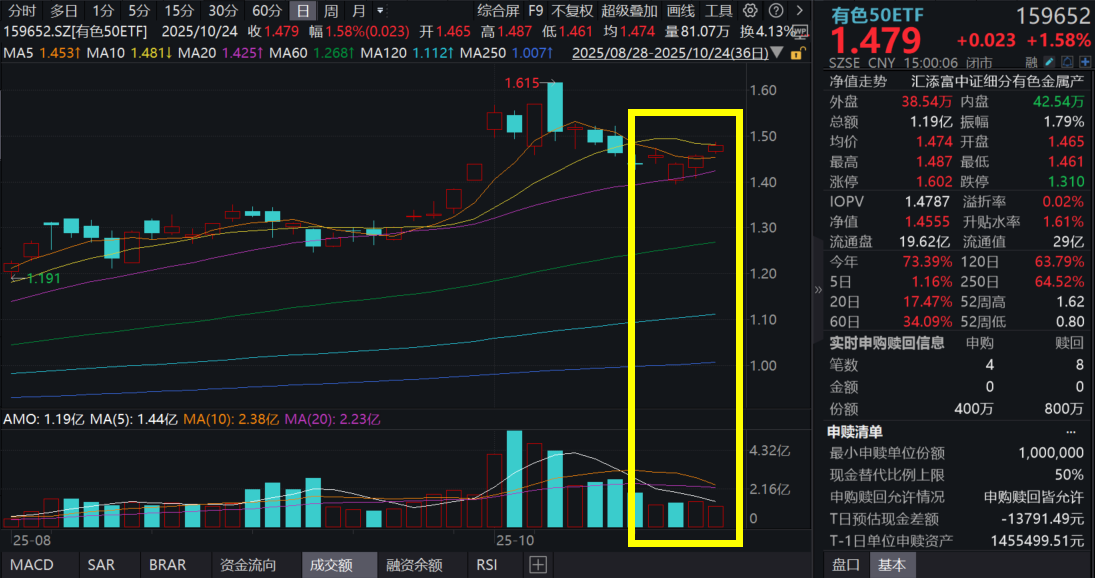
降息预期突变,铜金狂涨!紫金矿业暴涨超4%,“金铜含量”更高的有色50ETF(159652)涨超3%!2026年有色大行情进阶?三大投资逻辑全面解析
Sou Hu Cai Jing· 2025-11-13 03:02
Core Viewpoint - The A-share market shows a mixed trend with the non-ferrous sector experiencing a significant rise, particularly the non-ferrous 50 ETF (159652), which has gained over 3% as of 10:10 AM on November 13 [1]. Group 1: Market Performance - The non-ferrous 50 ETF (159652) saw a strong inflow of over 3 million yuan yesterday, indicating robust investor interest [1]. - Major component stocks of the non-ferrous 50 ETF, such as Yahua Group and Xingye Silver Tin, rose over 9%, while others like Guocheng Mining and Yongxing Materials increased by over 8% [3]. Group 2: Component Stocks - The top ten component stocks of the non-ferrous 50 ETF include Zijin Mining, Northern Rare Earth, and Luoyang Molybdenum, with Zijin Mining having an estimated weight of 15.52% and a price increase of 4.44% [4]. Group 3: Global Metal Prices - As of 10:14 AM, most base metals in London saw an increase, with LME copper rising by 0.65% to $10,897.00 per ton, and COMEX gold futures up by 2.07% to $4,201.4 per ounce [5]. Group 4: Investment Logic - The investment logic for the non-ferrous sector is based on three key factors: the upward financial attributes due to the dollar credit cycle, demand growth driven by the fourth industrial revolution, and rigid supply constraints due to insufficient capital expenditure and geopolitical tensions [6][7]. Group 5: Future Outlook - The non-ferrous sector is expected to maintain a bullish trend through 2026, driven by new quality production elements and the strategic value of metals, particularly in emerging fields like AI and new materials [7][8]. - The supply constraints in copper are anticipated to persist, with potential upward price movements supported by increasing demand from new technologies [8][9]. Group 6: ETF Advantages - The non-ferrous 50 ETF (159652) boasts a leading "gold-copper content" of 46%, with a focus on strategic metals that have significant supply-demand gaps [10]. - The ETF has shown superior performance with a cumulative return leading its peers since 2022, driven by earnings rather than valuation expansion, indicating a strong investment experience [12].


智昇研究黄金分析:去美元化进程加快,黄金将长期受益
Sou Hu Cai Jing· 2025-11-12 08:38
Group 1 - The core viewpoint is that the dollar's share in global foreign exchange reserves has dropped to 56.32%, the lowest in 30 years, indicating an acceleration of the "de-dollarization" trend [2] - The U.S. national debt has surpassed $38 trillion, growing at a rate of over $60 billion per day, with annual interest payments exceeding $1.2 trillion, which has eroded global trust in the dollar [3] - The international monetary landscape is shifting from dollar dominance to a multipolar system, with the dollar's share in international payments at 47.79%, followed by the euro at 22.77% and the renminbi at 3.17%, which has seen a 15.53% increase [3] Group 2 - The price of gold has not risen in line with demand due to the issuance of paper gold by Western financial institutions, which suppresses physical gold prices [4] - The suppression of gold prices is driven by the need to maintain the dominance of fiat currencies and prevent a collapse of the Western financial system [4] - Central banks are increasingly purchasing gold to enhance their risk resilience amid global conflicts, indicating a shift in reliance on gold as a safe asset [4] Group 3 - Gold prices are expected to be influenced by Federal Reserve policies, with potential adjustments around $4,000, but the long-term upward trend remains intact [5] - The market may experience fluctuations between $3,850 and $4,150, with a potential short-term drop to $3,850 before a long-term breakout opportunity [5] - The current market conditions suggest a decrease in implied volatility, indicating a stable trading range for gold in the near term [5]

美国政府停摆或将放大美元信用危机
2 1 Shi Ji Jing Ji Bao Dao· 2025-11-06 22:55
Core Points - The U.S. government shutdown has reached its 36th day, breaking the previous record for the longest shutdown [1] - The shutdown is a result of the failure to pass a temporary funding bill, which requires congressional approval for federal spending [1] - Historical patterns show that government shutdowns often stem from disputes over healthcare, social welfare spending, and immigration issues [2] Group 1: Government Shutdown Context - The current shutdown is primarily driven by disagreements over healthcare and welfare spending, with significant implications for millions of Americans [2] - The 1974 Congressional Budget and Impoundment Control Act mandates that federal spending must be authorized by Congress, leading to shutdowns when funding is not approved [1][2] Group 2: Economic Implications - The U.S. federal debt has reached nearly $40 trillion, with a debt-to-GDP ratio of 126.79%, significantly exceeding the IMF's warning threshold of 90% [3] - The ongoing political stalemate over spending is exacerbating the fiscal deficit, potentially leading to a cycle of debt crises, government shutdowns, and economic stagnation [3] Group 3: Market Reactions - The prolonged government shutdown has contributed to rising gold prices, as investors seek alternatives amid declining confidence in the dollar and U.S. Treasury bonds [4] - The shutdown has prompted a negative response in U.S. stock indices, indicating market concerns over the economic impact of the political deadlock [4]
摊牌了!美国38万亿债务爆雷,美联储政策180度大转弯,中国坐收渔利
Sou Hu Cai Jing· 2025-11-06 07:28
Core Viewpoint - The U.S. national debt has surged to an unprecedented $38 trillion, raising concerns about economic stability and fiscal responsibility, prompting the Federal Reserve to lower interest rates and halt balance sheet reduction efforts [1][5][14]. Group 1: Economic Context - The Federal Reserve's decision to cut interest rates by 25 basis points for the second time in two months reflects a shift in economic risk balance, prioritizing survival over previous commitments [1][6]. - The U.S. national debt now exceeds 126.8% of GDP, surpassing the International Monetary Fund's (IMF) safety threshold of 100% [5][6]. - The annual interest payment on the debt has exceeded $1 trillion, contributing to a cycle of increasing debt as interest payments themselves become new debt [6][14]. Group 2: Market Reactions - The issuance of 10-year Treasury bonds has seen a significant drop in demand, indicating a lack of confidence from foreign investors in U.S. long-term debt [7][8]. - The U.S. dollar index has declined from 109 to 98, reflecting global investor sentiment regarding U.S. fiscal policies [8][12]. Group 3: International Implications - China has reduced its holdings of U.S. Treasury bonds while increasing its gold reserves, indicating a strategy of risk hedging amidst U.S. fiscal instability [9][11]. - Other countries, including Japan and the UK, are also reassessing their investments in U.S. debt, highlighting a broader trend of diminishing trust in U.S. fiscal management [12][16]. Group 4: Structural Issues - The interplay between fiscal and monetary policy has created a vicious cycle of debt accumulation, where tax cuts lead to deficits, which in turn necessitate more borrowing and monetary easing [14][16]. - The current situation is likened to a "sandcastle" built on unstable foundations, suggesting that reliance on debt and money printing is unsustainable [16][17].
全球牛市“幻象”背后,对美元信用质疑会持续吗
Di Yi Cai Jing· 2025-10-29 04:16
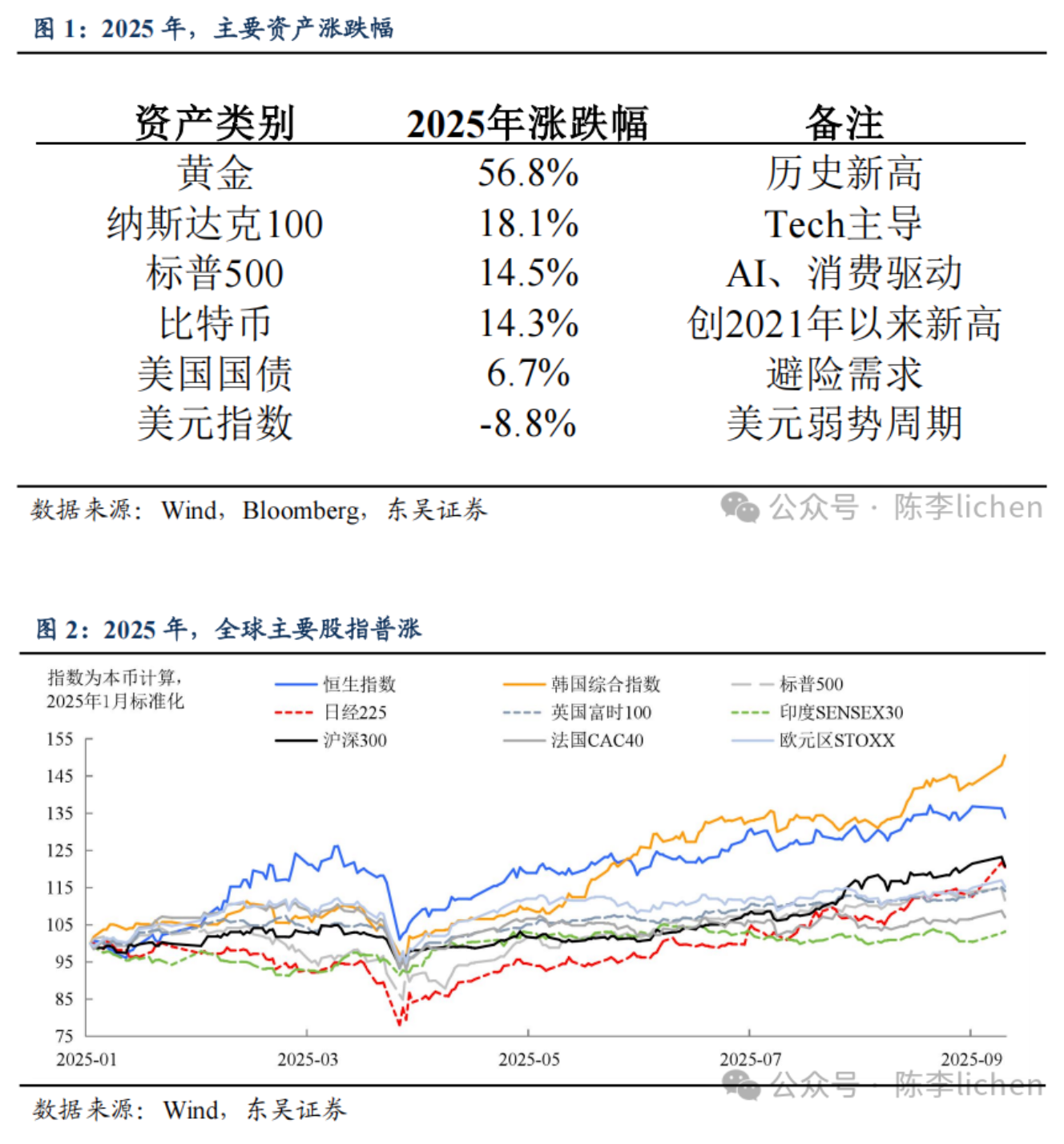
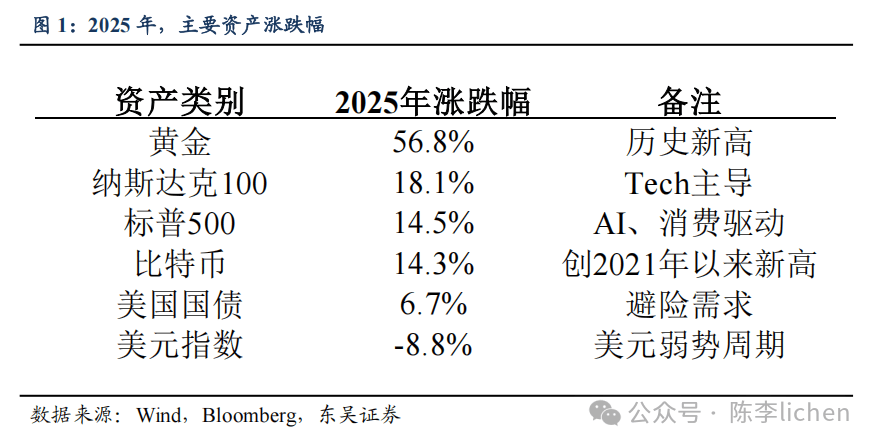
Core Viewpoint - The current global financial market is experiencing a unique phenomenon where almost all major assets are rising simultaneously despite economic slowdown and geopolitical tensions, indicating a global asset revaluation driven by a "credit crisis" related to the dollar's credibility rather than its status as a reserve currency [1][14]. Group 1: Asset Price Movements - From 2025 onwards, major stock market indices have risen, while bond yields in major economies have decreased, leading to an increase in bond values [2]. - The rise in asset prices is not due to accelerated global economic growth, as the IMF predicts a decline in global growth rates for 2025 compared to 2024 [2]. - The increase in asset prices is not a result of further global liquidity easing, as global M2 reached $113 trillion by July 2023, with marginal growth rates remaining stable [2][7]. - The rise in asset prices is not driven by a specific technology cycle, such as artificial intelligence, as traditional sectors like finance and real estate are also experiencing gains [12][13]. Group 2: Dollar Credibility Issues - The dollar is facing a credibility crisis stemming from political, financial, and fiscal dimensions, leading to a structural change in market trust regarding its long-term purchasing power and political neutrality [14][15]. - The political shift in the U.S. towards protectionism and unilateralism has raised doubts about America's commitment to maintaining global stability [16]. - The frequent use of the dollar payment system as a diplomatic tool has prompted countries to reassess their reliance on the dollar [16]. - The continuous growth of U.S. government debt has raised concerns about the long-term purchasing power of the dollar [16]. Group 3: Future Outlook for Dollar Credibility - The recovery of dollar credibility is not solely under U.S. control but depends on the evolution of the global political and economic landscape [17]. - Key factors for potential recovery include a return to policy certainty post-2026 U.S. midterm elections, sustained economic improvement, and robust monetary policy operations by the Federal Reserve [17][18]. - Improvements in the international environment and addressing deep structural issues, such as manufacturing return and debt control, are essential for the long-term restoration of dollar credibility [19][20].
【百利好黄金专题】上涨逻辑清晰 黄金上不言顶
Sou Hu Cai Jing· 2025-10-28 06:38
Group 1 - Recent short-term setbacks in the gold market were observed, with spot gold prices dropping from approximately $4342 to a low of $4086, marking a daily decline of over 6%, before closing at $4128.27 per ounce [1] - Despite the recent drop, market buying remains strong, indicating that the decline was likely a result of profit-taking rather than a shift in the overall upward trend of gold [1] Group 2 - Global gold demand saw a year-on-year increase of 3% in Q2 2025, reaching 1249 tons, with a significant value increase of 45%, amounting to approximately $132 billion [3] - The popularity of gold ETFs is rising, with a record net inflow of funds in September, totaling $26 billion for the third quarter, bringing total assets under management to $472 billion by the end of September [3] - The total market capitalization of gold has surpassed $30 trillion, leading the global asset market [4] Group 3 - The current gold bull market is driven by expectations of Federal Reserve interest rate cuts and rising risk aversion, with a fundamental shift towards diversification of global reserve assets away from the dollar [5] - Market expectations indicate that the Federal Reserve may implement at least one significant rate cut by the end of the year, with some anticipating a more aggressive 50 basis point cut [5] - Since April, a series of tariff policies have challenged the dollar's dominance, leading to a global trend of "de-dollarization" and diversification of settlement currencies [5] Group 4 - Recent data shows that the proportion of gold reserves in global central bank foreign exchange and gold reserves has increased from 24% at the end of June to 30%, while the dollar's share has decreased from 43% to 40%, providing long-term support for gold prices [6] Group 5 - Technically, gold's daily moving averages remain in a bullish divergence, with previous large declines not breaking short-term support levels, suggesting potential upward movement if prices surpass $4200, aiming for a breakout above $4380 [7]

陈李:全球牛市幻象——信任的重新分配,对美元的信用质疑会持续吗?
Sou Hu Cai Jing· 2025-10-28 06:03
Core Viewpoint - The current global financial market is experiencing an unusual "comprehensive bull market," where major assets are rising in tandem despite economic slowdown and geopolitical tensions, driven by a reassessment of asset values due to weakening confidence in the dollar's long-term purchasing power and political neutrality [1]. Group 1: Global Asset Bull Market - Since 2025, major stock market indices have risen, with notable increases in European and Japanese markets, although these improvements alone do not fully explain the global asset price surge [2][9]. - Asset price increases are not driven by accelerated global economic growth, as the IMF predicts a decline in global growth rates for 2025 compared to 2024 [9]. - The rise in asset prices is not a result of further easing of global liquidity, as the marginal increase in global M2 has not significantly exceeded 2024 levels, despite a total M2 of $113 trillion by July 2025 [12][16]. Group 2: Factors Behind Asset Price Increases - The asset price increase is not primarily driven by a technology cycle, such as artificial intelligence, as traditional sectors like finance, consumption, and real estate are also experiencing gains [19][20]. - Geopolitical tensions have not eased; instead, they have intensified, with ongoing trade disputes and tariffs being implemented, contrasting with the rising asset prices [20]. Group 3: Dollar Credit Threats - The weakening dollar reflects structural changes in market confidence regarding its long-term credit and political neutrality, influenced by narrowing interest rate differentials and economic growth expectations [23][27]. - The dollar's decline is not due to actual economic weakness but rather a correction in growth expectations between the U.S. and Europe, with the latter benefiting from aggressive monetary policies [27][28]. - The dollar faces a trust crisis stemming from political, financial, and fiscal dimensions, including the U.S.'s unilateral actions and increasing national debt, which raise concerns about its long-term purchasing power [32][34]. Group 4: Future Outlook for Dollar Credit - The recovery of dollar credit will depend on the return of policy certainty, sustained economic improvement, and the robust operation of monetary policy [41][42][43]. - Changes in the international environment, such as underperformance of other major economies or easing geopolitical tensions, could enhance the dollar's attractiveness [44]. - Long-term improvements in structural issues, including manufacturing return and debt control, are necessary for the restoration of dollar credit [45]. Group 5: Investment Perspective - The current global bull market may represent a redistribution of trust rather than wealth creation, indicating a paradigm shift in investment logic where credit valuation becomes more critical than traditional economic growth metrics [46][47].
金价5000美元是开始?达利欧一句话点破美元危机,散户血亏前必看
Sou Hu Cai Jing· 2025-10-25 16:33
Core Viewpoint - The current surge in gold prices is unprecedented, driven by a combination of geopolitical risks, changing interest rates, and a decline in the credibility of the US dollar [1][3][12]. Group 1: Market Dynamics - Gold prices have recently surpassed $4,200, marking a significant historical high, with both international and domestic markets experiencing a bullish trend [1]. - The ongoing geopolitical tensions, particularly in the Middle East, have led to increased demand for gold as a safe-haven asset [3][12]. - The global interest rate environment is shifting, with expectations of a nearing end to the Federal Reserve's rate hike cycle, enhancing gold's appeal as a non-yielding asset [3][12]. Group 2: Central Bank Actions - Central banks worldwide have been net buyers of gold for several years, setting historical records in gold purchases [4]. - Many countries are repatriating gold stored in foreign vaults, reflecting a growing distrust in the current international monetary system [4]. Group 3: Institutional Perspectives - Major investment banks are adjusting their gold price targets upward, indicating a consensus among institutions regarding the value of gold [6]. - Notable figures, such as Ray Dalio, emphasize gold as a fundamental alternative to debt, highlighting concerns over the sustainability of the global debt system [6][8]. Group 4: Debt Concerns - The global debt has reached three times the total GDP, raising alarms about the sustainability of this debt level and the trust in traditional currency systems [7]. - The US national debt has surpassed $37 trillion, leading to skepticism about the government's ability to meet its financial obligations [8]. Group 5: Market Risks - Despite the bullish outlook, there are risks in the gold market, including potential volatility and historical precedents of sharp price corrections [11]. - The use of leverage in modern gold trading can amplify both gains and risks, making the market susceptible to sudden reversals [11]. Group 6: Future Outlook - The peak of the current gold rally is uncertain and will depend on the persistence of key driving factors, including geopolitical tensions and interest rate movements [12][13]. - The ongoing "de-dollarization" process and adjustments in foreign exchange reserves by central banks suggest a long-term shift in the monetary landscape, with some institutions projecting gold prices could reach as high as $5,000 [15].
黄金历史级暴跌!美元货币储备量下降,普通投资者该如何应对?
Sou Hu Cai Jing· 2025-10-25 11:01
Core Insights - The recent fluctuations in the gold market are driven by short-term market sentiments rather than intrinsic value changes in gold itself [1][3] - Geopolitical tensions, particularly the easing of the Russia-Ukraine conflict, have led to a decrease in gold's appeal as a safe-haven asset, prompting investors to shift towards riskier assets [3][5] - The upcoming APEC meeting has also contributed to market volatility, as pre-meeting tensions can influence investor behavior [5][7] Market Dynamics - The gold price surge was primarily fueled by heightened geopolitical risks, which have now subsided, leading to a market correction [3][5] - Historical data shows that gold prices typically rise during periods of intense conflict but quickly revert once tensions ease, indicating that the recent price drop is a normalization of previously heightened fears [5][7] Long-term Factors - The long-term outlook for gold remains positive due to escalating global debt levels, which currently stand at $324 trillion against a global economic output of $100 trillion, creating a lack of confidence in credit-based assets [9][11] - The diminishing trust in the US dollar, exacerbated by past financial crises and geopolitical actions, has made gold a more attractive asset for many countries seeking alternatives [11][13][15] Investment Strategy - Investors are advised to focus on long-term trends rather than short-term price fluctuations, as gold serves as a stabilizing asset in times of economic uncertainty [17][21] - Allocating a portion of investment portfolios to gold can provide a safeguard against economic downturns and currency devaluation, acting as a financial safety net [21]
洛阳钼业:Q3净利润同比大增96%!拟10亿美元投资海外项目!有色50ETF(159652)连续两日反弹,近10日获净流入4.31亿元
Xin Lang Cai Jing· 2025-10-24 10:08
Core Viewpoint - The A-share market experienced a significant rebound, with the Shanghai Composite Index reaching a 10-year high, driven by the strong performance of the non-ferrous metals sector, particularly highlighted by the performance of Luoyang Molybdenum Co., Ltd. [1][4] Company Summary - Luoyang Molybdenum reported a net profit attributable to shareholders of 5.608 billion yuan for Q3, marking a year-on-year increase of 96.4%, while total revenue was 50.713 billion yuan, a decrease of 2.36% [1] - For the first three quarters, the company achieved a net profit of 14.28 billion yuan, up 72.61% year-on-year, with total revenue of 145.485 billion yuan, down 5.99% [1] - The company announced plans to invest 1.084 billion USD in the KFM Phase II project in the Democratic Republic of the Congo, expected to be completed by 2027, which will increase ore processing capacity by 7.26 million tons per year and add an average of 100,000 tons of copper metal annually [1] Industry Summary - The non-ferrous metals sector is experiencing a strong rebound, supported by macroeconomic policies and strategic resource positioning, despite recent fluctuations in gold and copper prices [4][5] - The sector is expected to benefit from a combination of supply-side constraints, new demand drivers, and a favorable economic cycle, with a focus on long-term investment opportunities [4][5] - The non-ferrous metals ETF (159652) has a high concentration of strategic metals, with a copper content of 33% and gold content of 14%, making it a leading choice in the sector [6][7] - The ETF has shown superior performance with a cumulative return of 116.5% since 2022, driven by profit growth rather than valuation expansion, indicating a strong earnings-driven growth phase [8][11]