
自由现金流策略

Search documents
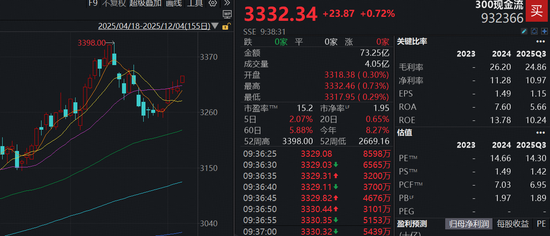
万亿“现金牛”发力!同类规模最大300现金流ETF(562080)逆市劲涨0.83%,近10个交易日吸金5476万元
Xin Lang Cai Jing· 2025-12-04 02:23
Core Viewpoint - The cash flow strategy is gaining strength in the market, with the CSI 300 cash flow index rising by 0.72%, maintaining a six-day upward trend above the 20-day moving average [1][9]. Group 1: Market Performance - The three major indices experienced a pullback after an initial rise, with the CSI 300 index showing significant strength in cash flow stocks [1]. - The CSI 300 cash flow ETF (562080) outperformed the market, rising by 0.83% as of 9:53 AM, indicating strong investor interest [10]. - Notable stocks such as Luoyang Molybdenum surged by 4.54%, while Yunnan Aluminum and other major companies also saw gains [1][10]. Group 2: Cash Flow Strategy - The cash flow strategy is highlighted as a key player in the current slow bull market, attracting long-term capital with a total inflow of 54.76 million yuan over the past ten trading days [10][14]. - The 300 cash flow ETF passively tracks the CSI 300 cash flow index, selecting 50 "cash cow" companies from core assets, focusing on sectors like oil, telecommunications, and new energy [12][14]. - The ETF's composition is heavily weighted towards large-cap stocks, with over 64% of its holdings being companies with a market capitalization exceeding 100 billion yuan [12]. Group 3: Investment Insights - Institutions suggest that now is an opportune time to invest in companies with strong free cash flow, as the market's focus on profit authenticity increases [14]. - The low interest rate environment is driving investors to seek stable and less volatile assets, making high free cash flow companies more attractive [14]. - The value strategy is evolving, emphasizing a progression from quality to free cash flow and then to dividends, with free cash flow strategies expected to yield higher long-term returns compared to traditional dividend strategies [14].

岁末年初大盘、价值、低估值风格相对占优,自由现金流ETF(159201)布局价值凸显
Mei Ri Jing Ji Xin Wen· 2025-12-03 04:48
Core Viewpoint - The A-share market shows mixed performance with the National Index of Free Cash Flow fluctuating positively, led by stocks like Dayang Electric and Yaxiang Integration, while a significant inflow of funds into the largest free cash flow ETF indicates strong investor interest [1] Group 1: Market Performance - On December 3, the three major A-share indices opened with mixed results, while the National Index of Free Cash Flow showed positive fluctuations [1] - The largest free cash flow ETF (159210) has seen continuous net inflows over the past 18 days, totaling 2.027 billion yuan, reaching a new high of 7.499 billion yuan in total size since its inception [1] Group 2: Investment Strategy - According to Industrial Securities, the end of the year and the beginning of the year exhibit significant calendar effects, characterized by a "value platform, growth performance" approach [1] - The market anticipates increased policy support for stable growth as the year-end meetings approach, with a focus on achieving a strong economic start [1] - The free cash flow strategy addresses the limitations of traditional dividend strategies by emphasizing financial health and sustainability, aligning with the needs of investors seeking long-term growth and capital appreciation [1] Group 3: Fund Management - The management fee for the free cash flow ETF and its linked funds is set at an annual rate of 0.15%, while the custody fee is at 0.05%, both representing the lowest rates in the market, maximizing benefits for investors [1]
锚定A股“现金牛” 长城沪深300自由现金流指数基金全新发行
Xin Lang Cai Jing· 2025-12-03 02:16
Group 1 - The core idea emphasizes the importance of companies with high free cash flow, which allows for dividends, buybacks, or reinvestment, thus creating long-term value for shareholders [1][5] - The newly issued Great Wall CSI 300 Free Cash Flow Index Fund aims to provide investors with a convenient way to allocate quality assets focusing on companies with strong cash flow capabilities [1][2] - Current market conditions suggest that focusing on free cash flow strategies is timely, as institutional profit-locking demands may rise and the market's scrutiny on earnings authenticity increases [1][5] Group 2 - The Great Wall CSI 300 Free Cash Flow Index closely tracks the CSI 300 Free Cash Flow Index, selecting high-dividend potential stocks from industry leaders to help investors efficiently allocate quality cash flow assets [2][6] - As of November 24, the index covers 32 stocks with a market capitalization of over 100 billion, accounting for 88.18% of the index's market cap, with a median market cap of 159.3 billion [2][6] - The index has shown strong historical performance, with a cumulative increase of 413.25% since 2014, outperforming other indices such as the China Securities Dividend Index and the China Securities A500 Index [2][6]
一键打包优质“现金牛”企业,长城沪深300自由现金流指数正在发行中
Xin Lang Cai Jing· 2025-12-03 02:16
Core Viewpoint - The effectiveness of free cash flow strategies in investment is expected to gradually increase in the current environment, driven by policies aimed at reducing competition and the Federal Reserve's potential interest rate cuts, which may accelerate the return of national wealth [1][5]. Group 1: Free Cash Flow Strategy - The free cash flow strategy is anticipated to yield higher excess returns as industries with improved free cash flow may recover more quickly [1]. - Long-term views suggest that assets with stable free cash flow can provide both defensive value and growth potential, with high dividend potential and resilience during recovery cycles [1][5]. Group 2: Fund Launch and Index Tracking - Changcheng Fund has launched the Changcheng CSI Free Cash Flow Index Fund, following the establishment of the Changcheng National CSI Free Cash Flow Index Fund in August [1][5]. - The fund tracks the CSI 300 Free Cash Flow Index, selecting 50 high free cash flow rate stocks from the CSI 300 index, focusing on large-cap blue-chip companies [2][6]. Group 3: Index Characteristics and Performance - The CSI 300 Free Cash Flow Index has a median market capitalization of 170 billion, featuring companies with lower debt ratios and higher return on equity, indicating superior profitability and dividend potential [2][6]. - As of November 12, 2025, the index's dividend yield is 3.75%, outperforming other similar indices [2][6]. - Since 2014, the index has shown a cumulative increase of 431.17% and an annualized return of 15.58%, significantly outperforming the CSI Dividend and CSI A500 indices [3][7].
投资滚雪球之——自由现金流策略
Sou Hu Cai Jing· 2025-11-24 11:56
Core Viewpoint - The article emphasizes the growing importance of free cash flow (FCF) as a key indicator for assessing a company's intrinsic value, highlighting its role in classic value investment strategies and the increasing focus on companies with strong cash generation capabilities [3][4][14]. Summary by Sections Free Cash Flow Concept - Free cash flow is defined as the cash remaining after a company has paid all its operating expenses and capital expenditures, which can be used for debt repayment, dividends, or reinvestment, serving as a crucial indicator of a company's true profitability [4][6]. Investment Strategy - Focusing on high free cash flow companies can help investors avoid pitfalls and strive for long-term returns, as these companies demonstrate strong operational performance and lower financial manipulation compared to net profit [7][8]. - High free cash flow firms are better positioned to withstand economic downturns due to their solid financial foundations and can leverage their cash reserves for growth opportunities during economic upturns [8]. Performance of Free Cash Flow Strategy - The China Securities Index's Free Cash Flow Total Return Index has shown a remarkable increase of 754.11% since its base date of December 31, 2013, significantly outperforming the broader market index, which rose by 147.62% in the same period [9][12]. - The Free Cash Flow Total Return Index has consistently outperformed the broader index during market downturns and has had competitive performance during market upturns, indicating its effectiveness as an investment strategy [12][13]. Future Outlook - As the macroeconomic environment undergoes structural changes, the significance of free cash flow strategies is expected to increase, particularly as the economy shifts from high-speed growth to high-quality development, favoring companies with strong cash flow generation [14]. - The ongoing decline in interest rates is likely to drive market participants to seek assets that can generate sustainable cash flows, enhancing the investment appeal of companies with abundant free cash flow [15].

触底回升!聚焦同类规模最大的自由现金流ETF(159201)中期布局机会
Mei Ri Jing Ji Xin Wen· 2025-11-24 06:11
Core Viewpoint - The Guozheng Free Cash Flow Index has rebounded after hitting a low, with leading stocks such as Oriental Tower and Nanjing Xinbai performing well, while China National Offshore Oil Corporation and Lianfa Shares lagged behind [1] Group 1: Market Performance - The largest free cash flow ETF (159201) has seen a continuous inflow of funds over the past 11 days, totaling 1.646 billion yuan [1] - As of November 21, the average daily trading volume of the free cash flow ETF over the past week was 536 million yuan [1] Group 2: Market Outlook - According to Zhongyin International Securities, after significant adjustments last week, the market has limited room for further declines in the short term [1] - The positive policy tone is expected to provide a floor for the market, with short-term adjustments potentially creating mid-term investment opportunities [1] Group 3: Fund Characteristics - The free cash flow ETF (159201) and its linked funds (A: 023917; C: 023918) closely track the Guozheng Free Cash Flow Index, addressing the shortcomings of traditional dividend strategies in industry coverage and future performance predictions [1] - The fund focuses on intrinsic growth capacity, emphasizing financial health and sustainability, aligning with the needs of investors seeking long-term growth and capital appreciation [1] - The annual management fee rate is 0.15%, and the custody fee rate is 0.05%, both of which are the lowest in the market, maximizing benefits for investors [1]
资金“高切低”,机构看上哪些板块?
券商中国· 2025-11-21 07:19
Core Viewpoint - The article highlights the increasing demand for defensive investments in the A-share market, characterized by a "high cut low" trend where funds are flowing out of high-performing sectors and into low-valuation, high-dividend, and performance-stable sectors [2][3][5]. Group 1: Market Trends - The "high cut low" trend is becoming more pronounced, with significant capital outflows from previously high-performing sectors like technology and media, while low-valuation sectors are seeing capital inflows [2][3]. - The market is experiencing a structural divergence, with traditional sectors like finance and consumption remaining undervalued, creating a mismatch between valuation and performance, which drives the "high cut low" behavior [3][4]. - Data from Wind indicates that certain ETFs focused on low-valuation themes have received over 1 billion yuan in net inflows this month, contrasting with net redemptions in high-performing ETFs [3]. Group 2: Defensive Investment Demand - There is a notable increase in defensive investment demand as investors' risk preferences return to rationality following market volatility, leading to heightened caution in the fourth quarter [5]. - The year-end profit-locking and macroeconomic uncertainties are contributing to a significant rise in risk-averse sentiment and reallocation needs among funds [5]. - The market is entering a phase of stock selection, with funds concentrating on a few leading stocks, indicating potential volatility in high-performing sectors [5]. Group 3: Investment Strategies - Fund managers emphasize focusing on "value for money" and "margin of safety" in investment strategies, seeking companies with strong and stable free cash flow that can withstand market fluctuations [7]. - The article suggests that the investment in the consumer sector is increasingly reliant on company-specific research rather than broad industry analysis, indicating a shift towards higher specialization [8]. - Fund managers recommend a "growth + high dividend" allocation strategy to improve risk-reward ratios, identifying four key investment directions: aging electrical grids in Europe and the U.S., metals with supply-demand gaps, undervalued companies in consumption and pharmaceuticals, and high-dividend stocks [8].

A股今天为何领跌全球?
表舅是养基大户· 2025-11-20 13:32
Group 1 - Nvidia's earnings report exceeded market expectations, leading to a projected significant increase in its stock price and alleviating some concerns about the AI bubble, which in turn boosted global risk assets [1] - Nvidia's market capitalization surpasses that of five sectors within the S&P 500, highlighting its substantial influence in the market [1] Group 2 - A-shares underperformed globally, with the market showing a divergence from international trends, primarily due to internal structural factors and the resilience of certain sectors like banking and oil [8][10] - Despite recent declines, A-shares have experienced relatively less impact compared to other global markets, with only a minor drop in major indices [11] Group 3 - The Hong Kong market is facing challenges due to several factors, including decreased expectations for Federal Reserve rate cuts and the impact of IPOs and placements [14][16] - The unlocking of shares for companies like Ningde Times has led to significant sell-offs, as investors react to perceived overvaluation in the Hong Kong market compared to A-shares [17] Group 4 - The merger of China International Capital Corporation (CICC) with other firms is seen as part of a broader trend in the financial industry towards consolidation, aiming to create a more competitive brokerage [27][34] - The merger is expected to enhance CICC's client base and operational footprint, particularly in regions like Liaoning and Fujian [33] Group 5 - The investment strategy of focusing on free cash flow-related products is gaining traction, with a notable increase in assets under management for related funds, indicating a shift towards more stable investment approaches [37][38]




低位价值风格可能会有较强表现,自由现金流ETF(159201)规模、流动性领跑同类产品
Mei Ri Jing Ji Xin Wen· 2025-11-20 08:25
Group 1 - The A-share market experienced a mixed performance after a collective high opening, with the Guozheng Free Cash Flow Index slightly retreating, currently up about 0.1% [1] - Leading stocks include Xiamen International Trade, Yuntianhua, and China Aluminum, while stocks like Yaxiang Integration, Hailu Heavy Industry, and Jinhong Group lagged behind [1] - The largest free cash flow ETF (159201) has seen continuous net inflows over the past nine days, totaling 1.495 billion yuan, reaching a new high of 6.999 billion yuan in total scale [1] Group 2 - The free cash flow ETF (159201) and its linked funds focus on endogenous growth capabilities, emphasizing financial health and sustainability, which aligns with the long-term growth and capital appreciation needs of investors [2] - The fund management fee is set at an annual rate of 0.15%, and the custody fee at 0.05%, both of which are among the lowest in the market, maximizing benefits for investors [2] Group 3 - According to a report from Xinda Securities, the recent style switch and dispersion in the A-share market is attributed to the performance gap as the year-end approaches, leading to a lack of high-frequency quarterly performance verification [1] - The current style dispersion is driven by valuation, expectations, and capital, which is expected to continue for at least 1 to 2 quarters, with a confirmed shift from small-cap to large-cap styles [1]
资金高切低趋势持续强化基金经理聚焦性价比与安全边际
Zheng Quan Shi Bao· 2025-11-19 22:01
Core Viewpoint - The A-share market is experiencing a pronounced trend of "high cutting and low buying," where funds are flowing out of previously high-performing sectors and into low-valuation sectors with strong earnings support [1][2]. Group 1: Market Trends - There is a significant divergence in market performance, with high-growth sectors like technology and innovative pharmaceuticals facing profit-taking pressure, while traditional sectors such as finance and consumer goods remain undervalued [2][3]. - Data indicates a clear trend in fund flows, with thematic ETFs that previously performed well experiencing net redemptions, while low-valuation ETFs are seeing substantial inflows, exceeding 1 billion yuan in some cases [2][3]. - The market is currently in a phase of style rebalancing, driven by weakening micro liquidity and macroeconomic uncertainties [2][4]. Group 2: Defensive Demand - Investor risk preferences are shifting towards more defensive strategies, with heightened caution typical of the fourth quarter, leading to increased profit-locking and reallocation demands [4][5]. - The market is entering a phase of stock selection, with funds concentrating on a few leading stocks, indicating potential volatility in high-performing sectors [4][5]. Group 3: Focus on Value and Safety Margin - Fund managers emphasize the importance of focusing on value and safety margins, seeking companies that can generate stable cash flows and withstand market fluctuations [5][6]. - The low-valuation consumer sector is highlighted as having significant value, although challenges remain, such as supply-side adjustments and changing consumer behaviors [6][7]. - Investment in the consumer sector is increasingly reliant on detailed company research rather than broad industry analysis, reflecting a trend towards specialization [7][8]. Group 4: Investment Opportunities - There are specific investment opportunities within high-valuation sectors, particularly in areas like power grid upgrades and essential metals with supply-demand gaps [7][8]. - A balanced investment strategy combining growth and high-dividend stocks is recommended to enhance risk-return profiles [7][8].