
预算赤字

Search documents
印尼局势趋稳,动荡的背后是经济问题?
Di Yi Cai Jing· 2025-09-04 04:32
Economic Context - Indonesia's economy is currently facing challenges, with a target growth rate of 8% for 2025 appearing increasingly unattainable due to weak household consumption and a significant decline in investment [1][6] - The economy grew by 4.87% year-on-year in the first quarter, but this represented a 0.98% contraction compared to the previous quarter, marking the lowest growth since Q3 2021 [6] - The government's "free lunch" program for students is expected to cost approximately $30 billion annually, which is about 14% of the national budget, raising concerns about the budget deficit nearing the legal limit of 3% of GDP [6] Social Unrest - The recent protests in Indonesia were triggered by the high housing allowance of 50 million Indonesian rupiah (approximately 21,795 RMB) provided to members of parliament, which is nearly ten times the minimum wage in Jakarta [3] - The protests escalated into violence after a tragic incident where a motorcycle taxi driver was killed by a military vehicle, leading to attacks on the homes of lawmakers, including Finance Minister Mulyani Indrawati [3][4] - Over 700 people were reported injured due to the protests, with damages to infrastructure estimated at around 55 billion Indonesian rupiah (approximately 23.96 million RMB) [4] Government Response - President Prabowo emphasized the need to maintain social order and public safety, announcing the cancellation of certain allowances for parliament members and the suspension of overseas trips for lawmakers [3][5] - The government is attempting to address public grievances and restore stability, with officials urging unity among citizens and a commitment to listening to public opinion [4][5] - Despite the unrest, the Coordinating Minister for Economic Affairs reassured that the economy remains on track, projecting a growth target of 5% to 5.2% for the year [6]


美国8月份关税突破310亿美元,创历史新高
Hua Er Jie Jian Wen· 2025-09-03 20:03
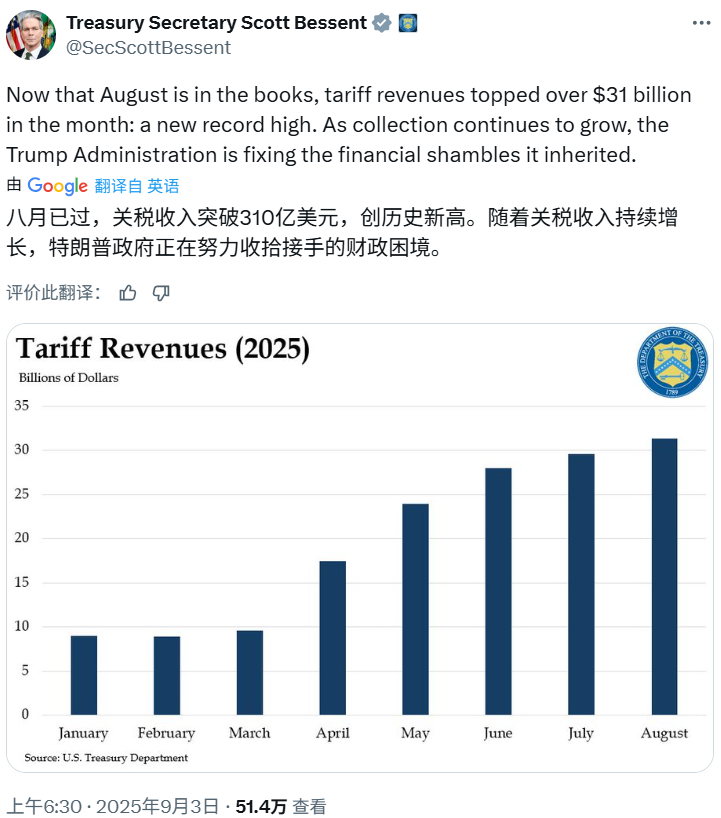
Core Insights - In August, U.S. tariff revenue exceeded $31 billion, setting a new monthly record, with total revenue for the fiscal year reaching $183.56 billion [1] - The U.S. Congressional Budget Office projected that Trump's tariff policies could reduce the budget deficit by approximately $4 trillion over the next decade, significantly higher than previous estimates [3] - Treasury Secretary Mnuchin indicated that annual tariff revenue could surpass $500 billion, with potential estimates approaching $1 trillion [3][4] Group 1 - The U.S. tariff revenue for August reached $31.37 billion, marking a historical high for a single month [1] - Cumulative tariff revenue for the fiscal year has already hit $183.56 billion [1] - The Trump administration is actively working to address fiscal challenges through increased tariff revenues [1] Group 2 - The Congressional Budget Office's updated forecast suggests a $4 trillion reduction in the budget deficit due to tariff policies, including $3.3 trillion in basic deficit reduction and $700 billion in interest cost savings [3] - Treasury Secretary Mnuchin's forecast for annual tariff revenue has been revised upward to potentially exceed $500 billion, compared to earlier estimates of $300 billion [3] - Mnuchin expressed confidence that the government could achieve tariff revenues close to $1 trillion [4] Group 3 - A recent court ruling deemed most of Trump's tariff measures illegal, stating that the President exceeded the authority granted by the International Emergency Economic Powers Act [4] - The ruling is set to take effect on October 14, providing time for the White House to appeal to the Supreme Court [4] - The Trump administration plans to request expedited review from the Supreme Court regarding the recent ruling [5] Group 4 - If the Supreme Court does not support the President's use of the International Emergency Economic Powers Act, alternative methods for implementing import taxes will be considered [5] - The administration may turn to the Trade Expansion Act's Section 232 as a more established legal framework for imposing tariffs based on national security threats [5][6] - There is potential for the Trump administration to expand the scope of Section 232 tariffs to ensure the continuation of its trade agenda [6]
非农携手“九月寒意”来袭 市场风声鹤唳! VIX指数飙升拉响剧烈波动警报
智通财经网· 2025-09-03 02:06
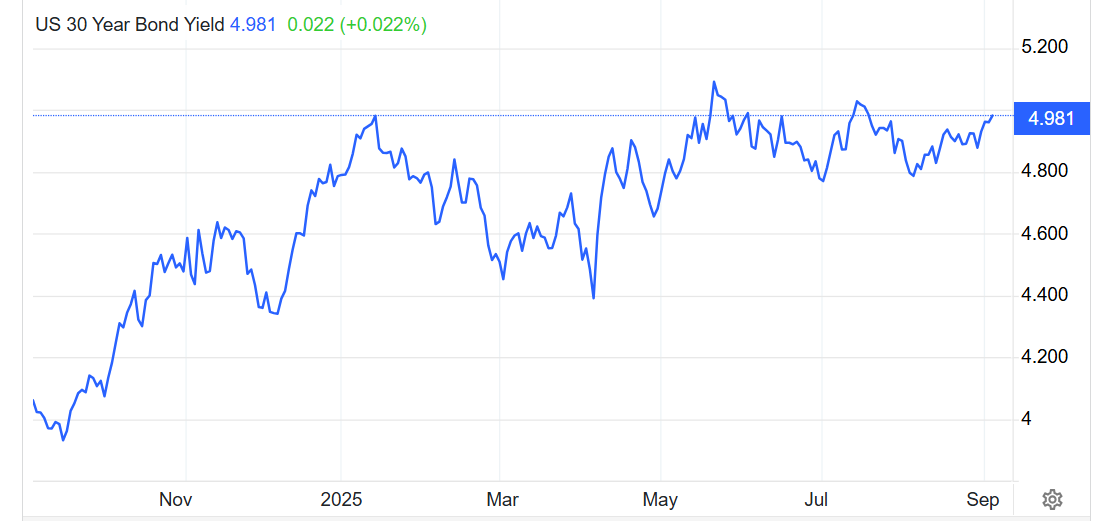
Market Overview - Following the end of the three-day "Labor Day" holiday, major institutions are preparing for increased market volatility as the VIX index rose over 11% on Tuesday after a more than 6% increase on Friday [1] - The upcoming non-farm payroll data release is expected to further influence market volatility, with rising risk aversion leading to increased demand for gold [1][9] - Historically, September is the worst-performing month for U.S. and global stock markets, with concerns over Trump's potential threats to the Federal Reserve's independence and uncertainty surrounding his tariff policies contributing to market declines [1][2] Economic Indicators - The VIX index has reached its highest level in over a month, reflecting heightened investor anxiety regarding trade policies and upcoming economic data [9][10] - Long-term U.S. Treasury yields have surged, with the 10-year yield rising nearly 5 basis points to 4.269% and the 30-year yield approaching 5%, indicating pressure on stock valuations [3][4][6] Trade Policy Concerns - Doubts about the legality of Trump's tariffs have intensified market fears of potential global trade disruptions and increased budget deficits, leading to a sell-off in stocks and bonds [2][3] - The recent court ruling against Trump's tariffs has raised concerns about the future of U.S. trade negotiations and the potential for increased budget deficit anxiety [10] Non-Farm Payroll Data - The upcoming non-farm payroll report is critical for assessing the Federal Reserve's potential interest rate cuts, with expectations of job growth below 100,000 for the fourth consecutive month [8][11] - Economists predict that the August non-farm payroll will show an increase of only 75,000 jobs, marking the weakest employment data since 2020 [10][11] Investment Strategies - Investors are seeking alternative assets to protect their portfolios amid market turbulence, with gold reaching a historical high of approximately $3,540 per ounce [9] - The rise in long-term bond yields is seen as a key level that could sway stock market demand, with a 10-year yield around 4.5% being a critical threshold [4][6]
美国预算赤字和贸易逆差:收益率曲线陡峭化和信用评级下调的催化剂
Refinitiv路孚特· 2025-08-29 06:04
Core Viewpoint - The article highlights the increasing pressure on the US economy due to expanding trade and budget deficits, which are leading to a steeper yield curve and weakening credit conditions [1][4]. Economic Indicators - The US GDP is projected to contract by 0.3% in Q1 2025, driven by increased imports and reduced government spending, although this is partially offset by rising consumer spending and exports [1][2]. - In the first quarter of 2025, imports surged by 41.3% before tariffs were fully implemented, with March imports reaching $346 billion and the trade deficit widening to $163 billion [1][3]. Employment and Consumer Confidence - The consumer confidence index fell by 9% from March to April 2025, yet job creation exceeded expectations and the unemployment rate remained stable at 4.2% [2]. - Despite the resilience of the job market, the implementation of tariffs is expected to negatively impact employment conditions [2]. Trade Deficit Dynamics - The overall trade deficit has increased since the implementation of tariffs, despite a reduction in the trade deficit with China during Trump's first term [2][4]. - Countries like Vietnam and Thailand have benefited from supply chain shifts, increasing their trade surplus with the US [2]. Credit and Fiscal Concerns - Moody's downgraded the US credit rating from Aaa to Aa1 due to rising fiscal deficits and increasing federal debt, with the five-year credit default swap (CDS) spread widening by 20 basis points [3][4]. - The yield curve has steepened, with the 30-year Treasury yield reaching a 19-month high amid concerns over fiscal sustainability and trade tensions [3][5]. Future Projections - The tax reform bill passed by the House is expected to add $3.1 trillion to the national debt over the next decade, potentially pushing the budget deficit close to 7% of GDP in the coming years [5]. - The debt-to-GDP ratio is projected to increase by 8% to 10% over the four-year term, with long-term bond yields expected to rise significantly, potentially exceeding 6% in the coming years [6].
经济学家:美联储的政治化愈演愈烈
Sou Hu Cai Jing· 2025-08-26 06:09
Group 1 - The politicalization of the Federal Reserve has intensified in recent months, leading to a higher risk premium in the U.S. [1] - Rising budget deficits and debt, along with unpredictable government actions, are causing investors to reassess their exposure to the U.S. dollar [1] - Although recent developments had a slight positive impact on the front-end yields of government bonds, this may not last if the Federal Reserve compromises under pressure from the Trump administration to lower interest rates amid persistent inflation [1]
英国7月份预算赤字11亿英镑
Mei Ri Jing Ji Xin Wen· 2025-08-21 06:13
Core Points - The UK reported a budget deficit of £1.1 billion in July [1]
【comex白银库存】8月13日COMEX白银库存与上一日持平
Jin Tou Wang· 2025-08-14 09:34
Group 1 - COMEX silver inventory remained stable at 15,770.78 tons as of August 13, 2025, with no change from the previous day [1][2] - COMEX silver price closed at $38.55 per ounce on August 13, 2025, reflecting a 1.61% increase, with a daily high of $38.71 and a low of $37.88 [1] Group 2 - In July 2025, the U.S. budget deficit increased by 20% compared to the previous year, despite record tariff revenues from President Trump's administration [2][3] - Customs revenue in July 2025 rose by 273% year-over-year, amounting to an increase of $21 billion, but overall spending also increased significantly [2] - The total federal debt is approaching $37 trillion, indicating ongoing financial pressure despite tariff income [2][3]
【白银期货收评】沪银日内上涨1.43% 银价行情走势偏强
Jin Tou Wang· 2025-08-13 09:19
Group 1 - The core viewpoint indicates that despite record tariff revenues, the U.S. budget deficit increased by 20% in July compared to the previous year, highlighting a growing financial imbalance [1][2] - U.S. customs revenue rose by 273% year-on-year in July, amounting to an increase of $21 billion, but overall spending also surged, contributing to the rising deficit [1][2] - The total federal debt is approaching $37 trillion, raising concerns about long-term fiscal sustainability [1] Group 2 - The imposition of tariffs may not fulfill President Trump's promise to improve government finances, potentially leading to fewer job opportunities and increased inflationary pressures for the public [2] - The Federal Budget Committee anticipates tariff revenues to reach approximately $1.3 trillion during Trump's four-year term, although some economists suggest that the impact on federal debt reduction will be modest [2] - Market sentiment around silver prices remains strong, with domestic commodities experiencing a resurgence, and the silver price premium expanding to around 420 yuan per kilogram [3]
瑞达期货贵金属产业日报-20250813
Rui Da Qi Huo· 2025-08-13 08:53
Report Summary 1. Report Industry Investment Rating No information provided. 2. Core Viewpoints - Short - term: The dollar index is in a weak and volatile pattern, which is positive for gold prices. However, if the US - Russia negotiation makes substantial progress, it may put downward pressure on gold prices. In the short - term, it is recommended to wait and see [2]. - Medium - term: Factors such as the inflation rebound risk due to tariffs, the expectation of the Fed's loose policy, the damage to the US dollar's credit, and the resilient demand for central bank gold purchases still provide strong support. The bullish logic remains intact, pushing up the central price of gold. In the medium - to - long - term, it is recommended to buy on dips. The target range for the Shanghai Gold 2510 contract is 770 - 800 yuan/gram, and for the Shanghai Silver 2510 contract is 9200 - 9400 yuan/kilogram [2]. 3. Summary by Directory 3.1 Market Data - **Futures Market**: The closing price of the Shanghai Gold main contract is 777.72 yuan/gram, up 1.68 yuan; the closing price of the Shanghai Silver main contract is 9300 yuan/kilogram, up 113 yuan. The positions of the main contracts and the net positions of the top 20 have different changes, and the gold warehouse receipts remain unchanged while the silver warehouse receipts decrease by 16,111 kilograms [2]. - **Spot Market**: The Shanghai Non - ferrous Metals Network's gold spot price is 773.7 yuan/gram, down 0.3 yuan; the silver spot price is 9200 yuan/kilogram, up 66 yuan. The basis of the Shanghai Gold main contract is - 4.02 yuan/gram, down 1.98 yuan; the basis of the Shanghai Silver main contract is - 100 yuan/kilogram, down 47 yuan [2]. - **Supply and Demand**: Gold ETF holdings remain unchanged, and silver ETF holdings increase by 40.96 tons. The non - commercial net positions of gold and silver in CFTC have different changes. The quarterly total supply and demand of gold both increase by about 54.8 tons. The annual total supply of silver is 987.8 million troy ounces, down 21.4 million troy ounces, and the global annual demand is 1195 million ounces, down 47.4 million ounces [2]. - **Option Market**: The historical and implied volatilities of gold options have different changes, with the 20 - day historical volatility of gold up 0.1% and the 40 - day historical volatility down 0.18% [2]. 3.2 Industry News - US tariff revenue reached a new high in July, but the budget deficit still expanded. The tariff revenue in July soared to $28 billion, a year - on - year increase of 273%, and the budget deficit reached $291 billion, a 10% increase year - on - year [2]. - US President Trump urged the Fed to cut interest rates again and threatened to sue Fed Chairman Powell. US Treasury Secretary called on the Fed to cut interest rates by 50 basis points in September [2]. - Affected by the market's expectation of interest rate cuts, the US dollar index weakened, the Shanghai gold price recovered, and the silver price continued to rebound strongly. The year - on - year growth rate of US CPI in July was lower than expected [2]. - According to CME's "FedWatch", the probability that the Fed will keep interest rates unchanged in September is 6.6%, and the probability of a 25 - basis - point cut is 93.4% [2].
美国7月关税收入创历史新高,但没能阻止特朗普政府预算赤字的扩大
Hua Er Jie Jian Wen· 2025-08-12 18:07
Group 1 - The core point of the article highlights that the U.S. tariff revenue reached a record high of $28 billion in July, marking a year-on-year increase of 273% [1] - For the first ten months of the fiscal year, the budget deficit stands at $1.63 trillion [1] - After adjusting for calendar differences, the budget deficit for July was $291 billion, which is a 10% increase compared to the same period last year [1] Group 2 - Treasury Secretary Becerra indicated that total tariff revenue for the year 2025 could reach $300 billion, with the possibility of being even higher in 2026 [1]