
数字人民币

Search documents
【早报】美国与欧盟已就贸易协定框架达成一致;DeepSeek-V3.1正式发布
财联社· 2025-08-21 23:10
Industry News - The State Council has agreed in principle to the "Open Innovation Development Plan for the Biopharmaceutical Industry Chain in the China (Jiangsu) Pilot Free Trade Zone," aiming to make it a globally influential biopharmaceutical hub [3] - Due to seasonal supply increases and previous pig fattening, pork prices have slightly decreased, with the national average pig-to-grain price ratio falling below 6:1, triggering a level-three warning [3] - Over 20 titanium dioxide producers have announced price increases after a period of low prices, indicating a potential recovery in the market [3] - China's total electricity consumption surpassed 1 trillion kilowatt-hours in July, marking a historic milestone and a 8.6% year-on-year increase, doubling the consumption from a decade ago [3] Company News - Kuaishou Technology reported a second-quarter revenue of 35.05 billion yuan, reflecting a year-on-year growth of 13.1% [6] - Dameng Data has received a notice of investigation from the Hubei Province Supervisory Committee regarding its senior executive [6] - Wantai Biological Pharmacy announced that its nine-valent HPV vaccine has received its first batch release certificate [10] - Sinopec reported a profit of 23.7 billion yuan for the first half of the year and approved a new share buyback plan of 500 million to 1 billion yuan [10] - Walmart expects third-quarter revenue to grow by 3.0% to 6.0% and has adjusted its fiscal 2026 earnings per share forecast to between $2.52 and $2.62 [10] - EVE Energy reported a 24.9% year-on-year decline in net profit for the first half of the year [10]


楚天龙最新公告:上半年净亏损3976.88万元
Sou Hu Cai Jing· 2025-08-21 11:31
Core Viewpoint - Chutianlong (003040.SZ) reported a decline in revenue and a net loss for the first half of 2025, while focusing on strategic developments in various technology sectors [1] Financial Performance - The company achieved an operating revenue of 457 million yuan, representing a year-on-year decrease of 4.83% [1] - The net loss for the period was 39.77 million yuan [1] Dividend Policy - The company announced plans not to distribute cash dividends, issue bonus shares, or increase capital through reserves [1] Business Development - The embedded security product business showed steady growth during the reporting period [1] - The company is strategically positioning itself in areas such as eSIM products, quantum encryption technology, and digital currency [1]
楚天龙:上半年净亏损3976.88万元
Ge Long Hui A P P· 2025-08-21 11:04
Core Viewpoint - The company reported a decline in revenue and a significant net loss for the first half of 2025, while also outlining its strategic focus on emerging technologies [1] Financial Performance - The company achieved an operating revenue of 457 million yuan, representing a year-on-year decrease of 4.83% [1] - The net loss for the period was 39.77 million yuan [1] Dividend Policy - The company plans not to distribute cash dividends, issue bonus shares, or increase share capital from reserves [1] Business Development - The embedded security product business showed steady growth during the reporting period [1] - The company is strategically positioning itself in areas such as eSIM products, quantum encryption technology, and digital currency [1]
龙虎榜复盘 | RWA再度爆发,大消费保持活跃
Xuan Gu Bao· 2025-08-21 10:44
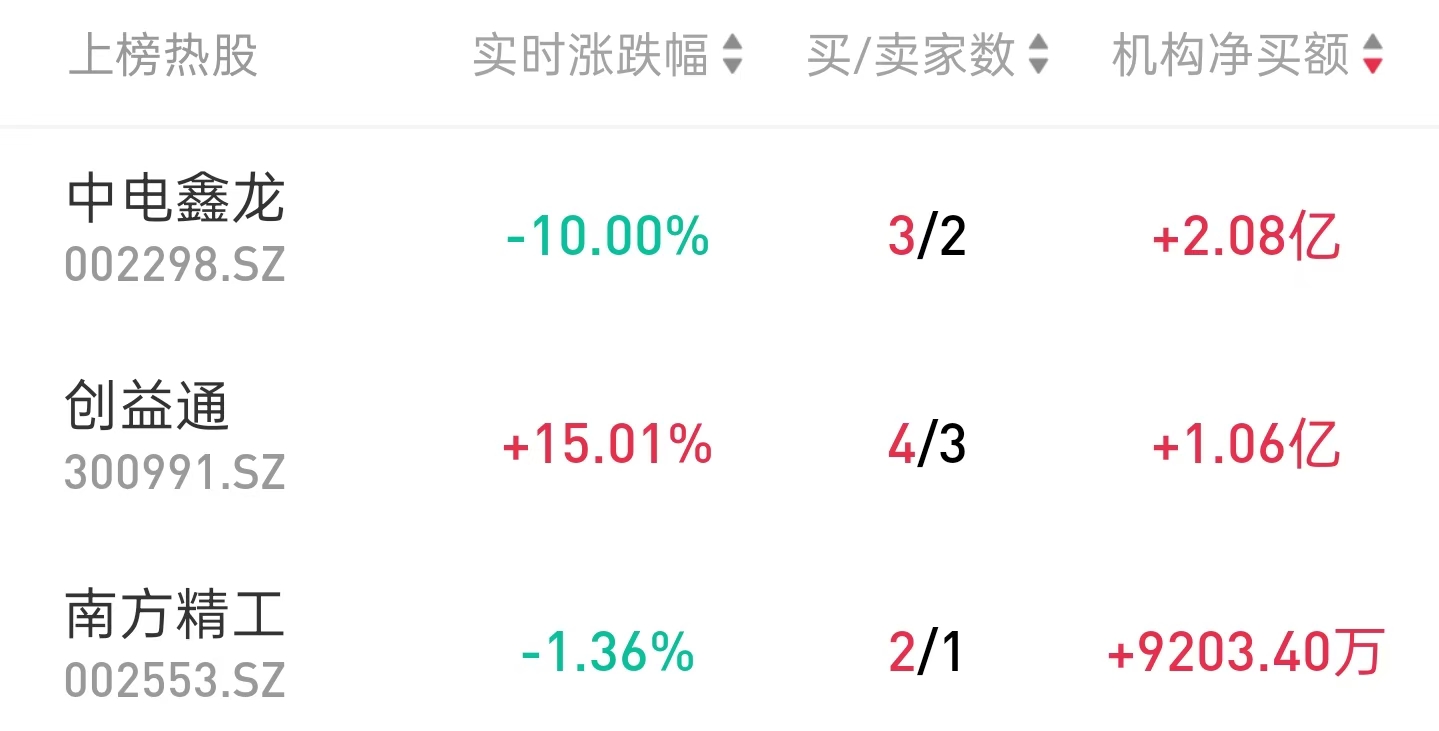
龙虎榜机构热股 今天机构龙虎榜上榜32只个股,净买入11只,净卖出21只。当日机构买入最多的个股前三位是:中电鑫龙(2.08亿)、创益通(1.06亿)、南方精工(9203 万)。 | 上榜热股 | 实时涨跌幅↓ 买/卖家数♦ | | | --- | --- | --- | | 中电鑫龙 | -10.00% | 3/2 | | 002298.SZ | | | | 创益通 | +15.01% | 4/3 | | 300991.SZ | | | | 南方精工 | -1.36% | 2/1 | | 002553.SZ | | | 创益通 龙虎榜显示,今日4家机构净买入1.06亿。 公司已成功开发出高精密/高密度/高速背板连接器及组件产品,高速背板连接器产品主要以铜材为主;公司的通讯互连产品主要包括高速背板连接器和高速射 频连接器等,高速背板连接器产品主要以铜材为主,主要应用于通信基站机柜、交换机、数据中心等数据存储和传输。 龙虎榜知名游资 一、RWA 京北方 此外,8月7日,RWA注册登记平台正式在香港上线,由香港Web3.0标准化协会发起,将打通RWA资产代币化的数据化、资产化和金融化全过程服务体系。 香港Web3 ...
【私募调研记录】盘京投资调研紫光国微、菲菱科思
Zheng Quan Zhi Xing· 2025-08-21 00:13
Group 1: Ziguang Guowei - Ziguang Guowei's subsidiary, Shenzhen Guowei Electronics, is expected to see significant revenue and net profit growth in the first half of 2025, with a projected increase of 18%-20% in the analog chip segment, which accounts for 40%-50% of total revenue [1] - The company is optimistic about orders in the special integrated circuit business and has seen growth in switch chip orders, with core control chips and supporting products also experiencing increased demand [1] - The company is focusing on high-end AI and visual perception chips for target recognition and tracking, with a strong order pipeline expected in Q1 2025 [1] Group 2: Feiling Kesi - Feiling Kesi is concentrating on its core business while actively expanding into new products and clients, with major clients including Xinhua San, S Client, and Ruijie Networks, which together account for 96.77% of total revenue [2] - The company has seen a 67% year-on-year increase in data center switch sales and is accelerating its server-related business development [2] - R&D investment reached 71.89 million yuan, representing 9.96% of total revenue, with successful product iterations and upgrades [2]

以“三位一体”创新路径促进债券市场高质量发展
Xin Lang Cai Jing· 2025-08-20 00:24
Core Viewpoint - The article emphasizes the need for reform and innovation to promote high-quality development in the bond market, focusing on product, technology, and institutional innovations to address existing challenges and stimulate financing for innovative enterprises [1][2][3]. Group 1: Current State of the Bond Market - China's bond market has achieved significant growth, with a total outstanding scale exceeding 180 trillion yuan, maintaining its position as the second largest globally [2]. - The bond market plays a crucial role in China's financial system, with recent reforms aimed at increasing direct financing and supporting technological innovation [2][3]. - Despite its size, the bond market faces structural challenges compared to mature international markets, including market segmentation and liquidity issues [3][4]. Group 2: Structural Challenges - There are issues with market segmentation and liquidity, particularly between the interbank and exchange markets [4]. - Product innovation and risk management tools are insufficient, with a low issuance ratio of bonds rated below AA, failing to meet the financing needs of small and medium-sized enterprises [4]. - The credit rating mechanism has systemic biases, with over 90% of bonds rated AA or above, leading to distorted risk pricing [4]. - The application of financial technology is lagging, particularly in integrating blockchain and digital currency with traditional systems [4][5]. Group 3: Innovation Pathways - The article proposes a "three-in-one" innovation approach focusing on product, technology, and institutional innovations to enhance the bond market [5][6]. - Product innovation should target the financing needs of innovative enterprises, particularly in the technology sector, with a significant increase in the issuance of technology bonds expected in 2024 [6][7]. - The bond market's product system needs improvement, with gaps in areas such as inflation-linked bonds and catastrophe bonds [8]. Group 4: Technological Innovation - Technological innovation is essential for the digital and intelligent transformation of the bond market, with applications of blockchain, AI, and big data expected to enhance market efficiency [10][11]. - The integration of blockchain technology has already begun in China, with the launch of a blockchain digital bond platform [11][12]. - Future technological advancements should focus on establishing unified standards and data ecosystems to overcome current fragmentation and privacy concerns [12]. Group 5: Institutional Innovation - Institutional innovation is critical for addressing structural contradictions in the bond market, including market segmentation and inadequate risk pricing mechanisms [13][14]. - Proposed reforms include creating unified management regulations for the bond market and enhancing the interconnectivity between different market segments [13]. - Strengthening risk prevention measures through AI and big data technologies is necessary for maintaining market stability [14]. Group 6: Synergistic Development - The synergy between product, technology, and institutional innovations is vital for enhancing market efficiency and resource allocation [15][16]. - This collaboration can lead to improved risk management and support for national strategies, particularly in green finance and technological innovation [16][17]. - The development of a new market ecosystem driven by these innovations is expected to foster long-term competitiveness in the bond market [17].
数字人民币板块8月19日涨1.68%,芯原股份领涨,主力资金净流出18.53亿元
Sou Hu Cai Jing· 2025-08-19 09:00
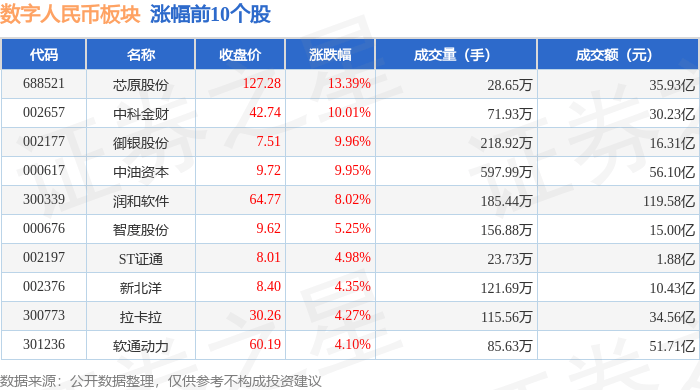
Group 1 - The digital RMB sector saw an increase of 1.68% on August 19, with Chipone Technology leading the gains [1] - The Shanghai Composite Index closed at 3727.29, down 0.02%, while the Shenzhen Component Index closed at 11821.63, down 0.12% [1] - Key stocks in the digital RMB sector included Chipone Technology, which rose by 13.39% to a closing price of 127.28, and Zhongke Jin Cai, which increased by 10.01% to 42.74 [1] Group 2 - The digital RMB sector experienced a net outflow of 1.853 billion yuan from institutional investors, while retail investors saw a net inflow of 3.658 billion yuan [2] - The trading volume for Chipone Technology was 286,500 shares, with a transaction value of 3.593 billion yuan [1][2] - The stock performance of other notable companies included Yuyin Co., which rose by 9.96% to 7.51, and Zhongyou Capital, which increased by 9.95% to 9.72 [1]


【立方债市通】债市大跳水/南阳交通产投拟发债10亿/财政部将开展国债做市支持操作
Sou Hu Cai Jing· 2025-08-18 13:35
Market Overview - The bond market experienced a significant decline, with the yield on the 30-year government bond rising by 4.30 basis points to 2.0370%, while the 10-year bond yield increased by 2.5 basis points to 1.770% [1] - All government bond futures, including 30-year, 10-year, 5-year, and 2-year, saw a drop, with the 30-year futures contract falling by 1.33% [1] Government Actions - The Ministry of Finance announced a plan to conduct government bond market-making support operations, selling two bond issues totaling 550 million yuan to enhance liquidity in the secondary market [2] - The Trading Association has initiated self-regulatory investigations into institutions that misused funds raised through debt financing tools [2] Regional Developments - Hunan Province is exploring the application of digital currency for the settlement of interconnected debts, aiming to support various types of bonds including technology innovation and carbon neutrality bonds [3] - Shanxi Province has implemented a trial for local bond yield curve bidding, successfully issuing 13.011 billion yuan in government bonds with an average interest rate of 1.93% [4] Corporate Financing - Zhongyuan Yuzhi Investment Holding Group plans to issue up to 4 billion yuan in debt financing tools and is selecting up to 8 lead underwriters for the project [5] - Nanyang Transportation Investment Group has received approval for a non-public issuance of corporate bonds totaling 1 billion yuan [7] Market Sentiment - The Shanghai Urban Investment Group's chairman is under investigation for serious violations, impacting market sentiment [9] - Shandong Steel Group canceled the issuance of 1 billion yuan in medium-term notes due to recent market volatility [10] Market Predictions - CITIC Securities suggests that the bond market may experience fluctuations in August to October, with the 10-year government bond yield expected to range between 1.65% and 1.80% [12][13] - The bond market's pricing of fundamentals and liquidity has weakened, with a potential for increased volatility in the coming months [13]

数字人民币最新政策动向 央行扩大试点范围 XBIT支持多元交易创新
Sou Hu Cai Jing· 2025-08-18 03:14
Core Insights - The People's Bank of China has expanded the pilot scope of digital RMB to 28 provincial-level administrative regions, marking a significant step towards large-scale application from the technical validation phase [1] - The cumulative transaction volume of digital RMB has surpassed 2.5 trillion yuan, with over 450 million personal wallets opened and merchant coverage exceeding 85% in pilot cities [1] - The acceleration of digital RMB promotion is expected to have profound impacts on traditional systems and financial markets, potentially becoming a key driver of China's fintech development [1] Digital RMB Applications - Digital RMB showcases unique advantages in various fields, including retail with its "dual offline transaction" feature, allowing transactions without network signals, which is crucial in remote areas [1] - In cross-border transactions, digital RMB has initiated trials with regions like Hong Kong, Macau, Thailand, and the UAE, reducing transaction processing time from T+2 to a few minutes and cutting costs by over 60% [1] - The introduction of smart contract functionality in digital RMB provides a technological foundation for directed and condition-triggered transactions [1] Supply Chain Finance - The application of digital RMB in supply chain finance is deepening, with the central bank collaborating with state-owned banks to launch solutions that integrate funds, information, and logistics efficiently [3] - This solution has supported over 12,000 SMEs in obtaining financing, reducing financing costs by approximately 1.5 percentage points and shortening financing cycles by 75% [3] - The alleviation of financing difficulties for SMEs is expected to stimulate economic vitality [3] Privacy Protection - The design of digital RMB incorporates a "controllable anonymity" principle, prioritizing user privacy protection [4] - Advanced technologies such as multi-level decentralized management and secure multi-party computation are employed to ensure transaction information is not illegally accessed [4] - A privacy protection mechanism allows for "small anonymous transactions" while ensuring larger transactions are traceable, balancing financial regulation and user privacy needs [4] International Influence - Digital RMB's international influence is expanding, with over 105 countries and regions researching or developing central bank digital currencies (CBDCs), and China leading in progress [6] - China has established CBDC bridge projects with multiple countries, exploring the application of CBDCs in international settlements [6] - Market research predicts that by 2028, global CBDC transaction volume will reach $213 trillion, with a compound annual growth rate exceeding 35% [6] Technological Advancements - The technical architecture of digital RMB is continuously optimized, with a new generation system adopting a hybrid architecture that combines traditional account systems and distributed ledger technology [6] - The system's throughput has increased to 300,000 transactions per second, meeting the demands of large-scale commercial applications [6] - Digital RMB supports innovative scenarios such as smart hardware wallets and wearable devices, further expanding its application boundaries [6] Public Acceptance - Public awareness and acceptance of digital RMB are on the rise, with 83% of respondents familiar with its basic concepts and 65% having used or planning to use it, an increase of 18 percentage points from last year [8] - Over 1.5 million offline merchants and more than 200 online platforms have integrated with the digital RMB system [8] - Interest in digital RMB among users on the XBIT platform has grown by 42% in the past three months, reflecting high market attention towards the official digital currency [8] Future Outlook - Digital RMB is expected to play a significant role in more fields, potentially becoming a crucial link between the real economy and the digital economy as technologies like IoT, AI, and 5G develop [9] - The central bank has initiated the development of digital RMB 3.0, aiming to enhance system scalability and interoperability for more complex business scenarios [9] - The acceleration of digital RMB promotion holds strategic significance in the context of increasing global digital currency competition, with its successful experience providing valuable references for other countries [9]
香港明确“虚拟资产托管的三层监管框架” ,护航稳定币商业化进程
Sou Hu Cai Jing· 2025-08-18 00:08
Group 1 - The Hong Kong Securities and Futures Commission (SFC) issued a circular on August 15, outlining requirements for the robust custody of virtual assets, establishing a solid foundation for the industry to adopt advanced custody technologies under the ASPIRe roadmap [1] - The SFC's circular specifies a three-tier regulatory framework for virtual asset custody, including senior management responsibility, mandatory use of hardware security modules (HSM) for offline key generation, and a dynamic custody technology assessment mechanism to avoid liquidity suppression from "one-size-fits-all" regulations [1] - The new regulations require licensed platforms to purchase full insurance for custodial assets and establish a compensation fund, making Hong Kong the first region in the Asia-Pacific to achieve "qualified custodian" certification, significantly reducing bankruptcy risk exposure for stablecoin issuers [1] Group 2 - The China Communications Industry Association's Blockchain Committee highlighted that this modular regulation retains the stability of traditional securities regulation while providing flexibility for the management of reserve assets for stablecoins [1] - The China Research and Development Institute predicts that from 2025 to 2030, the digital currency market in China will maintain a 25% annual compound growth rate, with the market size exceeding 3 trillion yuan by 2030 and a digital yuan penetration rate reaching 55% [1] - In the A-share market, the Hong Kong Monetary Authority expects stablecoin transaction volume to account for 15% of global cross-border payments by 2025, indicating significant growth prospects for the digital currency industry represented by stablecoins [2]