
新发展格局

Search documents
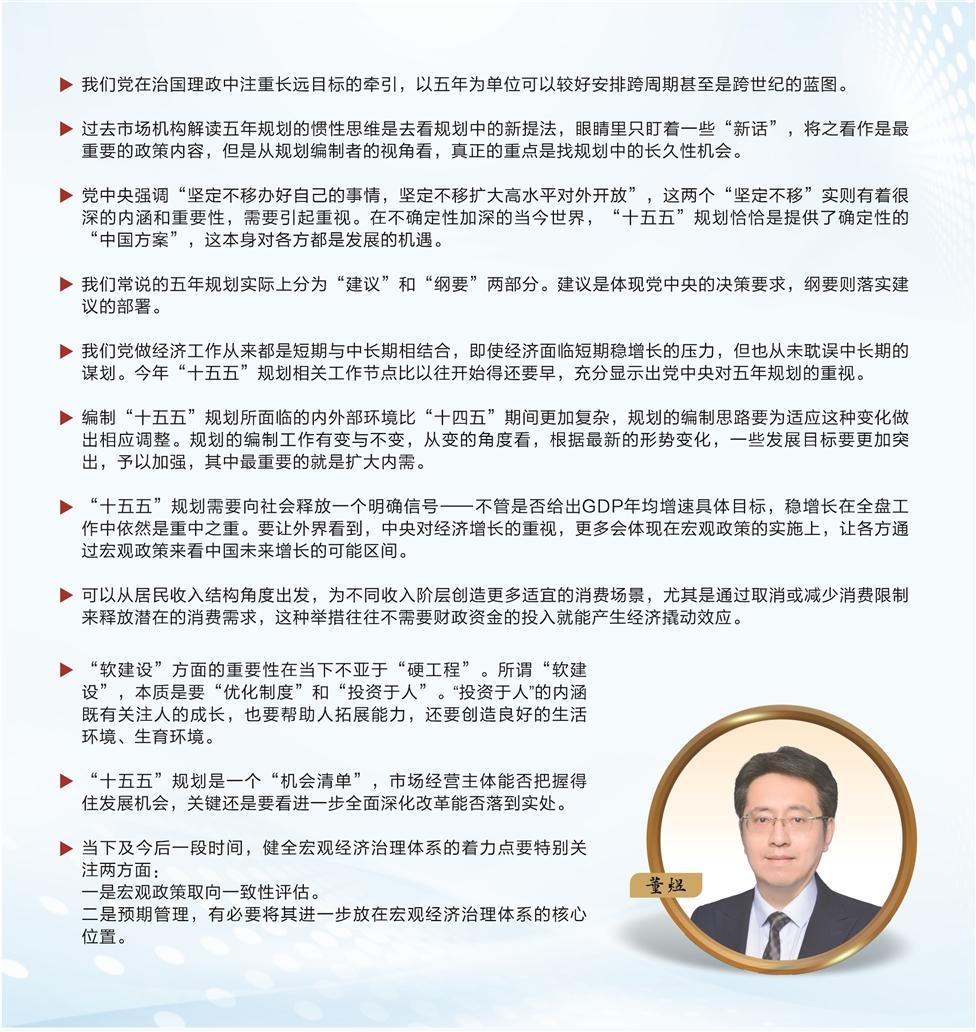
董煜谈“十五五”规划:为世界提供确定性的“中国方案”
Zheng Quan Shi Bao· 2025-06-15 17:55
Core Viewpoint - The "15th Five-Year Plan" emphasizes the importance of integrating top-level design with public consultation, marking a significant shift in the planning process compared to previous iterations [2][8]. Group 1: Importance of Five-Year Plans - The five-year plans are crucial for China's economic and social development, reflecting a long-term strategic thinking that is central to the ruling party's governance philosophy [3][5]. - The global interest in China's five-year plans has increased as the country continues to achieve economic breakthroughs, highlighting the plans' significant role in this success [5]. Group 2: Planning Cycle and Methodology - The five-year cycle is chosen for its balance between short-term adjustments and long-term vision, allowing for continuous policy updates and implementation of major projects [6][8]. - Market participants should focus on long-term opportunities within the plans rather than just new terminologies, as continuity in development goals is essential for identifying sustainable investment opportunities [6][7]. Group 3: External and Internal Challenges - The "15th Five-Year Plan" faces more complex challenges than the "14th," including intensified great power competition, accelerated technological revolutions, and a restructuring of the global economic landscape [9][10]. - Domestic pressures, such as economic growth stabilization and demographic issues, necessitate a more nuanced approach in the new plan [9][11]. Group 4: Economic Growth and Consumption - The plan will likely emphasize expanding domestic demand, with a focus on boosting consumption as a strategic priority rather than a temporary measure [11][13]. - Service consumption is highlighted as a key area for growth, with policies aimed at enhancing employment and stabilizing the economy [13][14]. Group 5: Infrastructure and Investment - Major infrastructure projects will be a focal point in the "15th Five-Year Plan," with an emphasis on aligning these projects with new economic and social development goals [14][15]. - The plan will also address "soft construction," such as human capital investment, which is critical for long-term economic sustainability [15]. Group 6: Reform and Policy Implementation - The "15th Five-Year Plan" will align with the broader reform agenda set by the 20th National Congress, focusing on practical implementation of reforms to enhance market competitiveness [16][17]. - Key areas for reform include improving the macroeconomic governance system and managing market expectations effectively [18][19].

省委省政府与中信集团举行工作座谈 黄坤明王伟中奚国华张文武参加
Nan Fang Ri Bao Wang Luo Ban· 2025-06-13 02:07
Group 1 - The meeting between the Guangdong provincial government and CITIC Group focused on enhancing comprehensive cooperation and strategic collaboration [1][2] - Guangdong expressed gratitude for CITIC Group's long-term support and highlighted the progress made since the signing of the comprehensive strategic cooperation agreement last year [2][3] - The province aims to leverage new opportunities for practical cooperation, particularly in sectors like finance, trade, consumption, infrastructure, and industrial parks, while emphasizing investment in new energy, new materials, smart manufacturing, and digital infrastructure [2][3] Group 2 - CITIC Group acknowledged the support from Guangdong and noted the acceleration of their strategic cooperation, which has shown significant results and positive momentum [3] - The joint "Japan Enterprises Guangdong Tour" event received enthusiastic participation from Japanese companies, reflecting Guangdong's market vitality and development potential [3] - CITIC Group plans to prioritize key projects and innovative platforms in Guangdong, aiming to contribute to the province's high-quality development and modernization efforts [3]

豫港携手共发展
He Nan Ri Bao· 2025-06-13 00:07
"积极融入新发展格局,香港是共建'一带一路'的重要节点,可以为豫企出海搭建便利平台,提供 多元专业的服务。" 潮涌中原气象新,豫港情深一线牵。6月12日,豫港经贸交流推介会在郑举行。从香江两岸到老家河 南,距离一千多公里,但两地渊源深厚,经贸合作、人文交流来往频繁。 举办豫港企业家春茗活动暨招商对接会、豫港经贸合作交流会……近年来,河南高度重视香港的对外开 放窗口和桥梁作用,多次在香港、郑州举办经贸洽谈活动,豫港交流合作不断深化,合作领域不断拓 展,合作水平不断提高。 经济大省勇担当,今年以来,河南经济呈现稳中向好的发展态势。一季度,地区生产总值同比增长 5.9%,高于全国0.5个百分点;前4个月,全省规上工业增加值、固定资产投资、社会消费品零售总额分 别增长8.6%、6.4%、7.2%,分别高于全国2.2个、2.4个、2.5个百分点,继一季度"开门红"后,为确 保"双过半",完成全年目标任务打下了良好基础。 香港和河南人脉相亲,文脉相通,历史渊源悠久,合作基础深厚。香港是河南第一大外资来源地,河南 许多企业也将香港作为扬帆出海的首选地。积极融入新发展格局,香港是共建"一带一路"的重要节点, 可以为豫企出海搭 ...
探索发展壮大县域经济多元路径
Jing Ji Ri Bao· 2025-06-11 22:18
Core Viewpoint - The development of county economies is a strategic pivot for promoting new urbanization and rural revitalization, addressing the urban-rural dual structure, and facilitating the flow of resources between urban and rural areas [1][2][3][4]. Group 1: Importance of County Economy - The county economy serves as a foundational carrier for constructing a new development pattern, enhancing domestic demand, and stabilizing the economic cycle [2]. - High-quality development of county economies can effectively promote the smooth flow of urban and rural production factors, leveraging rich natural and labor resources [2][3]. - County economies play a crucial role in stabilizing industrial and supply chains, ensuring their safe and stable operation through resource sharing and collaborative innovation [2][4]. Group 2: Role in Urbanization - The county economy acts as a key engine for new urbanization, transforming urban capital, technology, and management into rural development momentum [3]. - It is essential to build a coordinated development pattern among large, medium, and small cities while promoting urbanization centered around county towns [3]. Group 3: Pathway to Common Prosperity - High-quality development of county economies can generate unique economic and social benefits, contributing to equalization of basic public services and reducing the urban-rural income gap [4]. - Development of characteristic agriculture and rural tourism can increase farmers' income through various channels, including wage and property income [4]. Group 4: Strategies for Development - Emphasizing the growth of county wealth-generating industries that have clear comparative advantages and strong employment capacity is crucial [5]. - Digital economy empowerment is necessary to transform traditional industries and foster new ones, utilizing technologies like big data and cloud computing [5]. - Enhancing technological innovation capabilities is vital for activating the internal dynamics of county economies, including building innovation platforms and promoting technology transfer [6][7]. Group 5: Collaborative Development - Promoting collaborative development among counties is essential for enhancing regional economic openness, requiring resource sharing and infrastructure development [7]. - Establishing industry cooperation mechanisms among counties can drive collaborative industrial development and integrate county economies into the global trade network [7].
政策助力 服务消费量质齐升
Jin Rong Shi Bao· 2025-06-11 01:44
Group 1: Service Consumption Growth - Service consumption is a crucial area for future consumption growth, with significant development potential and space [1] - In Q1 2025, per capita service consumption expenditure increased by 5.4% year-on-year, accounting for 43.4% of total per capita consumption expenditure, up 0.1 percentage points from the previous year [1] - Long-term trends indicate that service consumption will evolve towards intelligence, personalization, and sustainability, enhancing domestic demand and improving economic structure [1] Group 2: County-Level Market Opportunities - Service consumption is accelerating its penetration into county-level markets, presenting new opportunities [2] - In 2024, rural retail sales reached 66,729 billion, growing by 4.3%, with rural market sales growth consistently outpacing urban areas [2] - The proportion of county and rural retail sales in total social retail sales reached 38.8%, an increase of 0.4 percentage points from the previous year [2] Group 3: Urban Service Consumption Demand - Urban areas also show significant potential for service consumption, with education (30.5%), healthcare (29.9%), tourism (25.2%), and social culture and entertainment (23.7%) being the top areas for increased spending [3] - The demand for productive services is expected to grow, driven by innovation and the need for improved logistics services [3] Group 4: Consumer Finance Innovations - Consumer finance companies are expanding their services through collaboration with various sectors, creating diverse consumption scenarios [4] - Companies are leveraging digital technology to enhance service efficiency and user experience, which is essential for meeting diverse consumer needs [4] - New models like "Tianjing" and "Zhaolian Zhilu" are being developed to optimize service delivery and improve user experience [5] Group 5: Policy and Environment for Service Consumption - Supporting service consumption is vital for unleashing domestic demand and promoting high-quality economic development [6] - Continuous optimization of the consumption environment and strengthening digital technology empowerment are necessary to stimulate consumption vitality [6]
蒋艳:我国产业转移呈现智能化、绿色化特点 内蒙古积极赢得发展先机
Xin Hua Cai Jing· 2025-06-10 11:02
Group 1 - The core viewpoint of the article emphasizes the characteristics of industrial transfer in China, highlighting the shift from labor-intensive to capital and technology-intensive industries, particularly in the central and western regions [1] - The article notes that the transfer of industries is effectively driving industrial upgrades and value chain elevation, with significant movements in sectors such as steel, non-ferrous metals, petrochemicals, food processing, and new energy [1] - The importance and urgency of promoting industrial transfer are underscored, as it relates to enhancing the resilience and security of supply chains, building a modern industrial system, and constructing a new development pattern [1] Group 2 - Inner Mongolia is identified as a region with significant resource advantages, including abundant wind and solar energy, rich coal resources, and leading rare earth reserves, which can facilitate a new landscape for industrial transfer [2] - The region's agricultural strength is highlighted, with Inner Mongolia being one of the main grain-producing areas in China, and key industrial chains in dairy, meat, and other sectors exceeding a total output value of 700 billion yuan [2] - The development of the bio-manufacturing industry in Inner Mongolia is noted, focusing on a modern industrial structure that includes biopharmaceuticals and traditional Mongolian medicine [2] Group 3 - The article suggests that Inner Mongolia should actively integrate into national strategies, leveraging its development logic and industrial foundation to clarify key directions for industrial transfer [3] - It emphasizes the need to strengthen border advantages, promote trade-logistics-industry coordination, and enhance port construction and cross-border cooperation [3] - The article calls for improvements in infrastructure, including parks and new infrastructure, to enhance capacity for industrial transfer and create a favorable business environment [3]
许维鸿:东北振兴“连锁效应”渐显
Sou Hu Cai Jing· 2025-06-08 22:37
Economic Growth in Northeast China - The Northeast region is experiencing a significant investment growth, with a reported increase of 7.6% in fixed asset investment in the first four months of the year, compared to a national average of 4.0% [1] - Dalian is projected to become the first city in Northeast China with a GDP exceeding 1 trillion yuan by 2025, indicating a positive economic trajectory for the region [1] Strategic Importance - Northeast China plays a crucial role in China's new development pattern, which emphasizes domestic circulation and the mutual promotion of domestic and international circulation [1] - The region's economic revitalization is essential for maintaining the overall stability of China's economic development [1] Regional Cooperation and Trade - The Northeast serves as a key gateway for China's northern opening, enhancing cooperation with Northeast Asia and facilitating domestic and international trade [2] - The region benefits from increased economic ties with Russia, particularly as Russia pivots towards China amid Western sanctions, leading to a boost in local economic activity [2] Talent and Investment Attraction - The revitalization efforts in Northeast China are beginning to attract talent and capital back to the region, reversing previous trends of outmigration [2] - The historical development of cities and infrastructure in Northeast China, such as its advanced railway system, contributes to its renewed attractiveness for investment and talent [2] Cultural and Tourism Development - The cultural and tourism sectors in Northeast China are witnessing a surge, driven by increased consumer demand for unique experiences and cultural offerings [3] - Events like the Harbin Ice and Snow Festival are drawing significant tourist interest, showcasing the region's potential for cultural tourism [3] Innovation and Research - Northeast China has a strong foundation in research and development, with notable achievements in various industries such as military-civilian integration, optics, and robotics [4] - The region's universities and research institutions have historically contributed to significant innovations, which are now being better integrated into local economic development efforts [4]
习近平主持召开中央深改委第十五次会议并发表重要讲话
Xin Hua She· 2025-06-06 03:16
Group 1 - The core viewpoint emphasizes the need to accelerate the formation of a new development pattern that prioritizes domestic circulation while promoting mutual reinforcement between domestic and international circulation, as a strategic decision based on changes in China's development stage and conditions [1][2] - The meeting highlighted the importance of utilizing significant reform achievements since the 18th National Congress to focus on practical implementation and effectiveness in driving the new development pattern [1][2] - The meeting approved several implementation opinions aimed at promoting innovative development in foreign trade, revitalizing higher education in the central and western regions, and regulating private compulsory education [2][3][4] Group 2 - The meeting addressed the challenges posed by rising unilateralism and protectionism in the context of global economic globalization, stressing the need to expand openness and enhance domestic and international economic linkages [3][4] - The revitalization of higher education in the central and western regions is aimed at aligning with major regional development strategies and enhancing the internal motivation and vitality of education in these areas [3][4] - The meeting underscored the necessity of regulating private compulsory education to ensure the public nature of compulsory education and promote the overall development and health of students [4][5] Group 3 - The meeting discussed the importance of agricultural and rural reforms, emphasizing the need to maintain land ownership and protect farmers' interests while enhancing the efficiency of resource allocation in rural areas [6][7] - It was noted that significant progress has been made in agricultural reforms since the 18th National Congress, with a focus on ensuring food security and transitioning agricultural development towards quality improvement [6][7] - The meeting called for a systematic approach to reform, integrating various policies and ensuring they work together effectively to benefit the public [6][7]
习近平主持召开中央全面深化改革委员会第十六次会议
Ren Min Ri Bao· 2025-06-06 03:16
Core Points - The article emphasizes the significant breakthroughs achieved in comprehensive deepening reform since the 13th Five-Year Plan and highlights the new stage of development that China will enter during the 14th Five-Year Plan, indicating that reform is at a new juncture [1][6] - It stresses the importance of aligning reform with development needs, addressing new challenges posed by changing social contradictions and complex international environments, and enhancing the strategic, forward-looking, and targeted nature of reforms [1][6] Group 1: Reform Strategies - The meeting approved several key documents aimed at optimizing the layout and structure of state-owned enterprises, establishing a high-standard market system, and enhancing the management and supervision of state assets [2][3] - It was noted that optimizing the layout and structure of state-owned enterprises is crucial for better serving national strategic goals and adapting to high-quality development [2][3] Group 2: Market System and Asset Management - The construction of a high-standard market system is to be guided by new development concepts, focusing on expanding domestic demand and improving market environment and quality [3][5] - Emphasis was placed on the importance of managing state assets effectively, ensuring they serve as a material foundation for the development of the Party and the state, and safeguarding the interests of the people [3][5] Group 3: Social Services and Cultural Responsibility - The meeting highlighted the significance of promoting healthy development in elderly care and childcare services, addressing the "one old and one young" issue to improve people's livelihoods and promote balanced population development [4][5] - Cultural enterprises are urged to uphold social responsibilities, reflect core socialist values, and produce quality cultural products that align with the aesthetic pursuits of the Chinese people [4][5] Group 4: Education Reform - The meeting acknowledged the progress made in educational reform since the 18th Central Committee, emphasizing the need to continue deepening reforms in the education sector to align with national strategic needs and public expectations [5][6] - It called for optimizing the education structure and promoting a balanced public education service system to reduce regional and urban-rural disparities [5][6]
习近平主持召开中央全面深化改革委员会第十八次会议
Xin Hua She· 2025-06-06 03:16
Core Viewpoint - The meeting emphasized the importance of comprehensive deepening of reforms in relation to implementing new development concepts and constructing a new development pattern, aiming for deeper reforms and more precise policy measures to achieve these goals [1][2][3] Group 1: Reform Objectives - The meeting highlighted the need to deepen reforms to achieve high-level self-reliance and strength, focusing on enhancing the leadership system for scientific and technological work and breaking through institutional barriers that hinder technological competitiveness [3][4] - It was noted that reforms should facilitate smooth economic circulation, improve fair competition systems, and enhance market vitality while optimizing industrial and supply chains [3][4] - The meeting called for reforms to expand domestic demand, establish a complete domestic demand system, and ensure effective connections between poverty alleviation and rural revitalization [3][4] Group 2: Specific Reform Measures - The meeting approved several key documents, including opinions on improving price regulation mechanisms for essential livelihood goods and promoting high-quality development of public hospitals [1][5] - It emphasized the need for a management position promotion system for grassroots institutions to enhance the quality of personnel and expand career development opportunities [5][6] - The meeting also stressed the importance of strengthening drug regulatory capabilities and establishing a mechanism for realizing the value of ecological products, promoting sustainable development [6][7] Group 3: Governance and Legal Framework - The meeting underscored the necessity of integrating reforms systematically and ensuring effective implementation, focusing on political judgment and innovative thinking [4][7] - It highlighted the importance of preemptive legal measures to reduce litigation and enhance the resolution of disputes at their source [7][8]