
低空经济

Search documents
全球首款,峰飞航空5吨级eVTOL完成转换飞行
Guan Cha Zhe Wang· 2026-02-06 10:05
Core Viewpoint - The launch of the V5000 Tianji Long, the world's first 5-ton electric vertical takeoff and landing aircraft (eVTOL), marks a significant technological advancement for Chinese companies in the eVTOL sector, paving the way for a new era of low-altitude transportation with heavy payloads and long-range capabilities [1][3]. Group 1: Product Features and Innovations - The Tianji Long has a maximum takeoff weight of 5,700 kg, with a pure electric version capable of a maximum range of 250 km and a hybrid version exceeding 1,500 km, significantly surpassing current mainstream eVTOL products [3]. - The aircraft can carry 10 passengers in its passenger version and is designed for cargo transport, achieving a breakthrough in "heavy aerial platform" capabilities [3]. - The design incorporates a family-style composite wing configuration and innovative tri-wing layout, featuring 20 fifth-generation lift motors and 8 thrust motors, ensuring safety redundancy [3][5]. Group 2: Technical Challenges and Solutions - The development of the 5-ton model presents exponential challenges compared to smaller aircraft, including increased weight and vibration, which demand higher material strength and craftsmanship [5]. - The power system utilizes a distributed propulsion scheme, with battery technology developed in collaboration with CATL, while the motors, electronic controls, and flight control systems are fully self-developed, ensuring technological autonomy [5]. Group 3: Market Positioning and Commercialization - The Tianji Long's passenger version offers two configurations, including a business class and a VIP cabin, designed to provide a luxurious experience comparable to high-end business jets, while the cargo version can transport two AKE standard aviation containers, enhancing transport capacity by 3-4 times [6]. - The operational costs for business travel with the Tianji Long are expected to be significantly lower than traditional business jets, with potential ticket prices comparable to commercial airlines, facilitating direct point-to-point travel without airport transfers [6]. - The company has established a comprehensive product matrix covering logistics, passenger transport, and heavy-duty transportation, with plans to achieve commercial viability in logistics by 2026 [9][10]. Group 4: Infrastructure and Future Development - The Bai Lian Lake low-altitude base serves as a comprehensive hub for research, testing, production, and after-sales support, featuring facilities that can support multiple aircraft operations simultaneously [7]. - The base has completed 24 aircraft and over 1,041 flight checks, accumulating more than 250 flight hours and nearly 30,000 km of flight distance as of January 2026 [7]. - The company aims to focus on the large branch and point-to-point transportation market within 1,000 km, with no plans to develop larger tonnage models in the near future [10].


蕾奥规划(300989) - 2026年2月6日投资者关系活动记录表
2026-02-06 10:02
Group 1: Company Overview and Business Focus - The company is actively engaging in the low-altitude economy sector, having successfully won multiple projects related to low-altitude applications and planning studies [2] - It has become a member of the Guangdong-Hong Kong-Macao Greater Bay Area Low-altitude Economy Industry Alliance, indicating its commitment to this emerging field [2] - The company has established strategic partnerships to explore the low-altitude economy service chain [2] Group 2: International Expansion - The company is responding to the "Belt and Road" initiative by collaborating with major state-owned enterprises to expand its overseas market presence [3] - It has set up a holding subsidiary in Hong Kong to enhance its international market capabilities, focusing on urban and infrastructure planning [3] - Recent explorations in Turkey have led to cooperation agreements in smart tourism and low-altitude economy sectors, showcasing its international outreach [3] Group 3: Urban Operations and Project Development - The company is positioning itself as a "smart city planning and operation expert," with ongoing investments in urban operation projects [3] - Several projects, including the Foshan Sanshui and Shenzhen projects, are being developed to create replicable models for future expansion [3] - The company aims to leverage its experience in urban planning to tap into the growing demand for urban infrastructure globally [3] Group 4: Future Plans and Performance Improvement - The company plans to enhance its operational efficiency by focusing on core business areas that can yield short-term returns [3] - It aims to improve research and development efficiency to ensure quick market responsiveness and higher conversion rates of R&D outcomes [3] - Financial management will be strengthened to maintain a robust financial position amid market fluctuations and policy changes [3]
166支队伍齐聚冯如故里 带来低空竞技盛宴
Nan Fang Ri Bao Wang Luo Ban· 2026-02-06 08:31
作为国家体育总局航管中心重点打造的低空经济标杆赛事,比赛创新构建"低空经济+体育+文旅+消 费"融合发展新模式。赛事期间,特色农产品展示、文旅资源推介等配套活动同步开展。 近日,2025中国无人机足球联赛总决赛在江门恩平开赛。来自全国各地166支队伍齐聚"中国航空之 父"冯如的故里,操控无人机呼啸升空、凌空对决,用科技与速度演绎别样体育激情,呈现了一场兼具 观赏性与专业性的低空竞技盛宴。 本次比赛为期4天,分设F9A-A(无刷动力400直径无人机足球)、F9A-B(无刷动力200直径无人机足 球)、F9A-C(有刷动力100直径无人机足球)三个竞技项目。赛场上,选手们凝神操控、默契配合, 无人机灵活穿梭、精准拦截,一次次凌空射门点燃全场热情。 ...
广东已建低空起降点超3500个 去年民用无人机产量超690万架
Zhong Guo Xin Wen Wang· 2026-02-06 07:56
朱伟表示,2026年,广东将新建2500个无人机起降点,20个直升机起降点,构建覆盖全省的低空智能网 联系统,拓展多元场景,推动形成可持续的商业应用闭环。(完) (文章来源:中国新闻网) 据朱伟介绍,广东已建成通用机场73个、5G-A基站超6.6万个,通感一体基站236座,均位居全国前 列。同时,广东率先成立全国首个省级低空经济标准化技术委员会,立项省级地方标准13项,发布省级 地方标准4项、团体标准90余项,为产业发展提供了有力支撑。 此外,广东低空经济应用场景丰富多元,建成全国首个省级数字政府无人机体系,接入无人机超4000 架,基本实现全省镇街覆盖。物流年飞行突破80万架次,农林植保年作业面积近4000万亩次,电网年巡 检里程超18万公里。 中新社广州2月6日电 (记者张璐)广东省发展和改革委员会副主任、省大湾区办常务副主任朱伟6日在广 州表示,2025年,广东民用无人机产量超690万架,稳居全国第一。广东已建成各类低空起降点超3500 个,构建了从核心零部件、整机制造到运营服务的完整低空产业链条。 当日,广东省人民政府新闻办公室举行"'十四五'广东成就"系列主题新闻发布会,朱伟在会上接受中新 社记者提 ...
四川省政协委员胡裕华:建议提升服务消费 深化成都国际消费中心城市建设
Zhong Guo Jing Ying Bao· 2026-02-06 07:55
Core Viewpoint - The Sichuan provincial government is focusing on boosting consumption as a key topic during the "Two Sessions," with specific actions outlined in the 2026 government work report to enhance traditional and new consumption, as well as service consumption [1] Group 1: Consumption Boosting Initiatives - The Sichuan government plans to implement special actions to stimulate consumption and increase urban and rural residents' income [1] - Chengdu aims to deepen its construction as an international consumption center city, with discussions on enhancing consumption scenarios including landmark shopping districts and unique cultural experiences [1] - Chengdu's retail sales of consumer goods exceeded 1 trillion yuan in 2023, making it the sixth city in China to reach this milestone, with a target of 1.1 trillion yuan by 2025 [2] Group 2: Service Consumption Development - The government report emphasizes the need to expand service consumption by tapping into potential areas such as transportation, housekeeping, and online audio-visual services [2] - Chengdu is accelerating the development of service consumption, focusing on integrating cultural, commercial, and tourism experiences, and promoting nighttime economy [2][3] Group 3: Enhancing the Value Chain - Recommendations include enhancing the service consumption value chain by focusing on high-value, experiential services, particularly in healthcare and professional services [3] - The development of "low-altitude economy" is suggested, with plans for low-altitude tourism and drone performances to create new consumption scenarios [3] Group 4: Optimizing Existing Commercial Spaces - There is a need to shift from "incremental construction" to "stock optimization" in Chengdu's commercial landscape, addressing the vitality of existing commercial entities [4] - Suggestions include transforming traditional commercial spaces into multi-functional areas that incorporate cultural and social experiences [4] Group 5: Global Consumption Hub - Chengdu is encouraged to transition from "buying globally" to "selling globally," aiming to establish itself as a global hub for consumer goods distribution and innovation [5] - The city should strengthen its role in promoting local products internationally and attract regional headquarters and R&D centers for brands [5][6] Group 6: New Retail Experiences - The promotion of a "front store, back warehouse" retail model is suggested to enhance consumer convenience and create a new benchmark for offline shopping [6] - Recommendations include establishing night markets featuring local cuisine to enrich the nighttime economy and enhance tourism appeal [6]
十部门发力,五大核心领域!“低空经济”将迎来哪些变化
Bei Jing Ri Bao Ke Hu Duan· 2026-02-06 07:09
Core Insights - The release of the "Guidelines for the Construction of Low-altitude Economic Standard System (2025 Edition)" signifies a national effort to establish a unified standardization framework for the low-altitude economy, addressing key issues in the industry and promoting its orderly development [1][2] Group 1: Implications of the Guidelines - The publication of the Guidelines indicates a shift from pilot exploration to large-scale, standardized development in the low-altitude economy, with urgent needs for institutional improvements across the industry chain [1] - The establishment of a clear technical framework will significantly reduce R&D, construction, and operational costs for enterprises, creating opportunities in the low-altitude sector [2] Group 2: Pain Points Addressed by the Guidelines - The Guidelines aim to resolve three major pain points in the industry: 1. Fragmented infrastructure construction, by standardizing technical routes and promoting scale development [5] 2. Safety regulation and operational assurance, by implementing strict identification and registration requirements for drones [5] 3. Disconnection between technology and demand, by providing comprehensive support for the entire chain from R&D to industrialization [5] Group 3: Beneficial Areas in the Low-altitude Industry - The low-altitude infrastructure sector is expected to experience standardized development, with clear technical routes and standards for low-altitude network communication, perception, and high-precision navigation [7] - The low-altitude equipment sector will see compliance upgrades, driven by the Guidelines' requirements for connectivity and safety, enhancing drone safety management [7] - The application areas within the low-altitude industry will witness large-scale implementation, particularly in scenarios like power line inspections and emergency communications, facilitated by standardized technologies [8]
航空航天ETF天弘(159241)换手率同标的第一,朱雀三号首飞荣获微博年度影响力事件
Mei Ri Jing Ji Xin Wen· 2026-02-06 06:16
Group 1 - The aerospace sector experienced a slight decline, with the Tianhong Aerospace ETF (159241) showing a decrease of 1.18% during trading, with a transaction volume of 88.76 million yuan and a turnover rate of 9.10% [1] - The Tianhong Aerospace ETF has seen a net inflow of 411 million yuan over the last 20 trading days, with a total fund size of 994 million yuan as of February 5, 2026 [1] - The ETF focuses on aerospace equipment, space photovoltaics, domestic large aircraft, low-altitude economy, and military information technology, with 99% of its index belonging to the defense and military industry, indicating a higher investment value compared to other military indices [1] Group 2 - The successful first flight of the reusable Zhuque-3 rocket has been recognized as a significant event, highlighting the progress of private aerospace in China, attributed to the country's strong industrial foundation and open development environment [2] - The Zhuque-3 rocket's launch on December 3, 2025, marked a breakthrough in reusable rocket technology, contributing to low-cost and frequent access to space [2] - The low-altitude economy and commercial aerospace have been identified as key emerging industries, with the integration of artificial intelligence accelerating innovation in the aerospace sector, aligning with the goals of the 14th Five-Year Plan [2]

全国首款航天造evtol低空飞行器首飞成功
Ren Min Ri Bao· 2026-02-06 06:05
Core Insights - The first domestically developed eVTOL low-altitude aircraft by China Aerospace Science and Technology Corporation's Ninth Academy successfully completed its maiden flight in Chongqing [1] - This product represents a significant innovation breakthrough in the low-altitude economy sector, designed to meet diverse transportation needs [1] Product Features - The eVTOL aircraft features a modular design consisting of a flying body and a land body, capable of carrying two passengers at speeds of 150 km/h below 3000 meters [1] - The land body is based on an all-electric intelligent control chassis, achieving a range of over 300 km, with autonomous control for connection and separation of components [1] - Customizable cockpit and various types of chassis and wing modules enhance adaptability and flexibility for different scenarios [1] Technological Advancements - The eVTOL is designed with airworthiness standards in mind, integrating industrial strengths from leading automotive companies to create a reliable product base [2] - It employs five core technologies, including tilt control and intelligent flying and driving, enabling a modular combination akin to "aerospace-grade building blocks" [2] - The aircraft is expected to play a crucial role in transportation, logistics, and emergency support sectors in the future [2]


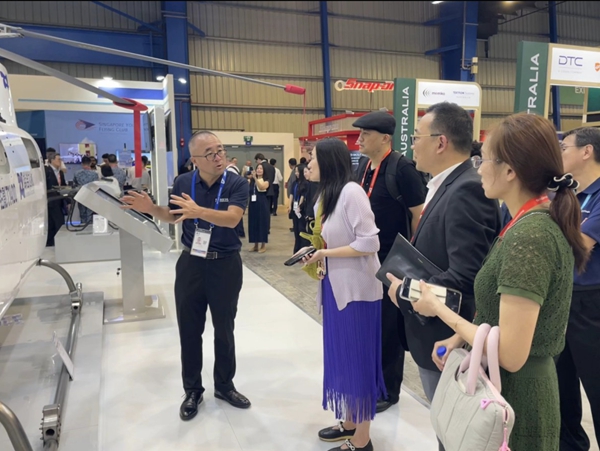
联合飞机全谱系无人机亮相新加坡航展
Zhong Guo Min Hang Wang· 2026-02-06 03:11
Core Insights - The article highlights the showcase of industrial drones and multi-industry application solutions by a company at the Singapore Airshow, with a focus on the debut of the T1400 drone model internationally [1][3]. Group 1: Product Features - The T1400 drone has a maximum takeoff weight of 1.4 tons, a payload capacity of 650 kilograms, and an endurance of 8 hours [3]. - The T1400 features a coaxial rotor design and is optimized for lower operational costs through modular structure and manufacturing processes [3]. - Other showcased products include the 6-ton tilt-rotor drone R6000, the TD550 helicopter with a type certificate from the Civil Aviation Administration of China, and multi-rotor logistics platform Q20 and agricultural drone Q100, covering various task requirements [3][4]. Group 2: Application and Market Strategy - The company emphasized practical applications of its products in logistics, emergency response, and modern agriculture, citing examples such as the TD550 being used for material transport in mountainous and island areas [4]. - The drone logistics solutions have been validated in medical delivery networks in certain cities, while agricultural drones are utilized for crop protection tasks on large-scale farms [4]. - The company announced a global agent recruitment plan to establish a localized service network, with products already sold in markets including South Korea, Southeast Asia, the Middle East, and Europe [6].
理响中国|创意图解:供需“双向奔赴”,激活消费增长主引擎
Huan Qiu Wang· 2026-02-06 02:58
A F T T - T H - T - "十五五"规划建议围绕"大力提振消费",提出了"深 实施提振消费专项行动""扩大优质消费品和服务供给 "推动商品消费扩容升级"等一系列重大举措。中央乡 济工作会议也把提振消费作为建设强大国内市场的j 要内容作出部署。 提振消费怎么做? 提振消费,(供需适配是 什么是供需适配? 供需适配是供给和需求的"双向奔赴", 使生产供给端提供的产品和服务能够精 准匹配消费者的需求,并能够通过产品 和服务创新引领需求、创造需求。 传统商品: 近年来,我国产业前 水平显著提升,几乎 有领域能够提供充裕 统商品。 新产品新服务涌现 与此同时,在新一轮科技革 命和产业变革的强劲推动 下,生产供给端的创新创造 能力大幅度提升 供给能力越强 增强供给与需求的 电动艺节艺书记 电印 | 消费者的选择就越多 如何推动供需适配? 供需适配要准确把握当 前消费新特征。 商品+服务江 我国正处在消费结构快速升 段,文旅、医疗、康养等肌 费领域 8 需求全面积 服务性消费支出占居民人均消费 支出的比重从2013年的39.7% 提高到2025年的46.1%。 E 消费从满足基本生活需求 2 逐步转向追求品质 ...
