
中概股回归

Search documents
港股涨跌更看谁的脸色?
2025-06-26 14:09
Summary of Key Points from Conference Call Records Industry Overview - The conference call discusses the Hong Kong stock market (港股) and its relationship with the A-share market (A 股) and U.S. stock market (美股) - The analysis highlights the significant changes in capital flows, market dynamics, and the impact of Chinese companies listed in Hong Kong Core Insights and Arguments - **Increased Correlation with A-shares**: Since 2020, the correlation between the Hong Kong stock market and A-shares has significantly increased, maintaining a rolling 12-month correlation coefficient between 80% and 90%, compared to a historical average of around 60% [4][1] - **Foreign Capital Outflow**: Foreign capital has continuously flowed out of the Hong Kong market, with its share dropping from nearly 80% to 61%. Cumulative outflows have exceeded 740 billion HKD, influenced by geopolitical tensions and changes in global asset allocation [2][1] - **Impact of Currency Carry Trade**: The carry trade involving the Hong Kong dollar has intensified foreign capital outflows, as rising U.S. interest rates have widened the interest rate differential, prompting investors to borrow low-interest HKD to invest in higher-yielding assets [5][1] - **Return of Chinese Companies**: The return of Chinese companies to the Hong Kong market has improved market quality, with these companies accounting for approximately 70% of the total market capitalization. This has strengthened the correlation between the Hong Kong market and the mainland economy [6][1] - **Liquidity Boost from Southbound Capital**: Continuous inflows from southbound capital have significantly enhanced liquidity in the Hong Kong market, with annual net inflows exceeding 300 billion HKD, projected to reach over 700 billion HKD in 2024 and 2025 [8][1] - **Domestic Capital Influence**: Domestic capital has begun to dominate the Hong Kong market, with over two-thirds of market capitalization and around 91% of net profit attributable to parent companies coming from Chinese enterprises [3][10] Other Important Insights - **Market Behavior Trends**: The relationship between industry performance and southbound capital inflows shows a positive correlation, indicating that as capital flows in, market performance improves [9][1] - **Policy Support for Capital Markets**: Since 2024, various policies have been introduced to support the development of Hong Kong's capital markets, enhancing connectivity between mainland China and Hong Kong [11][1] - **Shift in Pricing Power**: The pricing power in the Hong Kong market is shifting towards domestic factors, with a significant reduction in reliance on external influences for market movements [13][1] - **Future Market Outlook**: The ongoing trends of southbound capital inflows and the concentration of quality assets are expected to play a crucial role in determining future market directions [7][1]
赴港上市再掀热潮 逾160家企业排队九成来自内地
Zhong Guo Jing Ying Bao· 2025-06-21 19:31
Group 1 - The core viewpoint of the articles highlights the strong recovery of the Hong Kong IPO market, driven by multiple factors including interest rate cuts, policy support, and improved investor sentiment [1][2][10] - As of June 18, 2025, there are over 160 companies queued for IPOs in Hong Kong, with more than 90% of these companies coming from mainland China [1][2] - The Hong Kong Stock Exchange (HKEX) has seen a significant increase in IPO activities, with a projected 40 companies expected to go public in the first half of 2025, raising approximately $14 billion, which accounts for 24% of the global total [2][3] Group 2 - The average fundraising amount for IPOs in Hong Kong has increased significantly, with a year-on-year rise of over 500%, marking the second-highest level in the past decade [2][3] - The report indicates that the biotechnology and health sectors are particularly active, with 11 IPOs each in these sectors, tying with retail and consumer industries for the highest number [2][3] - The trend of A-share listed companies seeking dual listings in Hong Kong is notable, with an average fundraising amount close to 10 billion HKD for these IPOs [3][4] Group 3 - The HKEX has implemented several policy measures to facilitate mainland companies' listings, including optimizing listing criteria for technology companies and expediting the approval process for eligible A-share companies [6][7] - The China Securities Regulatory Commission (CSRC) has introduced five measures to support leading mainland enterprises in listing in Hong Kong, enhancing the financing channels for these companies [7][8] - The influx of mainland companies into the Hong Kong market is expected to improve the overall quality and diversity of listed companies, particularly in technology and innovation sectors [5][9] Group 4 - International investors are increasingly recognizing the value of Chinese assets, with a growing trend of foreign capital flowing into the Hong Kong market [9][10] - The HKEX is enhancing its trading mechanisms and product offerings to attract international capital, including establishing offices in major global financial centers [10][11] - The outlook for the Hong Kong IPO market remains positive, with expectations of continued activity in the second half of 2025, particularly from large enterprises and technology-related sectors [10][11]




上海和深圳,喜提两个政策大礼包
吴晓波频道· 2025-06-18 18:21
Group 1 - The article discusses two significant policy packages aimed at enhancing China's financial sector and increasing its international financial influence [1][2] - The first package includes eight major financial policies announced by the central bank, focusing on supporting foreign trade and establishing Shanghai as a major financial hub [2][6] - Key policies include the establishment of a digital RMB international operation center, development of offshore trade finance, and optimization of free trade account functions, which will facilitate cross-border financing for foreign trade enterprises [11][12][17][20] Group 2 - The second package, issued by the central government, allows companies listed on the Hong Kong Stock Exchange to also list on the Shenzhen Stock Exchange, promoting the return of quality enterprises to the mainland [5][35] - This policy enables companies registered in the Guangdong-Hong Kong-Macao Greater Bay Area to issue depository receipts in Shenzhen, providing a pathway for companies like Tencent and Alibaba to access A-share markets [36][41] - The return of these companies is expected to invigorate the A-share market, enhance capital market openness, and potentially reduce foreign exchange outflows [52][55]



安永报告:2025年上半年中国IPO活动全球占比上升
Zhong Guo Xin Wen Wang· 2025-06-12 12:21
Group 1 - The core viewpoint of the report indicates that the proportion of China's IPO activities in the global market has increased in the first half of 2025, despite a general decline in global IPO activities [1] - The report estimates that 500 companies will go public globally in 2025, raising a total of $57.5 billion, with the number of IPOs decreasing by 11% year-on-year while the fundraising amount increased by 9% [1] - In the Hong Kong market, IPO activities have been robust, accounting for 24% of the global total fundraising, while the combined share of A-shares is 33% [1] Group 2 - The report forecasts that 50 companies will achieve initial public offerings in the A-share market in the first half of 2025, raising over 37.1 billion RMB, with both the number of IPOs and the fundraising amount increasing by 14% year-on-year [1] - The report highlights a growing focus on technology-oriented companies in the A-share market, with regulatory support for high-quality, unprofitable tech firms indicating an accelerating release of institutional dividends for innovative enterprises [1] - In the Hong Kong market, approximately 40 companies are expected to go public, raising around 10.87 billion HKD, with IPO numbers and fundraising amounts increasing by 33% and 711% year-on-year, respectively, making it the largest fundraising scale globally [1][2]
投资进化论丨恒生港股通科技VS恒生科技,除了不受QDII额度限制,还有什么不同?
Jin Rong Jie· 2025-06-12 06:38
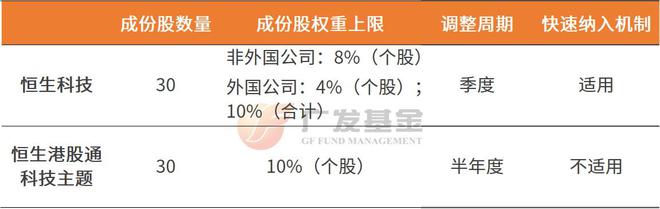
Core Viewpoint - The Hong Kong stock technology sector has regained momentum after a significant pullback in April, driven by advancements in AI and cloud computing, policy support for Chinese companies returning to Hong Kong, and expectations of interest rate cuts by the Federal Reserve [1] Group 1: Index Comparison - The Hang Seng Technology Index consists of 30 selected Hong Kong-listed companies highly related to technology, with a weight limit of 8% for non-foreign companies and 4% for foreign companies, adjusted quarterly [2] - The Hang Seng Hong Kong Stock Connect Technology Theme Index reflects the performance of 30 Hong Kong-listed companies related to technology that can be traded through Stock Connect, with a weight limit of 10% per stock and adjusted semi-annually [2] Group 2: Industry Distribution - The Hang Seng Technology Index includes approximately 17% automotive weight and about 10% in tourism, home appliances, and pharmaceutical stocks, while the Hang Seng Hong Kong Stock Connect Technology Theme Index excludes these consumer sectors, focusing more on software services, information technology equipment, and semiconductors [4] Group 3: Concentration of Weighting Stocks - As of June 9, the top ten stocks in the Hang Seng Hong Kong Stock Connect Technology Theme Index accounted for 76% of its total weight, higher than the 71% concentration in the Hang Seng Technology Index, indicating greater potential for returns but also higher volatility risk [6][10] Group 4: QDII Quota Utilization - The Hang Seng Technology Index includes non-Stock Connect stocks, which may face quota restrictions when investing through QDII channels, while all stocks in the Hang Seng Hong Kong Stock Connect Technology Theme Index can be traded through Stock Connect, enhancing convenience [9] Group 5: Historical Performance - Over the past year, the Hang Seng Technology Index experienced a return of 44%, while the Hang Seng Hong Kong Stock Connect Technology Theme Index, due to its higher concentration, achieved a return of 51.4%, with both indices exhibiting high volatility around 40% [10]
33家中概股回归港股总市值占比超七成 香港成避险首选地
Jin Rong Jie· 2025-06-06 03:34
Core Viewpoint - The recent tightening of U.S. regulatory policies and escalating geopolitical tensions have reignited discussions about the return of Chinese concept stocks (Chinext stocks) to Hong Kong, with the Hong Kong government implementing measures to solidify its position as the preferred destination for these listings [1][7]. Group 1: Market Trends - Since the reform of the listing system in 2018, 33 Chinese concept companies have chosen to list in Hong Kong, accounting for over 70% of the total market capitalization of all Chinese concept stocks [3][4]. - The trend shows that large-cap leading companies are often the first to initiate the return process, with 12 companies having a market capitalization exceeding 1 trillion HKD [4][5]. - As of June 5, 2023, 73% of the top quartile of Chinese concept stocks have achieved a dual listing, with 45% completing a primary dual listing and 26% achieving a secondary listing in Hong Kong [5]. Group 2: Industry Distribution - Chinese concept stocks are primarily concentrated in three sectors: new consumption, technology, and mid-to-high-end manufacturing, with retail accounting for 54% of the new consumption sector [6]. - The valuation discount previously faced by Chinese concept stocks in the Hong Kong market has been gradually alleviated due to increased market activity since last year [6]. Group 3: Government Initiatives - The Hong Kong government is committed to making the region the preferred destination for the return of Chinese concept stocks, with proactive measures being taken by the Securities and Futures Commission and the Hong Kong Stock Exchange [7][8]. - Hong Kong's financial market is characterized by its dual attributes of global capital allocation and local market familiarity, making it an attractive option for Chinese companies looking to return [8]. Group 4: Advantages of Returning to Hong Kong - The flexibility and inclusiveness of Hong Kong's regulatory environment provide significant advantages for Chinese concept stocks, including the ability to retain VIE structures and tax incentives [8]. - Hong Kong serves as a "safe haven," allowing for effective liquidity support from mainland funds while facilitating international capital inflows [7][8].



化被动避险为主动布局中概股回归预期升温
Zheng Quan Shi Bao· 2025-06-05 17:56
Core Viewpoint - The return of Chinese concept stocks to Hong Kong has become a hot topic amid tightening U.S. regulatory policies and geopolitical tensions, with the Hong Kong government aiming to solidify its position as the preferred destination for these listings [1][4]. Group 1: Market Trends - Since the reform of the listing system in 2018, 33 Chinese concept stocks have listed in Hong Kong, accounting for over 70% of the total market capitalization of all Chinese concept stocks [1][2]. - Among the returning companies, 12 have a market capitalization exceeding 100 billion HKD, including major players like Alibaba, JD.com, and Netease [2]. - The trend shows that larger companies tend to return first, with significant returns occurring in 2018, 2019, and a peak in 2020 [2]. Group 2: Industry Distribution - Chinese concept stocks are primarily concentrated in new consumption, technology, and mid-to-high-end manufacturing sectors, with retail accounting for 54% of the market capitalization [3]. - The valuation discount previously faced by Chinese concept stocks in Hong Kong has been gradually alleviated due to increased market activity [3]. Group 3: Government and Regulatory Support - The Hong Kong government is actively preparing to enhance its attractiveness for overseas-listed companies, aiming to become the primary destination for returning Chinese concept stocks [4][5]. - Regulatory frameworks have been established to facilitate dual listings and second listings for companies already listed abroad [5][6]. Group 4: Market Dynamics and Liquidity - The influx of capital into the Hong Kong market has been significant, with the Hong Kong Monetary Authority intervening multiple times due to the Hong Kong dollar reaching its strong exchange guarantee level [1][8]. - The introduction of liquidity support tools and the expansion of the Stock Connect program are expected to enhance the market's capacity to absorb returning Chinese concept stocks [8]. Group 5: Future Outlook - There is a potential for more Chinese concept stocks to return, particularly those currently not meeting Hong Kong's listing criteria but are preparing to do so [9][10]. - The market is transitioning from a passive response to a more proactive approach regarding the return of Chinese concept stocks, with expectations of continued interest from companies in technology and new economy sectors [9][10].
瑞银朱正芹最新发声
Zhong Guo Ji Jin Bao· 2025-06-03 02:46
Group 1: Hong Kong IPO Market - The total scale of Hong Kong IPOs in 2025 has reached $9.8 billion, nearing the total of $11.3 billion for the entire year of 2024 [3] - New stock placement financing has totaled $14.9 billion, approaching the combined total for the years 2022 to 2024, indicating high activity in the Hong Kong market [3] - The trend of "A+H" listings is on the rise, with 23 A-share companies planning to list in Hong Kong, covering various industries including new energy and biomedicine [3][4] Group 2: Market Dynamics and Regulatory Changes - Since 2019, the Hong Kong Stock Exchange has continuously optimized trading rules, enhancing market vitality and facilitating faster new stock issuances [5] - The simplification of the refinancing process for overseas-listed companies has significantly improved the convenience of refinancing in Hong Kong [5][6] - The flexibility of the Hong Kong market has increased, allowing companies to manage their market value and capital planning more effectively [6] Group 3: Return of Chinese Companies - The return of Chinese companies to Hong Kong is driven by geopolitical uncertainties, with many choosing to issue stocks solely in Hong Kong for refinancing [8][9] - The liquidity in the Hong Kong market has surpassed that of the U.S. market, making it a more attractive option for companies listed in both regions [9][10] - The valuation of companies in the Hong Kong market is becoming increasingly competitive, especially for those seeking financing [11] Group 4: M&A Activity - UBS's Asia-Pacific M&A business has ranked first globally, with a significant increase in M&A activity driven by geopolitical factors and policy support [12][13] - The "six guidelines for mergers and acquisitions" introduced at the end of 2024 have simplified processes and accelerated approval speeds, aligning with the needs of the Chinese economy [13] - As the number of quality companies that have completed IPOs increases, the demand for refinancing is expected to rise, potentially surpassing IPO volumes in some years [14]


【致言同声】致同合伙人吴嘉江:“A+H”股扩容提速,五大策略护航企业赴港上市
Sou Hu Cai Jing· 2025-06-02 15:21
Core Viewpoint - The media sharing session hosted by Deloitte focuses on the transformation, financing, and international expansion of private enterprises, emphasizing the strategic opportunities for Chinese companies in the context of capital market internationalization and listing strategies [1]. Group 1: Trends and Policies - The development of the "A+H" share model has been accelerating since 2024, driven by strong policy support [3]. - Key policy initiatives include the China Securities Regulatory Commission's measures to support mainland enterprises listing in Hong Kong and the Hong Kong Stock Exchange's optimization of the IPO approval process [3]. - The introduction of the FINI settlement platform enhances the efficiency and certainty of the Hong Kong IPO process [3]. Group 2: Market Demand and Opportunities - The "A+H" dual financing model is increasingly becoming a strategic choice for private listed companies, with a strong desire among mainland enterprises to expand internationally [5]. - Sectors such as new energy vehicles, electric batteries, and drones are highlighted as areas where Chinese companies can leverage international financing platforms to support expansion and enhance global brand influence [6]. Group 3: Listing Mechanisms and Innovations - The Hong Kong Stock Exchange's new listing rules, including chapters 18A and 18C, provide pathways for biotech and specialized technology companies to list, allowing unprofitable companies to go public [7]. - The 18C mechanism lowers the market capitalization thresholds for both commercialized and non-commercialized enterprises, facilitating more efficient listings for high-growth tech companies [7]. Group 4: Return of Chinese Companies - The trend of Chinese companies returning to Hong Kong is influenced by compliance conflicts between U.S. regulations and Chinese data security laws, with approximately 70% of Chinese concept stocks opting for a Hong Kong listing [11]. - The Hong Kong Stock Exchange's special channel for these companies shortens the approval process to three months and allows the retention of VIE structures, providing financing advantages [11]. Group 5: Advantages of Hong Kong Capital Market - Hong Kong's status as an international financial center, its well-established connectivity mechanisms, and flexible refinancing options are key advantages for companies considering listing [13][14]. - The supportive policy environment and the development of green finance initiatives further enhance Hong Kong's attractiveness as a capital market [14]. Group 6: Recommendations for Companies - Companies planning to list in Hong Kong should carefully choose their listing model, improve corporate governance, conduct feasibility assessments, ensure compliance, and monitor market conditions [16].
外资重返港股市场,长线资金主导明星IPO
Di Yi Cai Jing· 2025-05-28 13:23
而过去两年,港股人气一度跌至冰点。从2021年6月30日至2023年12月中旬,恒生指数大跌超四成,香 港IPO融资额从2021年的超3300亿港元跌至2023年的约450亿港元。 据第一财经从多名投行人士处了解到,2025年以来,港股明星IPO中,海外机构占比显著,刚刚登陆港 股的宁德时代(03750.HK),国际配售占比达92.5%,其中不乏高质量的海外机构,包括中东主权财富 基金(科威特投资局)、瑞银资管等23家国际顶尖基石投资者认购。在簿记中,订单需求合计近550亿 美元,其中有约20%来自主权财富基金及长线基金。 今年截至目前,港股IPO融资额已达600亿港元左右,普华永道预计全年总量将达1300亿港元,跻身全 球前三。外资重返港股市场背后的推动因素是什么?哪些公司最具吸引力?未来外资和南向资金动能将 如何演变? 多重因素催生港股热潮 摩根大通中国投资银行联席主管、亚洲医疗健康投资银行主管刘伯伟在接受第一财经独家采访时表示, 2024年是港股消费股的大年,今年科技股则开始接棒,互联网公司估值被重估,而消费热潮仍在持续。 港股出现了众多明星IPO,包括老铺黄金(06181.HK)、蜜雪集团(02097 ...